
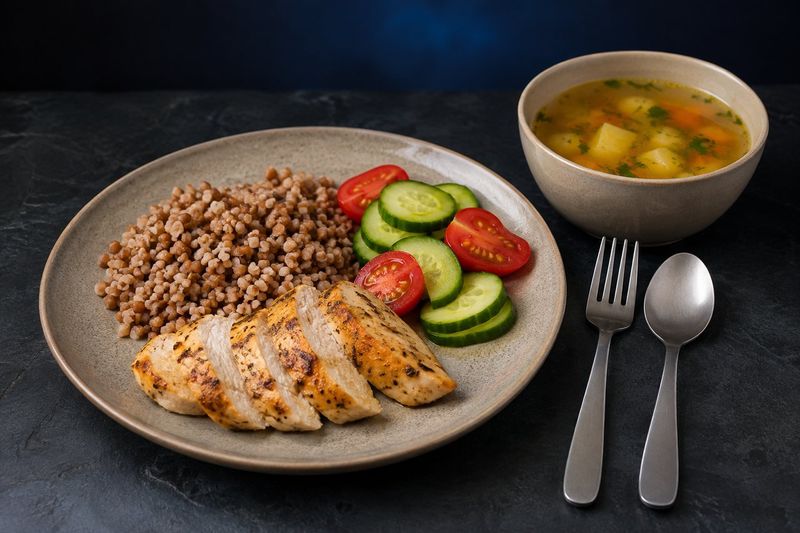
Weight loss depends on a daily calorie deficit, and a substantial, filling lunch helps you get through the second half of the day calmly without evening overeating. In my four-meal daily plan, lunch is the largest meal of the day at around 35% of daily intake—roughly 525 kcal on a 1,500 kcal target. The easiest way to build it is around at least 25 g of protein, vegetables, and a complex side dish on your remaining calories.
Online searches often call these "healthy weight-loss lunches," though no special diet is required—it's regular home cooking in clear portions. I'm Demid Lobanov, a fitness coach: I've coached people for over six years, starting out in gyms and now coaching clients online. In the recipe database I use to build monthly meal plans for clients, 84 out of 260 dishes are lunches: each provides 25.6 to 58.4 g of protein, 82 travel well in a work container, and 60 keep well cooked for 2–4 days for meal prep ahead.
Why making lunch your most filling meal works
When someone gets through the workday on coffee and cookies or a protein-free vegetable salad, intense hunger builds up by the time they get home, making it easy to blow past daily calories in the evening. Shifting a solid share of daily food to midday helps maintain steady fullness right until dinner.
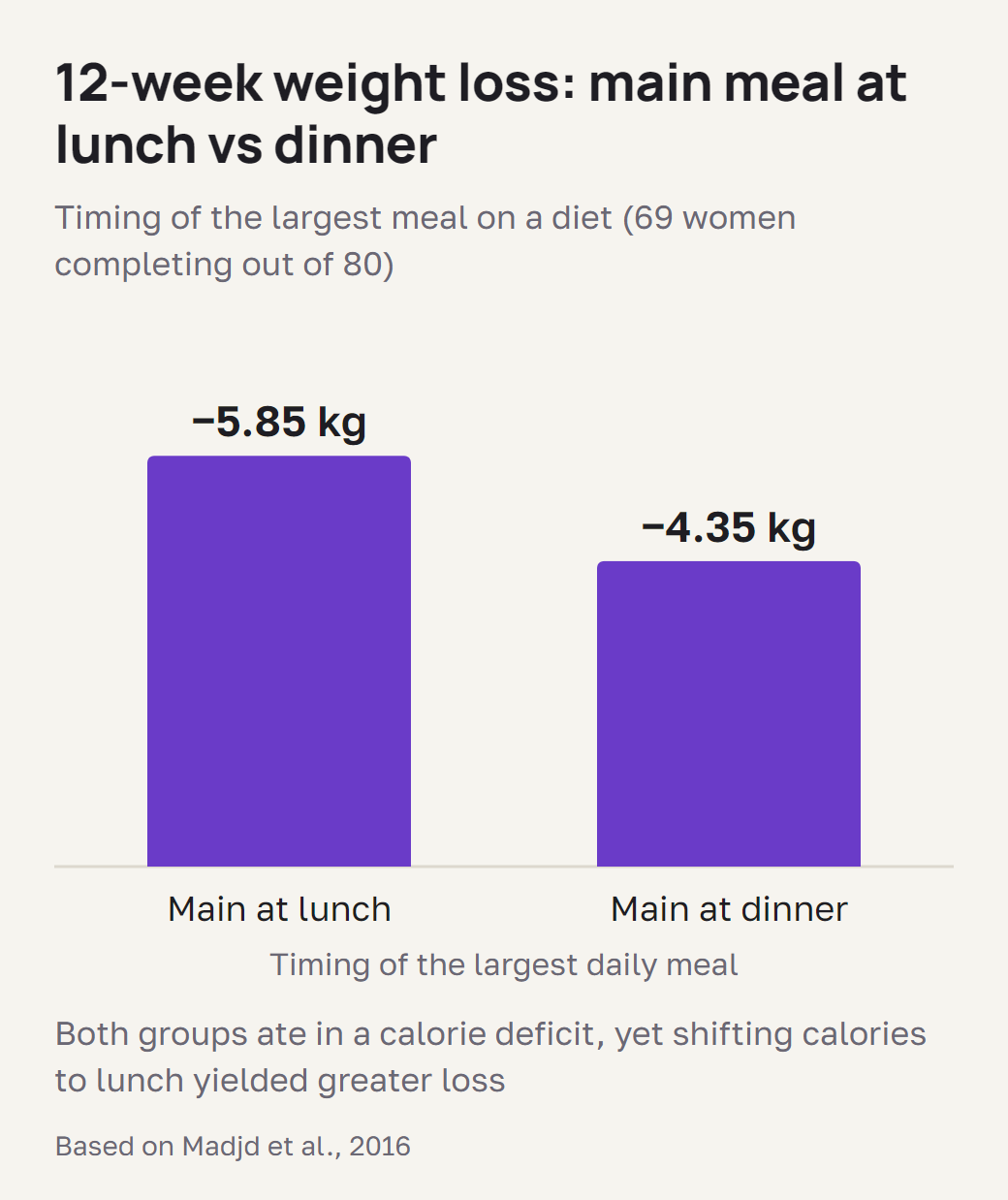
In 2016, Madjd and colleagues tested this in a randomized clinical trial, an experiment where participants are randomly assigned to groups: 80 women with overweight or obesity started a 12-week home weight-loss program following a dietitian's plan with the same calculated deficit, and 69 completed the trial. One group ate their main meal—half of daily calories—at lunch, while the other placed it at dinner. Both groups lost weight, yet participants eating a hearty lunch lost an average of 5.85 kg versus 4.35 kg in the heavy-dinner group and improved insulin sensitivity more noticeably (possibly because sticking to the deficit in the evening was easier).
In a tightly controlled 2022 crossover trial by Ruddick-Collins and colleagues, 30 adults with overweight or obesity ate provided meals for 4 weeks per phase where lunch always supplied 35% of calories while breakfast and dinner swapped places at 45% and 20%. Daily energy expenditure and weight loss (3.33 and 3.38 kg) matched, yet shifting the main share of food from dinner to morning left participants less hungry. In meta-analyses by Young and colleagues in 2023 (9 randomized trials) and Liu and colleagues in 2024 (29 trials, 2,485 adults, with 4 trials in the distribution subgroup), shifting calories to the first half of the day produced a modest extra weight loss of 1.23 and 1.75 kg. At the same time, Liu and colleagues noted a high risk of bias in most included studies. In a three-year observational study by Yamamoto and colleagues in 2021 tracking over 26,000 students, gaining 10% or more body weight was associated specifically with skipping dinner, whereas skipping lunch showed no significant association in either men or women (observational data does not prove causation). In everyday practice, a substantial lunch is valued primarily as a buffer against evening hunger when grabbing snacks on the run leads to overshooting your target at dinner.
How many calories belong in lunch and how tracking helps
Counting calories and weighing ingredients are among the most reliable weight-loss tools, helping most people see their actual eating picture. Start by finding your daily deficit target—the formula is in How Many Calories Per Day, and fast kitchen weighing is covered in How to Weigh Food.
Across four meals a day, I split intake like this: breakfast around 25%, lunch 35%, snack 10%, and dinner 30%. That's a practical starting point you can always adjust to your work schedule.
| Daily calorie target | Lunch (around 35% of daily target) |
|---|---|
| 1,300 kcal | around 455 kcal |
| 1,500 kcal | around 525 kcal |
| 1,800 kcal | around 630 kcal |
| 2,000 kcal | around 700 kcal |
In my database, the median lunch is 564 kcal, and 37 of the 84 lunches stay at or under 550 kcal per base serving. For anyone who finds daily gram-tracking inconvenient during work rushes or travel, a ready-made meal plan pre-calculated for their target—plus a simple plate builder when eating out—takes the hassle away.
What to put into a filling weight-loss lunch
A complete midday meal comes together easily from four building blocks:
| Lunch component | What to pick | Role during weight loss |
|---|---|---|
| Protein (25–30 g+) | chicken breast or thigh, turkey, lean beef, cod, pollock, tuna, eggs, legumes, tofu | drives fullness and helps preserve muscle in a deficit; 64 of my 84 lunches pack 30 g+ protein |
| Vegetables and greens | cucumbers, tomatoes, cabbage, broccoli, carrots, green beans | boost meal volume for few calories by replacing denser food, and help meet part of the WHO target of at least 400 g of fruits and vegetables a day |
| Complex side dish | buckwheat, bulgur, rice, pasta, baked or boiled potatoes, rye or whole-grain bread | sized to your remaining calories after protein, fats, and vegetables |
| Fats and sauces | vegetable oil, sour cream, cheese, seeds | weighed separately: just 10 g of vegetable oil contains 90 kcal |
Each element is backed by research:
- Protein. In a 2020 meta-analysis by Kohanmoo and colleagues (49 acute single-meal publications), protein lowered hunger by 7 mm and raised fullness by 10 mm on a 100 mm scale compared with isocaloric food, although 19 longer-term trials found no sustained effect on appetite. Over roughly 12 weeks in a 2012 meta-analysis by Wycherley and colleagues (24 studies, 1,063 participants), higher-protein diets preserved 0.43 kg more fat-free mass and removed 0.87 kg more fat at equal calories. Check your daily target in How Much Protein Per Day.
- Vegetables and salad dressing. In a 2023 meta-analysis by Klos and colleagues (38 randomized trials), lower energy-density dishes reduced laboratory meal intake by an average of 223 kcal—vegetables help with weight specifically when they replace a more calorie-dense share of the plate. Dressing matters here: in a 2004 crossover study by Rolls and colleagues in 42 women, a vegetable salad with light dressing before pasta reduced lunch calories by 7% for a 150 g portion and 12% for 300 g. A high-fat salad loaded with sauce and cheese raised lunch calories by 8% and 17%.
Do you need soup at lunch, and which kind helps with weight loss?
There is no mandatory rule to eat soup every day for weight loss: if you dislike first courses, you can comfortably skip them. For people who enjoy soups, however, lean broth-based soups noticeably help you feel full on fewer calories.
In a 2007 crossover study by Flood and Rolls, 60 normal-weight adults came in for laboratory lunches once a week over 5 weeks. Eating a low-calorie vegetable soup—chunky vegetables in broth or the same ingredients pureed—15 minutes before the main course lowered total lunch calories (soup included) by 20%, or 134 kcal. A year-long study by Rolls and colleagues in 2005 enrolled 200 adults with overweight or obesity on a deficit diet. Two servings of low-calorie soup a day in place of dense snacks produced 7.2 kg of weight loss versus 4.8 kg on dry snacks of the same calorie content (8.1 kg in the comparison group without provided foods).
My database includes 12 lunch soups, and comparing them highlights the impact of fats. Pollock fish soup provides 407 kcal and 41.8 g of protein per serving, fresh cabbage shchi with chicken has 425 kcal and 42.1 g of protein, and split-pea soup with chicken has 526 kcal and 49.0 g of protein. Pumpkin cream soup with cream and chicken delivers 43.0 g of protein, yet heavy cream, olive oil, and pumpkin seeds push it up to 580 kcal and 25.5 g of fat—like a hearty main dish.
Weight-loss lunch examples from my database
Below are nine lunches from my working database. Calories and macros are listed per base serving; in a custom meal plan, portions are scaled to your target, so exact gram amounts depend on your calorie budget.
| Lunch | Kcal | Protein, g | Fat, g | Carbs, g |
|---|---|---|---|---|
| Braised turkey with vegetables | 357 | 41.7 | 15.3 | 11.0 |
| Pollock fish soup | 407 | 41.8 | 2.9 | 50.2 |
| Fresh cabbage shchi with chicken | 425 | 42.1 | 11.6 | 33.1 |
| Baked cod with potatoes | 437 | 41.0 | 11.8 | 39.0 |
| Chicken noodle soup | 479 | 35.2 | 5.9 | 67.9 |
| Beef borscht | 515 | 41.8 | 17.9 | 40.7 |
| Braised beef with potatoes | 555 | 44.9 | 18.6 | 47.7 |
| Chicken breast with buckwheat and vegetable salad | 562 | 50.9 | 17.3 | 45.8 |
| Turkey with bulgur and broccoli | 577 | 55.5 | 14.2 | 50.6 |
Packing lunch for work and ordering at a cafe or cafeteria
Planning daytime meals ahead makes sticking to your routine much easier. In the large French NutriNet-Santé survey (Ducrot and colleagues, 2017, 40,554 adults), people who planned menus several days ahead ate a wider variety of foods and had obesity less often—odds ratios were 0.79 in women and 0.81 in men (observational data, which does not prove causation). In a 40-week corporate weight-loss program by Hayes and colleagues in 2021 with 139 employees, more frequent meal planning across the program also predicted a greater drop in body mass index. At home, the simplest approach is cooking lunch ahead for 2–3 workdays: weigh raw grains and meat once and divide the cooked meal into equal containers.
When eating at a cafe, cafeteria, or business-lunch special, account for hidden restaurant calories. In a 2012 systematic review by Bezerra and colleagues (28 observational studies: 20 cross-sectional and 8 prospective cohorts), frequent eating out went hand in hand with higher body weight in 7 of 8 cohorts and roughly half of cross-sectional studies, though study methods varied noticeably. Four habits keep restaurant lunches within target:
- Check calories and macros on the menu or delivery app. In a 2016 meta-analysis by Littlewood and colleagues (15 articles, 12 pooled), menu calorie labeling reduced calories ordered in real-world venues by 77.8 kcal on average and calories consumed overall across settings by 100.2 kcal.
- Pick recognizable whole protein. Baked chicken breast, turkey, steamed fish, or grilled beef are far more predictable in fat content than minced cutlets, batter-fried items, or cheese-topped dishes.
- Ask for sauces and salad dressing on the side. Just 20 g of vegetable oil (180 kcal) or 30 g of mayonnaise (186 kcal) quietly adds nearly a third of your lunch budget, and two full tablespoons of oil run around 240 kcal.
- Choose one dense carb source instead of the full combo. A cream soup plus an entrée with a side dish already adds up to well over 1,100 kcal before bread and sweet berry drink. Stick to a broth soup plus entrée with vegetables, or a salad plus entrée with grains, leaving a small buffer in your tracker for kitchen oil.
Common mistakes and a step-by-step lunch setup
Three daytime eating mistakes get in the way most often. First is replacing lunch with coffee and a bar or a plain protein-free salad, which often leads to intense hunger and evening overeating (details in the pillar guide How to Lose Weight). Second is ordering a full three-course restaurant lunch with a sugary drink or adding a generous pour of oil to grains without a scale. Third is needlessly fearing pasta, rice, or potatoes during the day, even though within your daily calorie budget they do not hinder weight loss.
- Calculate your daily calorie deficit target and allocate roughly 35% to lunch—around 525 kcal on a 1,500 kcal plan.
- Anchor every lunch with at least 25–30 g of protein from poultry, fish, lean meat, eggs, or legumes.
- Add fresh or cooked vegetables and a weighed portion of grains, pasta, or potatoes, logging cooking oil and sauces separately.
- Prep 2–3 containers ahead for busy weekdays, and when eating out check menu nutrition numbers and request dressings on the side.
- After 14 days, compare your week-two average morning weight against week one: if weight stalls, slightly trim the most calorie-dense extras—oil, sauces, or sweet drinks alongside lunch.
If you want to align nutrition and training in one system with a daily target, an in-app food log, and daily feedback, take a look at online coaching with a coach. If you have diabetes, take glucose-lowering medications, have an active gastrointestinal flare-up, are pregnant, or have an eating disorder, always clear your meal timing and composition with your physician.
I post nutrition and training breakdowns on my YouTube channel @lobanov_fitness.
Sources
- Madjd A et al. Beneficial effect of high energy intake at lunch rather than dinner on weight loss in healthy obese women in a weight-loss program: a randomized clinical trial. Am J Clin Nutr, 2016. Article
- Ruddick-Collins LC et al. Timing of daily calorie loading affects appetite and hunger responses without changes in energy metabolism in healthy subjects with obesity. Cell Metab, 2022. Article · Full text
- Young IE et al. Distribution of energy intake across the day and weight loss: A systematic review and meta-analysis. Obes Rev, 2023. Article · Full text
- Liu HY et al. Meal Timing and Anthropometric and Metabolic Outcomes: A Systematic Review and Meta-Analysis. JAMA Netw Open, 2024. Article · Full text
- Yamamoto R et al. Associations of Skipping Breakfast, Lunch, and Dinner with Weight Gain and Overweight/Obesity in University Students: A Retrospective Cohort Study. Nutrients, 2021. Article · Full text
- Kohanmoo A et al. Effect of short- and long-term protein consumption on appetite and appetite-regulating gastrointestinal hormones, a systematic review and meta-analysis of randomized controlled trials. Physiol Behav, 2020. Article
- Wycherley TP et al. Effects of energy-restricted high-protein, low-fat compared with standard-protein, low-fat diets: a meta-analysis of randomized controlled trials. Am J Clin Nutr, 2012. Article
- Klos B et al. Impact of energy density on energy intake in children and adults: a systematic review and meta-analysis of randomized controlled trials. Eur J Nutr, 2023. Article · Full text
- Rolls BJ et al. Salad and satiety: energy density and portion size of a first-course salad affect energy intake at lunch. J Am Diet Assoc, 2004. Article
- Flood JE et al. Soup preloads in a variety of forms reduce meal energy intake. Appetite, 2007. Article · Full text
- Rolls BJ et al. Provision of foods differing in energy density affects long-term weight loss. Obes Res, 2005. Article
- Ducrot P et al. Meal planning is associated with food variety, diet quality and body weight status in a large sample of French adults. Int J Behav Nutr Phys Act, 2017. Article · Full text
- Hayes JF et al. Greater Average Meal Planning Frequency Predicts Greater Weight Loss Outcomes in a Worksite-Based Behavioral Weight Loss Program. Ann Behav Med, 2021. Article · Full text
- Bezerra IN et al. Association between eating out of home and body weight. Nutr Rev, 2012. Article
- Littlewood JA et al. Menu labelling is effective in reducing energy ordered and consumed: a systematic review and meta-analysis of recent studies. Public Health Nutr, 2016. Article · Full text
- World Health Organization. WHO updates guidelines on fats and carbohydrates — at least 400 g of vegetables and fruits per day, 2023. Page




