
With the same number of working sets per week, full-body and split routines produce the same muscle growth and strength gains. A full-body workout trains the major muscle groups of your entire body in a single session. A split divides muscles across different days of the week—for example, upper and lower body, pull and push movements, or a classic routine training 1–2 muscle groups once a week. A working set is performed after warming up and finishes close to failure, the point where you can no longer complete another rep with proper technique.
I'm Demid Lobanov, a fitness coach and instructor at the PRO-FG coaching school. I've been coaching people for over six years—starting on the gym floor and now coaching clients online across different cities and countries. I build programs around a client's real weekly schedule and priority muscle groups so that each target muscle works at least 2 times a week without unnecessary exhaustion. Below is what head-to-head comparisons of splits and full-body training show, and how to match a setup to your calendar.
What research shows about muscle growth and strength
Whenever two programs are compared, the decisive question is whether weekly volume—the total number of working sets per muscle—was equated. Once volume is equal, the difference between routine labels disappears:
- Ramos-Campo and colleagues, 2024—a direct systematic review and meta-analysis (a statistical pooling of studies) of 14 trials in 392 healthy adults. At equal volume, split and full-body training produced identical strength gains in the bench press and lower-body exercises (14 studies). Increases in cross-sectional area of the elbow flexors and extensors, vastus lateralis, and lean body mass did not differ either (4–6 studies per measurement).
- Schoenfeld and colleagues, 2019, meta-analysis of 25 studies: at equal weekly volume, training a muscle 1, 2, or 3+ times per week had no significant effect on its growth. When volume wasn't equated, higher frequencies edged ahead slightly only because training on more days allowed people to fit in more sets.
- Pelland and colleagues, 2026, meta-regression of 67 studies with 2,058 participants: once weekly volume is accounted for, the independent contribution of frequency to muscle growth is negligible, whereas strength gains rose with higher training frequency. In an earlier meta-analysis by Grgic and colleagues in 2018 (22 studies), the strength advantage of higher frequency also disappeared once weekly volume was equated.
The 2026 American College of Sports Medicine (ACSM) position stand (Currier and colleagues, an overview of 137 systematic reviews and over 30,000 participants) aligns with these findings. For muscle growth, the document recommends a volume of 10 or more working sets per muscle group per week, while voluntary strength improves best at a frequency of 2 or more sessions per week using loads of at least 80% of one-rep max early in the workout. Weekly targets are covered in detail in How Many Sets per Week Do You Need to Build Muscle and How Many Times a Week to Train for Muscle Growth.
Full-body for beginners and women, splits for experienced men?
A common gym cliché says: do full-body for your first six months, then switch to a one-muscle-a-week split. Experiments with random group assignment—randomized controlled trials (RCTs)—don't support that strict divide.
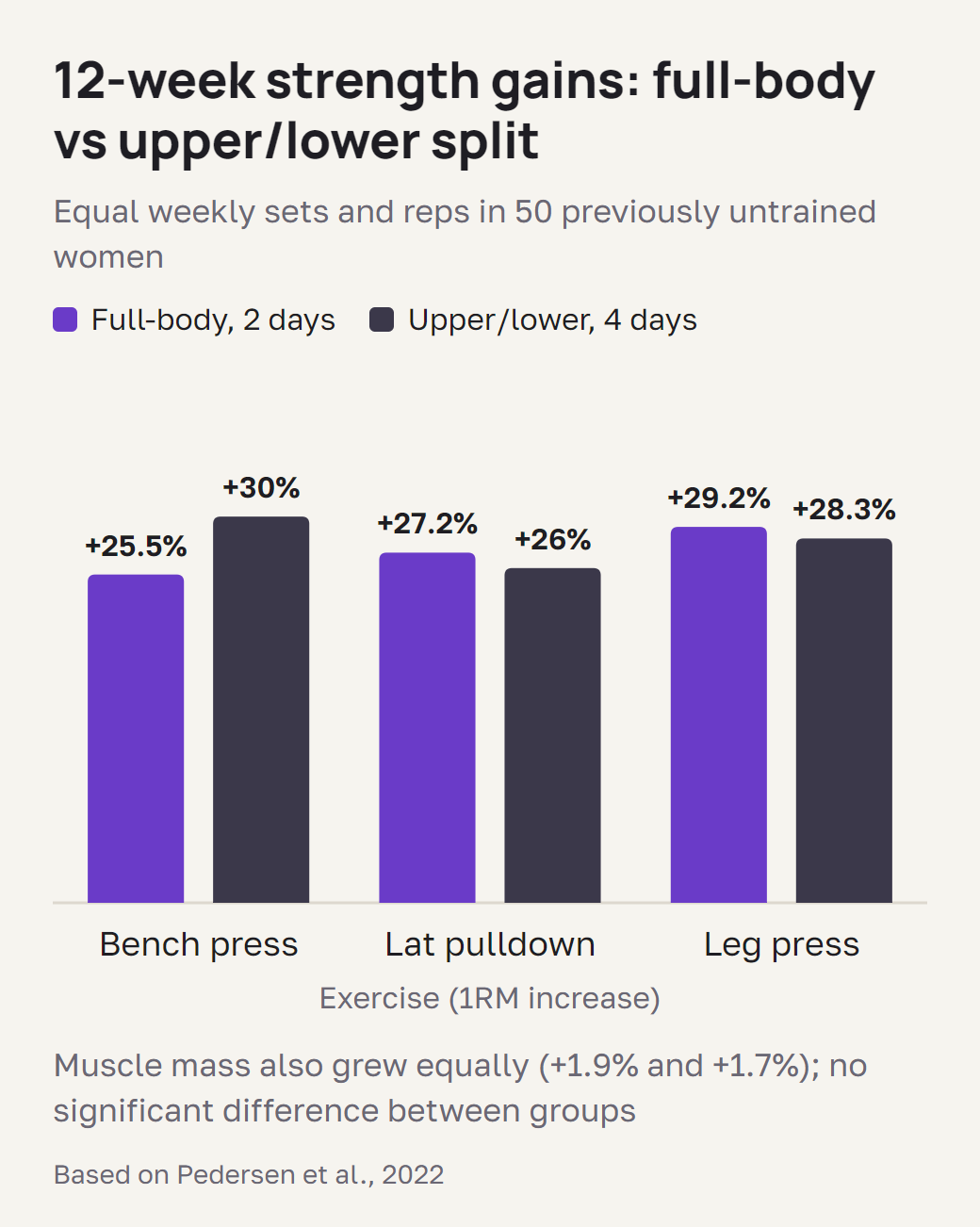
In untrained participants, both setups work equally well from week one. In a 12-week RCT by Pedersen and colleagues in 2022, 50 untrained women performed the exact same exercises and identical weekly sets and reps: one group trained full-body 2 times a week, and the other ran an upper/lower split 4 times a week. There was no significant difference in bench press (+25.5% versus +30.0%), lat pulldown (+27.2% versus +26.0%), leg press (+29.2% versus +28.3%), or muscle mass gains (+1.9% versus +1.7%). An 8-week RCT by Evangelista and colleagues in 2021 with 67 untrained participants showed the same result comparing a twice-weekly-per-muscle split against four-days-a-week full-body training.
Among experienced men, small individual RCTs differed only in minor details. In Schoenfeld and colleagues (2015, 20 trained men), full-body 3 times a week produced greater elbow flexor thickness gains than a once-weekly split, with equal gains in strength and thigh muscle size. In Bartolomei and colleagues (2021, 21 trained men, 10 weeks), the split edged ahead slightly in vastus lateralis thickness, whereas full-body training produced greater strength gains in an isokinetic bench press at a constant speed of 25 cm/s, with equal gains in standard one-rep max. Sample sizes in both trials are small, so the pooled 2024 meta-analysis by Ramos-Campo is the more reliable guide.
The real reason experienced lifters gravitate toward upper/lower or push/pull splits is practical. Once working weights require several ramp-up warm-up sets on every compound lift and weekly volume reaches 14–20 sets per muscle group, training your whole body in a single session gets long and exhausting.
Which is better for weight loss: full-body or a split?
Weight loss requires a calorie deficit in your diet—without one, no exercise layout will burn off body fat (covered in How to Lose Weight: What Actually Works (A Fitness Coach's Plan) and Cardio or Weights for Weight Loss: Which Is Better). How you spread training across the week, however, noticeably affects fatigue between workouts.
In an 8-week RCT by Carneiro and colleagues in 2024, 23 trained men worked out 5 times a week with equated weekly volume (75 sets) and habitual intake of roughly 31 kcal and 1.9 g of protein per kilogram of body weight. The full-body group lost an average of 0.78 kg of total fat mass, whereas fat mass did not decrease (+0.32 kg) in the split group training each muscle once a week with 5–10 sets per exercise. On full-body, participants lifted 16% more total tonnage, and their delayed-onset muscle soreness was 3.5–7.5 times lower.
The sample in that trial was small and daily step counts outside the gym weren't tracked, yet the pattern is familiar in coaching practice: after a brutal high-volume "leg day," people walk less and avoid stairs for several days. Spreading work evenly in a full-body routine or an upper/lower split preserves energy for everyday movement throughout the week.
The main selection criterion: how many sets fall into one session
The weak spot of a classic "bro split" (Monday chest, Wednesday back, Friday legs, hitting each muscle once a week) is within-session fatigue build-up. In a 2011 study by Senna and colleagues on 15 trained men, completed reps dropped from set to set even with 3–5 minutes of rest. If you stack 12–16 sets for chest or quads into a single evening, the second half of those sets runs with lighter weights and degraded form from fatigue.
That's why I stick to two simple practical benchmarks in my coaching:
- No more than 8–10 working sets per muscle group in one workout. If a muscle needs 12–20 sets per week, split them across 2–3 days.
- Around 18–24 total working sets for the entire session. With roughly 2 minutes of rest between sets, that workout fits into about 60–80 minutes without excessive systemic fatigue.
Which setup to choose for 2, 3, and 4 days a week
Pick your layout based on the number of days you can consistently show up without skipping:
| Workouts per week | Optimal setup | Why it works well |
|---|---|---|
| 2 days (e.g., Tue & Fri) | Full-Body + Full-Body | Every major muscle group gets stimulated 2 times a week instead of once a week on a 2-day split |
| 3 non-consecutive days (Mon, Wed, Fri) | 3 full-body sessions or a Full-Body + Lower + Upper hybrid | A complete 3-day full-body example with set counts is in Gym Workout Program: How to Build One and a 3-Day Example |
| 3 days with two back-to-back (e.g., Tue, Fri, Sat) | Full-Body (Tue) + Lower (Fri) + Upper (Sat) | Back-to-back Friday and Saturday separate lower and upper body so fatigued muscles rest while every group still gets hit twice a week |
| 4 days (Mon, Tue, Thu, Fri) | Upper / Lower / Upper / Lower split or Pull / Push twice | Convenient at 12–20 sets per muscle: upper/lower separates body halves by day, while pull/push alternates pulling and pressing muscles |
Another advantage of full-body and upper/lower splits for busy people is resilience when schedules slip. If you miss Friday on a classic once-a-week split because of a business trip, your legs go two full weeks (14 days) without training. On full-body or upper/lower, missing one evening shifts the cycle by just a couple of days.
How I match a setup to clients and how to test your choice
Whenever I build a monthly individual workout program or start working with someone in online coaching with a personal fitness coach, we first lock in realistic days of the week, session length, and 1–2 priority muscle groups. In online coaching, I track rep trends on the final sets for each muscle inside my web app. If reps on those later sets drop sharply below the target range or soreness interferes with the next workout, we spread that muscle's volume across more days. I publish exercise technique breakdowns for all of these setups on my YouTube channel @lobanov_fitness.
To pick and test your own setup independently, run through five steps:
- Decide how many days a week you can reliably commit to the gym over the next 4 weeks, and note whether two of those days are back-to-back.
- Count your weekly set volume per muscle (usually 10–12 working sets at the start).
- Choose a layout from the table above so a single session includes no more than 8–10 sets per muscle and roughly 18–24 total sets.
- Run that plan for 3–4 weeks without swapping exercises, logging weights and reps.
- Evaluate the result: if you finish on time, recover before your next session, and see reps or working weights climbing in your logbook, the setup fits you.
The guidelines in this article are intended for healthy adults; if you have injuries, acute pain, or chronic conditions, training frequency and load should be tailored after consulting a physician.
Sources
- Ramos-Campo DJ et al. Efficacy of Split Versus Full-Body Resistance Training on Strength and Muscle Growth: A Systematic Review With Meta-Analysis. J Strength Cond Res, 2024. Article
- Schoenfeld BJ et al. How many times per week should a muscle be trained to maximize muscle hypertrophy? A systematic review and meta-analysis of studies examining the effects of resistance training frequency. J Sports Sci, 2019. Article
- Pelland JC et al. The Resistance Training Dose Response: Meta-Regressions Exploring the Effects of Weekly Volume and Frequency on Muscle Hypertrophy and Strength Gains. Sports Med, 2026. Article
- Grgic J et al. Effect of Resistance Training Frequency on Gains in Muscular Strength: A Systematic Review and Meta-Analysis. Sports Med, 2018. Article
- Currier BS et al. American College of Sports Medicine Position Stand. Resistance Training Prescription for Muscle Function, Hypertrophy, and Physical Performance in Healthy Adults: An Overview of Reviews. Med Sci Sports Exerc, 2026. Article · Full text
- Pedersen H et al. A randomized trial on the efficacy of split-body versus full-body resistance training in non-resistance trained women. BMC Sports Sci Med Rehabil, 2022. Article · Full text
- Evangelista AL et al. Split or full-body workout routine: which is best to increase muscle strength and hypertrophy? Einstein (Sao Paulo), 2021. Article · Full text
- Schoenfeld BJ et al. Influence of Resistance Training Frequency on Muscular Adaptations in Well-Trained Men. J Strength Cond Res, 2015. Article
- Bartolomei S et al. A Comparison Between Total Body and Split Routine Resistance Training Programs in Trained Men. J Strength Cond Res, 2021. Article
- Carneiro MAS et al. Full-body resistance training promotes greater fat mass loss than a split-body routine in well-trained males: A randomized trial. Eur J Sport Sci, 2024. Article · Full text
- Senna G et al. The effect of rest interval length on multi and single-joint exercise performance and perceived exertion. J Strength Cond Res, 2011. Article