
"Just eat less to lose weight" is physically true, yet unhelpful in practice. Some people slash their food intake in half, burn out after two weeks, and lose muscle, while others hold a "deficit" on paper, see the scale freeze, and assume their metabolism is broken.
In practice, a calorie deficit works like a tunable dose. The right size depends on starting body fat, protein intake, resistance training, and how accurately you track food and daily movement.
I am Demid Lobanov, a coach with more than six years of experience. Below, I review what clinical research says about deficit size, how to calibrate intake using real scale trends, what actually happens to metabolic rate, and when diet breaks help.
Why the deficit drives results regardless of the diet label
The International Society of Sports Nutrition (ISSN) Position Stand (Aragon et al., 2017) states the foundation clearly: fat loss is driven by a sustained energy deficit, and a wide range of diets—from low-fat to low-carbohydrate—yield similar body-composition outcomes when energy deficit and protein are matched.
A meta-analysis of 32 controlled feeding studies (Hall & Guo, 2017) confirmed the same pattern. Under strict isocaloric substitution of fat for carbohydrate, energy expenditure (+26 kcal/day; p < 0.0001) and fat loss (+16 g/day; p < 0.0001) were statistically higher on lower-fat diets, but clinically that difference is tiny compared with total energy deficit.
Meal timing offers no magic shortcut either. A network meta-analysis of 99 randomized trials covering 6,582 adults—5,862 with existing health conditions (Semnani-Azad et al., 2025)—found that intermittent fasting schedules and continuous daily energy restriction all reduced body weight versus unrestricted eating. Across all trials, only alternate-day fasting showed a small advantage over continuous restriction (−1.29 kg; 95% CI −1.99 to −0.59; moderate certainty); results were similar in shorter trials under 24 weeks (76 RCTs), while differences disappeared in trials lasting 24 weeks or longer (17 RCTs). In another network meta-analysis of 47 trials with 3,363 adults (Huang et al., 2024), all four caloric restriction regimens reduced body weight (−1.59 to −3.42 kg), partial regain often appeared by 4–6 months (most notably with continuous restriction), 7–12 month programs produced larger losses, and short-term fasting regimens reduced lean mass (−1.26 kg).
Choosing a deficit size: moderate vs. aggressive
The core principle from the ISSN Position Stand (Aragon et al., 2017) is straightforward: the higher your baseline body fat, the more aggressively a deficit can be applied, while leaner lifters preserve lean mass better with slower rates of loss.
Research sets clear practical boundaries:
- The muscle-retention threshold during lifting is roughly 500 kcal/day. A meta-analysis and meta-regression of randomized trials lasting three weeks or longer (Murphy & Koehler, 2022) found that an energy deficit impaired lean-mass gains (ES −0.57; p = 0.02) without statistically reducing strength gains (ES −0.31; p = 0.28). Meta-regression showed that deficits around 500 kcal/day eliminated lean-mass gains: to preserve muscle while lifting, the authors advise avoiding deficits deeper than ~500 kcal/day, and for simultaneous muscle growth (see Body Recomposition), the deficit needs to be smaller still.
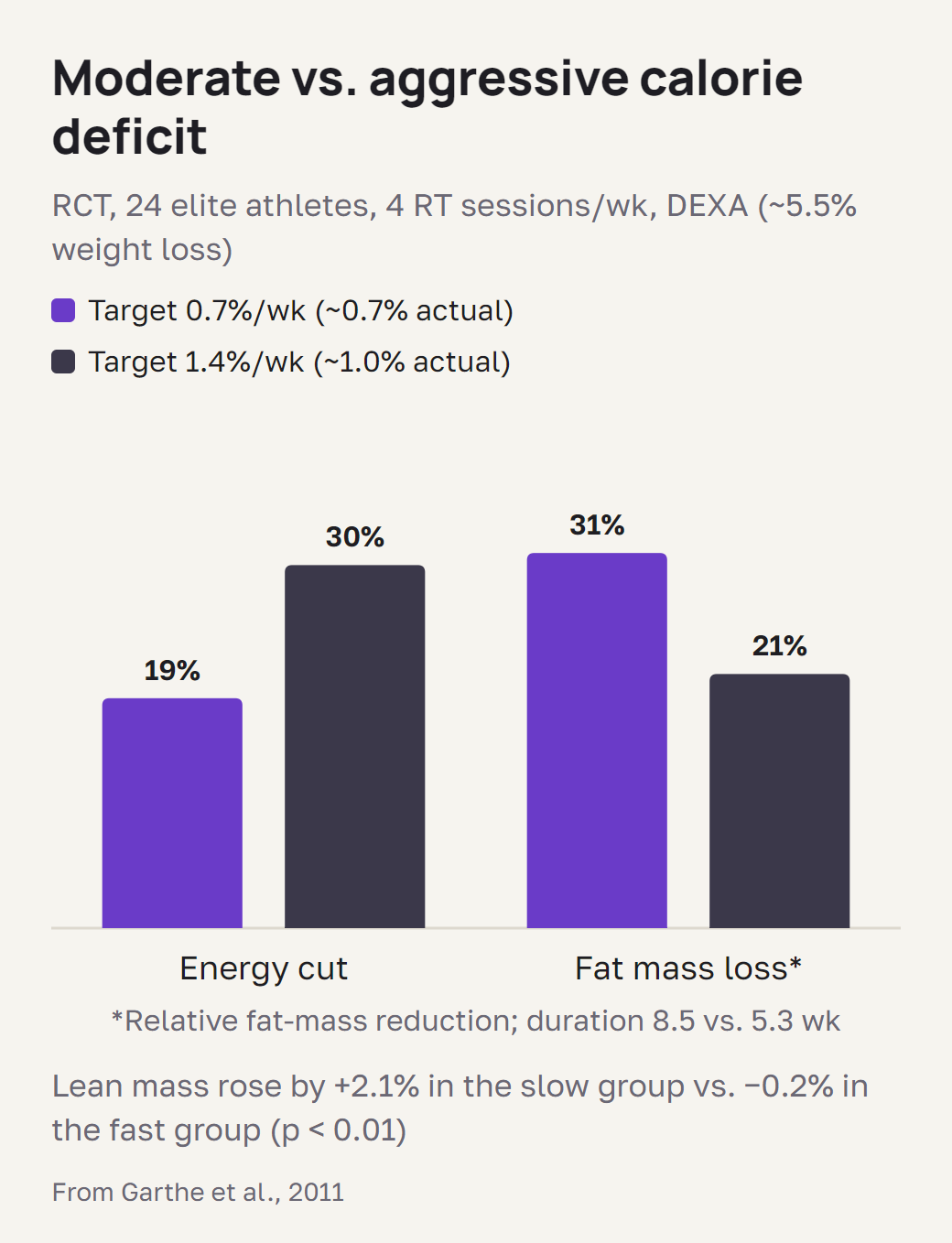
- A target rate of 0.7%/week outperforms 1.4%/week for body composition. In a randomized trial of 24 elite athletes adding four weekly resistance sessions (Garthe et al., 2011), one group cut calories by ~19% (target and actual rate ~0.7%/week over 8.5 weeks) and the other cut by ~30% (target 1.4%/week, actual ~1.0%/week over 5.3 weeks). Total body-weight loss was nearly identical (−5.6% vs. −5.5%). Yet on DEXA, relative fat-mass loss was −31% in the slow group versus −21% in the fast group, while lean mass rose by +2.1% versus −0.2% (p < 0.01).
- In adults with overweight and obesity, the tradeoff looks somewhat different, though steep cuts still carry costs. A meta-analysis comparing gradual versus rapid weight loss at matched total weight loss (Ashtary-Larky et al., 2020) found slightly greater reductions in fat mass (−1.0 kg) and body-fat percentage (−0.83%) along with better preservation of resting metabolic rate during gradual loss, with no significant difference in fat-free mass. In the three-year TEMPO Diet Trial of 101 postmenopausal women with obesity (Seimon et al., 2020), starting with four months of severe 65–75% restriction on total meal replacement (followed by eight months moderate) versus 12 months of moderate 25–35% restriction yielded 1.5–1.7 times greater weight and fat loss at 36 months (42% vs. 16% maintained ≥10% weight loss). The severe group lost ~1.4 times more lean mass (proportional to total weight lost, with no extra drop in grip strength) and roughly twice as much total hip bone mineral density in the first year—meaning severe deficits belong strictly under medical supervision.
In my coaching practice, these data map cleanly into three working deficit tiers:
| Starting point | Working calorie cut | Target weekly rate | Main priority |
|---|---|---|---|
| Lean lifter aiming for definition and muscle | 10–15% (typically 250–400 kcal/day) | 0.4–0.6% of body weight | High protein, strength training, lean-mass protection |
| Moderate excess weight (most gym-goers) | 15–20% (typically 350–500 kcal/day) | 0.5–0.8% of body weight | Balancing pace, satiety, and strength retention |
| Significant obesity | 20–25% (deeper only with a doctor) | 0.8–1.0% of body weight | Adequate protein, bone and joint protection, consistency |
The second pillar of muscle protection is adequate protein. According to the ISSN Position Stands (Jäger et al., 2017; Aragon et al., 2017), 1.4–2.0 g/kg of body weight per day covers most exercising adults, whereas lean resistance-trained lifters in a deficit may need 2.3–3.1 g/kg of fat-free mass (Aragon et al., 2017) or body weight (Jäger et al., 2017) to maximize lean-mass retention—see How Much Protein Per Day.
How to calculate and calibrate your deficit in practice
Any online calculator formula only gives a starting estimate with individual error—see How Many Calories Per Day. In my practice, three-step calibration against real scale trends works far more reliably:
- Set a starting target. Estimate maintenance from a formula or an ordinary week of tracking and subtract 15–20% (typically 300–500 kcal).
- Track the 7-day average instead of single weigh-ins. Weigh yourself in the morning after using the bathroom 4–7 days per week and compare this week's average with last week's (plus waist circumference every two weeks). Daily swings of 0.5–1.5 kg from sodium, carbs, sleep, or menstrual phase do not reflect fat changes.
- Adjust in small increments. If your 7-day average weight and waist do not budge over 2–3 weeks despite honest food logging and steady daily steps, reduce intake by 100–150 kcal (or add 2,000–3,000 daily steps) and reassess two weeks later.
Why weight stalls in a deficit: the "broken metabolism" myth
When the scale stops moving for two weeks, the cause almost always sits in four measurable areas—see Why Weight Stalls:
- Tracking inaccuracies. In a systematic review of 15 validation studies using doubly labeled water (Howes et al., 2024), the authors note that discrepancies between self-reported food logs and actual energy expenditure are widespread, especially in obesity. Their analysis found that adults with class III obesity (BMI ≥ 40) made up just 3.5% of validation participants, and five of six studies reporting validity for this group observed underreporting of calorie intake. In my practice, cooking oil, sauces, milk coffees, eyeballed nuts, and untracked weekends easily add 400–600 kcal per day—enough to erase a daily and weekly deficit.
- Normal drop in expenditure as you get lighter. A smaller body burns less energy both at rest and while walking, and daily non-exercise movement (steps, fidgeting) often dips quietly as fatigue builds.
- Adaptive thermogenesis—real, but rarely huge. A systematic review of 33 studies covering 2,528 adults (Nunes et al., 2022) detected additional reductions in energy expenditure beyond mass loss in 27 studies. However, better-designed studies found smaller or statistically non-significant values, and adaptive thermogenesis weakened or vanished after weight stabilization at maintenance.
- Fluid retention and stress. In my practice, water fluctuations from training, short sleep, and life stress frequently mask real fat loss on the scale for a period of time.
When diet breaks help
When you hold a deficit for two or three months straight, hunger climbs, workouts feel harder, and the risk of diet binges rises. A planned diet break at maintenance calories is a practical way to manage that strain.
In the ICECAP randomized trial of 61 resistance-trained adults (Peos et al., 2021), researchers compared 12 weeks of continuous moderate restriction with four 3-week deficit blocks interspersed with three 1-week maintenance breaks (15 weeks total). Body weight, fat loss, and fat-free mass retention did not differ between groups (p > 0.28), nor did strength or resting energy expenditure. Yet participants taking breaks reported significantly lower hunger (p = 0.002), lower desire to eat (p = 0.014), and higher satisfaction (p = 0.016).
A broader meta-analysis of 12 randomized trials covering 881 participants (Poon et al., 2025) confirmed similar body-composition outcomes while showing smaller compensatory drops in resting metabolic rate with diet breaks—especially in adults with overweight and obesity compared with resistance-trained lifters. In my coaching practice, scheduling one maintenance week every 6–10 weeks helps clients complete long fat-loss phases without severe rebounds.
Note clear boundaries for self-directed dieting: with eating disorders, pregnancy, breastfeeding, insulin-treated diabetes, or major endocrine conditions, calorie targets should be set together with your physician.
I post short breakdowns of tracking mistakes, food choices, and meal planning on Demid Lobanov's YouTube channel. If you want a structured meal plan built around your lifestyle and food preferences without rigid bans, see nutrition coaching. If you want calories, strength training, and weekly adjustments tied to weight and waist trends under one roof, online coaching fits best.
Frequently asked questions
Is there a universal minimum calorie floor you should never go below?
No universal number like "1,200 kcal for everyone" exists because energy needs vary with height, body mass, and activity. A practical safety boundary depends on starting body fat: 10–15% for lean lifters, 15–20% for moderate excess weight, and up to 20–25% for significant obesity (deeper than 25% only under medical supervision), while keeping protein high enough to protect muscle and avoiding extreme cuts that threaten bone health and wellbeing.
Can you lose weight in a deficit without counting calories?
Yes—if you build a repeatable meal structure with consistent portions of protein, vegetables, and whole foods, trim liquid calories and mindless snacks, and track weekly average weight. A calorie-tracking app works well as a temporary 2–4 week measuring tool to calibrate your eye rather than a lifelong chore.
Should you eat back the calories your smartwatch says you burned during workouts?
Usually no. In my practice, normal training activity is already factored into your starting maintenance estimate, so eating back watch-estimated workout calories is not necessary and often stalls progress.
How long can you safely stay in a calorie deficit?
In my practice, a sustainable block is 8–12 weeks in a deficit followed by 1–4 weeks at maintenance calories. Research shows planned breaks at maintenance lower hunger and cravings, improve diet satisfaction, and may lessen compensatory drops in resting metabolic rate.
Sources
- Aragon AA, Schoenfeld BJ, Wildman R, et al. International society of sports nutrition position stand: diets and body composition. Journal of the International Society of Sports Nutrition. 2017. DOI
- Jäger R, Kerksick CM, Campbell BI, et al. International Society of Sports Nutrition Position Stand: protein and exercise. Journal of the International Society of Sports Nutrition. 2017. DOI
- Murphy C, Koehler K. Energy deficiency impairs resistance training gains in lean mass but not strength: A meta-analysis and meta-regression. Scandinavian Journal of Medicine & Science in Sports. 2022. DOI
- Garthe I, Raastad T, Refsnes PE, Koivisto A, Sundgot-Borgen J. Effect of two different weight-loss rates on body composition and strength and power-related performance in elite athletes. International Journal of Sport Nutrition and Exercise Metabolism. 2011. DOI
- Ashtary-Larky D, Bagheri R, Abbasnezhad A, Tinsley GM, Alipour M, Wong A. Effects of gradual weight loss v. rapid weight loss on body composition and RMR: a systematic review and meta-analysis. British Journal of Nutrition. 2020. DOI
- Seimon RV, Wild-Taylor AL, McClintock S, et al. 3-Year effect of weight loss via severe versus moderate energy restriction on body composition among postmenopausal women with obesity – the TEMPO Diet Trial. Heliyon. 2020. DOI
- Hall KD, Guo J. Obesity Energetics: Body Weight Regulation and the Effects of Diet Composition. Gastroenterology. 2017. DOI
- Nunes CL, Casanova N, Francisco R, et al. Does adaptive thermogenesis occur after weight loss in adults? A systematic review. British Journal of Nutrition. 2022. DOI
- Howes EM, et al. Representation of adults with class III obesity in studies assessing validity of self-reported energy intake using doubly labeled water: A systematic review. Obesity Reviews. 2024. DOI
- Semnani-Azad Z, Khan TA, Chiavaroli L, et al. Intermittent fasting strategies and their effects on body weight and other cardiometabolic risk factors: systematic review and network meta-analysis of randomised clinical trials. BMJ. 2025. DOI
- Huang J, et al. Comparing caloric restriction regimens for effective weight management in adults: a systematic review and network meta-analysis. International Journal of Behavioral Nutrition and Physical Activity. 2024. DOI
- Peos JJ, Helms ER, Fournier PA, Krieger J, Sainsbury A. Continuous versus Intermittent Dieting for Fat Loss and Fat-Free Mass Retention in Resistance-trained Adults: The ICECAP Trial. Medicine & Science in Sports & Exercise. 2021. DOI
- Poon ET, et al. Effects of intermittent dieting with break periods on body composition and metabolic adaptation: a systematic review and meta-analysis. Nutrition Reviews. 2025. DOI




