
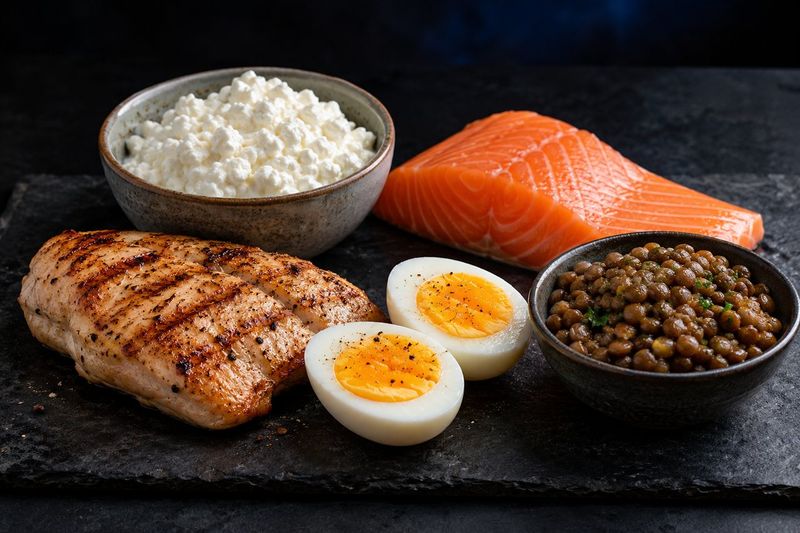
For muscle growth with strength training, the target is about 1.6 g of protein per kilogram of body weight per day, with a margin up to 2.2 g/kg. At 70 kg, that's 112–154 g of protein a day. The familiar 0.8 g/kg recommendation is a minimum for health; it isn't enough for muscle growth. Below: what the research shows, how many grams you need at your weight, and how to spread protein across the day.
0.8 or 1.6 g per kg: what's the difference
The 0.8 g per kg of body weight per day recommendation is designed to cover the needs of an ordinary person. For people who train, it isn't enough: the International Society of Sports Nutrition (ISSN) says so directly in its 2017 position stand. For building and maintaining muscle, the society considers 1.4–2.0 g per kg of body weight per day sufficient for most people who train.
A more precise target came from a 2018 meta-analysis by Morton and colleagues, a type of study that pools the results of several studies. It included 49 studies: 1,863 people, with strength training lasting at least 6 weeks. Protein supplementation increased gains in muscle and strength, but above roughly 1.6 g per kg per day, gains in lean mass (body weight minus fat) no longer increased on average. The cutoff is approximate: the authors' estimate ranged from 1.0 to 2.2 g/kg, and the model with this cutoff did not turn out to be statistically significant. That's why 2.2 g/kg gives a margin for those who need more than average.
| Study | What was studied | Main finding |
|---|---|---|
| Morton and colleagues, 2018, 49 studies, 1,863 people | protein with strength training | above ~1.6 g/kg per day, lean mass gains don't increase on average; the cutoff is approximate: 1.0–2.2 g/kg |
| ISSN, 2017 position stand | protein for people who train | 1.4–2.0 g/kg per day is enough for most; 0.8 g/kg is too little for people who train |
| Nunes and colleagues, 2022, 74 studies | more protein with strength training | under 65, an effect at 1.6 g/kg and above; 65 and older, already at 1.2–1.59 g/kg |
| Tagawa and colleagues, 2020, 105 articles, 5,402 people | the link between protein intake and muscle mass | each +0.1 g/kg per day means more lean mass; above 1.3 g/kg the gain is smaller |
| Devries and colleagues, 2018, 28 studies, 1,358 people | kidney function with high protein intake | in healthy people, changes in kidney function didn't differ from those on a normal diet |
In the Devries analysis, high protein was defined as at least 1.5 g/kg per day, at least 20% of calories, or at least 100 g of protein per day.
How many grams of protein per day at your weight
Multiply your weight in kilograms by 1.6 and by 2.2: that gives you your daily protein range in grams. ISSN gives its per-kilogram target without splitting it by sex, so in this calculation, protein amounts for men and women differ only because of different body weights.
| Weight | 1.6 g/kg | 2.2 g/kg |
|---|---|---|
| 60 kg | 96 g | 132 g |
| 70 kg | 112 g | 154 g |
| 80 kg | 128 g | 176 g |
| 90 kg | 144 g | 198 g |
If you carry a lot of fat, calculating from total body weight overestimates the target. In that case, protein is calculated from lean mass, your weight without fat. For example, at 100 kg and 35% body fat, lean mass is 65 kg, and 1.6 g/kg gives 104 g of protein a day. Body fat percentage is estimated with a device like InBody or with calipers, a tool for measuring skinfold thickness. It's an estimate with a margin of error.
How much protein you need after 65
The return on protein changes with age. In the Morton meta-analysis, the effect of protein supplementation decreased with age. In the 2022 study by Nunes and colleagues, people 65 and older gained more lean mass already at 1.2–1.59 g per kg per day, whereas for people under 65 it took 1.6 g/kg or more. Tagawa and colleagues found in 2020 that each additional 0.1 g/kg per day adds lean mass, but above 1.3 g/kg the gain is smaller.
How much protein you need when losing weight
In a calorie deficit, when you take in less energy from food than you burn, you need more protein to preserve muscle. In a 2014 systematic review, Helms and colleagues concluded that lean, trained people who are cutting (losing fat while keeping muscle) probably need 2.3–3.1 g of protein per kilogram of lean mass. The bigger the deficit and the less fat a person has, the higher the need. For trained people in a deficit, ISSN gives 2.3–3.1 g per kilogram of body weight per day.
Both ranges apply to trained people. If someone carries a lot of fat, I calculate protein from lean mass at 1.6–2.5 g/kg, as in the example above.
How much protein is absorbed in one meal
Protein from a large serving gets used too. Research doesn't support the popular claim that "you can't absorb more than 30 g at once." In Trommelen and colleagues (2023), 100 g of protein after training produced more intense and longer-lasting muscle protein synthesis (the building of new proteins in muscle) than 25 g. After 100 g, synthesis continued for more than 12 hours. This was a single-day study; on its own, it says nothing about long-term muscle growth.
Still, spreading protein evenly is convenient. In a 2018 review, Schoenfeld and Aragon recommend about 0.4 g per kg of body weight per meal at least 4 times a day, and ISSN recommends servings of 0.25 g/kg or 20–40 g every 3–4 hours. In practice, the simplest approach is to split your daily protein across 4–5 meals: for example, 128 g is 4 meals of 32 g.
Do you need protein powder
Protein powder, a protein supplement, isn't required: what matters for muscle is your total protein for the day, and Morton's 1.6 g/kg cutoff was calculated from all protein eaten. ISSN notes that someone who trains can meet their needs from regular food, and protein powder is a convenient way to top up protein without extra calories.
Where to get 100 g of protein
How much protein common foods contain, weighed raw:
| Food, 100 g raw | Protein |
|---|---|
| Turkey breast | 23.7 g |
| Lean beef | 22.7 g |
| Chicken breast | 22.5 g |
| Pink salmon | 20.5 g |
| Cod | 17.8 g |
| Tofu | 17.3 g |
| Farmer's cheese, 5% fat | 17.0 g |
| Egg | 12.6 g |
| Lentils, dry | 24.0 g |
| Buckwheat, dry | 12.6 g |
For example, 150 g of chicken breast, 200 g of 5% cottage cheese, and 3 eggs of 50 g each give about 33.8 + 34.0 + 18.9 ≈ 87 g of protein. You get the rest from other foods over the day.
How I calculate protein with clients
In my clients' meal plans, I set protein at 1.6–2.5 g per kilogram. Above 2.2 g/kg only if there are no stomach or bowel problems. If the questionnaire lists gastritis, an ulcer, reflux (stomach contents backing up into the esophagus), irritable bowel syndrome, gallstone disease, or a removed gallbladder, I don't raise protein above 2.2 g/kg. That's a limit in my meal plans; with a diagnosed condition, a doctor determines the protein target. With typical body composition, I calculate from current weight; if body fat is above 25% for men or 32% for women, from lean mass.
In the app, the client logs everything they eat, including sauces, oils, and nuts: if it went into your mouth, it has to go into the food diary.
How to calculate your protein: step by step
- Start with your weight. If your body fat is above 25% for men or 32% for women, calculate your lean mass: weight × (1 − body fat fraction). Write body fat as a decimal: 35% is 0.35.
- Multiply that mass by 1.6: that's your daily target in grams. If you're lean, lift weights regularly, and are cutting, the target is higher: 2.3–3.1 g per kilogram of lean mass, calculated with the formula from step 1.
- Split your daily protein across 4–5 meals.
- Check how much protein you eat now: log your food for a few days and count protein using labels and the table above.
- Judge the results over several weeks: are the weights you train with and your reps in the same exercises going up; take body measurements under the same conditions. How to set up the training itself is covered in the article How many sets per week you need for muscle growth.
The targets in this article are for healthy adults. With kidney or gastrointestinal disease, and during pregnancy, a doctor determines the protein target.
If you need meals built around your calorie target and your tastes, there's the meal plan.
Sources
- Morton RW et al. A systematic review, meta-analysis and meta-regression of the effect of protein supplementation on resistance training-induced gains in muscle mass and strength in healthy adults. Br J Sports Med, 2018. Article · Full text
- Jäger R et al. International Society of Sports Nutrition Position Stand: protein and exercise. J Int Soc Sports Nutr, 2017. Article · Full text
- Nunes EA et al. Systematic review and meta-analysis of protein intake to support muscle mass and function in healthy adults. J Cachexia Sarcopenia Muscle, 2022. Article · Full text
- Tagawa R et al. Dose-response relationship between protein intake and muscle mass increase: a systematic review and meta-analysis of randomized controlled trials. Nutr Rev, 2020. Article · Full text
- Helms ER et al. A systematic review of dietary protein during caloric restriction in resistance trained lean athletes: a case for higher intakes. Int J Sport Nutr Exerc Metab, 2014. Article
- Trommelen J et al. The anabolic response to protein ingestion during recovery from exercise has no upper limit in magnitude and duration in vivo in humans. Cell Rep Med, 2023. Article · Full text
- Schoenfeld BJ et al. How much protein can the body use in a single meal for muscle-building? Implications for daily protein distribution. J Int Soc Sports Nutr, 2018. Article · Full text
- Devries MC et al. Changes in Kidney Function Do Not Differ between Healthy Adults Consuming Higher- Compared with Lower- or Normal-Protein Diets: A Systematic Review and Meta-Analysis. J Nutr, 2018. Article · Full text