
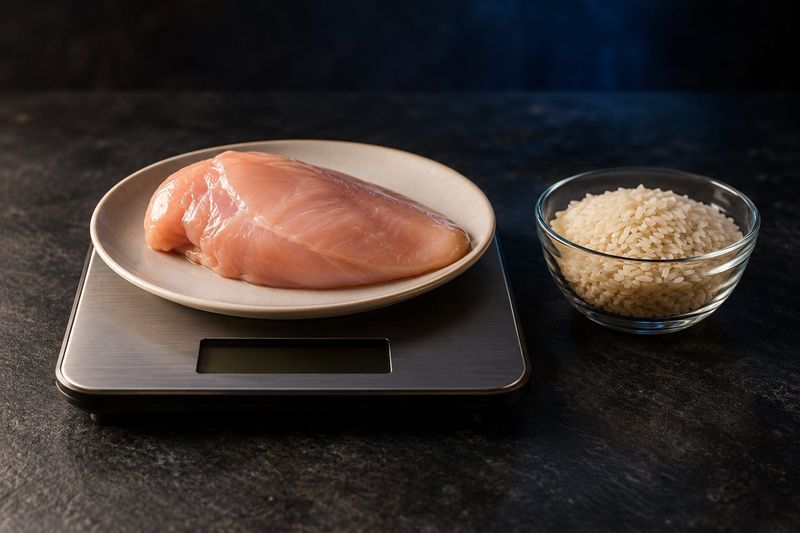
It's easiest to weigh food raw or dry, before cooking. Raw weight doesn't depend on how much water the grain absorbed or how much the meat lost, so it's easier to match with the raw entry in your app. If you weigh a cooked food, pick the entry for the cooked version specifically, and calculate the calories of your own dish from the recipe, as shown below.
Below: how many times the weight changes during cooking, how to count the calories of a dish made for several days, and why you need a scale at all.
Why it's easier to weigh food raw
Raw weight is a reliable reference point. How much cooked grain weighs depends on the amount of water and the cooking time, and the weight of meat depends on the cooking method. Water adds no calories: 60 g of dry white rice is about 219 kcal, no matter how much water it absorbs. That's why in the meal plans I put together, every food is listed by raw weight, and the client weighs it before cooking.
In calorie tables and apps, the raw and cooked versions of a food have separate entries. For white rice, that's 365 kcal per 100 g dry and 130 kcal per 100 g cooked. Mixing up these two entries can throw your count off several times over.
How many times the weight changes during cooking
Grains and pasta get 2.3–5.3 times heavier when boiled, while meat and poultry lose on average a fifth to a third of their weight. The exact figure depends on the amount of water, the cooking time, and the cooking method.
Below are data from the food database of the U.S. Department of Agriculture (USDA). To work out how many times heavier a food gets, the calories of the dry food were divided by the calories of the cooked food.
| Food | Dry, kcal per 100 g | Cooked, kcal per 100 g | How many times heavier |
|---|---|---|---|
| White rice | 365 | 130 | 2.8 times |
| Pasta | 371 | 158 | 2.35 times |
| Buckwheat | 346 | 92 | 3.8 times |
| Rolled oats, cooked in water | 379 | 71 | 5.3 times |
Meat loses water and some fat during cooking. The USDA table shows how much of the raw weight remains:
| Meat and cooking method | Share of raw weight remaining |
|---|---|
| Chicken breast, baked | 72% (from 61 to 82%) |
| Chicken breast, boiled | 77% (from 70 to 88%) |
| Pork tenderloin, baked | 80% (from 74 to 84%) |
| Ground beef, 12–22% fat, pan-fried | 67% |
Grains differ a lot from one another, and even for the same grain the weight depends on the amount of water. So the values in the grain table work as a rough guide, and the most accurate option is to weigh before cooking.
What happens if you mix up raw and cooked weight
With rice, you can be off several times over. 200 g of cooked rice is about 260 kcal. If you log it as 200 g of dry rice, your food diary will show 730 kcal, 2.8 times more than you actually ate.
With meat, the error goes the other way: it's smaller, but still noticeable. 150 g of baked chicken breast comes from roughly 208 g of raw breast. If you log it as 150 g of raw breast, your diary will record 28% less raw food than there actually was. The logged calories will also be noticeably lower than what you ate.
How to weigh a dish cooked for several days
Count the calories of the whole dish from the raw ingredients and divide them by the weight of the cooked dish. That gives you the calories per gram. After that, just weigh your portion and multiply its weight by the calories per gram; there's no need to recalculate the whole dish every time. Checking yourself is easy: the calories of all the portions should add up to the calories of the whole dish.
For example, the raw ingredients for a pilaf add up to 2,400 kcal, and the finished pilaf weighs 2,000 g. That's 1.2 kcal per gram, so a 350 g portion is 420 kcal. Soup, stew, and casseroles are counted the same way: the calories come from the raw ingredients, the weight from the finished dish.
Oil, sauces, and drinks
Oil absorbed during frying stays in the dish, so it's logged as a separate entry. If you calculate your dish's calories from the recipe, the oil is already included, and you don't add it to your portion again.
Measuring oil with a spoon isn't accurate: according to USDA data, a tablespoon of olive oil is 13.5 g and 119 kcal, and a teaspoon is 4.5 g and 40 kcal. It's more reliable to weigh the bottle before and after cooking and log the difference in weight.
Sauces, nuts, and sugary drinks should always be logged too: their calories are easy to miss if you only count the food on your plate.
Containers, grams, and milliliters
Before weighing, put an empty plate or container on the scale and reset it to zero. Then the scale will show only the weight of the food.
Liquids are also easier to weigh, because their weight in grams and their volume in milliliters don't match: for example, 100 ml of oil weighs about 91 g.
Why weigh food at all
In studies, people underreport how much they eat in their records more often than they overreport it. A systematic review is a paper that pulls together studies according to set rules. In the 2019 review by Burrows and colleagues (59 studies, 6,298 adults), most studies found statistically significant underreporting of calories in food records compared with energy expenditure, while overreporting was rare. Statistically significant means that such a difference is unlikely to be explained by chance.
Expenditure was measured with the doubly labeled water method, an objective way to check how accurate food records are.
In the 1992 study by Lichtman and colleagues, 10 people who considered themselves “diet-resistant” underreported their food intake by an average of 47% and overreported their physical activity by 51%. Their energy expenditure was within 5% of the predicted value, so their weight wasn't dropping because of calories that never made it into their records.
According to the 2017 position stand of the International Society of Sports Nutrition (ISSN), fat loss depends on a sustained calorie deficit, when you take in less energy from food than you burn. If your records understate how much you ate, your real deficit is smaller than the calculated one.
At the same time, self-monitoring of food intake is consistently associated with weight loss. That's the conclusion Burke and colleagues reached in a 2011 systematic review (22 studies), although the authors rated the evidence as weak.
Can you count calories without a scale
You can count without a scale, but eyeballing portions doesn't eliminate errors. A meta-analysis is a statistical pooling of study results. In the 2021 meta-analysis by McKenzie and colleagues (31 studies, 4,518 people), calories were underreported with every tracking method, including diaries with eyeballed portions. Even in weighed food diaries, men undercounted by about 820 kcal a day on average (based on 5 studies). A scale makes the grams more precise, but a food you didn't log won't make it into the count.
If you don't have a scale yet, rely on the weight printed on the package and on foods that come in single packs or by the piece: yogurt, cottage cheese, bread, eggs. You'll need a scale for grains, meat, and oil: grains and meat change weight a lot during cooking, and oil has a lot of calories in every gram.
How I teach clients to weigh food
In the meal plans I put together, every food is listed by raw weight: the client weighs food before cooking. The meal plan instructions include a guide for the cooked portion: grains and legumes get about three times heavier after boiling, pasta 2.2 times, and meat, poultry, and fish lose a fifth to a third of their weight. This guide is only for the plate: calories are counted by raw weight.
The main rule of tracking: if a food goes in your mouth, it goes in the app. Oils, nuts, and sauces must be logged. When a client says they eat very little but their weight isn't moving, the first thing I look for is unlogged snacks and sugary drinks.
The goal is to teach clients to count calories on their own: weigh food raw, swap foods, and use the plate method.
How to weigh food: step by step
- Put an empty plate or container on the scale and reset it to zero.
- Weigh the food before cooking: grains and pasta dry, meat and fish raw.
- In the app, choose the entry for the raw food, and log oil and sauce separately; in a dish made from a recipe, they're already included in the total calories.
- If you're cooking a dish for several days, count the calories of all the raw ingredients, weigh the whole cooked dish, and divide the calories by its weight.
- Weigh your portion and multiply its weight by the calories per gram.
- If you're weighing a food that's already cooked, choose the entry for the cooked food in the app; calculate the calories of your own dish from the recipe, as in steps 4–5.
To find out how much protein you need at your body weight, read How much protein you need per day for muscle growth and weight loss.
If you have or have had an eating disorder, discuss calorie counting and weighing food with your doctor. In my meal plans, this is a special case: such a plan isn't put together automatically, and I work through it with the person individually.
Sources
- Burrows TL et al. Validity of Dietary Assessment Methods When Compared to the Method of Doubly Labeled Water: A Systematic Review in Adults. Front Endocrinol (Lausanne), 2019. Article · Full text
- McKenzie BL et al. Investigating sex differences in the accuracy of dietary assessment methods to measure energy intake in adults: a systematic review and meta-analysis. Am J Clin Nutr, 2021. Article · Full text
- Lichtman SW et al. Discrepancy between self-reported and actual caloric intake and exercise in obese subjects. N Engl J Med, 1992. Article
- Burke LE et al. Self-monitoring in weight loss: a systematic review of the literature. J Am Diet Assoc, 2011. Article · Full text
- Aragon AA et al. International society of sports nutrition position stand: diets and body composition. J Int Soc Sports Nutr, 2017. Article · Full text
- Showell BA et al. USDA Table of Cooking Yields for Meat and Poultry. U.S. Department of Agriculture, 2012. Table
- U.S. Department of Agriculture, Agricultural Research Service. FoodData Central, SR Legacy. Database




