
In research, diet lapses and weekend overeating are linked to rigid restrictions, hunger, evening hours, stress, and alcohol rather than boiling down to "weak willpower." Studies show that fat loss is driven by a sustained calorie deficit, while long-term results depend on adherence—supported by flexible eating rules, enough protein, and a clear structure without labeling foods as "allowed" or "forbidden."
I am Demid Lobanov, a fitness coach with over six years of experience (over 300 clients) and more than four years teaching at PRO-FG school (170+ graduates). Below, I break down why lapses cluster in the evening and on Saturdays, what studies show about flexible restraint and diet breaks, and how to step out of the cycle without extreme "make-up" workouts.
Why weight jumps on weekends and holidays
Weekend weight gain is a measurable weekly rhythm in adults, recorded in year-long tracking. In a 12-month Australian cohort study (Maher et al., 2023, JAMA Network Open), 368 adults aged 18–65 (mean age 40.2) weighed themselves at home across a year. Weight fluctuated by roughly 0.3% (252 g) each week: Mondays and Tuesdays were heaviest, weight dropped toward Friday (−0.18% versus Monday, p < 0.001), and climbed back up over Saturday and Sunday.
The sharpest spikes happened around holidays: Christmas and New Year averaged +0.65% (p < 0.001), and Easter +0.29% (p < 0.001). Over the full year, median weight gain was 0.26% (218 g). If someone holds a tight deficit from Monday to Friday and overshoots calories across two weekend days of dinners and gatherings, the weekly deficit quietly vanishes. How the deficit itself is calculated is covered in How to Lose Weight.
How rigid bans relate to overeating
Nutrition psychology distinguishes between flexible and rigid cognitive restraint, as well as dichotomous ("all-or-nothing") thinking, where foods and diet days are divided strictly into "perfect" and "broken."
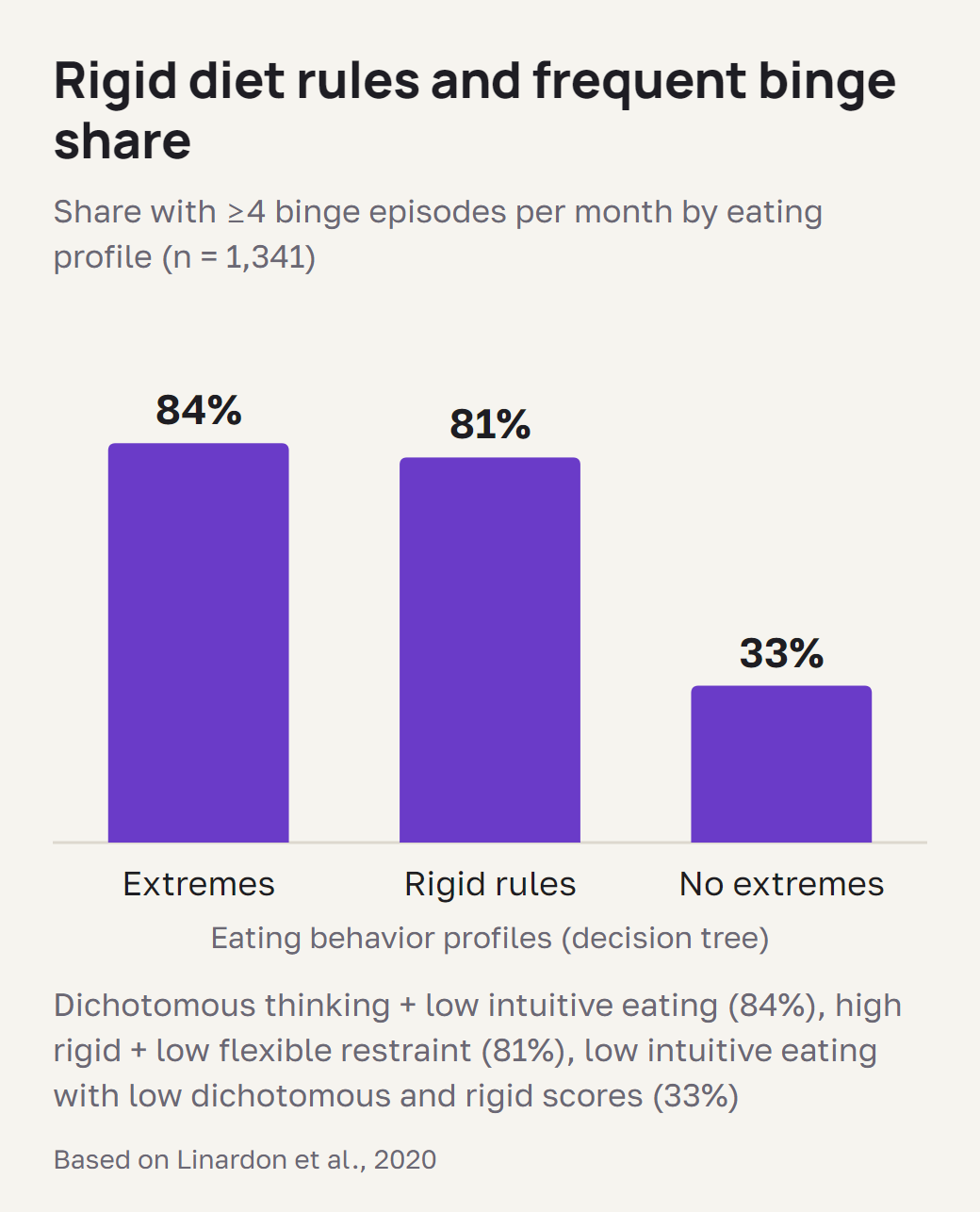
In an exploratory study by Linardon et al. (2020; 1,341 participants: 512 with recurrent binge-eating episodes of 4+ times per month and 829 without), a machine-learning model accurately classified about 70% of participants based on eating-pattern combinations. The highest share of recurrent binge eating appeared in two profiles: low intuitive eating paired with high all-or-nothing thinking (84%), and high rigid restraint paired with low flexible restraint (81%). When low intuitive eating came without extremes or rigid rules, the share dropped to 33%. Among participants with above-average intuitive eating, 75% had no recurrent binge episodes.
At the same time, research reveals a more nuanced picture:
- Difference between flexible and rigid control (Péneau et al., 2022; 620 participants in France). Higher flexible restraint was linked to lower impulsivity, whereas higher rigid restraint was linked to stronger uncontrolled eating and lower self-esteem, life satisfaction, and optimism (though both control types correlated with overall cognitive restraint and emotional eating).
- The role of conscious restraint over the long haul (Salmela et al., 2023; 9-year Finnish Diabetes Prevention Study substudy, 98 adults with overweight and impaired glucose tolerance). In the coached intervention group, all three restraint scales (total, flexible, and rigid) rose during year one while weight fell by 5.2 kg versus 1.2 kg in controls (p < 0.001). By year nine, differences remained significant for weight (−3.0 vs. +0.1 kg, p = 0.046), total restraint (p = 0.002), and rigid restraint (p = 0.004); first-year increases in conscious restraint statistically mediated 9-year weight maintenance.
The takeaway is important and does not mean "drop all structure." Conscious tracking and a clear framework help maintain weight for years, while rigid control and all-or-nothing extremes are linked in studies to frequent binge episodes and poorer psychological well-being.
Evening, stress, company, and alcohol: main risk factors for lapses
Studies using real-time mobile diaries (ecological momentary assessment, EMA) show in which situations and times of day people most often break their plan:
- Evening, environment, and company. In a 7-day study by McKee et al. (2014; 80 dieters, mean age 41.2, body mass index 30.8), dietary lapses were more likely in the evening, under strong temptation, in the presence of other people, and around visible food cues. They happened less often when dieters used specific coping strategies. Lapses themselves also lowered confidence in resisting future temptations.
- Alcohol. In an analysis by Sala et al. (2023; 87 participants with overweight or obesity completing 6 brief surveys per day across 16 risk factors), alcohol and self-efficacy appeared most often among the top 10 stable interactions. Drinking alcohol weakened the protective effect of self-efficacy, motivation, and advance planning.
- Chronic stress. This was shown in a secondary analysis of the 3-year PREVIEW trial (Jalo et al., 2022; 1,311 adults with BMI ≥25 and high type 2 diabetes risk). Frequent high stress during weight maintenance (months 6–36) was associated with a greater drop in improved flexible restraint (p = 0.026; change −1.1 vs. −0.7 points; small effect d = 0.24). Higher perceived stress at month six was linked to lower flexible restraint, greater disinhibition, and stronger hunger throughout maintenance (all p < 0.001).
What actually helps: protein, diet breaks, and a flexible plan
According to the International Society of Sports Nutrition (ISSN) Position Stand (Aragon et al., 2017), fat loss is driven by a sustained calorie deficit, different dietary styles perform comparably when matched, and long-term outcomes depend on adherence. Three pillars make a plan easier to hold.
| Tool | What studies show | How to apply in practice |
|---|---|---|
| Protein at meals | 49 acute RCTs (Kohanmoo, 2020): hunger −7 mm, fullness +10 mm on appetite scale; ghrelin −20 pg/ml, CCK +30 pg/ml, GLP-1 +21 ng/ml (ghrelin, CCK, and GLP-1 shifted significantly at ≥35 g) | Protein at breakfast, lunch, and dinner (protein target) |
| Planned diet breaks | ICECAP RCT (Peos, 2021; 61 resistance-trained adults): 4×3 wk deficit with 1-wk maintenance breaks – no statistically significant difference in final fat mass (p = 0.321), less hunger (p = 0.002), higher satisfaction (p = 0.016) | A planned maintenance week instead of chaotic "cheat meals" |
| Standard daily deficit instead of strict fasting windows | 28 RCTs (Schroor, 2024): intermittent regimens (5:2, alternate-day, windows) did not beat daily deficits for weight (p = 0.132) or fat (p = 0.362), but reduced fat-free mass slightly more (−0.20 kg, p = 0.044) | Choose a standard daily deficit if strict fasting windows are harder to sustain (see meal example in lunch for weight loss) |
The Kohanmoo (2020) meta-analysis carries an important caveat: the acute effect of protein on satiety and appetite hormones is supported across 49 trials, whereas 19 long-term trials found no consistent shifts in these outcomes (appetite and hormones), apart from a drop in GLP-1. In ICECAP, diet breaks lowered appetite and raised the satiety hormone peptide YY (p = 0.034), while extending overall program duration (15 weeks instead of 12).
In my nutrition coaching, meal plans are built around familiar foods without banning whole food groups and with a clear set of equivalent swaps so a dinner out or family weekend does not derail the whole week. A published case from my practice illustrates this: a female client came at 98 kg after several failed diets, and on a plan built from everyday foods without rigid bans her weight dropped to 83 kg in three months. This is an individual case, not a guarantee of the same result. If you want a structured plan built around your tastes and budget with swaps, that format is available in a custom meal plan, and paired with training and weekly adjustments in online coaching.
What to do the day after overeating: step by step
After overeating, do not "punish" yourself with fasting or two hours of cardio: in my practice, harsh restrictions only make it harder to return to a calm eating routine.
- Return to your normal plan at the very next meal. Do not subtract yesterday's calories from breakfast or run a liquid "detox" day.
- Do not panic at the morning scale number. A sharp overnight spike after a salty or sweet dinner is mostly water retention and gastrointestinal contents.
- Review the trigger without self-blame. Look at what came before the episode: hunger, stress, alcohol, a rigid ban, social company, or food sitting in plain sight.
- Fix one specific bottleneck for next week. For example, add a filling lunch with enough protein, plan a dessert within your calorie budget, or move high-calorie snacks off the counter.
- Track progress by weekly average weight instead of a Monday weigh-in. Single weekend fluctuations stop looking like a disaster.
I share short practical breakdowns on training and nutrition on my YouTube channel @lobanov_fitness.
When to see a doctor for overeating
Occasional overeating tied to an overly strict diet, hunger, or weekends can in many cases be addressed by adjusting the meal plan and routine. However, certain signs call for a psychiatrist or psychotherapist who specializes in eating disorders:
- regular episodes accompanied by a feeling of complete loss of control over how much you eat;
- compensatory behaviors after eating—inducing vomiting, taking laxatives, or exhausting exercise to "burn off" food;
- regular secretive eating alone.
These conditions fall outside the scope of a fitness coach and require medical and psychotherapeutic care.
Sources
- Maher C et al. Weekly, Seasonal, and Festive Period Weight Gain Among Australian Adults. JAMA Netw Open, 2023. Article · Full text
- Linardon J et al. Interactions between different eating patterns on recurrent binge-eating behavior: A machine learning approach. Int J Eat Disord, 2020. Article
- Péneau S et al. Validation of the Flexible and Rigid Cognitive Restraint Scales in a General French Population. Int J Environ Res Public Health, 2022. Article · Full text
- Salmela J et al. Eating behavior dimensions and 9-year weight loss maintenance: a sub-study of the Finnish Diabetes prevention study. Int J Obes (Lond), 2023. Article · Full text
- McKee HC et al. An ecological momentary assessment of lapse occurrences in dieters. Ann Behav Med, 2014. Article
- Sala M et al. Application of machine learning to discover interactions predictive of dietary lapses. Appl Psychol Health Well Being, 2023. Article
- Jalo E et al. Perceived stress as a predictor of eating behavior during the 3-year PREVIEW lifestyle intervention. Nutr Diabetes, 2022. Article · Full text
- Peos JJ et al. Continuous versus Intermittent Dieting for Fat Loss and Fat-Free Mass Retention in Resistance-trained Adults: The ICECAP Trial. Med Sci Sports Exerc, 2021. Article
- Schroor MM et al. Effects of Intermittent Energy Restriction Compared with Those of Continuous Energy Restriction on Body Composition and Cardiometabolic Risk Markers - A Systematic Review and Meta-Analysis of Randomized Controlled Trials in Adults. Adv Nutr, 2024. Article · Full text
- Aragon AA et al. International society of sports nutrition position stand: diets and body composition. J Int Soc Sports Nutr, 2017. Article · Full text
- Kohanmoo A et al. Effect of short- and long-term protein consumption on appetite and appetite-regulating gastrointestinal hormones, a systematic review and meta-analysis of randomized controlled trials. Physiol Behav, 2020. Article




