
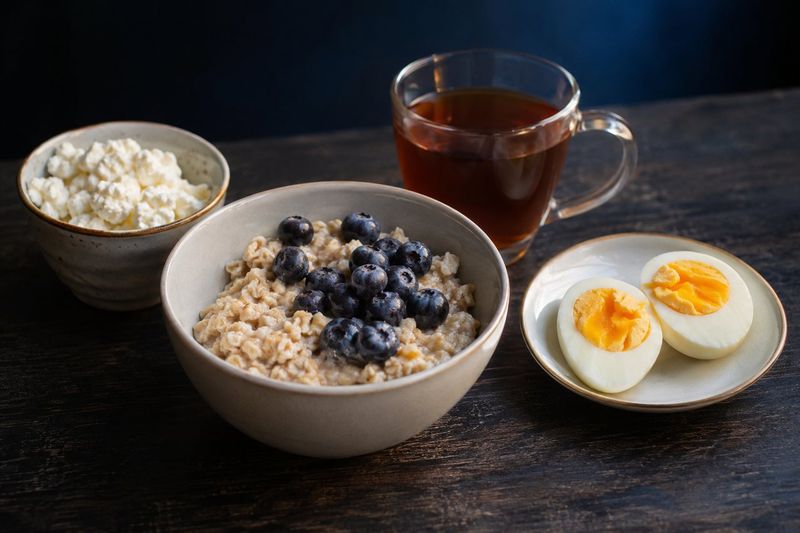
You don't have to eat breakfast to lose weight. In randomized trials, breakfast itself didn't reduce weight: people lose weight through a calorie deficit over the day. If eating breakfast suits you, in my meal split it makes up about 25% of the day's calories; at 1,500 kcal a day, that's about 375 kcal. Build it on protein plus porridge, bread, or fruit.
I'm Demid Lobanov, a fitness coach. The recipe database I use to build meal plans for clients has 56 breakfasts, each with at least 12 g of protein. Examples from it are in the table below.
Should you eat breakfast when losing weight
Breakfast is worth eating if it makes the deficit easier to stick to, and unnecessary if you don't overeat later in the day without it. In the 2019 meta-analysis by Sievert et al. (13 randomized trials: weight was measured in 7 of them, calorie intake in 10), daily calorie intake with breakfast was on average 260 kcal higher, and weight was 0.44 kg higher than without breakfast. The authors write that adding breakfast for weight loss may not be the best strategy. The trials were short (7 weeks on average for weight), and every one of them had a high or unclear risk of bias on at least one item.
In the 2020 meta-analysis by Bonnet et al. (7 randomized trials, 425 people, 8.6 weeks on average), weight ended up 0.54 kg lower without breakfast than with it. No difference was found in body fat percentage. In three trials, “bad” LDL cholesterol was higher without breakfast. The authors write that the effect of skipping breakfast on weight may be modest, and that LDL may rise in short trials.
Observational studies show the opposite association. In the 2020 meta-analysis by Ma et al. (45 observational studies), people who rarely ate breakfast had a 44% higher risk of excess weight in cohort studies and a 48% higher risk in cross-sectional studies. In the 2021 meta-analysis by Wicherski et al., which included only prospective studies, skipping breakfast 3 or more days a week came with an 11% higher risk, based on two studies, while the change in body mass index did not differ. The authors themselves call the evidence minimal. Studies like these show only an association; they don't prove cause.
Skipping breakfast is essentially shifting your eating window. More on this in the article Intermittent Fasting.
Does breakfast speed up your metabolism
No. In the 2014 randomized trial by Betts et al. (33 lean adults, 6 weeks), one group ate at least 700 kcal for breakfast before 11:00, and the other ate nothing until 12:00. Resting metabolism didn't change: the difference was within 11 kcal a day. With breakfast, people moved more, but they also ate more. Weight and body fat didn't differ between the groups.
In adults with obesity, in the 2016 study by Chowdhury et al. (23 people), resting metabolism didn't change either, and weight and body composition didn't differ between the groups. The difference in daily food intake here was not significant: without breakfast, people partly made up the calories later.
Big breakfast or big dinner
For weight, the difference is small. In a tightly controlled 2022 study by Ruddick-Collins et al., 30 people with overweight and obesity on the same deficit lost the same amount of weight with a big breakfast and with a big dinner: 3.33 and 3.38 kg. With a big breakfast, they felt less like eating during the day. In the 2023 meta-analysis by Young et al. (9 randomized trials), people in a deficit who ate a larger share of their calories in the first half of the day lost 1.23 kg more. There is an advantage, but it's small. More on meal timing in the article Can You Eat at Night.
How many calories breakfast should have
In my meal plans with four meals a day, breakfast is about 25% of the day's calories: lunch 35%, snack 10%, dinner 30%. This is a guideline: the split is adjusted to your schedule and hunger.
| Daily calorie target | Breakfast, about 25% |
|---|---|
| 1,300 kcal | 325 kcal |
| 1,500 kcal | 375 kcal |
| 1,800 kcal | 450 kcal |
| 2,000 kcal | 500 kcal |
First, work out your daily target: see the article How Many Calories Do You Need a Day. In my database, half of the breakfasts are up to 405 kcal per serving.
What to eat for breakfast when losing weight
A weight-loss breakfast is easy to build from protein and carbs: cottage cheese, eggs, or yogurt plus porridge, bread, or fruit. Nuts, butter, and peanut butter are counted by the gram, since they're high in calories.
| Part of breakfast | What to choose | How much in my breakfasts |
|---|---|---|
| Protein | cottage cheese, eggs, Greek yogurt, fish, tofu | at least 12 g; 20 g or more in 39 of 56 breakfasts |
| Grains | oatmeal, buckwheat, millet, rice | grains or flakes in 26 breakfasts |
| Bread | whole-grain or rye bread, crispbread, tortilla | in 11 breakfasts |
| Fruit and berries | berries, apple, banana | to taste, within breakfast calories |
| Fats | nuts, butter, peanut butter, cheese | by the gram |
Protein at breakfast
A high-protein breakfast reduces hunger compared with skipping breakfast, but compared with a regular breakfast, no difference in weight or food intake was found. In the 2015 randomized trial by Leidy et al., 57 young people with overweight, around 19 years old, who usually skipped breakfast and weren't restricting calories, spent 12 weeks eating a breakfast with 35 g of protein, a breakfast with 13 g of protein, or continuing to skip breakfast. With the high-protein breakfast, they didn't gain fat and ate less over the day. Without breakfast, body fat increased over the same 12 weeks. In a direct comparison of the two breakfasts, no difference was found.
In the 2024 crossover study by Dalgaard et al. in 30 young women with overweight, a high-protein breakfast gave more fullness until lunch. But at lunch and over the whole day, they ate as much as after a carb-based breakfast with the same calories or after no breakfast at all.
Porridge for breakfast
You can eat porridge while losing weight if the portion fits into your breakfast calories. In the 2013 crossover study by Rebello et al., 48 people ate oatmeal or a ready-to-eat cereal with the same calories for breakfast, once each. After oatmeal, fullness was higher and hunger lower for 4 hours. Porridge has only a weak effect on how much people eat later. More in the articles Oatmeal for Weight Loss and Buckwheat for Weight Loss.
Add protein to your porridge: cottage cheese, an egg, or yogurt. In the database, buckwheat porridge with egg is built this way, for example, and cottage cheese is added to the oatmeal cooked in water with apple.
Eggs and cottage cheese for breakfast
In my database, eggs appear in 22 of the 56 breakfasts and cottage cheese in 18. In the 2008 randomized trial by Vander Wal et al., people in a calorie deficit who ate two eggs for breakfast lost 2.63 kg over 8 weeks, while those who ate bagels with the same calories lost 1.59 kg. Without a deficit, there was no difference. And in the 2020 study by Keogh et al., which lasted six months, two eggs for breakfast and cereal on the same deficit gave similar results: 8.1 and 7.3 kg, and the difference was not significant. Eggs have no special effect on weight: the deficit is what decides. More in the articles Eggs for Weight Loss and Cottage Cheese for Weight Loss.
What to eat with cottage cheese at breakfast: berries, fruit, honey, or nuts, within your breakfast calories. For example, cottage cheese with berries and honey in my database has 298 kcal and 31.2 g of protein.
Sample breakfasts for weight loss
Below are breakfasts from my database. Calories and macros are given per serving as listed in the database; in a meal plan, portions are adjusted to your target, so the grams depend on your calorie intake.
| Breakfast | kcal | Protein, g | Fat, g | Carbs, g |
|---|---|---|---|---|
| Cottage cheese with berries and honey | 298 | 31.2 | 9.2 | 21.5 |
| Three-egg omelet with tomatoes | 293 | 21.0 | 20.4 | 5.7 |
| Greek yogurt with berries and seeds | 271 | 25.3 | 11.7 | 12.8 |
| Overnight oats in a jar | 360 | 21.5 | 6.1 | 52.2 |
| Buckwheat porridge with egg and green onion | 381 | 20.6 | 15.6 | 35.9 |
| Tuna and vegetable toast | 335 | 30.3 | 10.2 | 28.7 |
| Salmon, egg, and cucumber sandwich | 320 | 20.7 | 11.6 | 31.5 |
| Oatmeal cooked in water with apple and cinnamon | 477 | 28.3 | 10.0 | 64.8 |
People tolerate eating the same breakfast more easily than eating the same dinner. That's why in my meal plans breakfast can repeat several days in a row.
If you don't feel like eating in the morning
You can skip breakfast or eat later: what matters is calories for the day. In that case, breakfast calories move to your other meals. If skipping breakfast leaves you very hungry by evening and you overeat, it's better to bring back a breakfast with protein.
If you have diabetes and take glucose-lowering medication, set your meal schedule with your doctor. Pregnancy, breastfeeding, and eating disorders are also reasons to discuss skipping breakfast with a doctor first.
Common breakfast mistakes when losing weight
| Mistake | What's wrong |
|---|---|
| Eating breakfast when you're not hungry to “jump-start your metabolism” | resting metabolism didn't change with breakfast |
| A breakfast of just coffee and cookies | too little protein: my breakfasts have at least 12 g |
| Porridge with butter, honey, and nuts without weighing | add-ons also add calories: 10 g of vegetable oil is 90 kcal |
| Skipping breakfast and overeating in the evening | for weight, calories for the day are what matter |
Breakfast for weight loss: step by step
- Decide whether eating breakfast suits you: for weight, calories for the day are what matter.
- If you eat breakfast, give it about 25% of your daily target; at 1,500 kcal, that's about 375 kcal.
- Start with protein: cottage cheese, eggs, Greek yogurt, or fish.
- Add porridge, bread, or fruit.
- Weigh nuts, butter, honey, and peanut butter.
- After two weeks, compare your average weight for the week with the average for the previous week. If your weight isn't going down, cut back on portions of calorie-dense foods.
I publish breakdowns of nutrition and training on my YouTube channel @lobanov_fitness.
For structuring the rest of your meals and overall plan, see Lunch for Weight Loss, Snacks for Weight Loss, and How to Lose Weight. If you want training and nutrition managed together with ongoing support, see online coaching.
Sources
- Sievert K et al. Effect of breakfast on weight and energy intake: systematic review and meta-analysis of randomised controlled trials. BMJ, 2019. Article · Full text
- Bonnet JP et al. Breakfast Skipping, Body Composition, and Cardiometabolic Risk: A Systematic Review and Meta-Analysis of Randomized Trials. Obesity (Silver Spring), 2020. Article · Full text
- Wicherski J et al. Association between Breakfast Skipping and Body Weight-A Systematic Review and Meta-Analysis of Observational Longitudinal Studies. Nutrients, 2021. Article · Full text
- Betts JA et al. The causal role of breakfast in energy balance and health: a randomized controlled trial in lean adults. Am J Clin Nutr, 2014. Article · Full text
- Chowdhury EA et al. The causal role of breakfast in energy balance and health: a randomized controlled trial in obese adults. Am J Clin Nutr, 2016. Article · Full text
- Ruddick-Collins LC et al. Timing of daily calorie loading affects appetite and hunger responses without changes in energy metabolism in healthy subjects with obesity. Cell Metab, 2022. Article · Full text
- Leidy HJ et al. A high-protein breakfast prevents body fat gain, through reductions in daily intake and hunger, in "Breakfast skipping" adolescents. Obesity (Silver Spring), 2015. Article
- Rebello CJ et al. Acute effect of oatmeal on subjective measures of appetite and satiety compared to a ready-to-eat breakfast cereal: a randomized crossover trial. J Am Coll Nutr, 2013. Article
- Vander Wal JS et al. Egg breakfast enhances weight loss. Int J Obes (Lond), 2008. Article · Full text
- Young IE et al. Distribution of energy intake across the day and weight loss: A systematic review and meta-analysis. Obes Rev, 2023. Article · Full text
- Keogh JB et al. No Difference in Weight Loss, Glucose, Lipids and Vitamin D of Eggs for Breakfast Compared with Cereal for Breakfast during Energy Restriction. Int J Environ Res Public Health, 2020. Article · Full text
- Dalgaard LB et al. A dairy-based, protein-rich breakfast enhances satiety and cognitive concentration before lunch in overweight to obese young females: A randomized controlled crossover study. J Dairy Sci, 2024. Article
- Ma X et al. Skipping breakfast is associated with overweight and obesity: A systematic review and meta-analysis. Obes Res Clin Pract, 2020. Article