
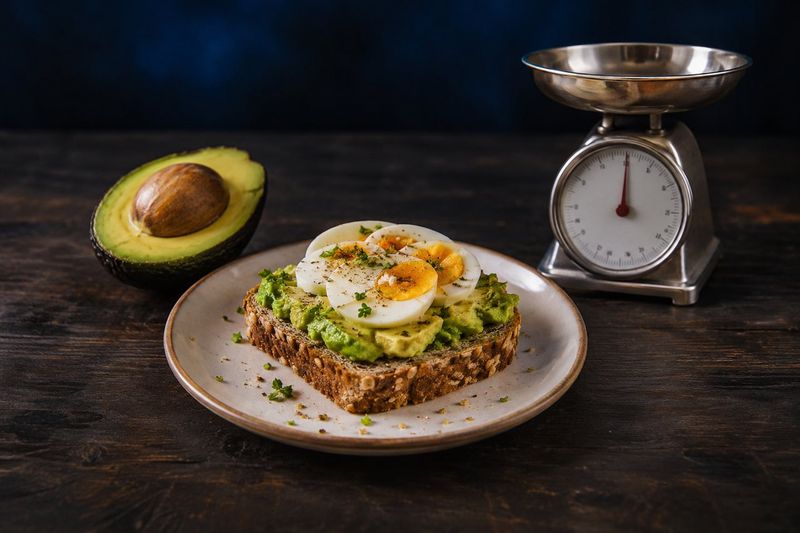
You can eat avocado while losing weight, as long as you weigh it. One hundred grams of avocado has about 161 kcal, and a 60 g serving has about 97 kcal. In a large trial, adding one avocado a day on top of a habitual diet for six months did not change weight, and did not reduce it either. In a calorie deficit, avocado did not get in the way of weight loss when eaten instead of other fats.
I'm Demid Lobanov, a fitness coach. In the database I use to build meal plans for clients, avocado appears in 4 out of 260 dishes: scrambled eggs for breakfast, egg toast as a snack, and chicken or shrimp salads for lunch. A serving uses 60–80 g.
Avocado calories
According to USDA data, 100 g of avocado has 2 g of protein, 14.7 g of fat, and 8.5 g of carbs, including 6.7 g of fiber. By my database's formula, that's about 161 kcal; by USDA data, 160. Avocado is higher in calories than most fruits because of its fat content.
Does avocado get in the way of weight loss
Not on its own, if it fits into your calories for the day. In the HAT trial (Lichtenstein et al., 2022), 1,008 adults with a large waist circumference added one large avocado a day to their usual diet for six months. Visceral fat did not drop compared with habitual eating. Body weight and body mass index were similar between groups. Nobody in that trial was trying to lose weight: both groups ate as usual.
For weight loss specifically, there is the 2005 study by Pieterse et al. Sixty-one people with overweight ate in a calorie deficit for 6 weeks, half of them having 200 g of avocado a day instead of 30 g of other fats. Weight, body mass index, and body fat percentage dropped equally in both groups.
In the 2024 systematic review by James-Martin et al., avocado did not worsen body weight or body composition. Taken together, these studies point to one conclusion: you can eat avocado, though it does not lower weight by itself. According to the International Society of Sports Nutrition position stand (Aragon et al., 2017), fat loss depends on a sustained calorie deficit.
How much avocado per day
There is no separate daily allowance: the amount depends on your daily calories. My dishes use 60–80 g of avocado per serving, which is about 97–129 kcal. It works well in place of part of the oil or cheese so the meal doesn't become higher in calories.
Avocado at night when losing weight
You can eat avocado in the evening. For weight, calories over the day matter more than meal timing. More in the article Can You Eat at Night.
What to eat avocado with
Avocado pairs well with a protein food. In my database, the lunch “chicken salad with avocado” has 403 kcal and 37.2 g of protein, and the snack “avocado and egg toast” has 288 kcal and 11.8 g of protein.
Avocado for weight loss: step by step
- Count avocado in your daily calories: about 161 kcal per 100 g.
- Weigh your serving: in my dishes that's 60–80 g.
- Use avocado instead of part of the oil or cheese rather than adding it on top.
- Pair avocado with protein: eggs, chicken, or fish.
- You can eat avocado in the evening too, if it fits into your calories for the day.
- After two weeks, compare your average weekly weight with the previous week's average. If your weight isn't going down, trim portions of calorie-dense foods.
I publish breakdowns of nutrition and training on my YouTube channel @lobanov_fitness.
Sources
- Lichtenstein AH et al. Effect of Incorporating 1 Avocado Per Day Versus Habitual Diet on Visceral Adiposity: A Randomized Trial. J Am Heart Assoc, 2022. Article · Full text
- James-Martin G et al. Avocado Consumption and Cardiometabolic Health: A Systematic Review and Meta-Analysis. J Acad Nutr Diet, 2024. Article
- Pieterse Z et al. Substitution of high monounsaturated fatty acid avocado for mixed dietary fats during an energy-restricted diet: effects on weight loss, serum lipids, fibrinogen, and vascular function. Nutrition, 2005. Article
- USDA FoodData Central, SR Legacy: Avocados, raw, all commercial varieties (FDC 171705). Database
- Aragon AA et al. International society of sports nutrition position stand: diets and body composition. J Int Soc Sports Nutr, 2017. Article · Full text




