
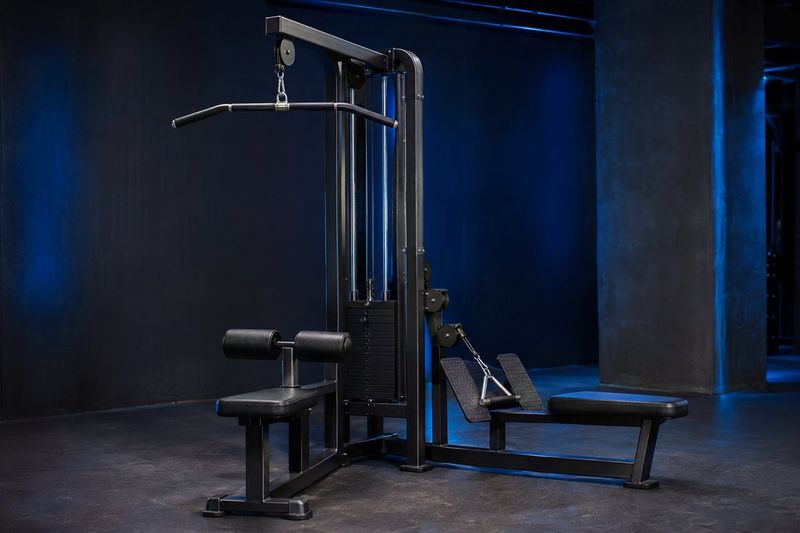
To build your back, you need two types of pulling exercises: vertical and horizontal. Vertical pulls (pull-ups and lat pulldowns) load the lats and teres major more, and they are what make your back wider. Horizontal rows (to the waist, on a cable machine or with a dumbbell) also load the middle and upper back: the trapezius, the rhomboids, and the rear delts. Which muscle works more depends mainly on the path of the elbow.
I'm Demid Lobanov, a fitness coach. In the programs I've written, the back exercise that appears most often is the wide-grip vertical pull: 12 times. Horizontal cable rows appear just as often: 12 times, 7 of them chest-supported. Below I'll explain how the back is built and how to put together a workout.
Which muscles make up the back
The back is made up of several muscle groups with different jobs. Their functions are described based on Hall's biomechanics textbook (chapter 7) and my exercise library.
| Muscles | What they do | Where they're loaded |
|---|---|---|
| Lats | depress and adduct the upper arm, extend it, help depress the shoulder blade | vertical pulls, rows to the waist, pullover |
| Teres major | extends and adducts the upper arm together with the lats | the same exercises |
| Trapezius (middle and lower parts) and rhomboids | pull the shoulder blades together; the lower trapezius also depresses them | horizontal rows, especially with the elbows out to the sides |
| Rear delt | moves the upper arm back | horizontal rows, reverse flyes |
| Spinal erectors | keep the back straight in bent-over positions and pulls | 45-degree hip extension (hyperextension), bent-over rows without support |
The lats are the only one of these muscles that move both the upper arm and the shoulder blade. The teres major and rear delt move only the upper arm bone. The trapezius and rhomboids move only the shoulder blade.
Back exercises at the gym
The table lists exercises from my exercise library. Each one has its own article.
| Exercise | What it loads more | Article |
|---|---|---|
| Lat pulldown | lats and teres major | Lat pulldown |
| Pull-ups | lats, biceps | How to learn to do pull-ups |
| Seated cable row | mid-back or lats, depending on the elbow path | Seated cable row |
| Bent-over dumbbell row | the same, plus core work | Bent-over dumbbell row |
| Cable pullover | lats and teres major without the biceps; the pec major assists | Cable pullover |
| 45-degree hip extension | hamstrings and glutes; the back holds its position | 45-degree hip extension (hyperextension) |
In my classification, the 45-degree hip extension is primarily hip extension. The hamstrings and glutes do the main work, while the back muscles hold the torso in place.
How to build a wide back
Back width comes from the lats and teres major. The main exercises for them are vertical pulls and pull-ups. You can add a cable pullover, where the elbow doesn't bend and the biceps doesn't help.
Grip width in the lat pulldown barely changes how the lats work. The 2014 study by Andersen and colleagues included 15 men. Lat activity over the whole movement was similar with narrow, medium, and wide grips.
With narrow and medium grips, participants lifted more: 80.3 and 80.0 kg versus 77.3 kg with a wide grip. Only during the lowering phase did the wide grip produce slightly more lat activity than the narrow one.
The 2026 narrative review by Di Fonza and colleagues also notes that grip width affects muscle activity inconsistently. These studies didn't measure muscle growth, only activity.
According to my exercise library, what shifts the load between the lats and the upper back in the lat pulldown is torso lean and elbow path. Drive your elbows down toward your hips, and the lats and teres major work more. Bring your elbows down and out to the sides while leaning your torso back, and the upper back gets more involved.
How to build the middle and upper back
The mid-back is loaded by horizontal rows. According to my exercise library, the emphasis depends on the elbow path. When the elbow travels along the torso toward the waist, the lats work more. When it travels out to the side toward the chest, the trapezius, rhomboids, and rear delts work more. Read more in the article on the seated cable row.
A chest pad on the machine reduces the work of the spinal erectors and keeps you from adding range of motion by moving your torso. That's why more than half of the horizontal rows in my programs are chest-supported.
What growth measurements show
There are few studies that measured back muscle growth. The 2016 study by Paoli and colleagues included 18 students around 25 years old. None of them had done regular resistance training for at least two years.
For 8 weeks, the students did lat pulldowns, seated rows, and exercises for the chest, shoulders, and arms. A biopsy (analysis of a muscle tissue sample) showed that the lat fibers got thicker, by 22% on average. Lat pulldown strength increased from 670.8 to 785 N.
I didn't find any studies that compared back growth from different pulling exercises. So the exercise choice here is based on movement mechanics and measurements of muscle activity.
How many sets for the back
My guideline for a muscle group is 10–20 working sets per week. A working set is one done close to failure, with 0–3 reps in reserve; the warm-up doesn't count. How to count these sets is covered in How many sets per week.
According to the 2026 meta-regressions by Pelland and colleagues, the results of 67 studies fit best with the following way of counting. A set counts in full for the muscle doing the main work and as half a set for a muscle that assists. In pulling exercises, the back does the main work, and the biceps gets credit for half a set.
Split your sets between vertical pulls and horizontal rows so that both the lats and the mid-back get loaded.
Sample back workout
This template comes from my database; it hasn't been tested in a study. Adapt it to your own program.
- Lat pulldown or pull-ups: lats and teres major.
- Chest-supported cable row: mid-back.
- Cable pullover: lats without help from the biceps.
- 45-degree hip extension: hamstrings and glutes, with the back holding its position.
How to build your back at home
At home, the main exercise is the one-arm bent-over dumbbell row, with your free hand braced for support. If you have a pull-up bar, do band-assisted pull-ups until you can do enough full ones. Read more about training without a gym in Working out at home.
Once you can do more than 15 reps in a set with 1–2 reps in reserve, you need a heavier weight. If you don't have one, slow down the lowering: the set will get harder with the same weight.
Back training when you have pain
- Pain with no established cause, severe pain, or worsening pain: see a doctor first. The advice below is for pain whose cause a doctor has already identified.
- Acute phase of low back pain with an established cause: my method leaves out horizontal rows. After the acute phase, a chest-supported row works well: it puts almost no load on the lower back.
- Shoulder pain when raising the arm above horizontal: if your doctor has cleared pulling exercises, shorten the top part of the movement in vertical pulls to a pain-free range rather than dropping the exercise.
- Epicondylitis flare-up: after consulting your doctor, reduce the elbow's share of the work. Use neutral handles, where the palms face each other, and lifting straps to hold the weight.
- Pain at rest or at night, numbness, shooting pain into a leg or arm, weakness: stop training and see a doctor.
How to build your back: step by step
- Check the conditions. If you have pain with no established cause, severe pain, or worsening pain, see a doctor first.
- Include a vertical pull and a horizontal row in your program.
- Add a cable pullover or 45-degree hip extension, depending on your goal.
- Get 10–20 working sets for your back per week; count each pulling set as half a set for the biceps.
- Watch your elbow: toward the hips for the lats, out to the sides for the mid-back.
- Add weight or reps as long as your technique holds.
If you need a plan for your goal and your gym, there's the personalized program.
I post exercise breakdowns on my YouTube channel @lobanov_fitness.
Sources
- Hall SJ. Basic Biomechanics. 9th edition. McGraw Hill, 2022. Chapter 7: upper extremity.
- Andersen V et al. Effects of grip width on muscle strength and activation in the lat pull-down. J Strength Cond Res, 2014. Article
- Di Fonza D et al. Electromyographic Analysis of Latissimus Dorsi Activation During Common Resistance Training Exercises: A Narrative Review. J Funct Morphol Kinesiol, 2026. Article · Full text
- Paoli A et al. Protein Supplementation Does Not Further Increase Latissimus Dorsi Muscle Fiber Hypertrophy after Eight Weeks of Resistance Training in Novice Subjects, but Partially Counteracts the Fast-to-Slow Muscle Fiber Transition. Nutrients, 2016. Article · Full text
- Pelland JC et al. The Resistance Training Dose Response: Meta-Regressions Exploring the Effects of Weekly Volume and Frequency on Muscle Hypertrophy and Strength Gains. Sports Med, 2026. Article