
The bent-over barbell row, also called the barbell row to the waist, is a foundational free-weight horizontal pull. You hold a hinged torso position and pull the bar toward your abdomen or lower chest. The lift works the lats and teres major, middle and lower trapezius, rhomboids, rear delts, elbow flexors, and spinal erectors. Emphasis within the back depends on the elbow path, while the main limiting factor is often lower-back fatigue from holding the hip hinge.
I am Demid Lobanov, a fitness coach and training methodology specialist with over six years of coaching experience (over 300 clients) and more than four years teaching strength practice at PRO-FG school (170+ graduates). I do not have a separate entry for the free bent-over barbell row in my exercise library: in client programs I more often use the seated cable row and chest-supported variations so lower-back fatigue does not limit back training. Below, I break down the biomechanics of the barbell row and research findings, who it fits, and when a swap makes more sense.
Which muscles work in the bent-over barbell row
The bent-over barbell row simultaneously works the muscles that move the shoulder and scapula and the muscles that prevent the torso from flexing forward. The latissimus dorsi and teres major extend the shoulder and pull the elbow back toward the pelvis (Hall, Chapter 7). The middle trapezius and rhomboids retract the shoulder blades, the lower trapezius keeps the shoulders down, the rear delt contributes more at the top once the elbow passes the torso, and the elbow flexors hold the bar.
| Muscle | Role in the exercise | When it is loaded more |
|---|---|---|
| Lats and teres major | Extend the shoulder, pull the elbow back toward the pelvis | Elbows track close to the torso, pulling to the waist |
| Middle traps and rhomboids | Retract the shoulder blades toward the spine | Wider grip, elbows flare out to the sides |
| Lower trapezius | Keeps the shoulders depressed | Throughout the pull when shoulders stay down from the ears |
| Rear delt | Helps pull the shoulder back | Final portion of the pull, elbow past the torso |
| Elbow flexors | Hold the bar as the arms bend | Throughout the lifting phase |
| Spinal erectors | Isometrically hold the torso hinge | Free-standing hinge without chest support |
High lower-trapezius activity was supported by Arlotta et al. (2011; 18 healthy participants, five isometric tests). The prone row produced one of the highest peak activities in this muscle (2.84 ± 1.67 mV in men and 2.37 ± 1.14 mV in women), although relative upper-trapezius activity was higher than in the modified prone cobra.
Grip, elbow path, and the hardest point of the row
Grip choice shifts back loading through the angle between the upper arm and torso. In a review of 23 EMG studies on the lats (Di Fonza et al., 2026), the humerus-to-trunk relationship is considered one of the key biomechanical determinants of load distribution in pulling exercises. In seated rows, a narrower grip and a smaller shoulder-abduction angle were each associated with higher lat activity in separate studies, though these two factors were not tested together in one trial.
In practice, the rule is straightforward:
- Grip slightly wider than shoulders, pull to the waist, elbows close to the torso – more work shifts to the lats and teres major.
- Wide grip, pull to the lower chest, elbows out to the sides – emphasis shifts to the middle trapezius, rhomboids, and rear delts.
At the bottom, the barbell hangs straight beneath the shoulder joint, so shoulder torque is near zero. As the elbow travels back, torque rises and peaks at the top, in the shortened position of the lats. Because of this, the barbell row barely loads the lats when stretched—for that range, pair it with the lat pulldown or single-arm pull-around. Across the scapula, external loading is more even (this is a geometric estimate, not a direct measurement).
A similar pattern appeared in a range-of-motion study by Fischer et al. (2025; 16 trained men doing the chest-supported prone barbell row at a 10-repetition maximum, 10RM, with a 2 s up and 2 s down tempo). Mean lat activity was higher in the upper-half range compared with the lower half (p < 0.001, d = −0.59) and full range (p < 0.001, d = −0.58), while peak middle-trapezius activity was lower in the upper half compared with the lower half (p = 0.042, d = 0.42) and full range (p = 0.013, d = 0.54). No differences were found for rear delts or biceps, and the authors noted the range-of-motion effect was moderate and inconsistent.
Keep the limit of such measurements in mind: as Vigotsky et al. (2022) and Di Fonza et al. (2026) emphasize, acute surface EMG amplitude reflects electrical activity during a single set and is not a validated predictor of long-term muscle hypertrophy.
Free barbell, chest support, Smith machine, or dumbbell
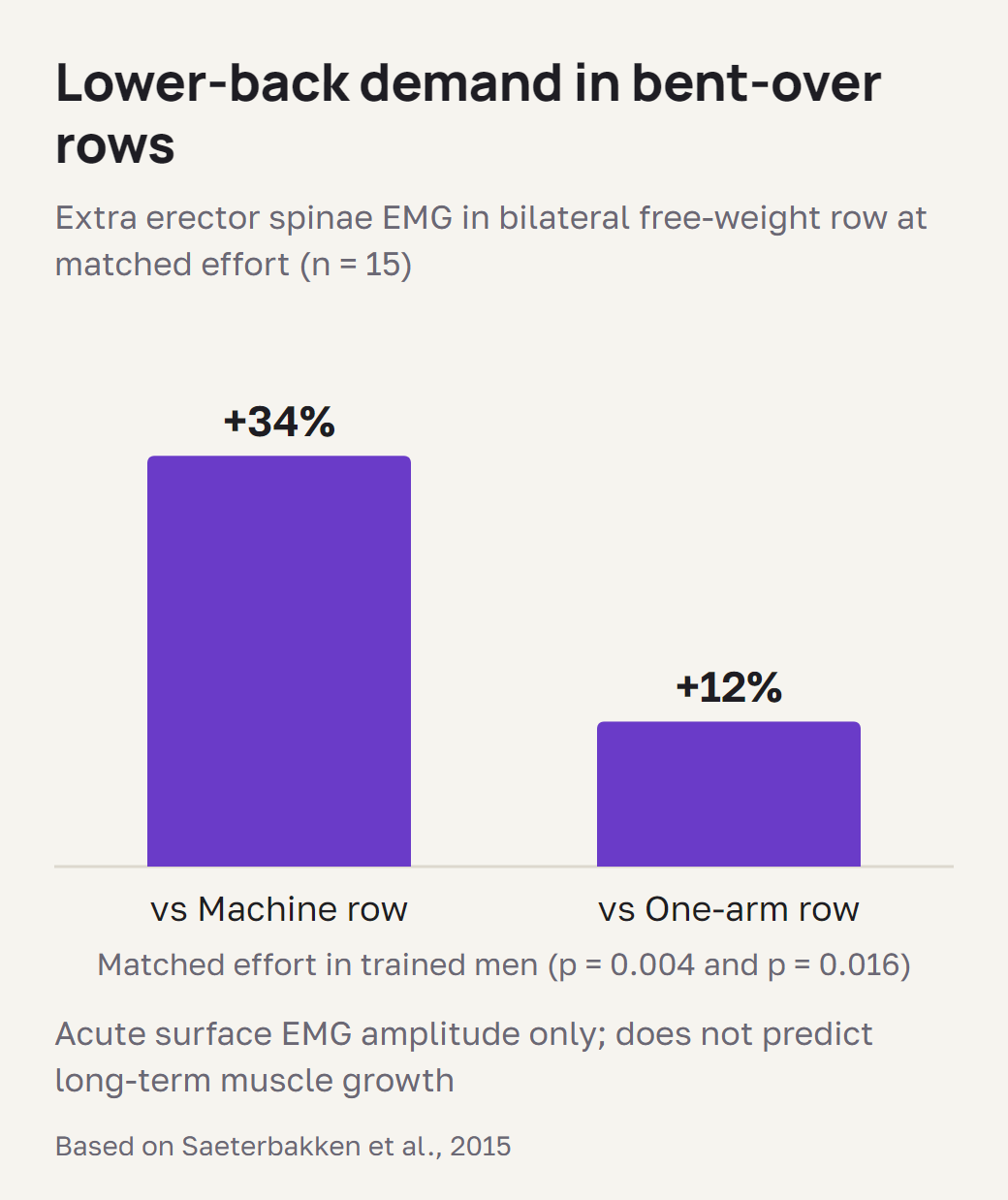
The main trade-off of the free bent-over barbell row is high static load on the lumbar spine. Saeterbakken et al. (2015; 15 trained men at matched effort) compared free-weight, cable, and machine rows. Erector spinae activity in the bilateral free-weight bent-over row was 34% higher than in the bilateral machine row (p = 0.004) and 12% higher than in the unilateral free-weight row (p = 0.016). In unilateral cable and machine rows, external oblique activity was 50–57% and lumbar multifidus activity was 70–73% of the unilateral free-weight row (p ≤ 0.002).
The same principle emerged in a biomechanical experiment by Fenwick et al. (2009; 7 healthy men). They compared three options: inverted rows, standing bent-over rows, and standing one-arm cable rows. The standing bent-over row produced strong symmetrical activation from upper to lower back and the highest spine stiffness, but also the greatest lumbar spine load. Inverted rows produced the lowest lumbar load (though Di Fonza et al., 2026 caution that their highest lat EMG comes from a single small study needing replication).
| Row variation | Lower-back load | Path freedom | When it works best |
|---|---|---|---|
| Free bent-over barbell | High (torso holds the hinge unsupported) | Free path, both hands share one bar | Lower back tolerates hinging well and you want a classic barbell pull |
| Chest-supported barbell row | Reduced (torso rests on a bench) | Bar moves freely while torso is fixed | Goal is loading the back while unloading the lower back |
| Smith machine bent-over row | Moderate to high (depends on angle) | Guided by vertical rails | You want a locked vertical bar path |
| One-arm supported dumbbell row | Reduced (free hand takes part of the load) | Independent right and left sides | You want each arm working separately (dumbbell row) |
Bar behavior across barbell row variants was tested by Nieto-Acevedo et al. (2023; 28 participants: 14 men and 14 women, loads 30–100% of 1RM). In the Smith machine, mean propulsive bar velocity was higher than in the free bent-over barbell row below 65% 1RM (p < 0.05) and higher than in the prone bench row below 90% 1RM (p < 0.05) in both sexes. Men produced higher velocities in the prone bench row at 55–100% 1RM and in the free bent-over and Smith rows below 85% 1RM (p < 0.05). Earlier, Loturco et al. (2021) in 30 top-level male athletes (rugby and MMA, 40–100% 1RM) confirmed a close linear link between bar velocity and % 1RM across all three rows (R² ≥ 80%). Both studies measured bar velocity, not muscle growth.
Meanwhile, according to the American College of Sports Medicine (ACSM) Position Stand (Currier et al., 2026; 137 systematic reviews, over 30,000 healthy adults), equipment type and exercise complexity alone did not consistently confer an advantage for muscle growth or strength. You can freely pick the row variation that fits your gym and lower-back tolerance.
How to do the bent-over barbell row: step by step
- Stand with feet hip-width apart and grip the bar slightly wider than shoulder width. Unrack the barbell or lift it from the floor with a neutral spine.
- Push your hips back and hinge your torso to roughly 45° to the floor. Keep knees slightly bent, maintain a natural lumbar curve, and let the bar hang straight under your shoulders.
- Lock in the torso angle and pull your shoulders down away from your ears. Let the shoulder blades protract freely at the start.
- Keeping your torso still, drive your elbows back along your sides and pull the bar to your waist. If the goal is middle and upper back, take a wider grip and lead the elbows out toward the lower chest.
- Squeeze the shoulder blades together at the top without jerking the torso. Your back angle stays the same as at the bottom.
- Lower the bar smoothly along the same line until your arms are straight. Let the shoulder blades protract again and start the next rep without momentum.
Common mistakes in the bent-over barbell row
| Mistake | What breaks down | How to fix it |
|---|---|---|
| Swinging and standing upright | Spinal erectors steal range of motion, taking load off the lats | Lower the weight and keep your torso angle still for the whole set |
| Rounding the lower back under load | Flexion stress on the lumbar spine increases | Hinge hips back, reduce torso depth, or switch to chest-supported rows |
| Shrugging shoulders toward the ears | Upper traps take over the top of the pull | Pull shoulders down before rowing and reduce working weight |
| Shoulder blades stay locked | Only the shoulder joint moves; mid-back misses full range | Let shoulder blades travel forward at the bottom and retract at the top |
| Bar drifts away from the thighs | Lever arm on the lower back spikes sharply | Keep the bar close to your legs along a vertical line |
If you are unsure about your torso angle or your lower back fatigues before your upper back, reviewing a video of your working set helps. That format is part of my technique and workout program review. I also publish breakdown videos of key lifts on my YouTube channel @lobanov_fitness.
Bent-over barbell row with lower-back pain
During the acute phase of low-back pain, I do not include horizontal rows—including the bent-over barbell row—in my programs: under my limitations protocol, only therapeutic exercise, isolation lifts, mobility, and stretching are used in that phase. After the acute phase, while the lower back still needs caution, free bent-over rows are replaced with chest-supported rows or supported cable rows.
This phased rule applies to pain with an established cause. Acute undiagnosed pain is not trained through—you need a doctor's exam first. Pain at rest or at night, numbness, shooting pain, or weakness in an arm or leg are reasons to stop training and see a physician.
How to fit the barbell row into your program
For hypertrophy, the ACSM Position Stand (Currier et al., 2026) highlights higher weekly volume (10+ sets per week), and for strength gains—loads of 80%+ 1RM, full range of motion, and at least two sessions per week. In a meta-regression of 67 studies (2,058 participants; Pelland et al., 2026) using fractional set counting (direct set = 1, indirect = 0.5), higher volume increased both strength and hypertrophy with diminishing returns (more pronounced for strength). Higher frequency added strength more reliably, while its effect on hypertrophy was close to negligible.
In practice, four steps work well:
- Place the barbell row in the first half of your back workout, while spinal erectors are fresh, and avoid putting heavy bent-over rows right after heavy deadlifts if your lower back is already fatigued.
- Pair horizontal rows with a vertical pull (pull-ups, lat pulldowns) or a pull-around so the lats are also loaded in a stretched position.
- Track total weekly back volume—how to distribute working sets across the week is covered in How Many Sets Per Week.
- Add weight using double progression: increase the load once you complete all working sets in your target rep range for two consecutive sessions, reaching the top of the range on the final set with clean form (see Progressive Overload).
If you want exercises tailored to your gym, goals, and back tolerance, a full plan is built in my custom workout program.
Sources
- Hall SJ. Basic Biomechanics. 9th edition. McGraw Hill, 2022. Chapter 7 – The Biomechanics of the Human Upper Extremity.
- Di Fonza D et al. Electromyographic Analysis of Latissimus Dorsi Activation During Common Resistance Training Exercises: A Narrative Review. J Funct Morphol Kinesiol, 2026. Article · Full text
- Fischer J et al. Impact of different ranges of motion in the prone barbell row on muscle excitation. J Electromyogr Kinesiol, 2025. Article
- Nieto-Acevedo R et al. Sex Differences in the Load-Velocity Profiles of Three Different Row Exercises. Sports (Basel), 2023. Article · Full text
- Loturco I et al. Force-Velocity Relationship in Three Different Variations of Prone Row Exercises. J Strength Cond Res, 2021. Article
- Fenwick CM et al. Comparison of different rowing exercises: trunk muscle activation and lumbar spine motion, load, and stiffness. J Strength Cond Res, 2009. Article
- Saeterbakken A et al. The Effect of Performing Bi- and Unilateral Row Exercises on Core Muscle Activation. Int J Sports Med, 2015. Article
- Arlotta M et al. Selective recruitment of the lower fibers of the trapezius muscle. J Electromyogr Kinesiol, 2011. Article
- Vigotsky AD et al. Longing for a Longitudinal Proxy: Acutely Measured Surface EMG Amplitude is not a Validated Predictor of Muscle Hypertrophy. Sports Med, 2022. Article
- Currier BS et al. American College of Sports Medicine Position Stand. Resistance Training Prescription for Muscle Function, Hypertrophy, and Physical Performance in Healthy Adults: An Overview of Reviews. Med Sci Sports Exerc, 2026. Article · Full text
- Pelland JC et al. The Resistance Training Dose Response: Meta-Regressions Exploring the Effects of Weekly Volume and Frequency on Muscle Hypertrophy and Strength Gains. Sports Med, 2026. Article