
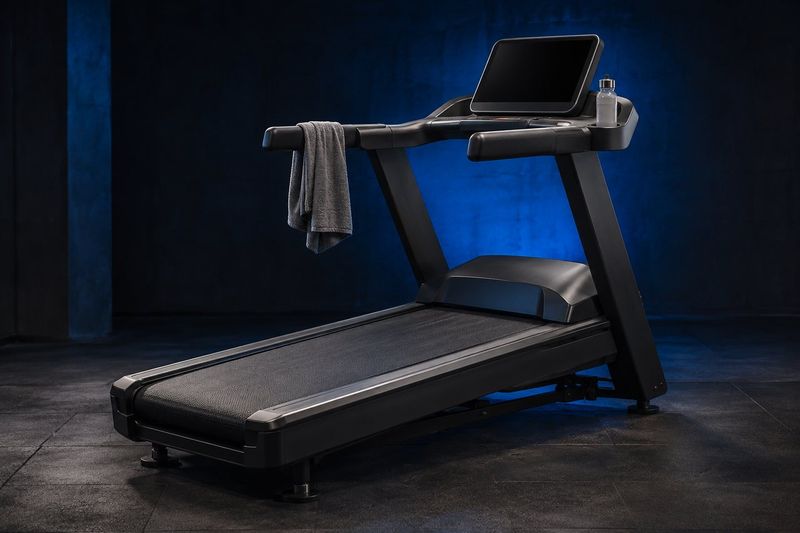
Treadmill walking helps you lose weight if it comes with a calorie deficit, meaning you burn more than you get from food. On its own, walking doesn't do much: in studies of brisk walking in people with obesity, weight dropped by 2 kg on average. The main settings are a moderate pace at which you can talk in full sentences, incline instead of running, and 150–300 minutes a week.
I'm Demid Lobanov, a fitness coach. Treadmill walking is the most frequent item in my exercise library, with 20 mentions in programs. In online coaching, it comes first in every new workout, for at least 5 minutes.
Does treadmill walking help you lose weight?
Yes, but less than people usually expect. The 2017 meta-analysis by Mabire et al. pooled 22 randomized trials of brisk walking in adults with obesity. On average, weight went down by 2.13 kg, waist by 2.83 cm, and fat mass by 2.59 kg. The authors note a noticeable reduction in people under 50; in women over 50 it is smaller. A meta-analysis is a statistical pooling of results from several studies.
In the 2013 study by Donnelly et al., 141 people aged 18–30 with overweight or obesity were assigned either to supervised training 5 times a week or to a no-exercise group; 92 made it to the end of the 10 months. The training was mostly treadmill walking and jogging at 70–80% of maximum heart rate, from the fifth month at 400 or 600 kcal per session, and diet was not changed. Weight decreased by 3.9 and 5.2 kg, while in the no-exercise group it rose by 0.5 kg. The difference between 400 and 600 kcal turned out to be not significant: the authors suggest the body compensates for part of the energy spent. Women needed an average of 48 minutes per session to burn 400 kcal and 63 minutes to burn 600 kcal. Only those who completed at least 90% of the sessions were included in the analysis.
The 2021 review by Bellicha et al. (12 systematic reviews) estimates the effect of exercise training itself at 1.5–3.5 kg of body weight, based on the four reviews that assessed weight. That's why I build the core of the deficit through diet, while walking adds to energy expenditure. More on this in the articles "How to Lose Weight" and "How Many Calories You Need per Day".
How many calories does treadmill walking burn?
Energy expenditure is calculated in METs, or metabolic equivalents: how many times higher the effort is than rest. One MET is roughly 1 kcal per kilogram of body weight per hour, so hourly expenditure roughly equals METs multiplied by your weight. For a level treadmill, the MET values come from the 2024 Compendium of Physical Activities; for incline, from the measurements by Stoedefalke et al. (2022), in which 100 men and 100 women of college age walked at 4.8 km/h.
| Speed and incline | MET | Kcal per hour at 70 kg body weight |
|---|---|---|
| 3.2–3.9 km/h, no incline | 3.0 | about 210 |
| 4.0–4.7 km/h, no incline | 3.5 | about 245 |
| 4.8–5.5 km/h, no incline | 3.8 | about 265 |
| 5.6–6.3 km/h, no incline | 4.8 | about 335 |
| 4.8 km/h, 2% incline | 4.3–4.4 | about 300–310 |
| 4.8 km/h, 4% incline | 4.6–4.9 | about 320–345 |
| 4.8 km/h, 6% incline | 5.0–5.6 | about 350–390 |
For a different body weight, multiply the MET value by your weight: at 90 kg, walking at 4.8–5.5 km/h burns about 340 kcal per hour. In the incline rows, the lower values are for women and the higher ones for men.
This is total expenditure, resting included. At 70 kg, an hour of rest burns about 70 kcal, and you would have spent those even without walking. So beyond rest, an hour of walking at 4.8–5.5 km/h adds about 195 kcal. When I calculate a client's activity expenditure, I use a reference of about 200 kcal per hour for walking, as in the article "Cardio or Strength Training for Weight Loss".
The numbers on the treadmill display are an estimate too. In the Stoedefalke study, the ACSM equation diverged from the measurements in women at all inclines and in men at 2% and 6%, and the authors concluded that for this group the equation predicts expenditure poorly.
What speed to set on the treadmill
Choose your speed based on your own effort level. Moderate intensity under the 2020 WHO guidelines is 3 to 6 METs, or 5–6 out of 10 in perceived effort. On a level treadmill, that is usually 4.8–5.5 km/h and faster (3.8 METs), while 3.2–3.9 km/h is the lower limit (3.0 METs).
The same speed takes different effort from two different people. For long, easy walking, I aim for 60–70% of maximum heart rate. Without a test, maximum heart rate is estimated with the formula 208 − 0.7 × age. Tanaka et al. derived it in 2001 from 351 studies involving 18,712 people. At age 30, that's about 187 beats per minute, and 60–70% is 112–131 beats. The formula gives an average value, and an individual's maximum heart rate may differ from it.
A simple check is conversation. If you can talk in full sentences, the pace is right for you. If you can only answer in single words, the intensity is already higher than easy walking. If you take medications that change your heart rate, go by perceived effort and conversation only.
Incline or speed: which is better for weight loss?
Incline increases energy expenditure without switching to running. In the Stoedefalke measurements, at the same speed of 4.8 km/h, every step up in incline from 2% to 6% added to expenditure, as the table above shows.
In the 2011 study by Ehlen et al., 12 adults with obesity (100.5 kg on average) walked on a level treadmill and uphill at different speeds. Expenditure was similar and moderate in all conditions. At the same time, slow uphill walking reduced the load on the legs. At a 6° incline and 2.7 km/h, the peak knee moments (extension and adduction) were 19% and 26% lower than during level walking at 5.4 km/h. A 6° incline is about 10.5% on the treadmill display.
That's why, for people who are overweight, I choose slow uphill walking over fast walking on a level belt. The participants in this study had no knee complaints. If your knees hurt, see a doctor first, especially if the pain appeared for no clear reason, is severe, or is getting worse. If your doctor has cleared you to walk, I use the same setup: slower and uphill.
Why you shouldn't hold the handrails
Leaning on the handrails reduces the workload. In the 2006 study by Berling et al., 10 healthy people aged 38–60 walked on a treadmill at the same speed and incline in three ways. When they held on to the handrails, oxygen consumption was 15–21% lower than with their arms free, and heart rate was 12–21 beats lower. When their hands simply rested on the handrails, the workload was also lower, but by less: 4–8%.
Hold the handrails when you step onto the belt and off it. If walking without the handrails is too hard, lower the incline or speed: then the expenditure from the table is closer to what you actually burn.
How long to walk on a treadmill for weight loss
The WHO recommends 150–300 minutes of moderate activity per week for adults, and sessions of any length count. That's, for example, 30–60 minutes of walking 5 times a week.
In my programs, treadmill walking gets its own line: speed, incline, and time. For cardio, I prescribe 20 minutes or more, and when the goal is weight loss, the guideline in my database is 40–80 minutes of easy-paced work. At the start of every workout, I put in at least 5 minutes of walking. Steps on the treadmill also count toward your daily total; more on that in the article "How Many Steps a Day".
Walking before or after strength training
Short walks go before strength training, long ones after. A 5-minute slow walk at the start is a warm-up before strength exercises. I don't schedule long cardio before a strength workout.
In the 2018 meta-analysis by Eddens et al. (10 studies), the order "strength first, then cardio" produced a greater gain in dynamic lower-body strength, by 6.91%, and for everything else the order made no difference. After a hard leg workout, I leave only light walking for the same day, at 60–65% of maximum heart rate.
Is there a "fat-burning zone" and should you walk fasted?
The fat-burning zone is the intensity at which the body oxidizes the most fat per minute. In the 2020 meta-analysis by Chávez-Guevara et al. (11 studies), training at this intensity for 8–20 weeks reduced body weight by 4.3 kg and fat by 4.03 kg. Of the 11 studies, 4 were in children and adolescents. Most studies made the comparison with people who didn't exercise or only dieted; only two compared it with a different intensity, and the authors did not prove an advantage.
Intervals and steady cardio reduce fat equally. In the 2017 meta-analysis by Wewege et al. (13 studies), intervals also took about 40% less time, and according to the 2021 Bellicha review, there is no difference when energy expenditure is the same. So for weight loss, how many calories you burn over the week matters more than an exact heart rate zone.
You can walk fasted, but you won't lose fat any faster that way. In the 2014 study by Schoenfeld et al., 20 women on a diet did cardio either fasted or after eating, and the results did not differ between the groups. More on this in the article "What to Eat Before and After a Workout".
Common treadmill mistakes
| Mistake | What happens | How to fix it |
|---|---|---|
| Holding the handrails | oxygen consumption is 15–21% lower | arms free; if it's too hard, lower the incline or speed |
| Copying someone else's speed | for one person it's easy walking, for another it's hard | choose by conversation and heart rate |
| Starting at working speed right away | no warm-up before the load | first 5 minutes slow |
| Going by the calories on the display | the number is an estimate that includes rest | calculate from METs and subtract rest |
| Fast walking on a level belt when overweight | higher knee load than with slow uphill walking | slower and uphill |
How to walk on a treadmill for weight loss: step by step
- Create a calorie deficit through diet; walking adds to it.
- Walk slowly for the first 5 minutes as a warm-up.
- Pick a speed at which you can talk in full sentences; aim for 60–70% of maximum heart rate.
- To burn more, add incline; you don't need to switch to running for that. If you're overweight, go slower and uphill; if your knees hurt, see a doctor first.
- Don't hold the handrails; if it's too hard, lower the incline or speed.
- Get 150–300 minutes a week; schedule long walks after strength training.
- After two weeks, compare your average weight for the week with the previous week's: if it isn't going down while you follow the plan, first check your food tracking, then cut calories by no more than 10% and 200 kcal, or add more walking.
I also talk about training and nutrition on my YouTube channel @lobanov_fitness.
Sources
- Mabire L et al. The Influence of Age, Sex and Body Mass Index on the Effectiveness of Brisk Walking for Obesity Management in Adults: A Systematic Review and Meta-Analysis. J Phys Act Health, 2017. Article
- Donnelly JE et al. Aerobic exercise alone results in clinically significant weight loss for men and women: midwest exercise trial 2. Obesity (Silver Spring), 2013. Article · Full text
- Bellicha A et al. Effect of exercise training on weight loss, body composition changes, and weight maintenance in adults with overweight or obesity: An overview of 12 systematic reviews and 149 studies. Obes Rev, 2021. Article · Full text
- Herrmann SD et al. 2024 Adult Compendium of Physical Activities: A third update of the energy costs of human activities. J Sport Health Sci, 2024. Article · Full text · Walking values
- Stoedefalke K et al. The accuracy of the ACSM prediction equations, for determining walking caloric expenditure, in college-aged males and females. J Am Coll Health, 2022. Article
- Bull FC et al. World Health Organization 2020 guidelines on physical activity and sedentary behaviour. Br J Sports Med, 2020. Article · Full text
- Tanaka H et al. Age-predicted maximal heart rate revisited. J Am Coll Cardiol, 2001. Article
- Ehlen KA et al. Energetics and biomechanics of inclined treadmill walking in obese adults. Med Sci Sports Exerc, 2011. Article
- Berling J et al. The effect of handrail support on oxygen uptake during steady-state treadmill exercise. J Cardiopulm Rehabil, 2006. Article
- Eddens L et al. The role of intra-session exercise sequence in the interference effect: a systematic review with meta-analysis. Sports Med, 2018. Article · Full text
- Chávez-Guevara IA et al. Chronic Effect of Fatmax Training on Body Weight, Fat Mass, and Cardiorespiratory Fitness in Obese Subjects: A Meta-Analysis of Randomized Clinical Trials. Int J Environ Res Public Health, 2020. Article · Full text
- Wewege M et al. The effects of high-intensity interval training vs. moderate-intensity continuous training on body composition in overweight and obese adults: a systematic review and meta-analysis. Obes Rev, 2017. Article
- Schoenfeld BJ et al. Body composition changes associated with fasted versus non-fasted aerobic exercise. J Int Soc Sports Nutr, 2014. Article · Full text




