
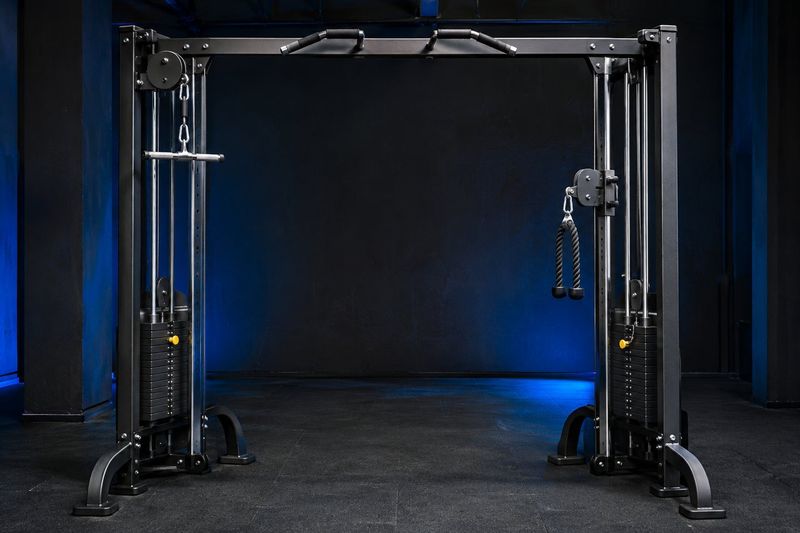
The cable pullover is a movement in which your nearly straight arms come down from a high pulley to your thighs. The work happens mainly at the shoulder joint, and the elbows don't bend. The main muscles are the lats and the teres major. They're assisted by the sternal part of the pectoralis major, the long head of the triceps, and the rear delt. The biceps barely takes part, so it's hard to let your arms take over the work of your back here.
The same exercise is also called the straight-arm pulldown, the straight-arm lat pulldown, or the standing cable pullover. The version with a rope attachment is called the rope pullover.
I'm Demid Lobanov, a fitness coach. In my exercise library, the pullover is on the list of lat exercises, in the version done with a rope while seated on a bench. I classify it as a back-width exercise: the elbow barely bends, so the back works without the elbow flexors.
What muscles does the pullover work?
The pullover extends the shoulder: the arm travels from overhead down to the thighs. The muscle roles are described according to my exercise library and Hall's biomechanics textbook (Chapter 7).
| Muscle | What it does in the pullover |
|---|---|
| Lats | extend the shoulder; at the end, depress the shoulder blade |
| Teres major | extends and adducts the shoulder, on par with the lats |
| Pectoralis major, sternal part | helps extend the shoulder from a raised position, most strongly at the start of the movement |
| Triceps, long head | helps extend the shoulder |
| Rear delt | helps extend the shoulder; according to my database, its contribution grows toward the bottom of the movement, but the transition angle hasn't been measured |
| Lower trapezius and pectoralis minor | depress the shoulder blade as the arms come down |
| Abdominals | brace the torso so the lower back doesn't arch |
Of the muscles that pull the upper arm back, the lats are the only one that moves both the upper arm and the shoulder blade. The teres major and the rear delt move only the humerus. So in the pullover, where mostly the upper arm moves, according to my database the teres major takes on most of the work. This is an analysis based on mechanics: pullover studies didn't measure it.
What the measurements show
I didn't find any studies on muscle growth from the pullover. The Di Fonza review below also notes that there are no long-term studies. There are only studies of the muscles' electrical activity, which is recorded with electromyography. Activity shows how engaged a muscle is, but it doesn't tell you whether it will grow.
In a 2022 study by Muyor et al., 20 physically active adults performed the barbell pullover and the cable straight-arm pulldown with a load of 30% of body weight. Lat and triceps activity in the cable pulldown was no lower than with the barbell. According to the authors' description, it was higher with both a shoulder-width grip and a wide grip, one and a half times shoulder width. How much higher can't be seen from the abstract. The pectoralis major, front delt, and rectus abdominis were more active in the barbell pullover.
In a 2011 study by Marchetti and Uchida with 8 men, the pectoralis major was more active than the lats in the barbell pullover. Using a dumbbell instead of a barbell doesn't change muscle activity: that was the result in a 2017 study by Campos et al. with 11 trained men. In the lying barbell pullover, Pezarat-Correia et al. (2020) found the rear delt and the infraspinatus among the most active muscles. In 2022, Teixeira et al. took measurements in 15 trained men during static efforts at different shoulder angles. Lat activity depended on the shoulder angle, and it changed in a similar way in the pullover and the pulldown.
A 2026 narrative review by Di Fonza et al. brought together the Marchetti, Teixeira, and Muyor studies: about 43 people, all or nearly all of them men. The authors' conclusion: the pullover works the lats and the pectoralis major together, but they don't call it a first choice specifically for the lats. Shoulder position is the main factor that changes each muscle's share. The review singles out the cable straight-arm pulldown as a variation with more targeted loading of the back muscles. The teres major wasn't measured in these studies.
Cable pullover vs. dumbbell pullover
The choice affects which muscle works more. In the barbell or dumbbell pullover, measurements show the pectoralis major is more active than the lats. On the cable, the lats work no less than with a barbell, while the chest and abs take a smaller share. If your goal is your back, the cable is the more convenient choice.
The second difference is which part of the movement is hardest. With a dumbbell, the weight pulls straight down; with a cable, it pulls along the line of the cable, so the hardest point of the movement is different for each. On the cable, you can shift that point, as described below.
How to do the standing cable pullover
- Stand facing the high pulley and grab a straight bar or a rope.
- Lean your torso slightly forward and reach your arms up and forward toward the pulley. At the top, your shoulder blades can rise along with your arms.
- Keep your elbows slightly bent. This angle stays the same until the end of the set.
- Bring your nearly straight arms down in an arc to your thighs. With a rope, you can spread your hands at the bottom and take your arms slightly behind the line of your torso.
- Slowly return your arms to the top until you feel a stretch in your back.
- Keep your ribs down: your lower back shouldn't arch as the cable pulls your arms up.
The arms move slightly out to the sides, with the elbows slightly flared. According to my database, this path loads the teres major more and the pectoralis major less. There are no measurements of the teres major with this path. Grip width has been measured: in the lying barbell pullover, a grip one and a half times shoulder width did not change muscle activity (Pezarat-Correia 2020). So this is a conclusion based on mechanics.
Seated pullover and rope pullover
The pullover seated on a bench facing the pulley is the version from my library, and the load distribution in it is the same. Standing, it's easier to shift the hardest point by stepping away from the pulley and by leaning; seated, the bench sets your position.
The rope gives you one difference: at the bottom, you can spread your hands and take your upper arms behind the line of your torso. This adds an extra portion of the range for the rear delt and the lats in a shortened position.
Where the load is greatest
This is a calculation based on mechanics, without measurement. At the top, the cable runs almost along your outstretched arm. The load on the muscles that extend the shoulder is close to zero there; it's held by the muscles that depress the shoulder blade. The load peaks in the middle of the movement, where your arm is at a right angle to the cable. Toward the thighs, it drops again.
You can shift the hardest point. The lower the pulley, the farther you stand from it, or the more you lean your torso, the closer that point moves toward the top, where the muscles are stretched. The analysis in my library is still preliminary: the position relative to the pulley hasn't been checked on video yet.
Common mistakes
- The ribs flare, the lower back arches, and the arms go higher by moving the torso.
- The elbows bend and straighten during the rep, and the pullover turns into a pulldown or a triceps extension.
- The arms don't go all the way up and the shoulder blade doesn't rise, so you lose the part of the range where the back muscles are at their longest.
How to add the pullover to your workout
The pullover complements vertical and horizontal pulls; it shouldn't replace them. My library also includes a “pullover before pulls” technique, used to feel the lats. Don't expect it to make the lats work harder in the pull itself. In a 2022 study by Fujita et al., 20 beginners did a set of pullovers before a seated row, but lat activity during the row did not increase.
Count your pullover sets toward your weekly volume for the back. My guideline is 10–20 working sets per muscle group per week; more on this in the article How Many Sets per Week. The long head of the triceps also gets some of the load. For other back exercises, see the article Lat Pulldown.
If you need a plan for your goal and your gym, there's the personalized program.
Pullover with shoulder pain
If the cause of your shoulder pain is known and the acute phase has passed, and it hurts above horizontal, shorten the top of the movement to a pain-free range, but don't drop the exercise. The same goes for the lower back: don't take your arms higher by arching. New pain without a diagnosis, pain at rest or at night, numbness, shooting pains, or weakness in the arm: stop training and see a doctor.
I post exercise breakdowns on my YouTube channel @lobanov_fitness.
Sources
- Hall SJ. Basic Biomechanics. 9th edition. McGraw Hill, 2022. Chapter 7: upper extremity.
- Muyor JM et al. Comparison of Electromyographic Activity during Barbell Pullover and Straight Arm Pulldown Exercises. Applied Sciences, 2022. Article
- Marchetti PH, Uchida MC. Effects of the pullover exercise on the pectoralis major and latissimus dorsi muscles as evaluated by EMG. J Appl Biomech, 2011. Article
- Campos Y et al. O uso de barra ou haltere não altera a ativação muscular durante o exercício pullover. Rev Bras Med Esporte, 2017. Article
- Pezarat-Correia P et al. Comparison of shoulder and trunk muscle activation between different pullover exercises. Rev Andal Med Deporte, 2020. Article
- Teixeira LFM et al. Differences Between Pullover and Pulldown Exercises on Maximal Isometric Force and Myoelectric Activity in Recreationally-Trained Men. Int J Exerc Sci, 2022. Article · Full text
- Di Fonza D et al. Electromyographic Analysis of Latissimus Dorsi Activation During Common Resistance Training Exercises: A Narrative Review. J Funct Morphol Kinesiol, 2026. Article · Full text
- Fujita RA et al. The Pre-Exhaustion Method Does Not Increase Muscle Activity in Target Muscle During Strength Training in Untrained Individuals. J Hum Kinet, 2022. Article · Full text




