
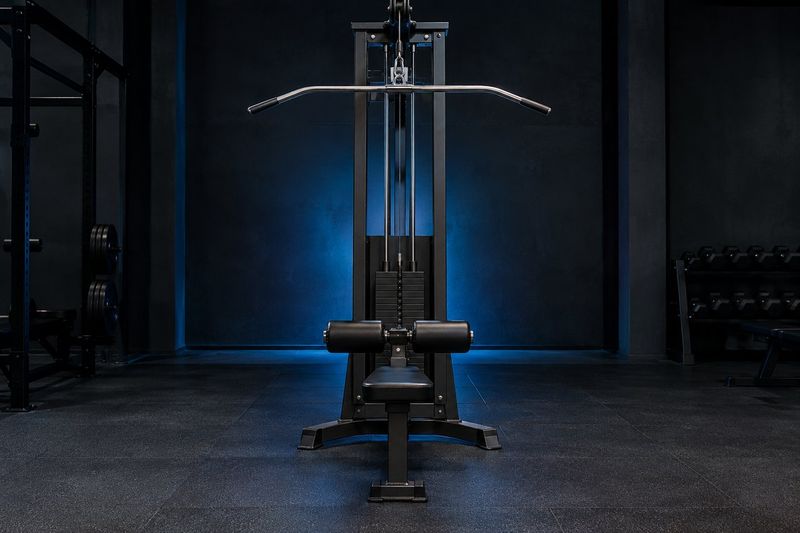
The lat pulldown is a seated exercise on a cable machine in which you pull the cable handle from overhead down to your upper chest. The same exercise is also called the pulldown, the cable pulldown, or the front pulldown. The main muscles are the lats and the teres major: they bring the upper arm down and in toward the body. In studies, grip width has almost no effect on lat activity, and the data on overhand versus underhand grips are mixed. Pull to your upper chest and fully straighten your arms at the top on every rep; pulling behind the head gives the lats no advantage.
I'm Demid Lobanov, a fitness coach. My exercise library has two versions of this pulldown: a wide overhand grip, and a close-grip handle with a neutral, or parallel, grip, where your palms face each other. It makes sense to keep both in your program; I'll explain why below.
Which muscles work in the lat pulldown
From an overhead position, the upper arm is brought down by the latissimus dorsi, the teres major, and the sternal head of the pectoralis major (Hall, Chapter 7). The rear delt and the long head of the triceps assist them, while the biceps, brachialis, and brachioradialis flex the elbow.
| Muscle | What it does in the pulldown |
|---|---|
| Lats | lower and adduct the upper arm, depress the shoulder blade |
| Teres major | adducts and extends the upper arm |
| Sternal head of the pectoralis major | assists at the start of the movement |
| Lower trapezius | depresses the shoulder blade, which is how the pull begins |
| Rhomboids and middle trapezius | pull the shoulder blades together during the movement |
| Rear delt | assists at the end of the movement |
| Biceps, brachialis, brachioradialis | flex the elbow |
The roles in the table come from my exercise library. The lats are stretched the most at the top, when your arms are straight overhead and your shoulder blades have risen to follow the handle.
Lat pulldown grips: wide, close, neutral, or underhand
The width of an overhand grip has almost no effect on lat activity. For the overhand grip, palms facing forward, and the underhand grip, palms facing you, the data are mixed: in two small studies the lats were more active with the overhand grip, and in the largest one there was no difference. These are EMG data. Electromyography records a muscle's electrical signal. It hasn't been confirmed that it can predict muscle growth (Vigotsky 2022), and all the grip studies I cite measured activity specifically.
| Grip | What studies show | What it does mechanically |
|---|---|---|
| Wide overhand | lat activity over the whole movement is the same as with medium and close grips; the weight for 6 reps is slightly lower | harder to pull with your arms; you have to keep the shoulder from rotating inward, which a problem shoulder tolerates less well |
| Medium or close overhand | the weight for 6 reps is slightly higher than with a wide grip | – |
| Close neutral (parallel), palms facing each other | lat activity is the same as in the overhand pulldown to the chest | greater range of motion and lat stretch; easiest to pull with your arms; more comfortable for the shoulder |
| Underhand, palms facing you | in two small studies the lats were less active than with an overhand grip; in the largest one, no difference | – |
Where these data come from. In 2014, Andersen and colleagues compared three overhand grip widths in 15 men: 1, 1.5, and 2 times shoulder width. Lat activity over the whole movement was similar, and the weight for 6 reps with the wide grip was 77.3 kg versus 80.0–80.3 kg with the medium and close grips. In a 2010 study by Lusk and colleagues, 12 men pulled with wide and close, overhand and underhand grips: the overhand grip produced more lat activity, and width had no effect on it. In 2025, Buonsenso and colleagues compared seven pulldown variations, including an underhand grip, in 40 trained men and found no difference in lat activity. Sperandei and colleagues compared the close-grip handle with a neutral grip to the pulldown to the chest in 2009: lat activity did not differ.
There is also a study with a different conclusion: in Signorile and colleagues' 2002 study of 10 men, a wide grip in front of the head produced more lat activity than close and underhand grips. A 2026 review by Di Fonza and colleagues called the effect of grip width inconsistent and the advantage of the overhand grip over the underhand grip unconfirmed by other studies.
How to do the lat pulldown to the chest: step by step
- Lock your thighs under the pads so your torso doesn't rise with the handle.
- Grab the bar with an overhand grip wider than your shoulders, or take the close-grip handle.
- At the top, fully straighten your arms and let your shoulder blades rise to follow the handle. In this position, your lats are stretched.
- Start the movement by depressing your shoulder blades: your shoulders move down, away from your ears.
- Drive your elbows down toward your torso and the handle toward your upper chest. Keep your torso nearly vertical.
- Return the handle smoothly until your arms are fully straight.
Leaning far back turns the exercise into a horizontal row, where the upper back does most of the work. In my exercise library, it's torso lean, not grip width, that shifts the load between the lats and the upper back. In Buonsenso's study, the rear delt was more active with a wide grip and a 30° torso lean than with no lean; lat activity did not differ.
Why you shouldn't pull behind your head
The behind-the-neck pulldown doesn't add work for the lats. In Sperandei's study of 24 trained men, lat activity did not differ between the behind-the-neck pulldown, the pulldown to the chest, and the close-grip handle pulldown, and the authors advise against the behind-the-neck version. In a 2024 study by Padovan and colleagues, the lats were more active in the pulldown to the chest while pulling the handle down, and in the behind-the-neck pulldown while letting it back up, and participants used more weight in the pulldown to the chest. According to Di Fonza's review, the behind-the-neck pulldown gives the lats no advantage, while the neck and shoulder are in a less favorable position. This is a precaution based on biomechanics, the mechanics of body movement: the authors don't provide direct data on injuries.
In my exercise library, the behind-the-neck pulldown counts as a substitution: it doesn't add range of motion, and it shifts the load onto the front structures of the shoulder joint. If there's any shoulder discomfort, I don't prescribe it.
How to feel your back in the lat pulldown
A technique cue helps engage the lats more, and it works right away. In a 2009 study by Snyder and Leech, 8 women with almost no strength training experience did the pulldown to the chest with a light weight, first with standard instructions, then after an explanation of how to load the lats without pulling with the arms. Lat activity increased within those same sets, while biceps activity did not change significantly: the arms still work in the pulldown, and that's normal.
What helps in practice:
- think about your elbows: drive them down toward your hips;
- start every rep by depressing your shoulder blades;
- don't cut the movement short at the top to use more weight;
- if you can't feel your back, start with a wide grip: according to my exercise library, with a close neutral grip the elbow flexors are in their most advantageous position, and it's easiest to pull with your arms.
Wide-grip or close-grip pulldown: which to put in your program
Both, if your shoulder tolerates them. The close neutral grip gives a greater range of motion, meaning a bigger movement: the upper arm rises higher, the shoulder blade moves more, and the lats get a greater stretch. The wide overhand grip is harder to turn into an arm exercise, but the lats work at a shorter length in it. In my exercise library, these are two separate exercises, and it makes sense to keep both in your program.
The lat pulldown only partly loads the upper back: the middle traps, rhomboids, and rear delts. For those, you need horizontal pulls: rows to the waist, rope face pulls, and the reverse pec deck.
Lat pulldowns and pull-ups
The lat pulldown works well as preparation for pull-ups. In a 2025 randomized study by Li and colleagues, 34 students who could already do at least one pull-up did lat pulldowns 3 times a week for 8 weeks, 4 sets of 12 reps. Their pull-ups went from 2.2 to 5.8 on average, and to 8.5 with an unstable load. That said, in pull-ups the biceps and spinal erectors are more active on the way up than in the pulldown (Doma 2013). A step-by-step plan is in the article How to learn to do pull-ups.
Common lat pulldown mistakes
| Mistake | What happens | How to fix it |
|---|---|---|
| Arms don't straighten at the top | you lose the part of the movement where the lats are stretched | return the handle until your arms are fully straight |
| The pull starts without depressing the shoulder blades | shoulders stay up by the ears, and the upper trapezius takes over the movement | start every rep by depressing your shoulder blades |
| Leaning far back | the pulldown turns into a horizontal row | keep your torso nearly vertical, reduce the weight |
| Pulling behind the head | the load shifts onto the front structures of the shoulder | pull to your upper chest |
| Pulling with the arms | the elbow flexors take over part of the back's work | drive your elbows toward your hips, try a wide grip |
Who should be more careful
With shoulder pain, see a doctor first. If they clear you for pulling exercises, shorten the top of the range to where it's pain-free, and swap the wide overhand grip for a neutral one: with it, you don't need to keep the shoulder from rotating inward. With any shoulder discomfort, skip the behind-the-neck pulldown. With elbow pain, after consulting a doctor, reduce the elbow's share of the work, for example with lifting straps. If your doctor has restricted the exercise, the program is built within those limits.
How to add the lat pulldown to your workouts: step by step
- If both grips are comfortable for you, put both in your program: wide overhand and close neutral. With a problem shoulder, start with the neutral grip.
- Start with a weight at which you straighten your arms at the top and don't lean back.
- Add a horizontal row for your upper back.
- How many sets to do per week is covered in How many sets per week; how many reps, in How many reps to do.
If you need a plan for your goal and your gym, there's the personalized program.
I post exercise breakdowns on my YouTube channel @lobanov_fitness.
For a full breakdown of lat training, see How to Build Your Back and Cable Pullover. If your arms fatigue before your back, you can get a video check in a training audit.
Sources
- Hall SJ. Basic Biomechanics. 9th edition. McGraw Hill, 2022. Chapter 7: the upper extremity.
- Vigotsky AD et al. Longing for a Longitudinal Proxy: Acutely Measured Surface EMG Amplitude is not a Validated Predictor of Muscle Hypertrophy. Sports Med, 2022. Article
- Andersen V et al. Effects of grip width on muscle strength and activation in the lat pull-down. J Strength Cond Res, 2014. Article
- Lusk SJ et al. Grip width and forearm orientation effects on muscle activity during the lat pull-down. J Strength Cond Res, 2010. Article
- Buonsenso A et al. Electromyographic Analysis of Back Muscle Activation During Lat Pulldown Exercise: Effects of Grip Variations and Forearm Orientation. J Funct Morphol Kinesiol, 2025. Article · Full text
- Sperandei S et al. Electromyographic analysis of three different types of lat pull-down. J Strength Cond Res, 2009. Article
- Signorile JF et al. A comparative electromyographical investigation of muscle utilization patterns using various hand positions during the lat pull-down. J Strength Cond Res, 2002. PubMed
- Di Fonza D et al. Electromyographic Analysis of Latissimus Dorsi Activation During Common Resistance Training Exercises: A Narrative Review. J Funct Morphol Kinesiol, 2026. Article · Full text
- Padovan R et al. High-Density Electromyography Excitation in Front vs. Back Lat Pull-Down Prime Movers. J Hum Kinet, 2024. Article · Full text
- Snyder BJ et al. Voluntary increase in latissimus dorsi muscle activity during the lat pull-down following expert instruction. J Strength Cond Res, 2009. Article
- Li Q et al. Eight-week lat pull-down resistance training with joint instability leads to superior pull-up endurance performance and reduced antagonist coactivation in recreationally active male college students. Eur J Sport Sci, 2025. Article · Full text
- Doma K et al. Kinematic and electromyographic comparisons between chin-ups and lat-pull down exercises. Sports Biomech, 2013. Article




