
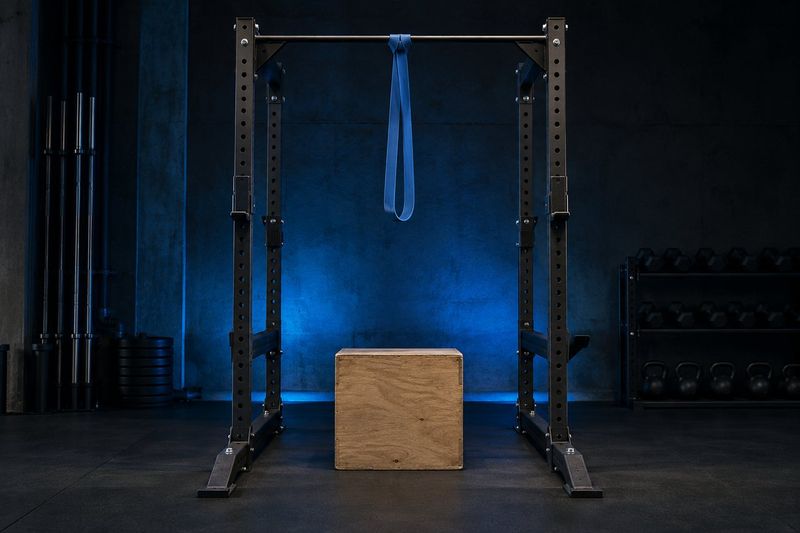
You can learn to do pull-ups from scratch. What it takes is back and arm strength relative to your body weight. You build it in stages: hanging and slow negatives, assisted pull-ups, then full reps. The lat pulldown helps too, an exercise where you pull a machine's handle down toward you from above. In one study, people who could do 2 pull-ups on average got up to almost 6 after 8 weeks of this kind of training.
I'm Demid Lobanov, a fitness coach. In my system for training on your own, pull-ups have five stages, from hanging to weighted pull-ups. Below is what research says about preparing for pull-ups and how to work through these stages.
Why you can't do a pull-up
In a pull-up you lift your entire body weight, and there's no way to reduce the load at any point in the movement. On the lat pulldown you choose the weight to match your level, but in a pull-up without assistance or added weight, the load equals your body weight.
That's why strength relative to body mass matters. In a 2016 study by Sanchez-Moreno et al. of 25 trained men, the number of pull-ups was related to the number of reps on the lat pulldown with a weight equal to body mass. No link was found with the maximum weight on the same pulldown.
The higher the body mass, the fewer pull-ups people could do. This held for both fat mass and fat-free mass, which is everything in the body that isn't fat, including muscle.
Why pull-ups are harder for women
In a 2009 study by Johnson et al., the maximum load participants could lift in a pull-up was measured with added weight or with a counterweight, a load that makes the lift easier. Men lifted 1.16 times their body weight on average, women 0.73. In other words, women on average needed a counterweight to do a single pull-up.
It can still be learned. In a 2003 study by Flanagan et al., female college students went through a program of strength and aerobic training, that is, endurance training. Their upper-body strength and fat-free mass increased, and their fat decreased. Not everyone managed a pull-up by the end: those who did had greater strength, both absolute and relative to body mass.
Which muscles work in a pull-up
The main muscles are the latissimus dorsi and the teres major. According to Hall's biomechanics textbook, they adduct and extend the shoulder: they bring a raised arm down from overhead. On the bar your hands are fixed, so the same muscles pull your body up to your hands.
In a 2010 study by Youdas et al., the lats were the most active muscle during the pull-up, followed by the biceps and the infraspinatus on the shoulder blade. The lower trapezius and pectoralis major also contributed noticeably. So in a pull-up, the arms work hard along with the back.
Overhand or underhand grip
In terms of muscle activity, grips differ little, so to start you can pick whichever is more comfortable. In the same Youdas study, the underhand grip, palms facing you, produced more biceps and pectoralis major activity, while the overhand grip, palms facing away, produced more lower trapezius activity.
A 2017 study by Dickie et al. compared overhand, underhand and neutral grips, with palms facing each other, as well as pull-ups on a rope. Overall activity of the shoulder girdle and arm muscles was almost the same. The middle trapezius worked harder with the overhand grip than with the neutral grip.
These are data on the electrical activity of muscles. They say nothing about which grip builds more strength and muscle. In my system, your level is tested with an overhand grip.
Five stages: from hanging to weighted pull-ups
Your stage is determined by a test: how many pull-ups with proper form you can do in one set. Work toward moving up to the next stage, and retest your max every 4–6 weeks.
Full range of motion means moving from a dead hang to your chin above the bar.
| Stage | What you can do |
|---|---|
| 1 | a 20–30 second hang from the bar and 3–5 slow negatives of 3–5 seconds each |
| 2 | 5–8 assisted pull-ups: a push with your foot off a support, or partial range of motion |
| 3 | 1–5 overhand pull-ups through full range of motion |
| 4 | 6–12 pull-ups |
| 5 | more than 12, or weighted pull-ups |
The thresholds are practical guidelines based on fitness test standards; studies haven't tested them as stage boundaries.
At stage three you can do 1–5 full pull-ups, but a working set for muscle growth in my method is 8–15 reps. So at this stage, unassisted pull-ups are a test plus a couple of sets at the start of a workout, and the main volume goes to the assisted pull-up machine, which works with a counterweight, or to a band: with assistance, you can get the needed number of reps through full range of motion. If you can't hold a 20–30 second hang yet, start with inverted rows at a low bar: in my system, the first stage of this exercise is a row with your body almost upright and your feet on the floor, 10 reps.
Slow negatives: why you need them
People can lower more weight than they can lift. In a 2023 meta-analysis by Nuzzo et al. that pooled data from 335 studies, strength in the lowering phase was on average 1.41 times greater than in the lifting phase. Almost all measurements were taken on specialized machines, so for pull-ups on a bar this is a guideline. But there too, you'll most likely manage a slow lowering from the bar before you manage a pull-up.
In my system, negatives are stage one. Step onto a support or jump so your chin is above the bar, then lower yourself over 3–5 seconds to a dead hang.
Training the lowering phase increases strength. In a 2009 meta-analysis by Roig et al. of 20 randomized studies, heavy lowering-focused training increased overall strength more than lifting-focused training. The biggest gain was in lowering strength specifically.
A 2025 meta-analysis by Spudić et al. of 27 studies looked at training on isokinetic machines, which keep movement speed constant. Lifting strength increased almost equally after lowering-only and lifting-only training: by 13% and 14%.
So negatives are a practical way to build strength while you still can't do a pull-up. Once you get your first assisted reps, add those too.
Band or assisted pull-up machine
An assisted pull-up machine uses a counterweight to take off part of your body weight. A band is looped over the bar, and you put your knee or foot in the loop. Both help, but in different ways.
| Assistance | Where it helps most | What it's good for |
|---|---|---|
| Assisted pull-up machine | equally through the whole range of motion | main work while you can't do a pull-up yet: lower the counterweight 5 kg at a time |
| Band | at the bottom; at the top the assistance almost disappears | going through full range of motion at home, adding reps after failure (the point where you can no longer do the next rep with proper form) |
| Push with your foot off a support | wherever you lack strength | stage two of the system |
The more a band is stretched, the harder it pulls, so it helps most at the bottom, where your back muscles are most stretched, and hardly helps at the top. On an assisted pull-up machine with a weight stack on a cable, the assistance is constant, and the load is distributed the same way as in a regular pull-up, just lighter.
In my method, this conclusion is based on mechanics; there are no measurements. The amount of assistance depends on the band's thickness and your height. On machines with a cam, a part of the mechanism that changes resistance through the movement, the assistance can vary across the range of motion. I haven't found any direct comparisons of bands and assisted pull-up machines for strength and muscle gains.
Lat pulldown instead of pull-ups
This exercise prepares you for pull-ups. In a 2025 study by Li et al., male college students did this pulldown 3 times a week for 8 weeks, 4 sets of 12 reps. Participants were randomly assigned to groups. In the regular pulldown group, the number of pull-ups rose on average from 2.2 to 5.8. It rose even more, to 8.5, in the group where bands were attached to the handle and the load was unstable. The effect of that kind of load was the study's main question.
The advantage of the pulley machine is that you choose a weight for your level and increase it gradually. It's a good substitute for pull-ups while you can only do a few reps on the bar.
Common mistakes
- Not hanging all the way at the bottom. In full pull-ups, start every rep from a dead hang, otherwise the bottom part of the movement doesn't get trained. Partial range of motion is only for the easier stage-two variation.
- Swinging. Momentum from your torso replaces the work of your back.
- Starting the pull with your arms. First pull your shoulder blades down, then bend your arms.
- On the assisted pull-up machine, pushing off the platform with your legs; with a band, swinging your torso and dropping down fast.
If your shoulder hurts, put pull-ups on hold and see a specialist.
If you can already do pull-ups
At stage four, 6 to 12 reps, write down your max.
If your goal is muscle growth, end your sets close to failure, with 0–2 reps in reserve; for general fitness, 2–3 reps in reserve is enough. Reps in reserve means how many more reps you could still do with proper form.
Once you can consistently do more than 12 pull-ups with proper form, my system says it's time to add weight: a loaded backpack or a weighted vest.
For more on training frequency, see How Many Times a Week to Work Out; for a pull-up bar at home, see Working Out at Home.
How to learn to do pull-ups: step by step
- Check your level: how many overhand pull-ups you can do with proper form. If none, how many seconds you can hang and how many slow negatives you can do.
- At stage one: a 20–30 second hang and 3–5 negatives of 3–5 seconds each, 2–3 sets with 60–90 seconds of rest.
- Add assisted pull-ups—on the assisted pull-up machine, with a band or with a push from your foot—and lat pulldowns. Choose the assistance or weight so that you get 8–15 reps with proper form per set, 2–4 sets.
- Train your pulling 2–3 times a week. For health, the World Health Organization recommends strength exercises for all major muscle groups on at least 2 days a week. In the Li study, participants did the pulldown 3 times a week.
- Retest your max every 4–6 weeks, and move up to the next stage once you've hit its numbers.
- If you're carrying extra weight, reducing body fat will make things easier: a pull-up means lifting your own body weight. How to lose weight while keeping muscle is covered in How to Lose Weight.
- Once you can consistently do more than 12 pull-ups with proper form, add weight.
If you need a plan for your goal and your gym, there's the personalized program.
I post exercise breakdowns on my YouTube channel @lobanov_fitness.
Sources
- Hall SJ. Basic Biomechanics. 9th edition. McGraw Hill, 2022. Chapter 7: the upper extremity.
- Sanchez-Moreno M et al. Determinant factors of pull-up performance in trained athletes. J Sports Med Phys Fitness, 2016. PubMed
- Johnson D et al. Relationship of lat-pull repetitions and pull-ups to maximal lat-pull and pull-up strength in men and women. J Strength Cond Res, 2009. Article
- Flanagan SP et al. Training college-age women to perform the pull-up exercise. Res Q Exerc Sport, 2003. Article
- Youdas JW et al. Surface electromyographic activation patterns and elbow joint motion during a pull-up, chin-up, or perfect-pullup™ rotational exercise. J Strength Cond Res, 2010. Article
- Dickie JA et al. Electromyographic analysis of muscle activation during pull-up variations. J Electromyogr Kinesiol, 2017. Article
- Nuzzo JL et al. The Eccentric:Concentric Strength Ratio of Human Skeletal Muscle In Vivo: Meta-analysis of the Influences of Sex, Age, Joint Action, and Velocity. Sports Med, 2023. Article · Full text
- Roig M et al. The effects of eccentric versus concentric resistance training on muscle strength and mass in healthy adults: a systematic review with meta-analysis. Br J Sports Med, 2009. Article
- Spudić D et al. Eccentric-Only Versus Concentric-Only Isokinetic Strength Training Effects on Maximal Voluntary Eccentric, Concentric and Isometric Contraction Strength: A Systematic Review and Meta-analysis. Sports Med Open, 2025. Article · Full text
- Li Q et al. Eight-week lat pull-down resistance training with joint instability leads to superior pull-up endurance performance and reduced antagonist coactivation in recreationally active male college students. Eur J Sport Sci, 2025. Article · Full text
- Bull FC et al. World Health Organization 2020 guidelines on physical activity and sedentary behaviour. Br J Sports Med, 2020. Article · Full text




