
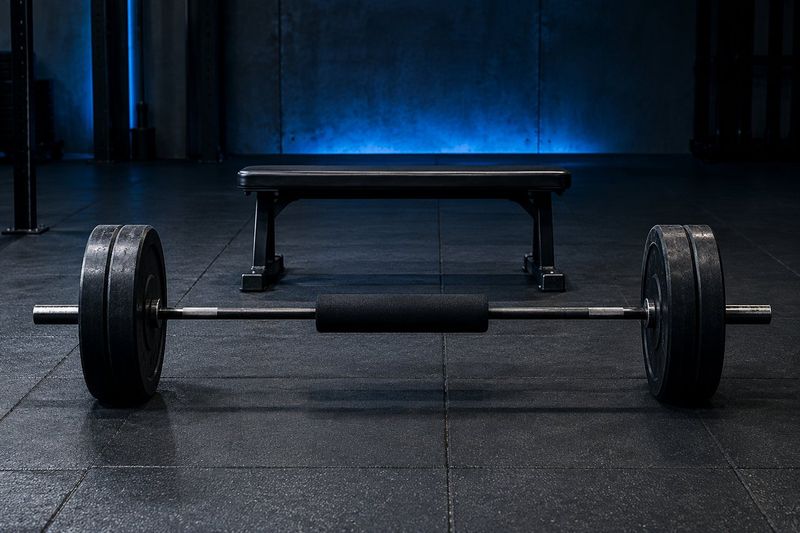
Your glutes grow from exercises in which the hip extends against resistance: squats, glute bridges, leg presses, deadlifts. You need 10–20 working sets per week, taken close to failure, and a gradual increase in load. In studies, the glutes grew within 6–10 weeks, and squats and the hip thrust (a glute bridge with your shoulder blades resting on a bench) produced the same growth.
Hip extension is moving the leg back relative to the pelvis, or straightening at the hip joint. Working sets are the main sets of an exercise after the warm-up. Failure is the point at which you can no longer complete the next rep with proper technique.
Which muscles make up the glutes
The gluteal group consists of three muscles: the gluteus maximus, gluteus medius, and gluteus minimus. According to Hall's biomechanics textbook, the gluteus maximus extends the hip and rotates it outward. It works mainly when the hip extends from a flexed position or against resistance, for example when you climb stairs.
The gluteus medius and minimus move the thigh out to the side and hold the pelvis steady when a person walks or stands on one leg.
That's why the foundation of glute training is exercises in which the hip extends under load.
Which exercises grow the glutes according to research
The gluteus maximus grows from a variety of hip extension exercises, and no single one of them is mandatory. A 2025 systematic review by Krause Neto and colleagues pooled 12 studies with 318 participants. In these studies, the gluteus maximus was measured with MRI or ultrasound before and after a training program.
According to the authors' conclusions, the muscle grew from barbell and bodyweight squats, the hip thrust, the leg press, quadruped hip extension, and programs made up of several exercises. The authors rated the overall effect as moderate, in both beginners and trained people.
The hip thrust is a barbell glute bridge in which your shoulder blades rest on a bench. In a bridge from the floor, the range of motion, meaning the span of the movement, is smaller; it's handy at home and when you're just starting out, with no added weight.
| Study | Participants and duration | What was compared | Gluteus maximus |
|---|---|---|---|
| Kubo et al., 2019 | 17 untrained men, 10 weeks | deep squat and squat to 90° at the knee | volume +6.7% and +2.2% |
| Plotkin et al., 2023 | 34 untrained people, 9 weeks | barbell squat and hip thrust | equal growth |
| Kassiano et al., 2024 | 33 untrained women, 10 weeks | leg press and stiff-leg deadlift, with and without the hip thrust | thickness +9.3% and +6.0% |
| Wei et al., 2023 | 13 untrained women, 6 weeks | bodyweight squats and barbell squat | thickness increased in both groups |
The review has limitations. There are few studies, and none of them describes how participants were randomly assigned to groups. The review also included two papers by the Barbalho group, while journals have retracted two other articles by this group. That's why from here on we rely on the individual studies in the table.
Squats or the glute bridge: which is better for your glutes?
No difference was found for glute growth. In the 2023 study by Plotkin and colleagues, 34 beginners (11 men and 23 women) did a single leg exercise for 9 weeks: either barbell squats or hip thrusts. They trained twice a week, doing 3–6 sets of 8–12 reps to failure. On MRI, the upper, middle, and lower portions of the gluteus maximus grew equally in both groups.
Growth of the thigh muscles differed. In those who squatted, the quads, on the front of the thigh, and the adductors, on the inner thigh, grew more. The authors conclude that the hip thrust loads the glutes more selectively. If you want both your glutes and your thighs to grow, go with squats. If you don't want bigger thighs, the hip thrust can be your foundation.
You can also combine exercises. In the 2024 study by Kassiano and colleagues, 33 women trained 3 times a week for 10 weeks. One group did leg presses and stiff-leg deadlifts; the second added hip thrusts to these. Gluteus maximus thickness increased by 6.0% in the first group and by 9.3% in the second. The second group did one more exercise, so it's unclear what produced the extra gain: the exercise itself or the additional sets.
How deep to squat
The deep squat grew the glutes more than the shallow one. In the 2019 study by Kubo and colleagues, 17 men did barbell squats for 10 weeks: some squatted deep, others to a 90° knee angle. Gluteus maximus volume increased by 6.7% with the deep squat and by 2.2% with the shallow one. For more on range of motion, see the article Full or Partial Range of Motion: Which Is Better for Muscle Growth.
Do you need to feel your glutes during an exercise?
A strong sensation of a muscle working doesn't by itself mean it will grow more. In the Plotkin study, the electrical activity of the glutes was measured during the first workout: it was higher in the hip thrust than in the squat. When asked verbally, all participants said they felt their glutes more in the hip thrust. Yet growth over 9 weeks turned out to be the same.
In a 2022 review, Vigotsky and colleagues concluded that the ability of electromyogram amplitude (the size of the signal of a muscle's electrical activity, measured during a single workout) to predict muscle growth has not been confirmed. So exercise rankings built on such measurements should be treated with caution. If you don't feel your glutes in an exercise, that alone is no reason to change it: it's more reliable to watch whether your working weight and rep count in it are going up. These are indicators of progress in the exercise, not a measurement of the muscle itself.
How to build your glutes without squats
Squats aren't mandatory. In the Plotkin study, the hip thrust group got the same glute growth as the squat group. In Kassiano's study, the glutes grew by 6.0% without squats too, from leg presses and stiff-leg deadlifts.
In the hip thrust, the glute bridge, and the Romanian deadlift, the main movement and effort happen at the hip joint. The Romanian deadlift is a forward bend with a weight, pushing your hips back with your knees slightly bent. The same group includes the 45-degree hip extension (hyperextension), which means extending your torso on a special bench, and the cable hip extension, done on a cable machine with pulleys.
Glute growth from the Romanian deadlift, the 45-degree hip extension, and the cable hip extension was not measured separately in the studies listed: these exercises were chosen by their movement, loaded hip extension.
Data showing that the glutes grow just as much while the thigh muscles grow less exist only for the hip thrust, in beginners in the Plotkin study.
If your knees hurt, a doctor should determine the cause of the pain: this article doesn't replace a medical consultation.
How to build your glutes at home
Your glutes grow at home too, as long as the exercises gradually get harder. In the 2023 study by Wei and colleagues, 13 sedentary women trained twice a week for 6 weeks. One group did barbell squats. The other did bodyweight squats across 10 levels of difficulty, progressing from two-leg squats to lunges, Bulgarian split squats, and single-leg squats. A Bulgarian split squat is a squat with your rear foot resting on a bench.
Gluteus maximus thickness increased in both groups: from 28.2 to 33.5 mm with bodyweight training and from 29.3 to 33.4 mm with the barbell. The groups had 6 and 7 people, and diet wasn't controlled, so the result is preliminary.
The result is consistent with the data on the weight you lift. A meta-analysis is a statistical pooling of results from several studies. In the 2021 meta-analysis by Lopez and colleagues (28 studies), muscles grew equally with heavy, moderate, and light weights when sets were taken to failure. Three rules for home workouts follow from this.
- Choose a version of the exercise in which the last reps of the set are hard.
- When the exercise gets easy, make it harder: switch to one leg, add dumbbells, a loaded backpack, or a resistance band.
- Write down your reps and add more from workout to workout.
How many sets to do and how many times a week to train your glutes
The guideline is the same as for other muscles: 10–20 working sets per week, and it's worth starting with 10–12. The American College of Sports Medicine's 2026 document with its official recommendations states that a volume of 10 or more sets per muscle group per week enhances muscle growth. How to count sets is covered in the article How Many Sets per Week You Need for Muscle Growth.
- Frequency. According to the same document, with equal weekly volume, no consistent effect of training frequency on muscle growth was found. It's convenient to split your sets across 2 workouts a week: that's how participants trained in the Kubo, Plotkin, and Wei studies, while in Kassiano's there were 3 workouts. More in the article How Many Times a Week to Train for Muscle Growth.
- Reps. In these four studies, sets ranged from 8 to 15 reps. For other ranges, see the article How Many Reps to Do for Muscle Growth and Strength.
- Failure. End a set when you can do no more than 3 more reps with proper technique; you don't need to take every set to failure. More in the article Training to Failure: Do You Need It for Muscle Growth.
The data come from both men and women: Kubo studied men, Kassiano and Wei studied women, and Plotkin studied both.
Sample weekly glute program
This is an example based on the programs from the studies above and the volume guideline. It doesn't replace an individual program. It includes 12 working sets of hip extension per week.
| Workout | At the gym | At home |
|---|---|---|
| First | barbell squats: 3 sets of 8–12 reps; hip thrust: 3 × 8–12 | Bulgarian split squat: 3 sets of 8–12 per leg; single-leg glute bridge: 3 × 10–15 |
| Second | leg press: 3 × 10–15; stiff-leg deadlift or Romanian deadlift: 3 × 10–15 | lunges: 3 × 8–12 per leg; weighted glute bridge: 3 × 10–15 |
Don't schedule the workouts on consecutive days. Add weight when, for two workouts in a row, your reps in all sets fall within the range and in the last set reach the top of the range without losing technique.
Gluteus medius: do you need abduction exercises?
In the Plotkin study, the gluteus medius and minimus grew less than the maximus: their area on MRI increased less in both groups. According to Hall's textbook, the main function of these muscles is hip abduction. So it makes sense to add an abduction exercise: the hip abduction machine, or leg abduction with a band or on a cable machine.
Direct measurements appeared only recently. In the 2026 study by Attarieh and colleagues, 17 young adults trained twice a week for 10 weeks: one leg did cable hip abduction, the other did hip extension. On MRI, the gluteus medius and minimus combined grew by 4% from abduction, while the authors consider the 2% gain from extension non-significant. The gluteus maximus grew more from extension: 9% vs. 5%. So far this is the only study, and it was done with cables. Details in the article Hip Abduction Machine.
How long it takes to build your glutes: what the measurements showed
In studies, glute growth was recorded after 6–10 weeks of regular training: after 6 weeks in Wei's study, after 9 in Plotkin's, and after 10 in Kubo's and Kassiano's. Over 10 weeks, the gluteus maximus gained 6.7% in volume with the deep squat in Kubo's study and 6.0–9.3% in thickness in Kassiano's. In the shortest program in the review, 5 weeks of squats on an inertial machine where the resistance comes from a spinning flywheel, no changes were found.
These are MRI and ultrasound measurements in people with no training experience. There are no data on growth over one or two weeks. No specific timeline can be promised: the pace depends on the program, nutrition, and your individual response to the training load. Assess your own results by measuring your hip circumference under the same conditions. Circumference depends not only on muscle, but also on fat.
Why your glutes aren't growing
Studies haven't measured how common each cause is, so below is not a ranking but a list of checks for your program.
- Are you doing enough working sets, and are they close to failure?
- Is the load going up, either the weight or the number of reps?
- Are you using a full range of motion? In Kubo's study, squatting to 90° at the knee produced a glute gain three times smaller than the deep squat: 2.2% vs. 6.7%.
- Are you getting enough protein and calories? The protein guideline is 1.6 g per kilogram of body weight per day; the calculation is in the article How Much Protein You Need per Day for Muscle Growth and Weight Loss. In the 2022 meta-analysis by Murphy and Koehler, with a deficit of about 500 kcal per day, strength training produced, on average, no gain in lean mass, meaning body mass without fat.
If your legs are growing but your glutes aren't, you can move some of your sets from squats to the hip thrust: in the Plotkin study, it produced the same glute growth, while the quads and adductors grew more from squats.
How I work on glutes with my clients
In online coaching, I start with a consultation and testing, and after workouts I review videos of the last working sets and adjust the load if needed.
In my exercise library, each movement is assigned to the muscle that does most of the work. I classify walking lunges as quad exercises, and wide-stance squats as exercises for the hip adductors.
In a walking lunge, the front leg brakes the body's movement by bending at the knee, and most of the work falls on the muscles that extend the knee. In a wide stance, the hip is already abducted and turned outward before the movement starts, and the adductor magnus takes over a large share of the hip extension.
The glutes work in these exercises too. Both decisions come from my analysis of movement mechanics: we haven't found any studies comparing glute growth across different stance widths.
Sources
- Hall SJ. Basic Biomechanics. 9th edition. McGraw Hill, 2022. Chapter 8.
- Krause Neto W et al. The impact of resistance training on gluteus maximus hypertrophy: a systematic review and meta-analysis. Front Physiol, 2025. Article · Full text
- Plotkin DL et al. Hip thrust and back squat training elicit similar gluteus muscle hypertrophy and transfer similarly to the deadlift. Front Physiol, 2023. Article · Full text
- Kubo K et al. Effects of squat training with different depths on lower limb muscle volumes. Eur J Appl Physiol, 2019. Article
- Kassiano W et al. Addition of The Barbell Hip Thrust Elicits Greater Increases in Gluteus Maximus Muscle Thickness in Untrained Young Women. Int J Strength Cond, 2024. Article
- Wei W et al. Effects of progressive body-weight versus barbell back squat training on strength, hypertrophy and body fat among sedentary young women. Sci Rep, 2023. Article · Full text
- Vigotsky AD et al. Longing for a Longitudinal Proxy: Acutely Measured Surface EMG Amplitude is not a Validated Predictor of Muscle Hypertrophy. Sports Med, 2022. Article
- Lopez P et al. Resistance Training Load Effects on Muscle Hypertrophy and Strength Gain: Systematic Review and Network Meta-analysis. Med Sci Sports Exerc, 2021. Article · Full text
- Currier BS et al. American College of Sports Medicine Position Stand. Resistance Training Prescription for Muscle Function, Hypertrophy, and Physical Performance in Healthy Adults: An Overview of Reviews. Med Sci Sports Exerc, 2026. Article · Full text
- Murphy C et al. Energy deficiency impairs resistance training gains in lean mass but not strength: A meta-analysis and meta-regression. Scand J Med Sci Sports, 2022. Article
- Attarieh P et al. Regional Hypertrophy of the Gluteal Muscles Is Task-Specific: Differential Responses to 10 Weeks of Hip Extension Versus Hip Abduction Training. J Strength Cond Res, 2026. Article




