
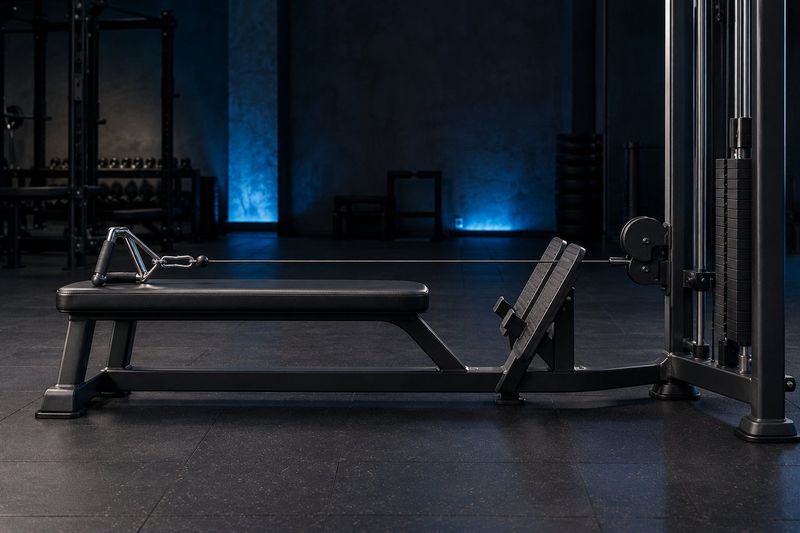
The seated cable row, or horizontal cable row, is an exercise in which you sit and pull a cable handle to your waist. It's also called the low cable row and the seated row. It works the latissimus dorsi and teres major, the trapezius and rhomboids, the rear delt, and the elbow flexors. Which of them work harder depends on the elbow path: close to the torso, the lats; out to the sides, the middle and upper back.
I'm Demid Lobanov, a fitness coach. The seated cable row appears 12 times in the programs I've written, and 7 of those are chest-supported. My exercise library has nine variations of it, with different handles, grips, and machines.
Which muscles work in the seated cable row?
When you row to the waist with a narrow handle, the lats and teres major do the main work: they extend the shoulder and drive the elbow back toward the pelvis (Hall, chapter 7). According to the annotations in my library, it's the upper fibers of the lats that work more here. The trapezius and rhomboids pull the shoulder blades together and give the lats a stable base, so the row loads the middle back with any grip. In a 2004 study by Lehman and colleagues, their activity in the seated row was higher than in two pulldown variations. The rear delt works harder at the end, when the elbow moves behind the line of the torso.
| Muscle | What it does in the seated cable row | When it works harder |
|---|---|---|
| Latissimus dorsi | extends and adducts the shoulder, drives the elbow toward the pelvis | the elbow moves close to the torso |
| Teres major | extends the shoulder together with the lats | narrow neutral-grip handle, elbow close to the torso |
| Middle trapezius and rhomboids | pull the shoulder blades together | wide grip, end of the movement |
| Rear delt | pulls the upper arm back | elbow behind the torso line, wide grip |
| Lower trapezius | keeps the shoulders down | the entire row |
| Brachialis, biceps, and brachioradialis | flex the elbow | narrow handle |
| Spinal erectors and core muscles | hold the torso angle | seated without chest support |
Narrow or wide grip: what the handle changes
Grip changes which muscles work through the position of the elbow. A narrow neutral-grip handle keeps the elbow close to the torso, and the exercise loads the lats and teres major. A wide overhand grip takes the elbows out to the sides at shoulder height. Then the middle and upper back do the main work: the trapezius, rhomboids, and rear delt. A MAG handle doesn't make the row a lat exercise on its own. The elbow path does.
Muscle activity shows a similar picture. In a 2025 study by Padovan and colleagues, 14 trained men did the row with a narrow and a wide grip using a weight they could lift 8 times. With the narrow grip, the lats were more active; with the wide grip, all three parts of the trapezius and the side delt. A 2026 review by Di Fonza and colleagues describes one more study: with the shoulder abducted 60–90°, the upper and middle trapezius and the rear delt were more active, and at smaller angles, the lats.
This is electromyography data: it shows muscle activity during the exercise, and muscle growth wasn't measured in these studies. The review authors point this out too.
| Handle and grip | Where the elbow goes | What works more |
|---|---|---|
| Narrow neutral-grip handle | close to the torso, toward the pelvis | lats, teres major |
| MAG handle, neutral grip | close to the torso | lats, teres major |
| Wide handle, elbows out | out to the sides at shoulder height | trapezius, rhomboids, rear delt |
Row to the waist or to the chest
The point you pull the handle to works the same way as grip. Rowing to your waist or stomach keeps the elbow close to the torso, so this is the version for the lats. If you pull to your chest, the elbows travel higher and out to the sides, and the load shifts to the middle and upper back and the rear delt.
In my library, the main switch is written down like this: elbow height relative to the shoulder joint. At shoulder level, the upper back works; below it, the lats.
How to do the seated cable row: step by step
- Sit in the machine, take the handle, and choose your torso angle. Keep it the same for the whole row.
- Start with your arms extended: shoulder blades released forward, shoulders down and not creeping up toward your ears.
- Pull your elbows back. With a narrow handle, keep them close to your torso and move them toward your pelvis.
- Bring your elbow behind the line of your torso without leaning back.
- Return to full arm extension and release your shoulder blades forward again.
Releasing the shoulder blades forward at the start is worth doing: it gives the lats the length they otherwise lack in this exercise. Of all pulling exercises, the seated cable row stretches the lats the least. For the stretched position, my library has a separate exercise, the pull-around: a single-arm row in which the arm starts reaching far forward and the torso is rotated.
There's more than one way to handle squeezing the shoulder blades together at the end. In Lehman's study, 12 men with more than six months of training experience held the row with the shoulder blades squeezed together and not squeezed. With the squeeze, middle back and lat activity was slightly higher, but no significant difference was found, and the muscles were measured in a static hold. In another 2025 study by Padovan and colleagues, 14 trained men compared a row with the shoulder blades held together throughout and a row in which they're released forward at the start and pulled together during the movement. Overall muscle activity was similar, and the authors consider both options valid.
Where the seated cable row is hardest
In a cable row with the elbows close to the torso, the load on the lats is almost the same along the entire path of the handle. The cable runs horizontally, and the load on the shoulder joint is set by how far the hand is below the shoulder. It doesn't depend on how extended the arm is. This is a calculation from my exercise library.
With a wide grip and the elbows out, the load on the rear delt increases toward the end of the row: by my calculation for a typical seated position, roughly twofold. So in this version, cutting the end short removes the hardest part of the movement.
In a lever machine with the elbows close to the torso, the picture depends on where the lever's pivot is. If the pivot is above the handles, the start, with your arms extended, is hardest. If it's below them, the end of the row is. Check this on the machine you train on. With a wide grip, the end of the row stays the hardest part on a lever machine too.
With or without chest support
Chest support takes the load off the spinal erectors and keeps you from adding range of motion by moving your torso. All the work stays in the shoulder joint and the shoulder blade. That's why this version is used when the lower back needs unloading after the acute phase of pain.
In general, a machine unloads the back more than free weights do. In a 2015 study by Saeterbakken and colleagues in 15 trained men, the spinal erectors were 34% more active in the free-weight bent-over row than in the machine row. In a 2009 study by Fenwick and colleagues in 7 men, the standing bent-over row loaded the lower back more than the two other rows studied.
Single-arm and lever machine rows
Working one arm at a time loads the obliques more, because the torso must not rotate after the arm. In Saeterbakken's study, during the two-arm row the external oblique worked at 37–41% of the level it reached in the single-arm row. With one arm, you can reach further forward and even out differences between sides.
A lever machine, often called a Hammer Strength machine, lets you work with heavy weights without being limited by the weight stack (the set of plates in the machine), and it sets the path of the movement. As on a cable, a wide grip on it shifts the work to the upper back, and a neutral grip shifts it to the lats. If the levers move independently, it's convenient for single-arm work.
Common mistakes in the seated cable row
| Mistake | What happens | How to fix it |
|---|---|---|
| Leaning back at the end | range of motion comes from leaning the torso back, and it swings | keep your torso angle the same |
| Shoulders creeping toward your ears at the start | the shoulder blade is released forward without control | shoulders down, shoulder blades move forward |
| Short range at both ends | the shoulder blades don't move forward, the elbow doesn't get behind the torso | go from full arm extension to the elbow behind the torso line |
| Pulling with your arms | the elbow doesn't move behind the torso line | lead the movement with your elbow |
| Elbow drops with a wide grip | the row shifts to the lats | keep your elbow at shoulder height if your goal is the upper back |
Seated cable row with back and shoulder pain
My library doesn't rule out the seated cable row based on a diagnosis alone, including herniated discs: what decides is the phase, tolerance, and dosage. This rule is for pain whose cause a doctor has already identified. In the acute phase of lower back pain, the seated cable row isn't done. After it, while the lower back still needs caution, start with the chest-supported row. If it hurts your shoulder to bring the elbow behind your torso, shorten the end of the range.
Don't train through acute pain without a diagnosis: skip the row until a doctor has examined you. Pain at rest or at night, numbness, shooting pain, and weakness in an arm or leg are also reasons to stop training and see a doctor.
Horizontal or vertical pull
In a horizontal row, the elbow moves from front to back; in a vertical pull, from top to bottom. The horizontal row stretches the lats less than any other pulling exercise, and the vertical pull stretches them more. My programs include both. More in the article Lat Pulldown.
How to add the seated cable row to your workouts: step by step
- Choose the version for your goal: for the lats, a narrow handle and a row to the waist; for the middle and upper back, a wide grip and elbows out.
- If your lower back needs caution but the acute phase is behind you, do the chest-supported row.
- For the stretched position of the lats, add a separate exercise, the pull-around.
- Choose the number of sets using the article How Many Sets per Week.
- Add weight when, for two workouts in a row, you complete all sets within your target rep range, with the last one near the top of that range and with clean technique.
If you need a plan for your goal and your gym, there's the personalized program.
I post exercise breakdowns on my YouTube channel @lobanov_fitness.
Sources
- Hall SJ. Basic Biomechanics. 9th edition. McGraw Hill, 2022. Chapter 7: upper extremity.
- Padovan R et al. High-Density Surface Electromyography Excitation of Prime Movers in the Narrow vs. Wide Grip Seated Row Exercise. Journal of Human Kinetics, 2025. Article
- Di Fonza D et al. Electromyographic Analysis of Latissimus Dorsi Activation During Common Resistance Training Exercises: A Narrative Review. J Funct Morphol Kinesiol, 2026. Article · Full text
- Lehman GJ et al. Variations in muscle activation levels during traditional latissimus dorsi weight training exercises: An experimental study. Dyn Med, 2004. Article · Full text
- Padovan R et al. High-Density Surface Electromyography Excitation of Prime Movers Across Scapular Positions in the Seated Row. J Funct Morphol Kinesiol, 2025. Article · Full text
- Saeterbakken A et al. The Effect of Performing Bi- and Unilateral Row Exercises on Core Muscle Activation. Int J Sports Med, 2015. Article
- Fenwick CM et al. Comparison of different rowing exercises: trunk muscle activation and lumbar spine motion, load, and stiffness. J Strength Cond Res, 2009. Article