
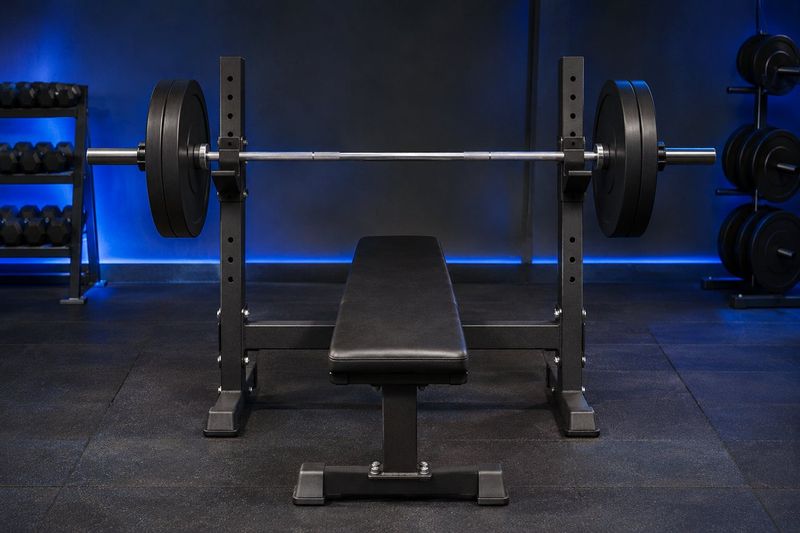
The flat barbell bench press is a foundational compound free-weight exercise that works and builds the pectoralis major, pectoralis minor, front delt, and triceps. For most gym-goers, the most comfortable and shoulder-friendly setup is a medium grip within 1.5 shoulder widths, retracted and depressed shoulder blades, feet planted firmly on the floor, and lowering the bar under control to touch the lower chest without bouncing.
This lift is also called the flat bench press with a barbell. I'm Demid Lobanov, a fitness coach and instructor at the PRO-FG school for fitness coaches: I've coached trainees for over six years and spent more than four years teaching aspiring specialists how to analyze movement biomechanics. In my exercise library, chest pressing mostly centers on incline dumbbell presses, cable and leverage machines, and the Smith machine, yet the exact same laws of shoulder and scapular mechanics govern a free barbell. When I run a video training diagnostic, a side-view clip clearly reveals the joint's axis of rotation, the line of force, and the moment arm—the shortest distance between the axis and the line of force, showing the most demanding phase of the lift.
Which muscles work and grow in the barbell bench press
According to Table 13.2 of the biomechanics textbook by Dubrovskiy and Fedorova, the pectoralis major originates from the clavicle, sternum, cartilages of ribs II–VII, and the rectus abdominis sheath, inserting onto the humerus. According to Chapter 7 of Hall's textbook, it has two working portions: the upper clavicular head raises the arm forward, while the sternal portion—the middle and lower chest—brings a raised arm down against resistance and horizontally adducts the upper arms in front of the torso. In my exercise library, the flat bench press is classified among movements led by the sternal portion.
Several muscle groups assist it at once:
- Front delt flexes the shoulder and drives the arm upward off the chest.
- Triceps extends the elbow joint, contributing most strongly through the second half of the press.
- Pectoralis minor lies beneath the pec major and pulls the shoulder blade forward and downward.
- Rotator cuff muscles center the humeral head in the socket, while the rhomboids with the middle and lower trapezius keep the shoulder blades pinned against the bench.
What actually grows in size was tested with magnetic resonance imaging in a 2024 randomized controlled trial by Lanza and colleagues. Out of 24 healthy men, 13 performed only the flat barbell bench press 3 times a week for 10 weeks using 3–4 sets of 12 reps at 50–55% of their one-rep max—the heaviest weight lifted once—with 3 minutes of rest, while 11 remained in the control group. Cross-sectional area of the pectoralis major, pectoralis minor, front delt, and triceps increased significantly compared with the control group and the side delt, and the pectoralis major grew more than the pectoralis minor and triceps.
If your goal is to specifically add thickness to the upper chest right below the collarbones, flat pressing alone may trail an incline bench. In a 2020 study by Chaves and colleagues (47 untrained men, once a week to failure for 8 weeks), upper chest thickness at the second intercostal space grew more from a 44° incline. The gain was 0.62 cm greater than flat benching and 0.50 cm greater than combining both. Middle and lower chest thickness and isometric strength gains (around 10–11 kg) did not differ—see more in How to Build Your Chest Muscles and Incline Dumbbell Bench Press.
Barbell vs. dumbbells vs. Smith machine
In a 2011 comparative study by Saeterbakken and colleagues, 12 resistance-trained men tested their one-rep max across three chest presses separated by 3–5 rest days. Free-barbell load was roughly 3% higher than on the Smith machine, whereas total dumbbell weight was 17% lower than the barbell and 14% lower than the Smith machine. Electrical activity of the pectoralis major and front delt did not differ, triceps activation was lower with dumbbells, and biceps activity as a stabilizer rose as balance demands increased—from Smith machine to barbell to dumbbells.
When reading acute measurements like these, keep in mind the conclusion of a 2022 review by Vigotsky and colleagues: it has not been confirmed that surface electromyography amplitude from a single session can predict muscle growth over months of training. In practice, each tool solves a different job: a free barbell lets you handle heavier weight and progress in 2.5 kg jumps, while dumbbells stretch the chest deeper and load each arm independently. The Smith machine and leverage presses let you stop worrying about balance close to failure—covered in detail in Smith Machine Bench Press.
How wide to grip the bar: wide, medium, or narrow
A widespread gym mistake is grabbing as wide as possible to chase extra weight or a supposed extra chest focus. The load advantage of a wide grip is modest, while stress on shoulder structures is noticeably higher.
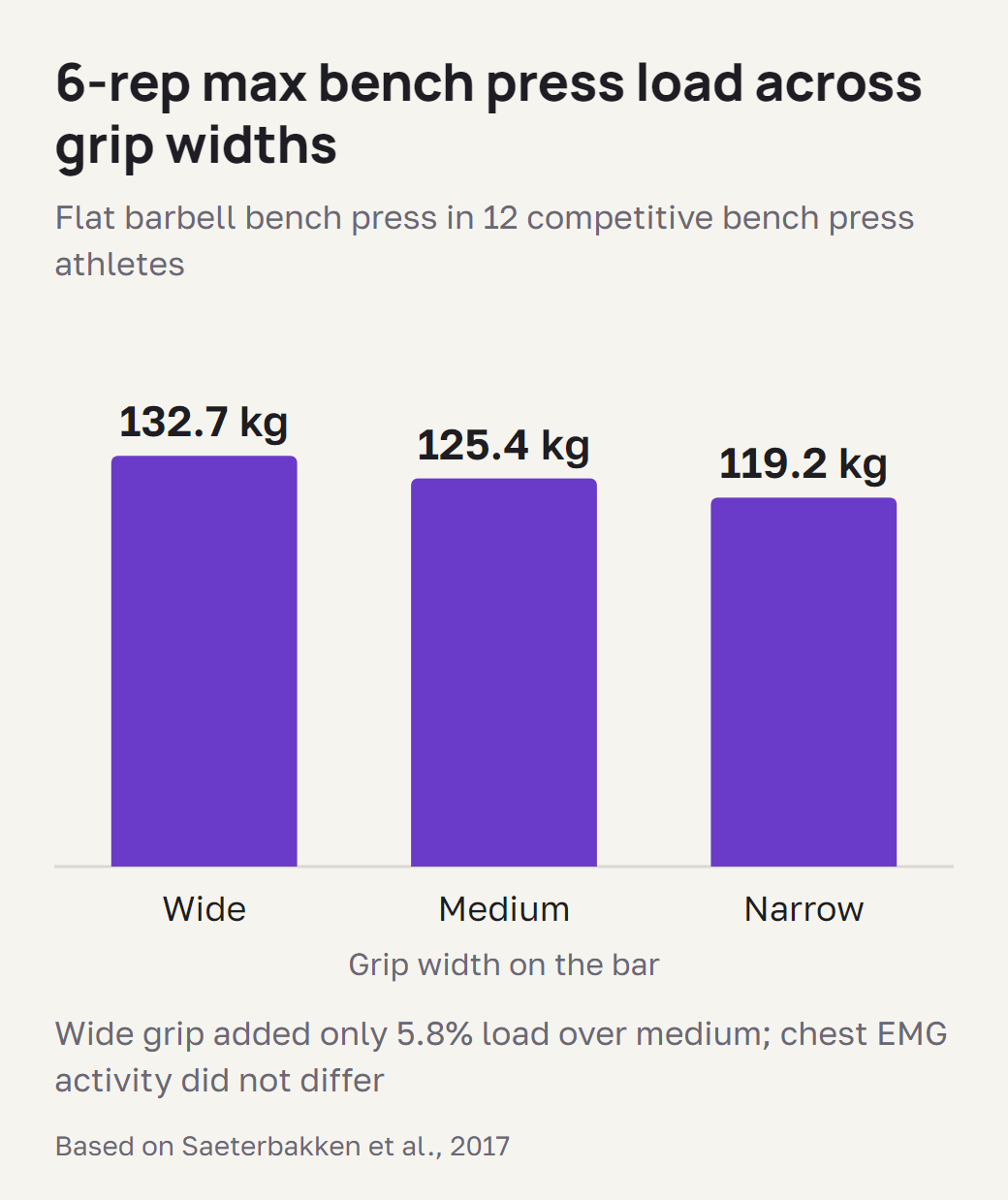
In a 2017 study by Saeterbakken and colleagues, 12 competitive lifters compared 6-rep working loads across three grips. Wide grip averaged 132.7 kg, medium grip 125.4 kg, and narrow grip 119.2 kg: differences of 5.8% and 11.1% compared with wide. Electrical activity in both parts of the pectoralis major, front delt, and triceps did not change—only biceps work dropped by 25.9–30.5% with a narrow grip.
Joint forces inside the shoulder were calculated in a musculoskeletal computer model by Noteboom and colleagues in 2024. Ten experienced lifters performed 21 bench press variations using a 16 kg barbell fitted with force sensors and motion capture: grip widths of 1, 1.5, and 2 bi-acromial distances (the width between the bony tips on top of the shoulders), shoulder angles of 45°, 70°, and 90°, and three scapular positions. Widening the grip from 1.5 to 2 shoulder widths statistically significantly increased acromioclavicular joint compression, posterior glenohumeral shear, and rotator cuff loading. Keeping grip width up to 1.5 shoulder widths with retracted shoulder blades significantly reduced those joint forces, and also lowered modeled peak loads on the supraspinatus and subscapularis. Conversely, a narrow grip of 1 shoulder width (compared with 1.5) and tucking the upper arms to 45° (compared with 70°) each separately raised superior shear force in the joint.
For pain-free training, take a medium grip around 1.3–1.5 shoulder widths. At the bottom, your forearms should sit close to vertical, and keep the upper-arm angle to your torso in the 45–70° range without flaring your elbows out to 90°.
Do you need a bench press arch, and where should your feet go?
In powerlifting, a high arch shortens bar travel, and gym-goers often confuse it with normal scapular retraction. In a 2024 study by Bartolomei and colleagues on 15 strong athletes, a pronounced arch shortened bar travel by 28–47 mm (47 mm at 50%, 40 mm at 70%, and 28 mm at 90% of max). It added 4.2 kg to one-rep max with equal upper and lower chest activity. In a 2021 study by García-Ramos and colleagues on 11 powerlifters, one-rep max between a natural arch and a high arch matched: 115.9 versus 115.7 kg.
The opposite extreme is putting your feet on the bench or holding your legs in the air. In a 2019 study by Muyor and colleagues (20 men, load at 60% of max), benching with legs held in the air at 90° of hip and knee flexion raised activity across all nine measured muscles, loading the rectus femoris and abdominals most heavily to maintain balance. The authors advise against that posture because of instability and hip-flexor pull on the lower back. A recreational lifter doesn't need an extreme lumbar arch, but does need retracted and depressed shoulder blades, a natural thoracic arch, hips on the pad, and feet planted firmly on the floor.
Range of motion, the sticking point, and safety
The chest works hardest in the bottom third near the ribcage: the horizontal moment arm is longest there, the muscle is stretched, and upward drive starts from zero velocity. Stopping the bar 5–10 cm above the chest to load extra plates cuts out the most productive part of the movement.
In a 2022 randomized study by Martínez-Cava and colleagues, 50 trained men were split into four groups for 10 weeks. Three groups pressed at 60–80% of max through a full range to the chest, the top two-thirds, or the top one-third of the stroke, while the control group stopped training. Full bench press produced the largest gains in one-rep max and velocity across all three ranges, whereas partial presses worked worse the shorter the bar path became (details in Full vs. Partial Range of Motion).
According to a 2016 systematic review by Kompf and Arandjelović, the sticking point depends on multiple factors and doesn't always match peak leverage. That exact zone is where failure hits and movement breaks down most often. A 2025 systematic review by Bakhshinejad and colleagues (22 studies and 293 experienced lifters, including 8 bench press studies with 110 lifters) analyzed fatigue mechanics. As load and fatigue climbed in the bench press, bar speed dropped, time spent in the sticking point lengthened, and horizontal bar drift toward the shoulders along with speed asymmetry between the arms increased. On heavy sets, set rack safety pins just below your arched chest height or call a spotter, and wrap your thumb around the bar in a closed grip.
How to barbell bench press: step by step and without common mistakes
- Lie on a flat bench with your eyes roughly underneath the racked bar.
- Retract your shoulder blades, pull them down toward your hips, and brace the back of your head, upper back, and glutes against the pad with your feet planted flat on the floor.
- Grip the bar with a closed medium grip at roughly 1.3–1.5 shoulder widths.
- Unrack the barbell and bring it over your shoulder joints on straight arms while keeping your shoulder blades retracted.
- Lower the bar under control along a slight arc toward your lower sternum: upper arms travel at 45–70° to your torso, and forearms sit nearly vertical at the bottom.
- Touch your shirt or chest gently without bouncing or sinking the weight into your ribs, then press up and slightly back toward the shoulder line while keeping your glutes and shoulder blades pinned.
On form videos, I see five mistakes most often:
| Mistake | Why it hurts and how to fix it |
|---|---|
| Shoulders roll forward, shoulder blades spread apart | bottom stretch shifts into the anterior joint capsule instead of the pec—keep shoulder blades retracted throughout the set |
| Elbows flare out to 90°, bar drifts toward the neck | increases stress on shoulder structures—touch lower on the chest and tuck elbows to 45–70° |
| Bouncing the bar off the ribcage | momentum takes away part of the muscle's work at the bottom and sharply loads the stretched tendon—touch the chest calmly |
| Glutes lift off the bench during effort | breaks your base of support and overloads the lower back—drive feet into the floor, directing force along the pad toward your shoulders |
| Stopping 5–10 cm short of the chest to lift heavier | loses the stretched range and slows strength gains—strip extra weight and use a full pain-free depth |
Shoulder and pectoralis major safety
In a 2012 systematic review by ElMaraghy and colleagues (365 pectoralis major injuries), 48% of ruptures occurred during resistance training. In a 2020 meta-analysis of pectoralis major tendon tears by Bodendorfer and colleagues (23 articles, 693 injuries, including 664 in men with a mean age of 31.5 years in treatment comparisons), weights accounted for 63.2% of cases, and 87.0% of weight-training ruptures happened specifically in the bench press. The typical mechanism is overload while lowering the bar into the stretched bottom position with an abducted upper arm, and an overly wide grip further raises risk (Kompf and Arandjelović, 2016).
During flare-ups of subacromial pain (beneath the bony tip of the shoulder blade above the joint), temporarily limit bottom depth or switch to a leverage press with a range stop, avoiding both flaring elbows to 90° and pinning arms tightly to your sides with a narrow grip. With anterior shoulder instability or a prior dislocation, also limit deep bottom range and guide your elbows closer to your torso. After a tear or surgery on the chest muscle or shoulder, return to pressing only with a physician's clearance. Uncontrolled high blood pressure requires medical clearance and avoiding breath-holding. Pain at rest or at night, numbness, weakness, shooting arm pain, or any acute undiagnosed pain means stopping the set immediately and seeing a doctor.
How to fit the barbell bench press into your training program
According to the 2026 American College of Sports Medicine position stand (Currier and colleagues, 137 systematic reviews, over 30,000 participants), muscle growth is enhanced by a weekly volume of 10 or more working sets per muscle group. Voluntary strength grows better with loads of 80% of one-rep max or heavier through a full range of motion early in the workout at least 2 times a week.
- Allocate 10–20 weekly working sets for chest across 2 sessions (start with 10–12), counting each bench press set in full for chest and as roughly half a set for triceps (details in How Many Sets Per Week).
- Do the bulk of your work in the 6–12 rep range with 1–3 reps in reserve, setting a tight 3-rep window—such as 6–8 or 8–10—following the rules in Progressive Overload.
- Pair the flat barbell press with a 30–35° incline dumbbell press for the upper chest or with cable and machine flyes.
- Check progress after 4 weeks: on side video your shoulder blades and glutes stay pinned, forearms are vertical at the bottom, shoulders don't ache the next morning, and your logbook shows 1–2 extra reps or a weight step without cutting depth.
If you want a well-calibrated monthly plan built around your gym, goal, and shoulder limitations, check out an individual training program.
I share exercise technique breakdowns on my YouTube channel @lobanov_fitness.
Sources
- Dubrovskiy VI, Fedorova VN. Biomechanics. VLADOS-PRESS, 2003. Table 13.2 — back, chest, and upper-extremity muscles (in Russian).
- Hall SJ. Basic Biomechanics. 9th edition. McGraw Hill, 2022. Chapter 7 — upper extremity.
- Lanza MB et al. Muscle hypertrophy response across four muscles involved in the bench press exercise: Randomized 10 weeks training intervention. J Bodyw Mov Ther, 2024. Article
- Chaves SFN et al. Effects of Horizontal and Incline Bench Press on Neuromuscular Adaptations in Untrained Young Men. Int J Exerc Sci, 2020. Article · Full text
- Saeterbakken AH et al. A comparison of muscle activity and 1-RM strength of three chest-press exercises with different stability requirements. J Sports Sci, 2011. Article
- Vigotsky AD et al. Longing for a Longitudinal Proxy: Acutely Measured Surface EMG Amplitude is not a Validated Predictor of Muscle Hypertrophy. Sports Med, 2022. Article
- Saeterbakken AH et al. The Effects of Bench Press Variations in Competitive Athletes on Muscle Activity and Performance. J Hum Kinet, 2017. Article · Full text
- Noteboom L et al. Effects of bench press technique variations on musculoskeletal shoulder loads and potential injury risk. Front Physiol, 2024. Article · Full text
- Bartolomei S et al. Flat-Back vs. Arched-Back Bench Press: Examining the Different Techniques Performed by Power Athletes. J Strength Cond Res, 2024. Article · Full text
- García-Ramos A et al. Differences in the one-repetition maximum and load-velocity profile between the flat and arched bench press in competitive powerlifters. Sports Biomech, 2021. Article
- Muyor JM et al. Evaluation and comparison of electromyographic activity in bench press with feet on the ground and active hip flexion. PLoS One, 2019. Article · Full text
- Martínez-Cava A et al. Bench Press at Full Range of Motion Produces Greater Neuromuscular Adaptations Than Partial Executions After Prolonged Resistance Training. J Strength Cond Res, 2022. Article
- Kompf J et al. Understanding and Overcoming the Sticking Point in Resistance Exercise. Sports Med, 2016. Article · Full text
- Bakhshinejad JA et al. Effects of Intensity and Fatigue on the Kinetics and Kinematics of the Barbell Squat, Bench Press, and Deadlift in Experienced Lifters: A Systematic Review. Sports Med Open, 2025. Article · Full text
- ElMaraghy AW et al. A systematic review and comprehensive classification of pectoralis major tears. J Shoulder Elbow Surg, 2012. Article
- Bodendorfer BM et al. Treatment of Pectoralis Major Tendon Tears: A Systematic Review and Meta-analysis of Operative and Nonoperative Treatment. Orthop J Sports Med, 2020. Article · Full text
- Currier BS et al. American College of Sports Medicine Position Stand. Resistance Training Prescription for Muscle Function, Hypertrophy, and Physical Performance in Healthy Adults: An Overview of Reviews. Med Sci Sports Exerc, 2026. Article · Full text




