
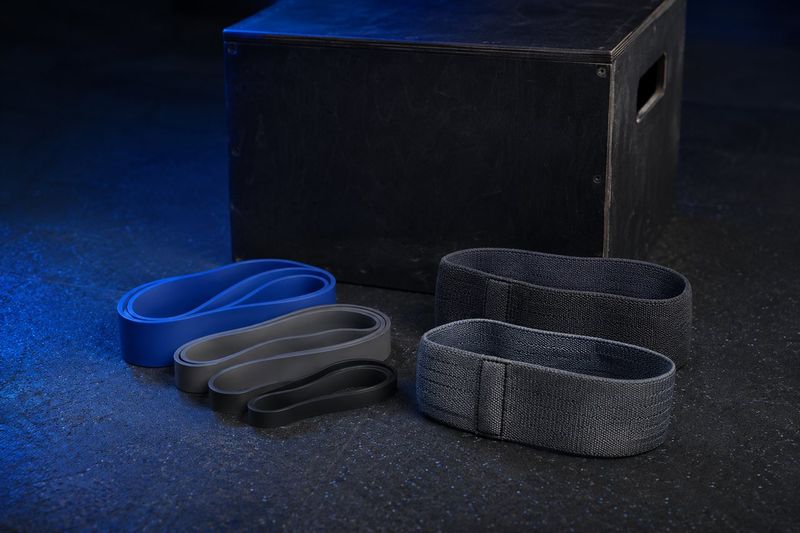
You can build muscle and strengthen your body with resistance bands if band tension forces you to finish sets close to failure—the point where you can't complete another rep with clean form—within roughly 25–30 reps. Bands don't burn fat on their own: weight drops from a calorie deficit in your diet, while resistance work with bands helps preserve muscle. Elastic bands do have two mechanical traits to keep in mind: light tension at the start of the movement and resistance that shifts with every step away from the anchor.
Stores sell this gear as fitness bands, pull-up assist loop bands, or flat and tube resistance bands. I'm Demid Lobanov, a fitness coach and instructor: for over six years I've coached people—starting out in gyms and now coaching clients online, including those who train at home or on business trips. For over four years I've also taught aspiring coaches at the PRO-FG school. In my programs, bands sit where their mechanics genuinely fit: in home and travel complexes, for controlling knee alignment, and in specific assisted drills.
How a resistance band works biomechanically
A dumbbell and a weight-stack cable machine work through constant gravity, whereas an elastic band follows Hooke's law. As described in Chapter 6 of the biomechanics textbook by Dubrovskiy and Fedorova, elastic force is directly proportional to band elongation and material stiffness: the farther you stretch the loop, the harder it pulls back.
In a 2016 review by Kompf and Arandjelović, elastic bands are classified as variable resistance that increases as the band stretches along the ascent. At the start of a set, when the target muscle is stretched and the band is nearly slack, resistance is minimal. Near the end of the movement, where the muscle is already shortened, tension climbs to its peak. Because of that trait, exercise form with bands is tailored to their tension curve.
Can you build muscle with resistance bands? What research shows
What drives muscle growth is not the material of the implement, but the magnitude of mechanical tension and how close the set comes to fatigue. In a 2016 meta-analysis—a statistical pooling of studies—by Aboodarda and colleagues, electrical activity of prime movers, assisting muscles, and muscles stabilizing body position did not differ between elastic bands and conventional weights at matched load. At the same time, it has not been confirmed that single-session surface electromyography amplitude can predict muscle growth (review by Vigotsky and colleagues, 2022).
Longer-term comparisons of strength and muscle mass confirm the effectiveness of elastic bands:
- Upper- and lower-body strength. A 2019 systematic review and meta-analysis by Lopes and colleagues, accounting for its 2020 correction, pooled 7 studies and 224 participants aged 15 to 88—from active young adults and soccer players to cardiac rehabilitation and chronic lung disease patients—over 4–12 weeks. Elastic bands and tubes produced the same arm and leg strength gains as weight machines and dumbbells. In a 2022 meta-analysis by Andersen and colleagues (17 studies, 491 adults aged 18–37), variable resistance also included combining bands or chains with a barbell. Both formats increased maximal strength and power equally, although traditional weights raised lower-body strength more noticeably on higher-rep sets.
- Conditions for muscle growth. In a 2021 network meta-analysis by Lopez and colleagues (28 studies, 747 adults training to failure), muscle growth matched across heavy loads up to 8 reps, moderate loads of 9–15 reps, and light loads above 15 reps, whereas maximal strength responded better to moderate and heavy loads. Meta-regressions by Robinson and colleagues in 2024 showed that muscles grow better the closer sets finish to failure. In the 2026 American College of Sports Medicine position stand (Currier and colleagues, reviewing 137 systematic reviews and over 30,000 participants), equipment type itself did not consistently alter training outcomes. See more on these mechanisms in Home Workouts and Training to Failure.
- Direct body-composition trials. In a 2008 randomized study by Colado and colleagues, 45 sedentary middle-aged women trained major muscle groups twice weekly across 6 exercises for 10 weeks using bands, weight machines, or remained in the control group at matched reps and perceived exertion. Both training groups comparably increased bioimpedance fat-free mass, reduced fat mass, and improved knee push-ups and 1-minute squats. In a 2015 study by Calatayud and colleagues, 30 experienced students split into three groups: barbell bench press, band-resisted push-ups, and a non-training control. Over 5 weeks working at a 6-rep max, both training groups achieved equal gains in 1-rep and 6-rep max bench press (13.65% to 22.21%). In Ferreira and colleagues in 2025 (29 older completers out of 31, 8 weeks at 10RM), peak strength and functional tests did not change significantly, yet bands and free weights equally increased working loads for knee extensors and flexors. Meanwhile, a 2024 review in older adults by Hernandez-Martinez and colleagues (9 studies, 477 participants) found improvements in 30-second chair stands and flexibility without a significant gain in fat-free mass at very low certainty of evidence.
Three practical nuances: glute mini-bands, pull-ups, and progression
My exercise library covers three situations where people often expect too much from bands:
- A short mini-band above the knees in squats and glute bridges. A mini-loop pulls the thighs inward, forcing the gluteus medius, gluteus minimus, and upper fibers of the gluteus maximus to keep the knees tracking over the feet in a shortened position. That's an excellent cue against knee cave, yet a light thigh band on its own without heavy hip extension won't build big glutes—I broke down the foundational form in Glute Bridge.
- A long loop band on the pull-up and dip bars. During pull-ups and dips, the band is stretched tightest at the bottom: in pull-ups it flips the resistance profile, and in dips it shifts peak load toward mid-range while unloading the stretched bottom position of the muscles. There are no direct muscle-growth trials comparing bands against an assisted pull-up machine, yet biomechanically a constant counterweight machine is more advantageous in a gym, while at home or an outdoor park a loop band remains a handy way to learn the movement—the step-by-step path is in How to Learn Pull-Ups.
- Tracking progression. Dumbbells have their step in kilograms stamped on the end, whereas band resistance changes with every footstep and gradually softens as latex ages.
Do resistance bands help with weight loss?
Weight loss requires a calorie deficit in your diet—the full plan is in the pillar guide How to Lose Weight. The role of strength training with bands on a diet is to signal your body to preserve muscle so you lose fat.
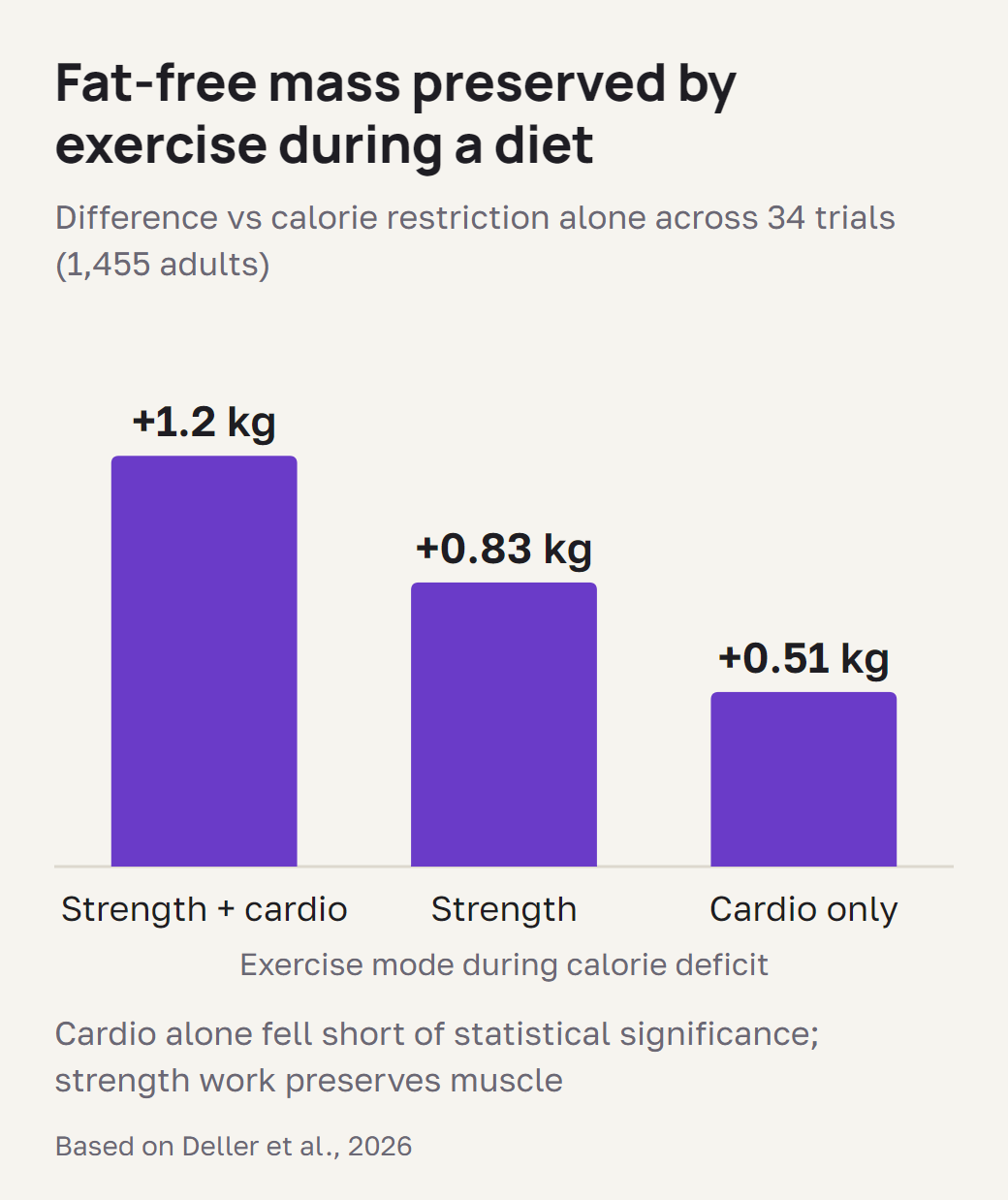
In a 2021 meta-analysis by Liu and colleagues (15 randomized trials and 669 participants with overweight or obesity, including 4 trials using bands), elastic bands significantly reduced body fat percentage. Strength gains did not differ among bands, bodyweight, and free weights. In a large 2026 meta-analysis of strength and aerobic programs during a calorie deficit by Deller and colleagues (34 randomized trials, 1,455 adults with overweight or obesity; 33 studies in the network analysis), training preserved an average of +0.87 kg of fat-free mass, preventing nearly half—45.7%—of diet-induced lean loss. Combining strength training and endurance training preserved +1.20 kg (rounded to +1.2 kg on the chart), strength sessions preserved +0.83 kg, whereas cardio alone (+0.51 kg) did not reach statistical significance.
Which bands to choose for home, travel, and the gym
| Band type | Best exercises | Pros and limitations |
|---|---|---|
| Short mini-loops (fabric preferred) | hip abductions, knee-tracking cue in squats and bridges | fabric bands don't roll up on clothing and outlast thin latex, though their stroke is too short for rows and presses |
| Long power loops (set of 3–4 widths) | rows, band-resisted push-ups, band Romanian deadlifts, overhead/chest presses, arms, pull-up assistance | most versatile home and travel kit with a wide tension range |
| Tube band set with carabiners, handles, and door anchor | high pulldowns, face pulls, horizontal rows, and curls anchored in a doorway | turns a closed interior door into a convenient multi-height home cable station |
To even out tension across the range of motion and progress month after month, stick to four simple rules. Start every rep with noticeable pre-stretch on the band while the muscle is still lengthened. Hold peak contraction for 1 second and return smoothly over 2–3 seconds without letting the band snap you back. Place your feet on the exact same floor mark, and once you can easily hit more than 25–30 reps with a single band, move up to a thicker loop or double up two bands.
Step-by-step band workout plan and safety rules
- Put together a set of 3–4 long power loops of varying thickness or a tube band kit with handles and a door anchor.
- Train major muscle groups 2–3 times per week for at least 10 weekly working sets per group (guidelines in How Many Sets Per Week), taking sets of 10–25 reps to 1–3 reps in reserve.
- Combine bands on back, rear delt, and arm pulls with squats, lunges, and push-ups, logging band color and reps on every set.
- Inspect latex before every session for pale stretch marks or edge nicks, place the door anchor on the hinge or latch-closing side so the door pulls shut into the frame, and never pull a taut band straight toward your eyes or face.
- Check progress after 4 weeks: from the exact same foot mark, you've cleanly added 3–5 reps or moved up to the next band thickness without joint discomfort.
If you want a complete monthly plan built around your home bands and dumbbells, take a look at an individual training program, or if you want weekly video form reviews and nutrition adjustments, check out online coaching. If you have acute joint or spine pain, clear appropriate loading with a physician first.
I share exercise technique breakdowns on my YouTube channel @lobanov_fitness.
Sources
- Dubrovskiy VI, Fedorova VN. Biomechanics. VLADOS-PRESS, 2003. Chapter 6 — types of forces in nature (elastic force, Hooke's law) (in Russian).
- Kompf J et al. Understanding and Overcoming the Sticking Point in Resistance Exercise. Sports Med, 2016. Article · Full text
- Aboodarda SJ et al. Muscle activation comparisons between elastic and isoinertial resistance: A meta-analysis. Clin Biomech (Bristol), 2016. Article
- Vigotsky AD et al. Longing for a Longitudinal Proxy: Acutely Measured Surface EMG Amplitude is not a Validated Predictor of Muscle Hypertrophy. Sports Med, 2022. Article
- Lopes JSS et al. Effects of training with elastic resistance versus conventional resistance on muscular strength: A systematic review and meta-analysis. SAGE Open Med, 2019 (erratum 2020). Article · Full text · Erratum
- Andersen V et al. Comparing the effects of variable and traditional resistance training on maximal strength and muscle power in healthy adults: A systematic review and meta-analysis. J Sci Med Sport, 2022. Article
- Lopez P et al. Resistance Training Load Effects on Muscle Hypertrophy and Strength Gain: Systematic Review and Network Meta-analysis. Med Sci Sports Exerc, 2021. Article · Full text
- Robinson ZP et al. Exploring the Dose-Response Relationship Between Estimated Resistance Training Proximity to Failure, Strength Gain, and Muscle Hypertrophy: A Series of Meta-Regressions. Sports Med, 2024. Article
- Currier BS et al. American College of Sports Medicine Position Stand. Resistance Training Prescription for Muscle Function, Hypertrophy, and Physical Performance in Healthy Adults: An Overview of Reviews. Med Sci Sports Exerc, 2026. Article · Full text
- Colado JC et al. Effects of a short-term resistance program using elastic bands versus weight machines for sedentary middle-aged women. J Strength Cond Res, 2008. Article
- Calatayud J et al. Bench press and push-up at comparable levels of muscle activity results in similar strength gains. J Strength Cond Res, 2015. Article
- Ferreira RZ et al. Effects of strength training with free weights and elastic resistance in older adults: A randomised clinical study. J Bodyw Mov Ther, 2025. Article
- Hernandez-Martinez J et al. Effects of elastic band training on body composition and physical performance in older people: A systematic review with meta-analysis. Exp Gerontol, 2024. Article
- Liu X et al. Effects of Different Resistance Exercise Forms on Body Composition and Muscle Strength in Overweight and/or Obese Individuals: A Systematic Review and Meta-Analysis. Front Physiol, 2021. Article · Full text
- Deller M et al. Effects of Calorie Restriction With and Without Strength, Endurance or Mixed Training on Fat-Free and Skeletal Muscle Mass in Overweight or Obese Individuals-A Systematic Review With Pairwise Meta-Analysis and Network Meta-Analysis of Randomized Controlled Studies. Diabetes Obes Metab, 2026. Article · Full text