
Progressive overload is the gradual increase of demands placed on a muscle as it adapts and grows stronger. You can increase load either through the weight on a barbell or dumbbells or through the number of reps performed with the same weight: over 8–10-week cycles, with clean technique and sets taken close to failure, both methods produced comparable muscle growth. Failure is the point where you can no longer complete another rep without distorting the movement.
I'm Demid Lobanov, a fitness coach and instructor at the PRO-FG coaching school. I've been coaching people for over six years—starting on the gym floor and now coaching clients online—and for over four years I've trained future coaches and reviewed programs with practicing colleagues. The core rule in my practice is never to increase working weight two workouts in a row: after any weight jump, at least one session consolidates the new load and verifies technique. Below is what research shows about progression and deloads, and how to build a system without injuries or false plateaus.
Why progression matters and what's better to add: weight or reps?
Without increasing demands, a muscle adapts to familiar work and progress slows down. In a 2026 randomized controlled trial by Kassiano and colleagues, 55 untrained young women performed elbow extensions three times a week for 8 weeks at 3 sets of 8–12 reps, with loading conditions randomly assigned between their arms. The arm where working weight was increased each time 12 reps were reached gained nearly twice as much total triceps thickness as the arm that kept weight and reps unchanged for all 8 weeks (+22.9%, or +0.79 cm, versus +11.6%, or +0.41 cm; +1.8%, or +0.05 cm, in the non-training control).
At the same time, progression doesn't have to come only from adding plates—two direct experiments tested this:
- Plotkin and colleagues, 2022, 43 men and women with at least a year of lower-body training experience (38 completed the 8-week program): both groups did 4 leg exercises twice a week to failure. One group added working weight within a fixed rep range, while the other kept weight constant and added reps. No significant differences were found: rectus femoris growth leaned slightly toward the rep group (+2.8 mm summed across measurement sites, 90% interval from −0.5 to 5.8 mm). One-rep max—the heaviest weight lifted for a single rep—in the Smith machine squat leaned slightly toward the weight group (+2.0 kg, 90% interval from −2.4 to 7.8 kg). Both intervals cross zero.
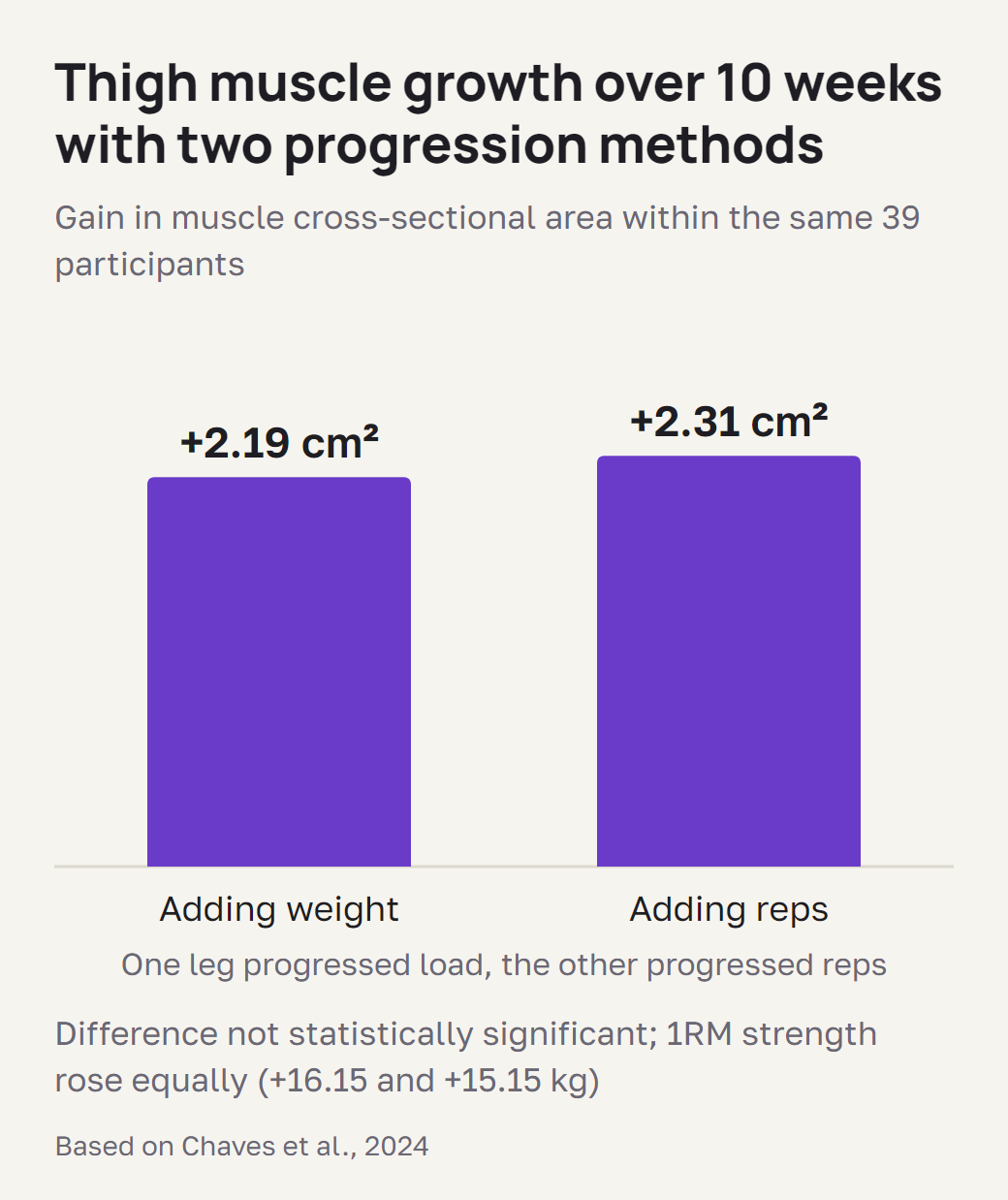
- Chaves and colleagues, 2024, 39 untrained young men and women, 10 weeks: the comparison ran within each person, with one leg progressing via weight and the other via reps. Leg extension one-rep max rose from 52.90 to 69.05 kg (+16.15 kg) with load progression and from 51.67 to 66.82 kg (+15.15 kg) with rep progression. Vastus lateralis cross-sectional area increased from 21.34 to 23.53 cm² (+2.19 cm²) and from 21.08 to 23.39 cm² (+2.31 cm²), with no statistically significant difference.
The practical takeaway takes off unnecessary pressure: if you did one clean rep more today with the same weight than last week, progression has already happened. Choosing your target rep range is covered in How Many Reps to Do for Muscle Growth and Strength.
Where "2–10%" came from and how double progression works
Popular articles often repeat advice from the 2009 American College of Sports Medicine (ACSM) position stand: add 2–10% weight once you perform 1–2 reps above your target. Direct experiments comparing a 2% step against 5% or 10% were never run. In the updated 2026 ACSM position stand (Currier and colleagues, an overview of 137 systematic reviews and over 30,000 participants), the fixed percentage was removed, leaving the general principle of gradual load increases.
That makes any specific step rule a practical convention. In my work with clients, I use double progression, where reps climb inside a set range first and equipment weight goes up only afterward:
- A narrow 3-rep range. I set a range like 8–10 or 10–12 reps instead of a vague 8–15, giving you a clear upper boundary for adding weight.
- Two confirmations in a row. You earn a weight increase once, for two sessions with that exercise in a row, all working sets land inside the range, the final working set hits the top of the range (say, 12 reps), and technique stays clean.
- Smallest step and reset to the bottom of the range. At the next session, add the smallest available increment—up to 2.5 kg on a barbell or one pin on a machine—and work calmly near the bottom of the range (10 reps). Dropping from 12 reps to 10 after adding weight is a normal response to a heavier load. It isn't a setback.
- Equipment increment cap. If the smallest jump on dumbbells or a weight stack exceeds roughly 5% of your working weight (for instance, adding 2.5 kg to 20 kg is an immediate 12.5% jump), hold off on changing weight: keep adding reps, slow down the lowering phase under control, or use 0.25–1 kg microplates.
Reps in reserve help dose effort without constant one-rep max testing (Helms and colleagues, 2016; covered in detail in Training to Failure: Do You Need It for Muscle Growth?). In a 2022 meta-analysis—a statistical pooling of studies—by Hickmott and colleagues (15 studies, including 6 on load autoregulation), selecting load by reps in reserve or bar velocity produced the same one-rep max gains as fixed percentages (mean difference 2.07 kg, not statistically significant). In a 2025 network meta-analysis of 19 studies by Zijing Huang and colleagues, only autoregulatory progressive resistance exercise based on reps to failure (APRE) beat percentage programs with statistical significance. Schemes based on reps in reserve (just 3 studies) and velocity ranked higher than percentages only in probability rankings, without a significant difference. Helms and colleagues advise beginners to practice estimating reserve, and a large review covered in that same training-to-failure article shows lifters of every experience level misjudge by about one rep—so calibrating at the start of a new movement matters for everyone.
Why beginners and experienced lifters progress at different speeds—and where false progress hides
No direct trials measure an exact monthly progression rate across years of training experience, yet coaching practice clearly shows two phases and a wide gap between a novice and a seasoned lifter.
During the first two or three sessions with a new exercise, you're simply finding your working weight and learning the movement path. Once your true working weight is set, adaptation speeds diverge:
- In the first year of training, working weights climb faster alongside neuromuscular skill acquisition, yet to protect tendons, joints, and form, my guideline for beginners is adding 2.5 kg or one stack plate roughly every 2–4 weeks rather than jumping weight every workout.
- In intermediate and advanced lifters, actual muscular adaptation slows to roughly 1–2% per month. At that pace, a 2.5 kg jump naturally takes 4 to 8–12 weeks. Going three or four weeks without new plates while adding at least one rep is normal progress. It isn't a plateau.
The biggest trap for experienced lifters is the illusion of progression bought by cutting range of motion. The bar is 5 kg heavier, yet the hips stop 10 cm higher in the squat, or torso momentum creeps into rows (how movement depth affects growth is covered in Full or Partial Range of Motion: Which Is Better for Muscle Growth?). To keep things honest, every 4 weeks I compare a fresh video of a client's final working set against their earlier baseline clip on the same lift. We break down these exact nuances of progression assessment and biomechanics with colleagues in mentorship for fitness coaches.
Do you need a deload week every 4 weeks?
The rigid template of "three hard weeks, mandatory deload on week four" hasn't held up in recent trials:
- In a 2024 RCT by Coleman and colleagues, 39 trained men and women (out of 50 enrolled) completed a 9-week cycle. Taking a full week off from lifting in week five did not speed up leg muscle growth, and leg strength gains were smaller than with continuous training across all 9 weeks.
- In a 2026 RCT by Pancar and colleagues (19 untrained men, 8 weeks), limbs were compared within the same person. Cutting training in weeks 4 and 8 down to a single session of 2 sets produced the same gains in muscle thickness and strength endurance as uninterrupted training: planned backing off didn't erase progress, nor did it add an extra boost.
- In a survey of 246 competitive strength and physique athletes who use deloads (Rogerson and colleagues, 2024), the main goal of a deload week was reducing fatigue and joint aches. Athletes typically run it for about 6 days every 5–6 weeks on average, either as scheduled or when fatigue builds up, lowering working weight, sets, reps, and proximity to failure on their usual lifts.
That's why I don't slash clients' loads mechanically by the calendar. We bring in a deload as needed: when sleep debt piles up, life stress spikes, tendons ache, or reps at the same weight drop below the bottom of the target range for two sessions with that lift in a row. On a double miss like that, working weight steps down by one increment and you rebuild cleanly through the range. If recovery is solid, however, and working weights and reps haven't budged for months, it's worth checking weekly volume—how to dial it in is covered in How Many Sets per Week Do You Need to Build Muscle.
How to set up your load progression: step by step
- Keep your exercise lineup fixed for at least 4–8 weeks and start a logbook of working sets—if you swap lifts every week, progression can't be measured.
- Pick a narrow 3-rep working range (such as 8–10 or 10–12) and finish working sets with 1–3 reps in reserve.
- Spend the first 2–3 sessions on a new movement calmly finding your working weight and filming a side-angle baseline video of your form.
- Increase weight by the smallest step (up to 2.5 kg or one stack plate) only after two workouts in a row land every working set inside the range and reach the top of the range on the final set. At the session right after a weight jump, lock in the new weight without taking another step.
- If the smallest dumbbell or stack jump exceeds 5% of your working weight, progress through reps or use 0.25–1 kg microplates.
- Verify success after 4 weeks using your video and logbook: if range of motion and form match your baseline while you've added at least 1–2 reps across sets or consolidated one weight jump without joint pain, the system is working. If reps drop below the bottom of the range for two sessions in a row, step the working weight back by one increment; if overall fatigue has piled up, cut weekly sets for a week.
I post exercise technique breakdowns on my YouTube channel @lobanov_fitness. The guidelines in this article are intended for healthy adults; if you experience sharp back or joint pain, do not increase weight—sort out the cause with a physician and a qualified specialist first.
If you want a structured plan built around your gym, training history, and priority muscles, take a look at an individual workout program.
Sources
- Kassiano W et al. Progressive Overload Affects the Magnitude of Muscle Hypertrophy. Med Sci Sports Exerc, 2026. Article
- Plotkin D et al. Progressive overload without progressing load? The effects of load or repetition progression on muscular adaptations. PeerJ, 2022. Article · Full text
- Chaves TS et al. Effects of Resistance Training Overload Progression Protocols on Strength and Muscle Mass. Int J Sports Med, 2024. Article
- American College of Sports Medicine. American College of Sports Medicine position stand. Progression models in resistance training for healthy adults. Med Sci Sports Exerc, 2009. Article
- Currier BS et al. American College of Sports Medicine Position Stand. Resistance Training Prescription for Muscle Function, Hypertrophy, and Physical Performance in Healthy Adults: An Overview of Reviews. Med Sci Sports Exerc, 2026. Article · Full text
- Helms ER et al. Application of the Repetitions in Reserve-Based Rating of Perceived Exertion Scale for Resistance Training. Strength Cond J, 2016. Article · Full text
- Hickmott LM et al. The Effect of Load and Volume Autoregulation on Muscular Strength and Hypertrophy: A Systematic Review and Meta-Analysis. Sports Med Open, 2022. Article · Full text
- Zijing Huang et al. Autoregulated resistance training for maximal strength enhancement: A systematic review and network meta-analysis. J Exerc Sci Fit, 2025. Article · Full text
- Coleman M et al. Gaining more from doing less? The effects of a one-week deload period during supervised resistance training on muscular adaptations. PeerJ, 2024. Article · Full text
- Pancar Z et al. Effects of deload periods in resistance training on muscle hypertrophy and strength endurance in untrained young men using a randomized within subject design. Sci Rep, 2026. Article · Full text
- Rogerson D et al. Deloading Practices in Strength and Physique Sports: A Cross-sectional Survey. Sports Med Open, 2024. Article · Full text