
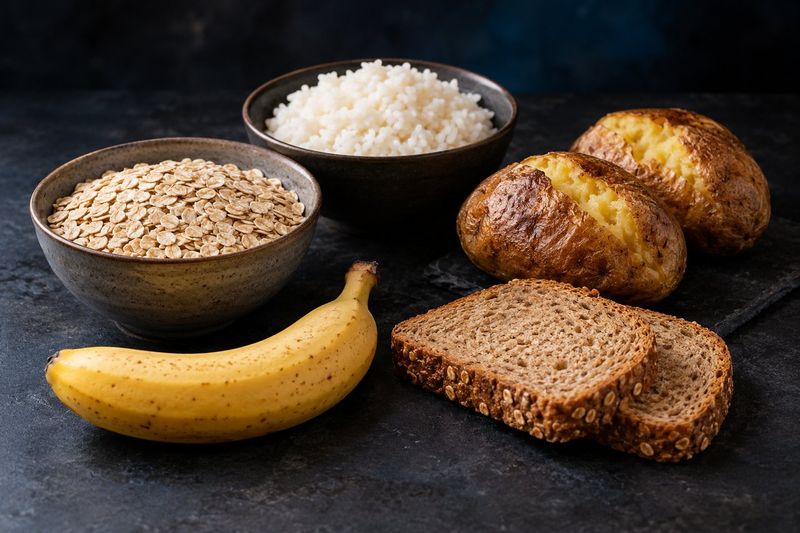
There's no single carb target for everyone. The European Food Safety Authority (EFSA) gives a reference range of 45–60% of calories; Russian guidelines give 56–58%. According to EFSA, the exact requirement depends on how much fat and protein a person eats.
In a calorie deficit, when you take in less energy than you burn, protein and fat targets stay the same in grams, so carbs are calculated from what's left. For a 65 kg woman eating 1,507 kcal a day, that comes to about 114 g, or 30% of calories.
I'm Demid Lobanov, a fitness coach. In the meal plans I calculate, the order is strict: calories, protein, fat, and carbs are whatever's left. At the same time, I don't ban any types of carbs: everything is allowed within your calorie target.
Carb guidelines: EFSA, WHO, and Russian recommendations
These guidelines set either a share of calories or grams per kilogram of body weight. Russian guidelines calculate carbs from daily energy requirements, that is, for a diet that maintains weight. These percentages aren't transferred directly to weight loss; the next section explains why.
| Source | Target | For whom |
|---|---|---|
| EFSA, 2010 | 45–60% of calories | adults and children over 1 year old |
| Guidelines MR 2.3.1.0253-21, Rospotrebnadzor | 56–58% of calories from digestible carbs: 238–435 g per day for women, 301–551 g for men | adults |
| International Society of Sports Nutrition (ISSN), 2018 | 3–5 g per kg of body weight | training for general fitness, a regular diet without a deficit |
| WHO, 2023 | doesn't set an amount: carbs should come primarily from whole grains, vegetables, fruits, and legumes | everyone aged 2 and older |
Why carbs are lower in a deficit than in the guidelines
When calories are below what's needed to maintain weight, protein and fat targets in grams stay the same and aren't lowered below their minimums. So the deficit comes mostly out of carbs. The share of carbs drops as a result.
Example: a 30-year-old woman, 165 cm tall, 65 kg, lightly active, with 1–3 workouts a week. Her daily energy expenditure is about 1,884 kcal. If she eats that much, with 117 g of protein and 65 g of fat, carbs come to 208 g, or 44% of calories, almost in line with EFSA.
In a 20% deficit, her target is 1,507 kcal. Protein and fat stay the same, leaving 114 g of carbs, or 30% of calories.
That's still far from keto: on a keto diet, carbs are no more than 50 g a day. More on that in The Keto Diet. How to find your own calorie target is covered in How Many Calories Do You Need per Day.
How many carbs are left at different protein and fat intakes
The more protein and fat, the fewer carbs are left. For the same woman at 1,507 kcal a day:
| Protein | Fat 1.0 g per kg (65 g) | Fat 1.2 g per kg (78 g) | Fat 1.5 g per kg (97.5 g) |
|---|---|---|---|
| 1.6 g per kg (104 g) | 127 g carbs | 97 g | 53 g |
| 1.8 g per kg (117 g) | 114 g | 84 g | 40 g |
| 2.0 g per kg (130 g) | 101 g | 71 g | 27 g |
In a deficit, I usually start at the low end for fat, 1.0 g per kg. At 1.5 g per kg, 27–53 g of carbs are left, which is close to the keto threshold (up to 50 g) or already below it. If what's left is too small, I revisit protein or fat.
How many carbs you need when you train
The more you train and the longer your sessions, the more carbs you need. The ISSN gives these guidelines:
| Training load | Carbs per day |
|---|---|
| training for general fitness | 3–5 g per kg |
| intense training for 2–3 hours, 5–6 times a week | 5–8 g per kg |
| 3–6 hours of intense training a day, 5–6 days a week | 8–10 g per kg |
The larger amounts are needed to replenish glycogen, the carbohydrate stored in your muscles and liver.
With strength training, the link is weaker. A systematic review is a summary of all the studies on a topic found using predefined rules. The 2022 systematic review by Henselmans et al. included 49 studies.
In people training in a fed state, with up to 10 sets per muscle per session, carb intake barely changed performance in the session itself: strength and the number of reps. A set is a series of reps of an exercise done without a break. In 15 of the 17 longer-term studies, there was no difference. With higher training volume, carbs may help, but there's little data.
For trained athletes on a cut, that is, reducing body fat while keeping muscle, the 2021 review by Ruiz-Castellano et al. gives 2–5 g per kg. This review didn't use a systematic search.
For the woman in the example, 114 g is 1.75 g per kg. For regular strength training (not fasted, up to 10 sets per muscle), the Henselmans review finds no benefit from extra carbs. In the longer-term studies it included, people trained 2–4 times a week. If you train more, your energy expenditure goes up, and with it your calorie target and the carbs left over.
Do you need to cut carbs to lose weight?
There's no need to cut carbs specifically: in studies, low-carb and low-fat diets produce similar results. At equal calories, a low-carb diet has no advantage.
A meta-analysis pools the results of several studies into a single estimate. In a randomized trial, participants are assigned to groups at random.
| Study | What was compared | Result |
|---|---|---|
| Ge et al., 2020, network meta-analysis of 121 randomized trials | low-carb and low-fat diets vs. usual diet | −4.63 and −4.37 kg at six months; by one year, the effect was smaller for all diets |
| Gardner et al., 2018, DIETFITS randomized trial | healthy low-fat and low-carb diets | −5.3 and −6.0 kg over one year |
| Hall and Guo, 2017, review with a meta-analysis of 32 controlled-feeding studies | equal calories, with carbs replaced by fat | energy expenditure 26 kcal per day higher and fat loss 16 g per day higher on the lower-fat diet, a slight difference |
| Tobias et al., 2015, meta-analysis of 53 studies | low-fat diets vs. low-carb diets | 1.15 kg more weight loss on low-carb over one year or longer. Authors' conclusion: the data don't support low-fat diets being better |
The quick weight drop in the first days without carbs is partly water loss: glycogen is stored with water, 3–4 parts water to 1 part glycogen.
You can create a deficit from any part of your diet, but protein and fat shouldn't drop below their minimums. If it's easier for you to eat less bread and more of something else, that's a valid tool: save in one place and allow yourself more in another.
How many carbs women need
These guidelines don't set a separate carb share for women: EFSA and ISSN give the same numbers for everyone. In the Russian guidelines, the percentage is the same, but the grams are lower because of lower energy expenditure: 238–435 g per day. That's for a diet without a deficit. The calculation is the same: calories, protein, fat, and carbs from what's left.
If your period is late while you're in a deficit, in my practice the cause is an overall energy shortfall. In that case, I raise calories, adding +300–400 kcal from carbs 1–2 times a week, and reduce the training load; I don't cut carbs.
In its 2023 consensus statement, a document setting out an agreed expert position, the International Olympic Committee (IOC) describes how an energy shortfall harms athletes' health and notes the growing role of a carbohydrate shortfall. If your period is late, see a gynecologist.
Which carbs to choose
The WHO advises getting carbs primarily from whole grains, vegetables, fruits, and legumes. For adults, that means at least 400 g of vegetables and fruits and at least 25 g of dietary fiber from food a day. How much fiber different foods contain is covered in How Much Fiber Do You Need per Day.
Added sugar: no more than 10% of calories; with a body mass index of 25 or higher, Russian guidelines advise cutting it to 5%. Body mass index is a measure of weight relative to height. At 1,507 kcal, that's about 38 g and about 19 g of sugar.
Fruit doesn't count as sugar, and the split into fast and slow carbs is a rough practical model (see Fast Carbs). Bread, lavash, potatoes, and grains are interchangeable within one meal: if lunch includes potatoes, you don't need grains at that meal.
Carbs when cutting and bulking
On a cut, carbs are what's left after protein and fat, as in the example above. When bulking, the added calories go mostly to carbs.
Example: a 26-year-old man, 180 cm, 75 kg, with an activity factor of 1.55 and a 10% surplus over expenditure. The calculation gives 2,984 kcal, 150 g of protein, 82.5 g of fat, and about 410 g of carbs, or 5.5 g per kg.
How to calculate your carb target: step by step
- Calculate your calorie target: basal metabolic rate × activity factor − deficit. Basal metabolic rate is the energy your body uses to keep running at rest.
- Protein: 1.6–2.5 g per kg of body weight; go above 2.2 g only if you have no stomach or bowel problems. Multiply the grams by 4.
- Fat: 1.0–1.5 g per kg, and for women no less than 45 g. Multiply the grams by 9.
- Carbs = (calorie target − protein calories − fat calories) ÷ 4.
- Check: protein × 4 + fat × 9 + carbs × 4 should equal your calorie target within 1–2%.
- If carbs come out very low, at 50 g or less (keto level), revisit protein or fat.
- After 14 days, compare your average weight for two consecutive weeks. If your weight is dropping at less than half the expected rate and you stuck to the plan, first cut 5–10 g of fat; if fat is already at the low end, cut about 90 kcal from carbs. How to calculate the expected rate is covered in How Many Calories Do You Need per Day.
I post exercise breakdowns on my YouTube channel @lobanov_fitness.
Sources
- EFSA Panel on Dietetic Products, Nutrition and Allergies (NDA). Scientific Opinion on Dietary Reference Values for carbohydrates and dietary fibre. EFSA Journal, 2010. Article
- Rospotrebnadzor. Methodological Guidelines MR 2.3.1.0253-21 "Norms of Physiological Requirements for Energy and Nutrients for Various Population Groups of the Russian Federation," 2021. Text (in Russian)
- World Health Organization. WHO updates guidelines on fats and carbohydrates, 2023. WHO news release
- Kerksick CM et al. ISSN exercise & sports nutrition review update: research & recommendations. J Int Soc Sports Nutr, 2018. Article · Full text
- Henselmans M et al. The Effect of Carbohydrate Intake on Strength and Resistance Training Performance: A Systematic Review. Nutrients, 2022. Article · Full text
- Ruiz-Castellano C et al. Achieving an Optimal Fat Loss Phase in Resistance-Trained Athletes: A Narrative Review. Nutrients, 2021. Article · Full text
- Ge L et al. Comparison of dietary macronutrient patterns of 14 popular named dietary programmes for weight and cardiovascular risk factor reduction in adults: systematic review and network meta-analysis of randomised trials. BMJ, 2020. Article · Full text
- Gardner CD et al. Effect of Low-Fat vs Low-Carbohydrate Diet on 12-Month Weight Loss in Overweight Adults and the Association With Genotype Pattern or Insulin Secretion: The DIETFITS Randomized Clinical Trial. JAMA, 2018. Article · Full text
- Hall KD, Guo J. Obesity Energetics: Body Weight Regulation and the Effects of Diet Composition. Gastroenterology, 2017. Article · Full text
- Tobias DK et al. Effect of low-fat diet interventions versus other diet interventions on long-term weight change in adults: a systematic review and meta-analysis. Lancet Diabetes Endocrinol, 2015. Article · Full text
- Kreitzman SN et al. Glycogen storage: illusions of easy weight loss, excessive weight regain, and distortions in estimates of body composition. Am J Clin Nutr, 1992. Article
- Bueno NB et al. Very-low-carbohydrate ketogenic diet v. low-fat diet for long-term weight loss: a meta-analysis of randomised controlled trials. Br J Nutr, 2013. Article
- Mountjoy M et al. 2023 International Olympic Committee's (IOC) consensus statement on Relative Energy Deficiency in Sport (REDs). Br J Sports Med, 2023. Article




