
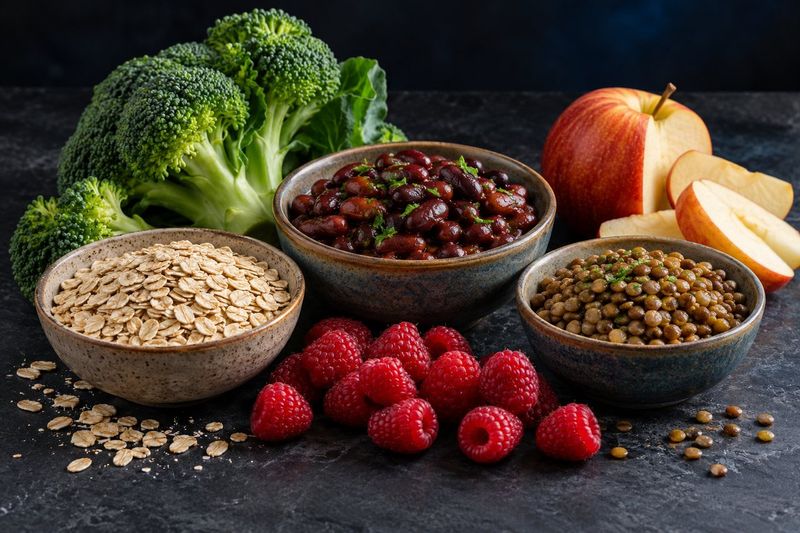
Adults need at least 25 g of fiber a day: that's what the World Health Organization (WHO) recommends. The European Food Safety Authority (EFSA) considers the same amount adequate, and Russian guidelines set 20–25 g. In a review of 185 observational studies and 58 clinical trials published in The Lancet, the reduction in risk for the main outcomes (heart disease, type 2 diabetes, and colon cancer) was greatest at 25–29 g a day. Fiber on its own has almost no effect on weight, but in a calorie deficit it helps a little. A deficit is when you get fewer calories from food than you burn.
I'm Demid Lobanov, a fitness coach. In the meal plans I put together, I check the amount of fiber over the week: an average of at least 25 g a day and at least 14 g per 1,000 kcal. If it falls short, I add 10–15 g of flaxseed to porridge, yogurt, or cottage cheese.
How much fiber you need per day: guidelines
Fiber, or dietary fiber, is the part of plant foods that isn't digested in the small intestine and reaches the large intestine. The guidelines of different organizations are close:
| Source | Recommendation for adults |
|---|---|
| WHO, 2023 | at least 25 g a day of naturally occurring fiber from food |
| EFSA, 2010 | 25 g a day, adequate for normal bowel function |
| Guidelines MR 2.3.1.0253-21, Rospotrebnadzor | 20–25 g a day or 10 g per 1,000 kcal |
| US Academy of Nutrition and Dietetics, 2015 | 14 g per 1,000 kcal: 25 g for women, 38 g for men |
Few people reach these targets. In the US, for example, people eat 17 g a day on average, and only 5% meet the American recommendation.
How much fiber do women and men need?
WHO and EFSA give one figure for all adults: 25 g. The American guideline depends on how many calories you eat: 14 g per 1,000 kcal. That's why the target is higher for men: 38 g versus 25 g for women.
In a deficit, the calorie-based calculation gives less. At 1,507 kcal a day, it comes to 21 g. This is a worked example for a 30-year-old woman, 165 cm tall and weighing 65 kg, with a 20% deficit, from the article How many calories you need per day. So in meal plans I use the larger of the two values: 25 g or 14 g per 1,000 kcal.
What fiber does for your body
The main data come from the 2019 review by Reynolds and colleagues in The Lancet: 185 prospective observational studies, in which people were followed for years without any intervention, and 58 clinical trials. Clinical trials test the effect of an intervention, such as a change in diet. A meta-analysis combines the results of several studies into a single estimate.
- Observational studies: people who ate the most fiber had 15–30% lower mortality from all causes and from cardiovascular disease. They also had less coronary heart disease (impaired blood supply to the heart), stroke, type 2 diabetes, and colon cancer. This is an association; it doesn't prove cause.
- Clinical trials: with more fiber, body weight, systolic blood pressure, and total cholesterol were lower.
- The reduction in risk was greatest at 25–29 g a day. According to dose-response curves, which show how the amount of fiber relates to the effect, more may be even better. The authors' confidence in the fiber data is moderate.
EFSA bases its 25 g on bowel function. The Russian guidelines describe soluble fiber separately: the kind that dissolves in water, such as pectin. It may affect cholesterol, blood sugar, and gut bacteria.
Does fiber help you lose weight?
A little. In meta-analyses, viscous fiber supplements reduced weight by 0.3 kg without calorie restriction and by 0.8 kg in a deficit. Viscous fiber is the kind that turns into a gel in water: beta-glucan from oats and barley, psyllium, pectin. Psyllium is the husk of Plantago seeds. The foundation of weight loss is a calorie deficit, and fiber can help you maintain it.
In a randomized trial, participants are assigned to groups at random. A statistically significant result is one that, by the criterion adopted in the study, is unlikely to be explained by chance.
| Study | What was compared | Result |
|---|---|---|
| Jovanovski et al., 2020: 62 randomized trials, 3,877 people | viscous fiber supplement without calorie restriction | weight −0.33 kg, waist −0.63 cm; body fat percentage didn't change significantly |
| Jovanovski et al., 2021: 15 trials, 1,347 people | viscous fiber supplement in a calorie deficit | weight −0.81 kg, body fat −1.39% |
| Miketinas et al., 2019: 345 people in a deficit, 6 months | association between fiber and results | more fiber, greater weight loss and better diet adherence; this kind of association doesn't prove cause |
The effect on satiety is modest. A systematic review is a summary of all the studies found on a question, done according to rules set in advance. In Clark and Slavin's 2013 systematic review, where the effect was assessed within 24 hours, fiber reduced appetite in 39% of comparisons with a control and food intake in 22%.
Viscous fiber worked more often: according to the 2011 review by Wanders and colleagues, it reduced appetite in 59% of tests versus 14% for less viscous fiber.
Fiber from the pharmacy: do you need a supplement?
The data on supplements are mixed. The Jovanovski meta-analyses above are also about supplements. In a review of 12 studies in adults with excess weight, soluble fiber supplements over 2–17 weeks produced a weight change of −2.52 kg, but the results varied widely between studies.
In a meta-analysis of 22 psyllium studies, weight didn't decrease significantly (−0.28 kg). The same was true for glucomannan, another type of soluble fiber, in 8 studies (−0.22 kg). Reported side effects included abdominal discomfort, diarrhea, and constipation.
WHO sets its target for naturally occurring fiber from food. That's why in meal plans I make up the amount with food: vegetables, berries, grains, legumes, and flaxseed. Whether you need a supplement for constipation or bowel disease is for your doctor to decide; with diabetes, the amount of fiber and supplements should also be discussed with your doctor.
Which foods have the most fiber?
The values come from the food database I use to build meal plans: data from the Federal Research Center of Nutrition and Biotechnology (Russia), GOST, and USDA; the bread values are estimates. Grains and legumes are listed dry, canned foods drained.
| Food and serving | Fiber |
|---|---|
| canned chickpeas, 150 g | 9.6 g |
| canned beans, 150 g | 8.2 g |
| bulgur, 60 g dry | 7.5 g |
| lentils, 60 g dry | 6.9 g |
| buckwheat, 60 g dry | 6.8 g |
| avocado, 100 g | 6.7 g |
| raspberries, 100 g | 6.5 g |
| pear, 180 g | 5.6 g |
| rye crispbread, 30 g | 5.0 g |
| apple, 1 whole (180 g) | 4.3 g |
| broccoli, 150 g | 3.9 g |
| rolled oats, 50 g | 3.0 g |
| flaxseed, 10 g | 2.7 g |
| almonds, 20 g | 2.5 g |
| whole-grain bread, 40 g | 2.4 g |
| white rice, 60 g dry | 1.8 g |
| cucumber, 150 g | 0.8 g |
How to get 25 g of fiber a day
An example from the table above: 50 g of oatmeal with 100 g of raspberries gives 9.5 g, 60 g of buckwheat with 150 g of broccoli gives 10.7 g, and an apple gives 4.3 g. Together that's 24.5 g, and with 10 g of flaxseed, 27.2 g.
In the weekly weight loss meal plan I put together from my meal plan recipe database, fiber averages about 27 g a day.
- Vegetables and fruit: at least 400 g a day, as WHO recommends.
- Grains: buckwheat, bulgur, oatmeal; bread: whole-grain bread or rye crispbread.
- Legumes (beans, chickpeas, lentils) at lunch or dinner.
- If you're short of your target, add 10–15 g of flaxseed to porridge, yogurt, or cottage cheese.
- Check your fiber over the week in a food tracking app: an average of at least 25 g a day and at least 14 g per 1,000 kcal.
Why fiber can cause bloating
Bloating is a common reaction to eating more fiber. In the randomized OmniHeart trial (164 people), on high-fiber diets it occurred in 24–33% of participants versus 18% at baseline, most often on the higher-protein version.
The 2026 review by Ozduran and colleagues on fiber in sport says that too much fiber can cause abdominal discomfort and reduce the number of calories you get from food. The authors suggest choosing your fiber sources and getting used to fiber gradually. Many athletes don't get enough fiber, partly because of restrictions before competitions. So increase your intake gradually.
Severe pain, blood in your stool, or a bowel disease is a reason to see a gastroenterologist.
I post exercise breakdowns on my YouTube channel @lobanov_fitness.
Sources
- World Health Organization. WHO updates guidelines on fats and carbohydrates, 2023. WHO news release
- EFSA Panel on Dietetic Products, Nutrition and Allergies (NDA). Scientific Opinion on Dietary Reference Values for carbohydrates and dietary fibre. EFSA Journal, 2010. Article
- Rospotrebnadzor. Guidelines MR 2.3.1.0253-21 “Norms of physiological requirements for energy and nutrients for various population groups of the Russian Federation”, 2021. Text (in Russian)
- Dahl WJ, Stewart ML. Position of the Academy of Nutrition and Dietetics: Health Implications of Dietary Fiber. J Acad Nutr Diet, 2015. Article
- Reynolds A et al. Carbohydrate quality and human health: a series of systematic reviews and meta-analyses. Lancet, 2019. Article
- Jovanovski E et al. Can dietary viscous fiber affect body weight independently of an energy-restrictive diet? A systematic review and meta-analysis of randomized controlled trials. Am J Clin Nutr, 2020. Article
- Jovanovski E et al. Effect of viscous fiber supplementation on obesity indicators in individuals consuming calorie-restricted diets: a systematic review and meta-analysis of randomized controlled trials. Eur J Nutr, 2021. Article
- Miketinas DC et al. Fiber Intake Predicts Weight Loss and Dietary Adherence in Adults Consuming Calorie-Restricted Diets: The POUNDS Lost (Preventing Overweight Using Novel Dietary Strategies) Study. J Nutr, 2019. Article · Full text
- Clark MJ, Slavin JL. The effect of fiber on satiety and food intake: a systematic review. J Am Coll Nutr, 2013. Article
- Wanders AJ et al. Effects of dietary fibre on subjective appetite, energy intake and body weight: a systematic review of randomized controlled trials. Obes Rev, 2011. Article
- Thompson SV et al. Effects of isolated soluble fiber supplementation on body weight, glycemia, and insulinemia in adults with overweight and obesity: a systematic review and meta-analysis of randomized controlled trials. Am J Clin Nutr, 2017. Article
- Darooghegi Mofrad M et al. The effects of psyllium supplementation on body weight, body mass index and waist circumference in adults: A systematic review and dose-response meta-analysis of randomized controlled trials. Crit Rev Food Sci Nutr, 2020. Article
- Onakpoya I et al. The efficacy of glucomannan supplementation in overweight and obesity: a systematic review and meta-analysis of randomized clinical trials. J Am Coll Nutr, 2014. Article
- Zhang M et al. Effects of High-Fiber Diets and Macronutrient Substitution on Bloating: Findings From the OmniHeart Trial. Clin Transl Gastroenterol, 2020. Article · Full text
- Ozduran E et al. Dietary Fiber in Sport: Implications for Performance and Body Composition Optimization. Int J Sport Nutr Exerc Metab, 2026. Article




