
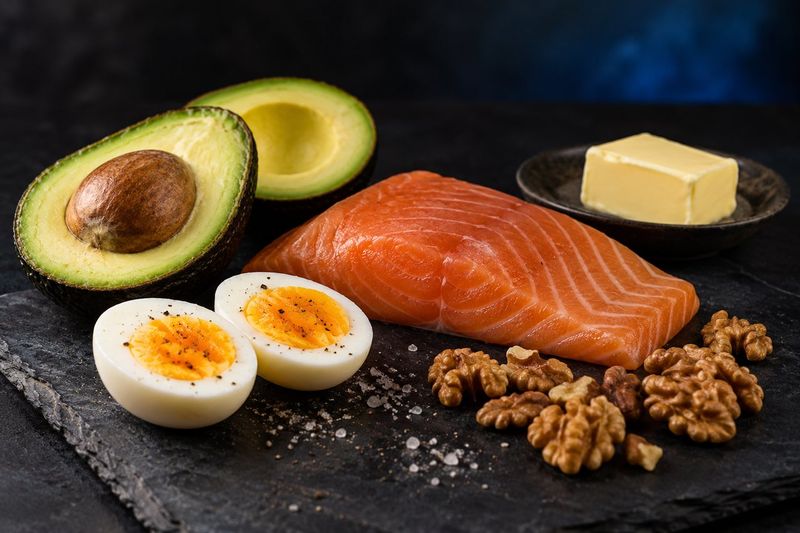
The keto diet is a way of eating so low in carbs, usually no more than 50 g a day, that the liver starts making ketone bodies from fat, and the brain uses them as an alternative energy source. People lose weight on keto through the same calorie deficit: when you get less energy from food than you burn. After a year, weight loss is on average 0.9 kg greater than on a low-fat diet. With equal calories, fat doesn't come off any faster on keto.
I'm Demid Lobanov, a fitness coach. My nutrition materials sum up keto briefly: for a healthy person who trains, it makes no sense, and it carries a risk for the thyroid. Below is what research confirms of this and what is still an open question.
What the keto diet is, in simple terms
On keto, carbs are cut to 50 g a day or less; that's how the diet is defined in the 2013 meta-analysis by Bueno and colleagues. A meta-analysis pools the results of several studies. Fat becomes the main fuel: the liver turns it into ketone bodies, which the brain uses as an alternative fuel. This state is called ketosis. The diet is high in fat: in the 2021 study by Hall and colleagues, almost 76% of calories.
Keto is also used as a therapeutic diet for epilepsy that can't be controlled with medication. According to the 2020 Cochrane review by Martin-McGill and colleagues, children on keto have fewer seizures, but the certainty of this is low, and in adults the effect is unclear.
What you eat on keto: how many carbs are in foods
The values below are digestible carbs per 100 g from the food database behind my meal plans. It's compiled from the database of the Federal Research Center of Nutrition and Biotechnology (Russia), the American USDA database, and Russian GOST standards.
| Food | Carbs per 100 g | 50 g of carbs equals |
|---|---|---|
| Sugar | 100 g | 50 g of sugar |
| White rice, dry | 74 g | 68 g of dry grain |
| Buckwheat, dry | 57.1 g | 88 g |
| Rye bread | 41 g | 122 g |
| Banana | 20.2 g | 248 g |
| Potatoes | 15.4 g | 325 g |
| Apple | 11.4 g | 439 g |
| Milk, 2.5% | 4.8 g | about 1 L |
| Broccoli | 4 g | 1.25 kg |
| Egg | 0.7 g | – |
| Chicken breast, mackerel, semi-hard cheese, vegetable oil | 0 g | – |
An 80 g serving of dry buckwheat already accounts for 46 g of carbs out of 50. That's why keto nearly eliminates sugar, grains, bread, potatoes, and most fruit, and the diet is built on meat, fish, eggs, cheese, oils, and low-starch vegetables.
In my nutrition calculations, carbs get the calories left over after protein and fat are set. I don't ban foods: anything goes within your calorie target. Keto cuts out an entire food group. Some people find it easier to stay in a deficit that way, but fat doesn't come off any faster because of it.
Does the keto diet help you lose weight?
It does, like any other diet with a calorie deficit. In Bueno's meta-analysis (13 randomized trials lasting a year or longer, 1,415 people), weight dropped 0.91 kg more on keto than on a low-fat diet. In randomized trials, participants are assigned to groups at random. In the 2020 network meta-analysis by Ge and colleagues (121 studies, 21,942 people), low-carb diets, not necessarily keto, reduced weight by 4.63 kg at six months compared with usual eating, and low-fat diets by 4.37 kg. By one year, weight loss had shrunk with every approach.
With equal calories, keto has no advantage. In the 2017 review by Hall and Guo of 32 controlled-feeding studies, energy expenditure and fat loss were actually slightly higher on the lower-fat diet. In the 2016 study by Hall and colleagues, 17 overweight men lived in a metabolic ward: 4 weeks on a high-carb diet, then 4 weeks on keto with the same calories. On keto, fat loss slowed down, and more fat-free mass was lost. Fat-free mass is everything in the body except fat, including muscle and water.
The quick drop in the first weeks is partly water. Glycogen, the carb store in your liver and muscles, is stored together with water: three to four parts water to one part glycogen. When carbs are low, glycogen gets used up, and the water goes with it.
Are you less hungry on keto?
Slightly. In the 2015 meta-analysis by Gibson and colleagues, people in ketosis were a little less hungry. According to the authors' conclusion, the benefit is that hunger usually rises during weight loss, while in ketosis it doesn't. But in Hall's 2021 study, 20 adults ate as much as they wanted on two diets for two weeks each: on the plant-based, low-fat diet they took in 689 kcal a day less than on the animal-based keto diet.
What keto does to muscle
For people who train, this is the main downside. In the 2022 meta-analysis by Ashtary-Larky and colleagues (13 studies, 244 people doing strength training), weight dropped 3.67 kg more on keto and fat 2.21 kg more, but fat-free mass also dropped 1.26 kg more. The authors' conclusion: keto may reduce fat-free mass, and strength training doesn't fix that.
The 2023 umbrella review by Patikorn and colleagues (17 meta-analyses), after recalculating this same meta-analysis, also lists loss of muscle mass among the adverse effects of keto. Without a calorie deficit, according to the 2022 review by Vargas-Molina and colleagues (5 studies, 111 trained people), fat-free mass did not differ significantly from a regular diet. If your goal is muscle growth, keto offers no advantage.
Keto and cholesterol
The Patikorn review showed with high certainty that in adults with type 2 diabetes, over a year on keto, triglycerides went down, while LDL cholesterol, the "bad" kind, went up by 6.35 mg/dL, about 0.16 mmol/L. The authors call this increase clinically significant, meaning important for assessing health, but they note that by itself it doesn't necessarily mean harm to the heart. In people with excess weight, very-low-calorie keto did not worsen LDL. And in people of normal weight, in the 2023 meta-analysis by Joo and colleagues (3 randomized trials), LDL rose by 1.08 mmol/L and total cholesterol by 1.47 mmol/L; "good" HDL rose too, by 0.35 mmol/L, but the authors advise taking the risk into account. If you stay on keto long term, get your blood cholesterol checked.
Keto and the thyroid
There's little data. In the 2022 pilot study by Iacovides and colleagues, 11 healthy people spent 3 weeks each on keto and on a high-carb diet with the same calories. After keto, the thyroid hormone T3 was lower and T4 was higher than at baseline, while thyroid-stimulating hormone (TSH), which regulates thyroid function, didn't change. The authors write about as yet unknown metabolic changes in ketosis.
In children on a therapeutic keto diet for epilepsy, the 2017 observational study by Kose and colleagues (120 children, on keto for at least a year) found hypothyroidism, meaning reduced thyroid function, in 20 of them, or 16.7%, more often in girls and in those whose TSH was elevated from the start. There was no control group. In the 2017 observational study by Lee and colleagues (28 children), hormone levels did not change significantly on average.
So I'd refine the "risk for the thyroid" from my materials this way: in healthy adults the risk has not been proven, but there are open questions. If you have thyroid disease, keto only together with an endocrinologist.
| What's promised | What research shows |
|---|---|
| You lose weight faster | after a year, 0.9 kg more than on a low-fat diet; with equal calories, no advantage |
| You're less hungry | hunger is slightly lower; when eating freely, people on keto ate 689 kcal a day more than on a plant-based diet |
| Only fat comes off | with strength training, fat-free mass dropped 1.26 kg more |
| It's good for your heart | triglycerides lower, LDL higher; at normal weight, by 1.08 mmol/L |
Side effects of the keto diet
In the first weeks, people describe the "keto flu": headache, fatigue, nausea, dizziness. In the 2020 analysis by Bostock and colleagues, 101 of 300 users of online forums wrote about such symptoms, most often in the first week. This is weak evidence: forum stories, not a clinical study.
In the 2019 practical guide by Muscogiuri and colleagues on the therapeutic very-low-calorie keto diet, the most common early complications are dehydration (dry mouth, headache, dizziness) and digestive complaints: nausea, diarrhea, or constipation. The guide requires at least 2 L of sugar-free fluids a day. Constipation comes partly from eating less fiber.
Among the long-term risks are kidney stones: in the 2021 meta-analysis by Acharya and colleagues (36 studies, 2,795 people on keto), they occurred in 5.9% over 3.7 years of follow-up, and in 7.9% of adults. These studies don't compare against people who weren't on keto.
Who should not follow the keto diet
The Italian Society of Endocrinology lists absolute contraindications for the therapeutic very-low-calorie keto diet; the Muscogiuri guide cites them. Among them: type 1 diabetes; taking gliflozins, SGLT2 inhibitors (drugs that lower blood sugar), because of the risk of ketoacidosis, a dangerous acidification of the blood; pregnancy and breastfeeding; kidney and liver failure; severe heart failure, heart rhythm disorders, a heart attack or stroke in the last 12 months; eating disorders.
With these conditions, a regular keto diet is also started only with a doctor. In type 2 diabetes treated with insulin and sulfonylureas, drugs that lower blood sugar, a sharp cut in carbs risks hypoglycemia, a drop in blood sugar, so treatment is adjusted together with a doctor. That's the advice of the 2019 practical guide by Murdoch and colleagues.
If you decide to try keto: step by step
- Check the contraindications. Diabetes medications, kidney, liver, heart, or thyroid disease: see a doctor first.
- Count your calories, since weight loss comes from a deficit. See the article How Many Calories You Need per Day.
- Eat enough protein and keep up your strength training. See the articles How Much Protein You Need per Day and Cutting.
- Drink enough water. See the article How Much Water to Drink per Day.
- Some of the first kilograms you lose are water. Watch your average weight for the week. See the article The Scale Isn't Moving.
- If you stay on keto long term, get your blood cholesterol checked; if your LDL has gone up, discuss with your doctor whether to continue keto.
- If it's hard to stick with, go back to regular eating with a deficit: at six months, low-carb and low-fat diets give similar results. See the article How to Lose Weight.
If you need meals built around your calorie target and your tastes, there's the meal plan.
I post exercise breakdowns on my YouTube channel @lobanov_fitness.
Sources
- Bueno NB et al. Very-low-carbohydrate ketogenic diet v. low-fat diet for long-term weight loss: a meta-analysis of randomised controlled trials. Br J Nutr, 2013. Article
- Bostock ECS et al. Consumer Reports of "Keto Flu" Associated With the Ketogenic Diet. Front Nutr, 2020. Article · Full text
- Iacovides S et al. Could the ketogenic diet induce a shift in thyroid function and support a metabolic advantage in healthy participants? A pilot randomized-controlled-crossover trial. PLoS One, 2022. Article · Full text
- Hall KD et al. Effect of a plant-based, low-fat diet versus an animal-based, ketogenic diet on ad libitum energy intake. Nat Med, 2021. Article
- Martin-McGill KJ et al. Ketogenic diets for drug-resistant epilepsy. Cochrane Database Syst Rev, 2020. Article · Full text
- Ge L et al. Comparison of dietary macronutrient patterns of 14 popular named dietary programmes for weight and cardiovascular risk factor reduction in adults: systematic review and network meta-analysis of randomised trials. BMJ, 2020. Article · Full text
- Hall KD, Guo J. Obesity Energetics: Body Weight Regulation and the Effects of Diet Composition. Gastroenterology, 2017. Article · Full text
- Hall KD et al. Energy expenditure and body composition changes after an isocaloric ketogenic diet in overweight and obese men. Am J Clin Nutr, 2016. Article · Full text
- Kreitzman SN et al. Glycogen storage: illusions of easy weight loss, excessive weight regain, and distortions in estimates of body composition. Am J Clin Nutr, 1992. Article
- Gibson AA et al. Do ketogenic diets really suppress appetite? A systematic review and meta-analysis. Obes Rev, 2015. Article
- Ashtary-Larky D et al. Effects of resistance training combined with a ketogenic diet on body composition: a systematic review and meta-analysis. Crit Rev Food Sci Nutr, 2022. Article
- Patikorn C et al. Effects of ketogenic diet on health outcomes: an umbrella review of meta-analyses of randomized clinical trials. BMC Med, 2023. Article · Full text
- Vargas-Molina S et al. Effects of the Ketogenic Diet on Muscle Hypertrophy in Resistance-Trained Men and Women: A Systematic Review and Meta-Analysis. Int J Environ Res Public Health, 2022. Article · Full text
- Joo M et al. Effects of very low-carbohydrate ketogenic diets on lipid profiles in normal-weight (body mass index < 25 kg/m2) adults: a meta-analysis. Nutr Rev, 2023. Article
- Kose E et al. Changes of thyroid hormonal status in patients receiving ketogenic diet due to intractable epilepsy. J Pediatr Endocrinol Metab, 2017. Article
- Lee YJ et al. Longitudinal Change in Thyroid Hormone Levels in Children with Epilepsy on a Ketogenic Diet: Prevalence and Risk Factors. J Epilepsy Res, 2017. Article · Full text
- Muscogiuri G et al. The management of very low-calorie ketogenic diet in obesity outpatient clinic: a practical guide. J Transl Med, 2019. Article · Full text
- Acharya P et al. Incidence and Characteristics of Kidney Stones in Patients on Ketogenic Diet: A Systematic Review and Meta-Analysis. Diseases, 2021. Article · Full text
- Murdoch C et al. Adapting diabetes medication for low carbohydrate management of type 2 diabetes: a practical guide. Br J Gen Pract, 2019. Article · Full text




