
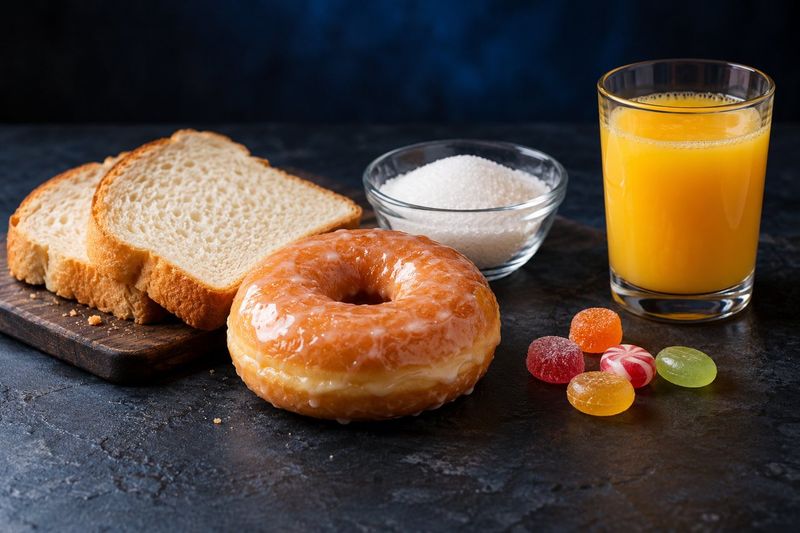
Fast carbs usually means carbs from foods with a high glycemic index (GI), 70 or above. GI is a measure of how much a food raises blood sugar: after these foods, it rises more. Slow carbs are those in foods with a low GI, 55 or below. But the split is just a convention: white and whole-wheat bread have almost the same GI, 75 and 74, and regular sugar is even lower, at 65. For your weight, calories matter more: sugar affects weight through them.
I'm Demid Lobanov, a fitness coach. In my nutrition materials, the split into fast and slow carbs is a practical model, not a law. There I also point out that fruit is not the same as sugar. Below is where these caveats come from and how to use a GI table without banning foods.
What fast and slow carbs are
Carbs are often divided by structure: simple sugars are considered fast, and starch slow. The glycemic index measures something else: how much a food raises blood sugar. A person eats a portion of the food containing 50 g of digestible carbs. The rise in blood sugar over the next few hours is compared with the rise from 50 g of glucose, a simple sugar whose GI is set at 100. A GI of 55 or below is considered low, 70 or above high, and anything in between medium.
The measurements don't fit this split. The starch in white bread and boiled potatoes raises blood sugar more than regular sugar does: a GI of 75 and 78 versus 65. And fructose, one of the sugars in fruit, has a GI of just 15.
Glycemic index table of foods
The values are averages across studies from different labs, taken from the 2008 international tables by Atkinson and colleagues.
| Food | GI | Category |
|---|---|---|
| Instant mashed potatoes | 87 | high |
| Rice cakes | 87 | high |
| Cornflakes | 81 | high |
| Instant oatmeal | 79 | high |
| Boiled potatoes | 78 | high |
| Watermelon | 76 | high |
| White bread | 75 | high |
| Whole-wheat bread | 74 | high |
| Boiled white rice | 73 | high |
| Boiled brown rice | 68 | medium |
| Couscous | 65 | medium |
| Sugar (sucrose) | 65 | medium |
| Boiled sweet potato | 63 | medium |
| Honey | 61 | medium |
| Sugary soda | 59 | medium |
| Muesli | 57 | medium |
| Rolled oat porridge | 55 | low |
| Banana | 51 | low |
| Ice cream | 51 | low |
| Orange juice | 50 | low |
| White-flour spaghetti | 49 | low |
| Orange | 43 | low |
| Chocolate | 40 | low |
| Whole milk | 39 | low |
| Boiled carrots | 39 | low |
| Apple | 36 | low |
| Lentils | 32 | low |
| Red kidney beans | 24 | low |
| Fructose | 15 | low |
The table shows three things. Processing changes GI: rolled oat porridge is 55, while instant oatmeal is 79. Regular whole-wheat bread barely differs from white bread in GI; bread with whole kernels can have a low GI, 53. And a low GI doesn't mean "healthy": chocolate is 40, but the authors of the tables point out that it's high in saturated fat and advise looking at GI together with a food's calorie content and composition.
Why GI is a guideline, not an exact number
In a 2016 study by Matthan and colleagues, 63 healthy people ate white bread and glucose three times each. The average GI of the bread came out at 62 ± 15, compared with 75 in Atkinson's tables. Within the same person, GI varied by 20% on average from one test to the next, and between people by 25%. The authors conclude that this approach is unlikely to be a good way to choose foods.
There is another view. In a 2015 consensus, the International Carbohydrate Quality Consortium (ICQC) recognized GI as a reliable way to classify carbohydrate foods, and a low-GI diet as important for preventing and treating diabetes and coronary heart disease and, probably, obesity. But the consortium also notes that a low GI makes sense in a diet that is already healthy, together with fiber and whole grains.
GI is calculated for 50 g of carbs, but a normal portion may contain more or less. That's why there is glycemic load: the carbs in a portion multiplied by the GI and divided by 100. Watermelon has a high GI, 76, but 200 g of watermelon contains about 14 g of carbs, so the load is about 11. In 70 g of dry white rice there are 52 g of carbs, and with a GI of 73 the load is about 38, three and a half times higher. The carbs per 100 g here come from the food database of my meal plan.
Do fast carbs get in the way of weight loss?
On their own, probably not: calories are what matter most. A 2013 meta-analysis by Te Morenga and colleagues pooled the results of 30 randomized and 38 cohort studies. In the former, participants are randomly assigned to groups; in the latter, they are observed over time. With unrestricted eating, less sugar meant 0.80 kg lower body weight, and more sugar meant 0.75 kg higher. But when sugar was replaced with other carbs of the same calorie content, weight didn't change. The authors' conclusion: sugar affects weight through calories.
Low-GI diets help a little. In a 2007 Cochrane review by Thomas and colleagues (6 studies, 202 people with excess weight; weight was compared in 163), weight dropped 1.1 kg more than on other diets. In a 2019 meta-analysis by Zafar and colleagues (101 studies, 8,527 people), weight loss was small but statistically significant. And in a 2013 meta-analysis of long-term studies by Schwingshackl and Hoffmann (14 studies), weight and body measurements didn't change significantly, but on a low GI, 1.04 kg more fat-free mass was lost.
The idea that fast carbs by themselves make you overeat was tested in a 2021 study by Hall and colleagues, and it wasn't confirmed. In it, 20 adults ate as much as they wanted for two weeks on each diet. On a plant-based diet of minimally processed foods with a high glycemic load and little fat, they consumed 689 kcal per day less than on a keto diet with a low load. A keto diet is a way of eating with very few carbs and a lot of fat. This is a single small study.
Fruit is not the same as sugar
The World Health Organization (WHO) defines free sugars as sugars added to food and drinks by the manufacturer, the cook, or the person eating them, as well as the sugars in honey, syrups, fruit juices, and concentrates. Sugars in whole fruit are not on this list. An apple has a GI of 36, an orange 43, a banana 51: all low.
Juice is a different story. In a 2024 meta-analysis by Nguyen and colleagues (42 studies), in children each daily serving of 100% juice was associated with an increase in body mass index, a measure of weight relative to height. In adults, weight gain was seen in studies that didn't account for the calorie content of the diet; the authors attribute it to the calories in juice.
But fruit doesn't burn fat on its own either. In a 2014 meta-analysis by Kaiser and colleagues, advice to eat more fruit and vegetables without cutting back on other food did not lead to weight loss.
How much sugar per day is OK?
The WHO recommends that free sugars make up less than 10% of your daily calories: at 2,000 kcal, that's about 50 g, roughly 12 level teaspoons. Reducing this to 5% or less may provide additional benefits. With a daily target of 1,500 kcal, 10% is 150 kcal, about 37.5 g of sugar.
In my nutrition materials, the rule is: everything is allowed within your calorie target. Sweets aren't banned; they fit into your daily calorie target. And the WHO guideline will tell you how much room to give them.
Fast carbs and training
Before a regular strength workout, they do almost nothing for someone who has already eaten: in a 2022 systematic review by Henselmans and colleagues, a single dose of carbs did not improve performance in 13 of 19 studies. Where they are needed is long, intense exercise: the International Society of Sports Nutrition (ISSN) recommends 30–60 g of carbs per hour for sessions longer than an hour. Quickly replenishing your carb stores after training is worthwhile if your next session is less than 4 hours away. Details in the article What to Eat Before and After a Workout.
What matters more than the glycemic index
With diabetes, GI makes more sense. In a 2021 meta-analysis by Chiavaroli and colleagues (29 comparisons, 1,617 people with type 1 and type 2 diabetes), a low-GI diet lowered glycated hemoglobin, the main measure of blood sugar control in this review, by 0.31%, with high certainty. A meal plan for diabetes is put together with a doctor.
For everyone else, fiber matters more. In a 2019 series of meta-analyses by Reynolds and colleagues (185 observational studies and 58 clinical trials), disease risk dropped the most at 25–29 g of fiber per day, with similar results for whole grains. Observational studies track people's diet and health; clinical trials test the effect of changes in diet. For low GI, the risk reduction was smaller or absent; certainty in these data is low and very low.
How to use GI: step by step
- First, calculate your calories and protein: see the articles How Many Calories Do You Need per Day and How Much Protein Do You Need per Day.
- Get most of your carbs from foods with fiber: grains, legumes, vegetables, and whole fruit. Aim for 25–29 g of fiber per day.
- Fit sweets and juices into your calorie target; keep free sugars under 10% of calories.
- Look not only at GI but also at the portion: glycemic load depends on the amount of carbs.
- Fast carbs can come in handy during a long, intense workout and when there's a short break between workouts.
- If you have diabetes or prediabetes (elevated blood sugar that hasn't yet reached the level of diabetes), put together your meal plan with a doctor.
- Judge your weight loss progress by your average weight over the week: see the article When Your Weight Stalls.
If you need meals built around your calorie target and your tastes, there's the meal plan.
For the full picture on weight loss, see the article How to Lose Weight. I post exercise breakdowns on my YouTube channel @lobanov_fitness.
Sources
- Atkinson FS et al. International tables of glycemic index and glycemic load values: 2008. Diabetes Care, 2008. Article · Full text
- Matthan NR et al. Estimating the reliability of glycemic index values and potential sources of methodological and biological variability. Am J Clin Nutr, 2016. Article · Full text
- Augustin LSA et al. Glycemic index, glycemic load and glycemic response: An International Scientific Consensus Summit from the International Carbohydrate Quality Consortium (ICQC). Nutr Metab Cardiovasc Dis, 2015. Article
- Te Morenga L et al. Dietary sugars and body weight: systematic review and meta-analyses of randomised controlled trials and cohort studies. BMJ, 2013. Article
- Thomas DE et al. Low glycaemic index or low glycaemic load diets for overweight and obesity. Cochrane Database Syst Rev, 2007. Article · Full text
- Zafar MI et al. Low glycaemic index diets as an intervention for obesity: a systematic review and meta-analysis. Obes Rev, 2019. Article
- Schwingshackl L, Hoffmann G. Long-term effects of low glycemic index/load vs. high glycemic index/load diets on parameters of obesity and obesity-associated risks: a systematic review and meta-analysis. Nutr Metab Cardiovasc Dis, 2013. Article
- Hall KD et al. Effect of a plant-based, low-fat diet versus an animal-based, ketogenic diet on ad libitum energy intake. Nat Med, 2021. Article
- WHO. Healthy diet. Fact sheet, January 26, 2026. Page
- Nguyen M et al. Consumption of 100% Fruit Juice and Body Weight in Children and Adults: A Systematic Review and Meta-Analysis. JAMA Pediatr, 2024. Article · Full text
- Kaiser KA et al. Increased fruit and vegetable intake has no discernible effect on weight loss: a systematic review and meta-analysis. Am J Clin Nutr, 2014. Article · Full text
- Henselmans M et al. The Effect of Carbohydrate Intake on Strength and Resistance Training Performance: A Systematic Review. Nutrients, 2022. Article · Full text
- Kerksick CM et al. International society of sports nutrition position stand: nutrient timing. J Int Soc Sports Nutr, 2017. Article · Full text
- Chiavaroli L et al. Effect of low glycaemic index or load dietary patterns on glycaemic control and cardiometabolic risk factors in diabetes: systematic review and meta-analysis of randomised controlled trials. BMJ, 2021. Article · Full text
- Reynolds A et al. Carbohydrate quality and human health: a series of systematic reviews and meta-analyses. Lancet, 2019. Article




