
"I think I'm overtrained" – people often walk into the gym saying this after two hard weeks. Their usual working weight feels like lead, and the drive to train disappears. Online advice in these cases often tells them to order a dozen cortisol tests and quit the gym for a month.
In reality, true overtraining syndrome is rare in recreational strength training. Far more often, lifters are dealing with accumulated fatigue from excessive volume, frequent training to failure, poor sleep, and everyday life stress.
These states call for different responses. In my coaching practice, accumulated fatigue often responds well to a 5–7 day deload week and better sleep, whereas taking a full week completely off when you are not overreached can sometimes hold back strength gains.
I am Demid Lobanov, a coach and strength training educator. Below, I break down how sports medicine classifies fatigue stages and which signs genuinely point to overload. We will cover why blood work rarely settles the question and how to structure a deload without losing progress.
Three stages of fatigue: why not every slump is overtraining
The joint consensus statement of the European College of Sport Science and the American College of Sports Medicine (Meeusen et al., 2013) divides the body's response to overload into three states.
Because the symptoms of non-functional overreaching and overtraining syndrome often overlap, clinicians separate them by clinical outcome, recovery timeline, and a diagnosis of exclusion—ruling out other medical and nutritional causes first.
| State | What happens to performance | Nature of maladaptation | Practical response |
|---|---|---|---|
| Functional overreaching (FOR) | Short-term dip in performance without severe or lasting negative symptoms | Reversible productive overload | Planned load reduction; performance often rebounds above baseline after recovery |
| Non-functional overreaching (NFOR) | Persistent plateau or drop in lifts, fatigue, and mood disturbances | Accumulated fatigue without added benefit from overload | Structured deload and review of volume, sleep, nutrition, and outside stressors |
| Overtraining syndrome (OTS) | Prolonged maladaptation with lasting performance decline | Extended state with symptoms often overlapping NFOR | Medical evaluation (diagnosis of exclusion) and clinician-guided recovery |
Research in strength sports highlights an important point. A scoping review of 47 publications (Bell et al., 2020) confirmed that chronic high-volume or high-intensity resistance training can push lifters into non-functional overreaching.
However, reliable evidence of true overtraining syndrome in resistance training and strength sports is minimal. This aligns with qualitative interviews of 14 high-performance strength sport coaches across weightlifting, powerlifting, sprinting, throws, and jumps (Bell et al., 2021).
Most coaches viewed OTS prevalence as low and had not observed long-term performance declines in their athletes.
In my practice, when recreational lifters training 3–4 times per week feel sluggish for a second week in a row, the cause is usually accumulated fatigue rather than a multi-month breakdown in adaptation.
Which symptoms are reliable and which can mislead
A systematic review of 22 studies on overtraining in resistance exercise (Grandou et al., 2020) found no standardized biomarker scale.
Out of 22 studies, 8 recorded a performance decline with follow-up testing after rest, 4 noted a decline without follow-up measures, and 10 found no decline at all.
The only reliably established indicator of overreaching in resistance exercise remains a sustained drop in performance. In practice, that looks like working weights or reps falling off and failing to bounce back after a couple of rest days.
The ECSS and ACSM consensus (Meeusen et al., 2013) confirms the same diagnostic limits. Hormonal, biochemical, immune markers, performance tests, and questionnaires do not yet meet all criteria for a universally accepted OTS test.
OTS itself is a diagnosis of exclusion. Before blaming chronic exhaustion on the gym, a physician must rule out organic diseases, infections, iron or magnesium deficiencies, allergies, and inadequate calories, carbohydrates, or protein.
In an international survey of 605 competitive athletes from sports with a major resistance-training component (Grandou et al., 2021), roughly 71% reported having experienced an unexplained performance drop. For 43.8% of them, the slump lasted from one week to one month.
General fatigue was the most frequently reported symptom. Slumps lasting under a month were also commonly accompanied by musculoskeletal aches and pains. Because this was a cross-sectional self-report survey, it maps symptom patterns and associations rather than proving direct causation.
In my coaching practice, accumulated overload shows up most clearly as a cluster of four everyday signs:
- Working weights or reps drop for 2–3 sessions in a row despite unchanged technique and a normal warm-up.
- Warm-up sets feel unusually heavy, and bar speed slows noticeably even on the first working set.
- Joints and tendons feel achy, and normal post-workout muscle soreness lingers longer than usual and carries into the next session.
- Sleep worsens and drive to train drops, even though gym sessions used to help you unwind.
Why overload happens: gym stress rarely acts alone
The same survey of 605 athletes (Grandou et al., 2021) revealed a striking pattern: in 92.5% of cases, training maladaptation occurred alongside additional non-training stressors. In practice, evaluating a slump means looking at work, family, and daily demands—not just your training log.
Three primary drivers of overload are well documented in the literature:
- Training to muscular failure on top of high volume. In Grandou et al. (2021), a larger share of athletes with severe maladaptation lasting over four months trained to muscle failure. A systematic review of 51 studies (Varela-Olalla et al., 2025) confirmed that proximity to failure, high volume, set duration, and session density drive the largest spikes in acute neuromuscular and perceived fatigue, especially with lighter loads. Meanwhile, the ACSM Position Stand synthesizing 137 systematic reviews (Currier et al., 2026) found that training to momentary muscle fatigue did not consistently improve strength or hypertrophy outcomes in healthy adults compared with stopping short of failure. See the full breakdown in Training to Failure.
- Accumulated sleep restriction. A systematic review of 17 studies rated moderate or weak in methodological quality (Knowles et al., 2018) found that consecutive nights of restricted sleep can reduce force output in multi-joint lifts. Single-joint movements were unaffected, and single-night total sleep deprivation had little effect. As a result, several workweek nights of cut sleep can drag down working weights in compound lifts like squats and pulls.
- Aggressive calorie deficits and monotonous overload. The ECSS/ACSM consensus explicitly lists negative energy balance and low carbohydrate or protein intake among factors that must be ruled out during prolonged slumps. In my practice, pairing a steep calorie cut with high weekly set volume quickly outpaces recovery capacity. For practical volume limits, see How Many Sets Per Week.
How to run a deload without losing strength
When fatigue hits, the first instinct is to skip the gym completely for a week. Research suggests that complete rest is not always the best move.
In a randomized controlled trial of 39 resistance-trained men and women (Coleman et al., 2024), one group took a full one-week break from lifting at the midpoint of a nine-week high-volume program. The other group trained continuously without a break.
Researchers assessed the lower body. Full cessation offered no advantage in muscle growth, power, or local muscular endurance. Lower-body strength improved more in the continuous group, which also showed slight psychological benefits in readiness to train.
One key caveat: the break was pre-planned, and participants were not overreached at the time.
When fatigue has actually built up, experienced lifters and coaches typically choose an active deload rather than complete rest—a brief, planned reduction in training stress.
In a survey of 246 competitive strength and physique athletes (Rogerson et al., 2024), every respondent used deloads primarily to manage energy and fatigue.
Deloads averaged 6.4 ± 1.7 days and occurred every 5.6 ± 2.3 weeks. Note that this is a self-reported survey of coaching practice rather than a clinical efficacy trial.
Athletes reduced training volume (both sets and reps), load lifted, and effort (leaving more reps in reserve), while keeping training frequency and exercise selection unchanged.
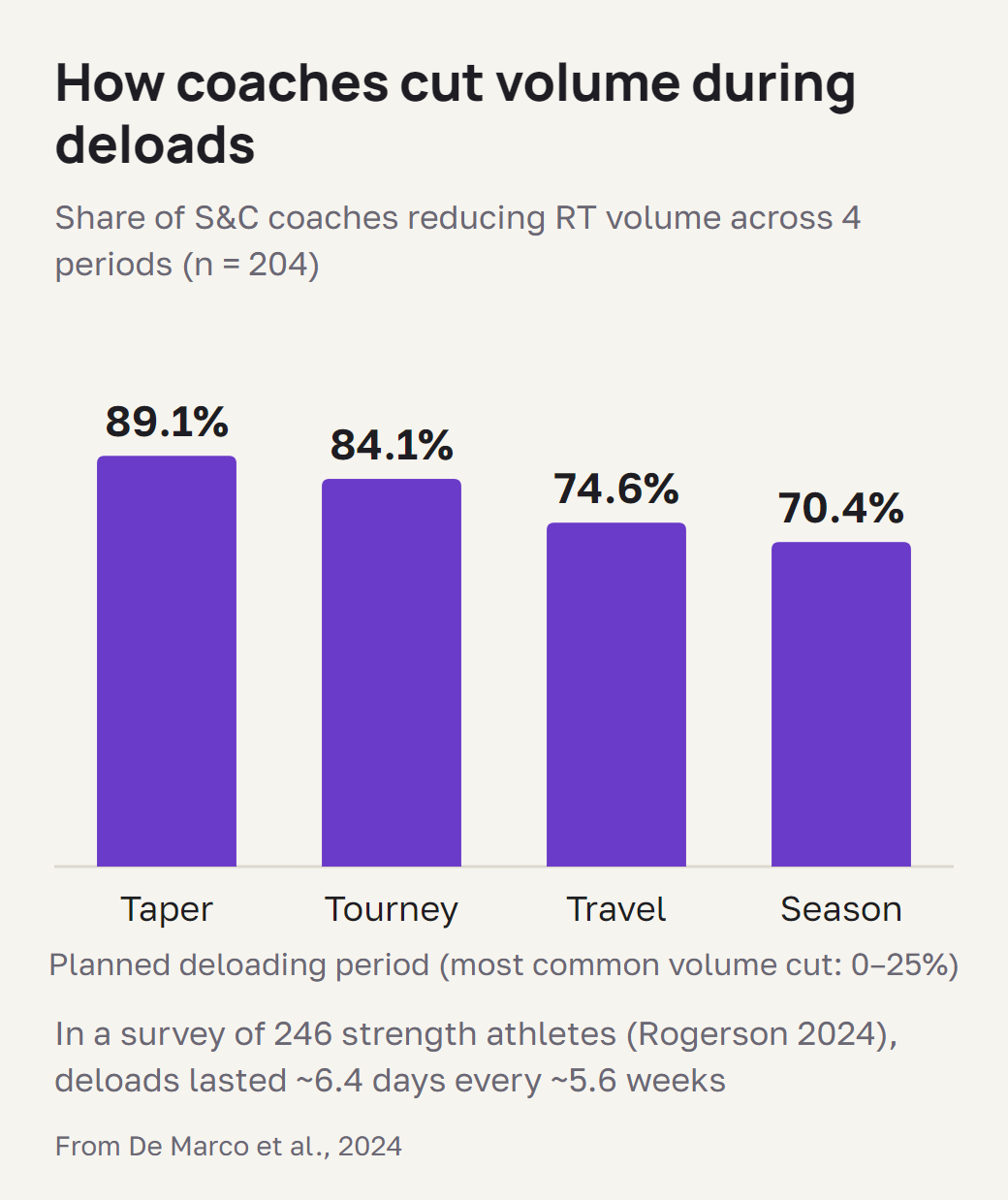
A survey of 204 strength and conditioning coaches (De Marco et al., 2024) showed a similar pattern. Most coaches reduced resistance-training volume—most commonly by 0–25%—across four planned deloading periods.
Volume cuts were reported during taper (89.1%), tournaments (84.1%), travel (74.6%), and competitive season (70.4%).
Intensity was reduced by just over half of coaches in three of those four periods: taper (52.9%), travel (53.6%), and tournaments (54.8%). During the competitive season, most coaches did not reduce intensity.
In my practice, recreational lifters dealing with accumulated gym fatigue do best with a clear 5–7 day deload plan:
- Keep your usual days and exercises so you preserve movement skill and routine.
- Cut working sets by 30–40%. If you normally perform 4 working sets of a press or row, drop to 2–3.
- Increase reps in reserve to RIR 3–4. RIR measures how many reps you could still perform before failure. Keep the load moderate—roughly 10–15% lighter than usual—or unchanged, and finish every set cleanly without grinding.
- Restore sleep and calories. If you were in a steep deficit, bring calories back up to maintenance for the week and add 1–1.5 hours of sleep per night.
- Ramp back up smoothly. After the deload week, resume at roughly 85–90% of prior volume rather than jumping straight to peak loads, and track bar weights. For integrating deloads into longer cycles, see Periodization in Strength Training.
In my practice, seeing energy and working weights rebound within 7–10 days of lighter work typically points to reversible fatigue (any formal OTS diagnosis is always made by a physician through exclusion).
If fatigue comes with fever, shortness of breath, heart palpitations, or unexplained weight loss, see a physician immediately rather than waiting out a deload. Seek medical evaluation as well if persistent exhaustion, weakness, or sleep disruption do not improve after a deload week.
When the program itself needs fixing
Sometimes fatigue returns two weeks after every break. In that case, the root issue usually sits in program design: too many heavy sets for the same muscle groups, redundant exercises, chronic failure training, or no alternation between heavier and lighter days.
You can run an initial self-check using the step-by-step checklist in How to Audit Your Workout Program. I also share short breakdowns of load management and lifting technique on Demid Lobanov's YouTube channel.
If you want a detailed review of your current program with volume recalculation and video technique analysis, you can request a training protocol review. For fellow coaches looking to build systematic load management and troubleshoot tough client cases, see coaching education and case reviews for trainers.
Frequently asked questions
Do I need to take a deload week strictly once a month?
No—there is no mandatory calendar for everyone. As Coleman et al. (2024) showed, taking a full pre-planned week off mid-cycle when you feel fresh and are progressing adds no extra muscle and can slightly blunt strength gains. In my coaching practice, recreational lifters do better pairing a rough 5–8 week guideline with actual readiness and their training log.
Can resting heart rate or a fitness tracker diagnose overtraining?
In my practice, morning heart rate and heart rate variability serve only as background context when the body is run down from stress, poor sleep, or illness. A watch alone cannot diagnose overtraining—always read those numbers alongside bar performance, sleep quality, and overall feel.
Do massage, sauna, or ice baths speed up recovery from overload?
In Rogerson et al. (2024), nearly half of athletes (48%) paired deloads with extra recovery modalities—most commonly massage, static stretching, or foam rolling. In my practice, these tools can improve subjective comfort, but they never replace reducing volume, sleeping enough, and eating adequately.
If I am tired of lifting, can I swap my deload week for hard running?
In my practice, replacing lifting with intense cardio gets in the way of leg and nervous system recovery. During a deload week, stick to easy walking and light resistance sessions with plenty of reps in reserve.
Sources
- Meeusen R, Duclos M, Foster C, et al. Prevention, diagnosis, and treatment of the overtraining syndrome: joint consensus statement of the European College of Sport Science and the American College of Sports Medicine. Medicine & Science in Sports & Exercise. 2013. DOI
- Grandou C, Wallace L, Impellizzeri FM, Allen NG, Coutts AJ. Overtraining in Resistance Exercise: An Exploratory Systematic Review and Methodological Appraisal of the Literature. Sports Medicine. 2020. DOI
- Grandou C, Wallace L, Coutts AJ, Bell L, Impellizzeri FM. Symptoms of Overtraining in Resistance Exercise: International Cross-Sectional Survey. International Journal of Sports Physiology and Performance. 2021. DOI
- Bell L, Ruddock A, Maden-Wilkinson T, Rogerson D. Overreaching and overtraining in strength sports and resistance training: A scoping review. Journal of Sports Sciences. 2020. DOI
- Bell L, Ruddock A, Maden-Wilkinson T, Hembrough D, Rogerson D. "Is It Overtraining or Just Work Ethic?": Coaches Perceptions of Overtraining in High-Performance Strength Sports. Sports. 2021. DOI
- Rogerson D, Nolan D, Guppy F, et al. Deloading Practices in Strength and Physique Sports: A Cross-sectional Survey. Sports Medicine – Open. 2024. DOI
- De Marco K, Goods PSR, Baldwin KM, Hiscock DJ, Scott BR. Resistance Training Prescription During Planned Deloading Periods: A Survey of Strength and Conditioning Coaches Across Varying Sporting Codes. Journal of Strength and Conditioning Research. 2024. DOI
- Coleman M, Burke R, Augustin F, et al. Gaining more from doing less? The effects of a one-week deload period during supervised resistance training on muscular adaptations. PeerJ. 2024. DOI
- Knowles OE, Drinkwater EJ, Urwin CS, Lamon S, Aisbett B. Inadequate sleep and muscle strength: Implications for resistance training. Journal of Science and Medicine in Sport. 2018. DOI
- Varela-Olalla D, del Campo-Vecino J, Balsalobre-Fernández C. Influence of Proximity to Failure, Relative Intensity, and Volume on Voluntary Performance and Fatigue Symptoms After Resistance Training: A Systematic Review. Journal of Strength and Conditioning Research. 2025. DOI
- Currier BS, Mcleod JC, Banfield L, et al. American College of Sports Medicine Position Stand. Resistance Training Prescription for Muscle Function, Hypertrophy, and Physical Performance in Healthy Adults: An Overview of Reviews. Medicine & Science in Sports & Exercise. 2026. DOI