
Body recomposition—losing fat mass while gaining fat-free mass, primarily skeletal muscle—is confirmed by controlled trials, though it does not happen under every set of conditions.
It works best for beginners, lifters returning after a layoff, and people with higher body fat. It requires progressive strength training, a moderate calorie deficit up to 300–500 kcal/day or maintenance intake, high protein, and adequate sleep.
I am Demid Lobanov, a fitness coach and training methodology specialist with over six years of experience (more than 300 clients) and over four years teaching strength training practice at PRO-FG school (170+ graduates).
Below, I break down what research shows about the calorie deficit threshold, protein intake, and sleep so you can decide honestly whether recomposition fits you or whether separate fat-loss and muscle-building phases make more sense.
Is body recomposition possible: what recent studies show
In everyday practice, people often assume muscle grows strictly in a calorie surplus and fat drops strictly in a deficit. In reality, the body can draw energy from fat stores while synthesizing muscle protein when given a strong resistance training stimulus and enough amino acids.
According to a structured narrative review by Naddafha et al. (2026, Journal of the International Society of Sports Nutrition), controlled trials confirm that body recomposition occurs in adults.
In those trials, body composition was assessed with dual-energy X-ray absorptiometry (DXA) and four-compartment models. Still, the size of the effect depends strongly on your starting point.
The largest shifts appear in untrained adults and people with higher body fat, while gains are more modest in trained and already lean lifters. Positive shifts are also achievable in older adults when training load and protein are well managed.
In specific samples, results also depend on how a composite index is calculated. For example, in a retrospective analysis of 99 untrained older women (Ribeiro et al., 2023), a composite recomposition index was higher in the lower baseline fat group, while strength grew similarly across all groups (p > 0.05).
A direct test in already trained lifters was conducted by Vargas-Molina et al. (2026): 30 trained participants (mean age 23 years, BMI 26.3) lifted four days per week for 10 weeks, with body composition assessed by DXA.
Participants were split into three small groups of 10: maintenance calories with high protein at 2.5 g/kg/day, a moderate calorie deficit with the same 2.5 g/kg/day protein, and an uncontrolled nutrition control group.
Within the deficit group, fat mass dropped by 2.94 kg (p < 0.001). Within the maintenance group, the −1.41 kg change did not reach statistical significance (p = 0.051).
Fat-free mass (FFM) increased in both experimental groups: +0.97 kg at maintenance (p < 0.001) and +1.04 kg in a deficit (p = 0.009). After subtracting fat-free adipose tissue (FFM−FFAT), gains were +1.22 kg and +1.50 kg, whereas the control group showed no significant changes (p ≥ 0.778).
An important caveat: the time-by-group interaction was statistically significant for FFM (p = 0.034) and separately for FFM−FFAT (p = 0.006), but not for fat mass (p > 0.05), and group sizes were small.
The main limiter – calorie deficit size
Trying to slash calories aggressively to get lean and build muscle faster noticeably impairs fat-free mass gains.
Murphy and Koehler (2022) ran a meta-analysis and meta-regression of randomized trials of resistance training in an energy deficit lasting at least three weeks.
An energy deficit significantly impaired lean mass gains compared with non-deficit controls (effect size −0.57; p = 0.02), whereas strength gains were not impaired (p = 0.28).
Meta-regression identified an approximate threshold: a deficit around 500 kcal/day prevented lean mass gains.
Accordingly, the authors drew two separate conclusions: to build lean mass purposefully, avoid a prolonged energy deficit; to preserve lean mass while losing fat, avoid deficits larger than roughly 500 kcal/day.
A similar pattern in trained athletes appeared in a randomized controlled trial by Garthe et al. (2011) on 24 elite athletes lifting four times per week, measured by DXA.
They compared a slow target weight-loss rate of 0.7%/week (~19% deficit, 8.5 weeks) against a fast target rate of 1.4%/week (~30% deficit, 5.3 weeks); actual rates were 0.7% vs. 1.0%/week.
Both groups lost roughly 5.5–5.6% of body weight, but in the slow group lean body mass grew by +2.1% (p < 0.001) while losing 31% of fat mass, whereas in the fast group lean mass did not grow (−0.2%; between-group difference p < 0.01).
How much protein is needed and why it matters
A 10-day RCT by Hector et al. (2018) revealed the mechanism behind muscle loss during dieting in 24 men on a 40% energy deficit consuming 1.2 or 2.4 g/kg/day of protein.
Muscle protein breakdown did not change, while resting muscle protein synthesis fell in both protein groups—a drop linked to the risk of muscle loss in a deficit. Resistance exercise itself mitigated this drop (comparing a trained leg against a resting leg).
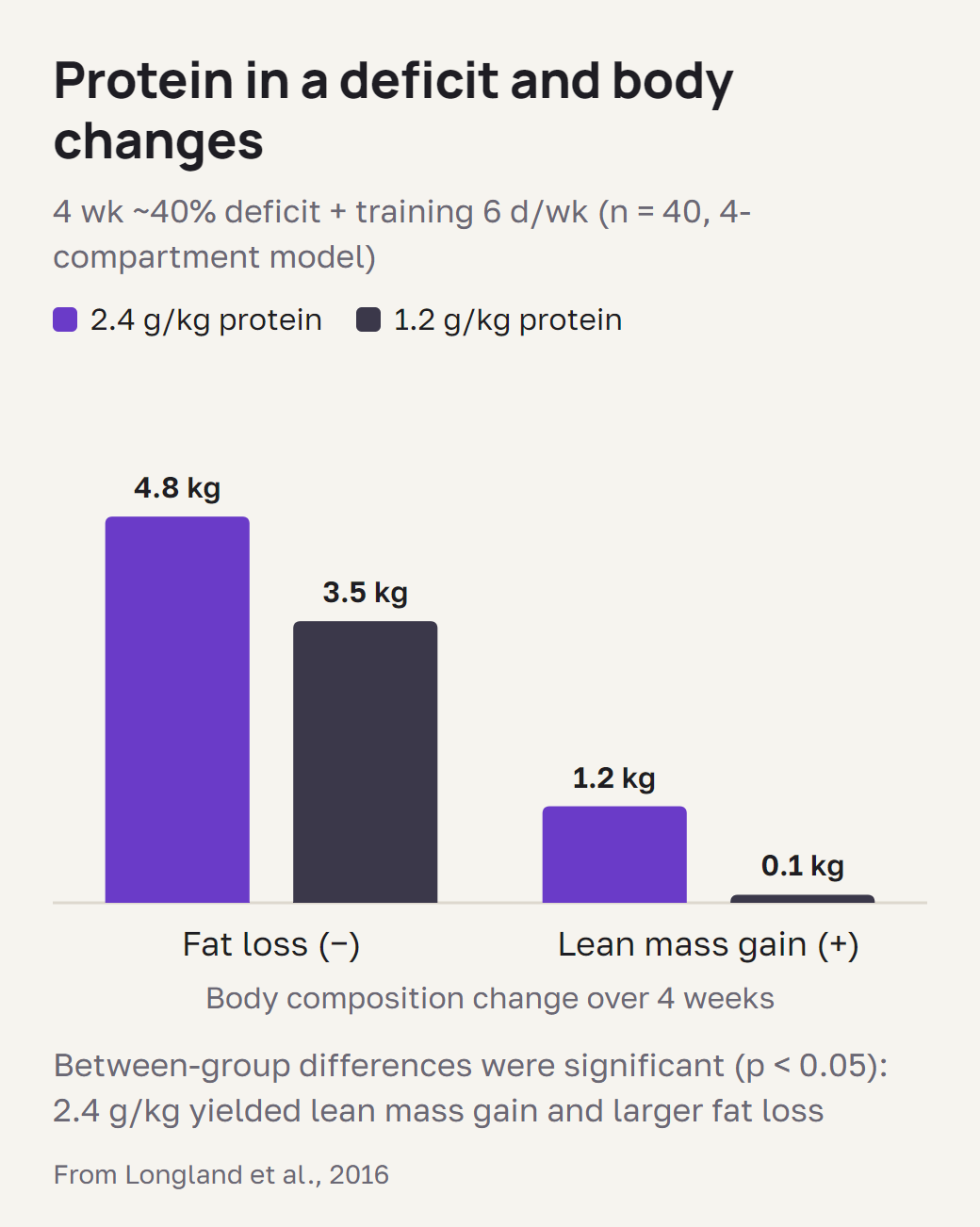
The impact of high protein combined with training was shown most vividly in a 4-week RCT by Longland et al. (2016) in 40 young men on an ~40% deficit doing resistance and interval training six days per week, measured with a four-compartment model.
With 2.4 g/kg/day of protein, lean body mass rose by +1.2 kg versus +0.1 kg with 1.2 g/kg/day (p < 0.05), and fat loss was also greater (−4.8 kg vs. −3.5 kg; p < 0.05).
Although the protocol was short and intense, the contrast is telling: at 1.2 g/kg fat still dropped (−3.5 kg), while lean mass gain virtually disappeared (+0.1 vs. +1.2 kg).
Outside a pronounced deficit, a meta-analysis of 49 RCTs by Morton et al. (2018; 1,863 participants) found the breakpoint for protein's effect on fat-free mass gains around 1.62 g/kg/day.
During an energy deficit and for recomposition, Naddafha et al. (2026) point to a working range of 1.6–2.4 g/kg/day. The International Society of Sports Nutrition (ISSN) Position Stand on protein and exercise (Jäger et al., 2017) provides close guidelines: 1.4–2.0 g/kg/day suffices for most exercising adults, while resistance-trained people in hypocaloric periods may need 2.3–3.1 g/kg/day to maximize lean mass retention. See full calculations in How Much Protein Do You Need Per Day.
A similar association appears in older age. In a retrospective analysis of 130 untrained older women (Ribeiro et al., 2022) lifting for 24 weeks—grouped by habitual dietary intake without dietary randomization—moderate (+5.4%) and high (+5.1%) protein groups gained more skeletal muscle and achieved a higher recomposition index than the low-protein group (+2.3%; p < 0.05), while fat loss did not differ statistically between groups (p > 0.05).
Sleep, strength training, and cardio: three underrated levers
- Sleep shifts whether you lose fat or fat-free mass. In a crossover sleep-lab RCT by Nedeltcheva et al. (2010; 10 overweight adults, 14 days of moderate deficit), researchers compared 8.5 vs. 5.5 hours of sleep opportunity per night. With sleep restriction, the proportion of weight lost as fat dropped by 55% (0.6 vs. 1.4 kg; p = 0.043), while fat-free mass loss rose by 60% (2.4 vs. 1.5 kg; p = 0.002) alongside increased hunger. Although the sample was small and included no strength training, marked sleep loss clearly shifts losses toward lean mass.
- Strength training is mandatory; cardio is a tool for energy expenditure. In a meta-analysis of 36 RCTs (31 synthesized, 1,564 healthy adults; Lafontant et al., 2025) lasting 10+ weeks, aerobic training alone reduced body mass (−1.82 kg) and fat (−1.06 kg) more than resistance training alone, but retained less fat-free mass (−0.88 kg; p = 0.04). Concurrent strength plus cardio lost more fat than strength alone (−1.09 kg; p = 0.009), with no difference between same-day or separate-day scheduling (p > 0.05). When total workload was equated, all modalities performed similarly (p > 0.05), and body fat percentage did not differ significantly (p > 0.05): cardio works as an energy-expenditure tool rather than a "special fat burner."
- Account for creatine and water. In a meta-analysis of 143 RCTs (Pashayee-Khamene et al., 2024), creatine supplementation increased body mass by +0.86 kg and estimated fat-free mass by +0.82 kg while reducing body fat by 0.28 percentage points. If you start creatine early in recomposition, remember that part of the scale and fat-free mass increase reflects intracellular muscle water.
Who body recomposition fits and who should separate phases
Below are practical guidelines from my coaching work based on the research thresholds above:
| Starting point | Recomposition odds | Usually the better choice |
|---|---|---|
| Strength beginner with extra body fat | High | Recomposition: 250–400 kcal deficit, 1.6–2.0 g/kg protein, 2–3 strength sessions/week |
| Returning after a training break | High | Recomposition at maintenance or mild deficit up to 300 kcal |
| Intermediate, 3–7 kg extra fat | Moderate | Maintenance or 200–350 kcal deficit, 1.8–2.2 g/kg protein, 3–4 strength sessions |
| Need to lose 15–20+ kg | Secondary | Prioritize steady fat loss (How to Lose Weight) with strength training to protect muscle |
| Low body fat and 3+ years lifting | Modest and slow | Separate phases: mild surplus (How to Build Muscle), then cutting |
How to structure body recomposition and track progress: step by step
- Set calories between maintenance and a mild 200–400 kcal/day deficit. This is a practical target inside the ~500 kcal threshold. If you have extra body fat, aim to lose weight no faster than 0.5–0.7% of body weight per week.
- Meet a protein target of 1.6–2.4 g/kg/day, spread across main meals without banning entire food groups. In practice, most people comfortably hold 1.6–2.2 g/kg of current body weight, or calculate from target body weight when excess weight and BMI are high.
- Strength train 2–4 times per week with gradual increases in working weight or reps and keep a log. Start with 2–3 sessions, or 3–4 with experience. In my practice, dropping working weights on compound lifts for several weeks straight is a prompt to check deficit size, sleep, and overall recovery first.
- Sleep 7–8 hours and keep baseline daily activity steady. Walking or 1–2 easy aerobic sessions per week is a practical guideline to avoid pushing food intake too low.
- Do not judge results by the scale alone. In my practice, scale weight during recomposition often barely budges for weeks. Track weekly average weight, waist and hip measurements every two weeks, check-in photos in consistent lighting, and your lifting log.
In my practice, meal plans are built individually from familiar foods to hit exact calorie and protein targets with equivalent food swaps.
That format is available in individual nutrition plan, while combining nutrition, strength training, and weekly adjustments by measurements and photos is part of online coaching. I also share short nutrition and training breakdowns on my YouTube channel @lobanov_fitness.
With pronounced underweight, menstrual disruption, or signs of disordered eating, do not start body recomposition or a calorie deficit—consult a doctor first.
Sources
- Naddafha S et al. Body recomposition in adults: mechanisms, modulators, and practical algorithms for simultaneous skeletal muscle mass gain and fat mass loss. J Int Soc Sports Nutr, 2026. Article · Full text
- Murphy C, Koehler K. Energy deficiency impairs resistance training gains in lean mass but not strength: A meta-analysis and meta-regression. Scand J Med Sci Sports, 2022. Article
- Vargas-Molina S et al. Comparison of two nutritional protocols in body re-composition of resistance-trained participants. Eur J Appl Physiol, 2026. Article · Full text
- Longland TM et al. Higher compared with lower dietary protein during an energy deficit combined with intense exercise promotes greater lean mass gain and fat mass loss: a randomized trial. Am J Clin Nutr, 2016. Article
- Hector AJ et al. Pronounced energy restriction with elevated protein intake results in no change in proteolysis and reductions in skeletal muscle protein synthesis that are mitigated by resistance exercise. FASEB J, 2018. Article
- Garthe I et al. Effect of two different weight-loss rates on body composition and strength and power-related performance in elite athletes. Int J Sport Nutr Exerc Metab, 2011. Article
- Morton RW et al. A systematic review, meta-analysis and meta-regression of the effect of protein supplementation on resistance training-induced gains in muscle mass and strength in healthy adults. Br J Sports Med, 2018. Article · Full text
- Ribeiro AS et al. Moderate and Higher Protein Intakes Promote Superior Body Recomposition in Older Women Performing Resistance Training. Med Sci Sports Exerc, 2022. Article
- Ribeiro AS et al. Effects of resistance training on body recomposition, muscular strength, and phase angle in older women with different fat mass levels. Aging Clin Exp Res, 2023. Article
- Nedeltcheva AV et al. Insufficient sleep undermines dietary efforts to reduce adiposity. Ann Intern Med, 2010. Article · Full text
- Lafontant K et al. Comparison of concurrent, resistance, or aerobic training on body fat loss: a systematic review and meta-analysis. J Int Soc Sports Nutr, 2025. Article · Full text
- Pashayee-Khamene F et al. Creatine supplementation protocols with or without training interventions on body composition: a GRADE-assessed systematic review and dose-response meta-analysis. J Int Soc Sports Nutr, 2024. Article · Full text
- Jäger R et al. International Society of Sports Nutrition Position Stand: protein and exercise. J Int Soc Sports Nutr, 2017. Article · Full text




