
When bar weight and physique stall for more than four to six weeks, look for the cause across six concrete audit steps: fractional weekly volume, proximity to failure, load-selection method, goal alignment and rest intervals, advanced methods and deloads, and technique on video. Randomly swapping exercises or piling on drop sets without checking these variables rarely moves results.
I am Demid Lobanov, a fitness coach and training methodology specialist with over six years of experience (more than 300 clients) and over four years teaching strength training practice at PRO-FG school (170+ graduates). Below is the checklist I use to audit client programs and review cases with fellow coaches—grounded in recent meta-analyses, randomized trials, the ACSM Position Stand, and coaching practice.
Step 1. Recalculate weekly volume including indirect sets
The most common error when auditing a plan is estimating sets by feel or ignoring synergist muscles that assist compound movements. For instance, chest presses also load the triceps and anterior delts, while rows load the biceps and rear delts.
Multilevel meta-regressions across 67 studies (Pelland et al., 2026; 2,058 participants: 79.1% men, 20.9% women, mean age 25.2 years) tested three ways of counting weekly sets.
Fractional counting showed the strongest relative evidence: a direct working set counts as 1, and an indirect set where the muscle assists counts as 0.5. Both muscle size and strength rose with higher weekly volume (100% posterior probability of a positive slope), with diminishing returns that were notably steeper for strength.
According to the American College of Sports Medicine Position Stand (ACSM; Currier et al., 2026; 137 systematic reviews, over 30,000 healthy adults), weekly volumes of 10 or more sets per muscle group enhance hypertrophy. In my coaching practice, totals below 6 fractional sets per week often signal insufficient stimulus, while totals above 25 tend to accumulate excess fatigue. See full volume guidelines by muscle group in How Many Sets Per Week.
Frequency should also be assessed separately from volume. In Pelland (2026), higher weekly frequency consistently boosted strength gains (100% probability, with diminishing returns), while its independent effect on muscle growth was compatible with negligible effects.
For strength, training frequency matters more (per ACSM, maximal strength responds better with at least two sessions per week). For hypertrophy, total quality weekly volume is the main driver.
Step 2. Check proximity to failure and actual reps in reserve
Client logs commonly show two extremes: stopping sets with 5–6 reps still in reserve, or taking every single set in the program to absolute failure.
Research separates how reps in reserve (RIR)—the number of repetitions you could still perform before failure—affects strength versus hypertrophy:
- RIR dose-response (Robinson et al., 2024, series of meta-regressions). Estimated RIR across a broad range had a negligible impact on strength gains, whereas muscle size increased more as sets approached failure. The authors highlight the exploratory nature and modest overall model fit, since RIR was estimated from protocol descriptions.
- Absolute failure vs. a small reserve (Refalo et al., 2023, meta-analysis of 15 studies). Training to set failure gave only a tiny advantage for hypertrophy (effect size 0.19; p = 0.045), which vanished under strict momentary muscular failure (0.12; p = 0.343) and between high (>25%) vs. moderate (20–25%) velocity loss (0.08; p = 0.529).
- The fatigue cost of excess failure (Varela-Olalla et al., 2025, systematic review of 51 studies). Acute neuromuscular and perceived fatigue rose most sharply when proximity to failure combined with high volume and high density—especially with lighter loads.
To audit this on yourself, use the RPE scale anchored to reps in reserve (RPE 9 = 1 RIR, RPE 10 = 0 RIR), tested by Zourdos et al. (2016).
In 29 back-squat lifters (15 experienced, 5.2 years; 14 novices, 0.4 years), RPE correlated strongly and inversely with mean bar velocity in both experienced (r = −0.88, p < 0.001) and novice lifters (r = −0.77, p = 0.001).
Experienced lifters also recorded higher RPE and slower velocity at 1RM (p = 0.023). In my coaching practice, if bar speed does not slow down at all during the final reps, the reserve before failure is often too large. Read more in Training to Failure.
Step 3. Check how working weights adjust over time
In my practice, a rigid spreadsheet with fixed percentages of 1RM often breaks down after poor sleep, a work trip, or a jump in fitness. When weights are locked a month ahead without adjusting for daily readiness, the plan underloads you on a strong day or buries you in fatigue on a poorly recovered day.
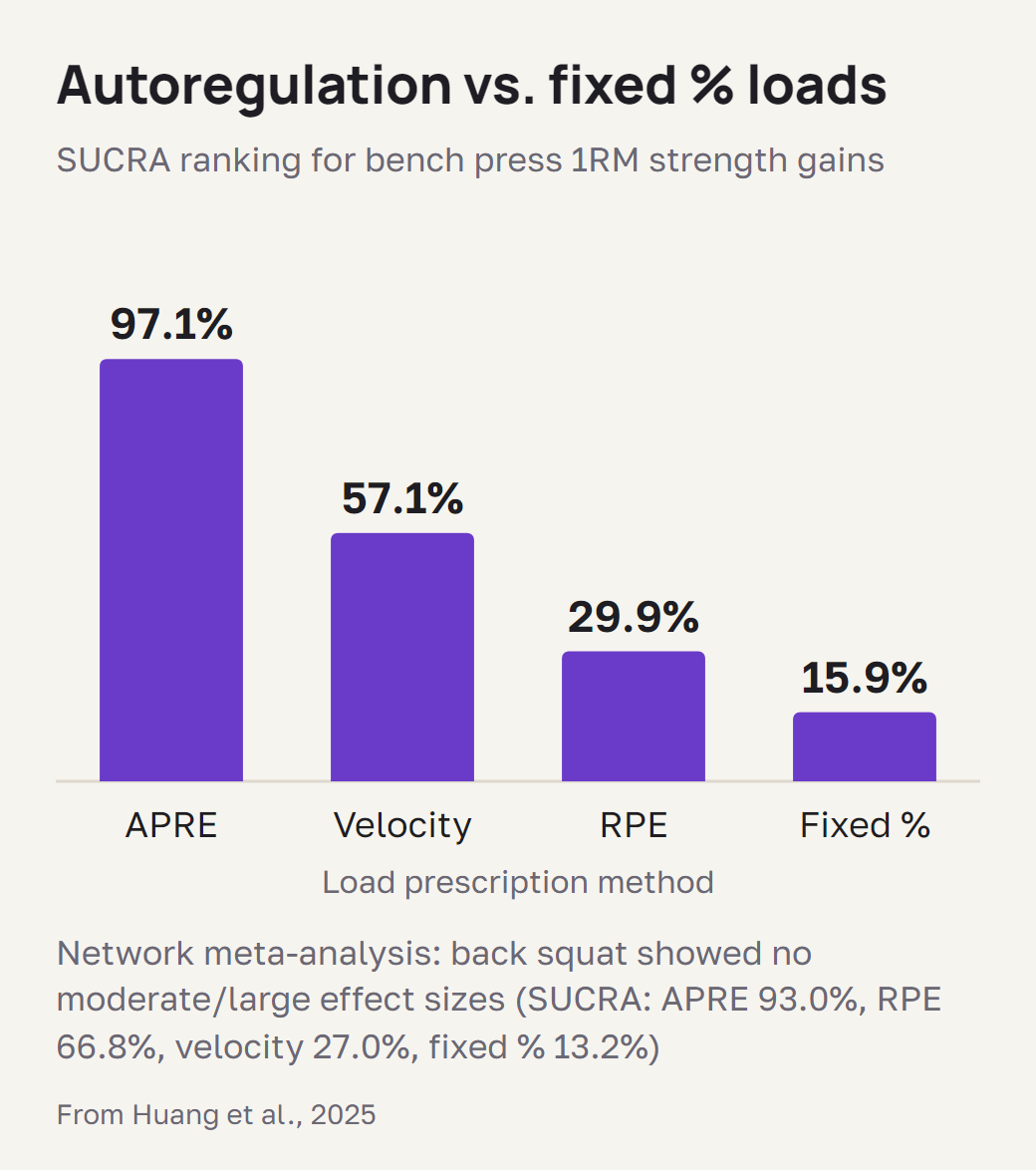
A network meta-analysis by Huang et al. (2025) compared three autoregulation methods—autoregulatory progressive resistance exercise (APRE), velocity-based resistance training (VBRT), and RPE—against fixed percentage-based training (PBRT).
APRE showed a statistically significant advantage over fixed percentages in the bench press (pooled SMD = 0.83; 95% CI 0.44–1.22). By probabilistic SUCRA ranking in the bench press, methods ranked: APRE 97.1%, VBRT 57.1%, RPE 29.9%, and fixed percentages 15.9%.
In the back squat, no moderate or large differences emerged between methods, though SUCRA rankings still favored autoregulation: APRE 93.0%, RPE 66.8%, VBRT 27.0%, and fixed percentages 13.2%. SUCRA reflects rank probability rather than statistical significance.
Still, the picture is nuanced. In an earlier meta-analysis of 15 studies in trained lifters (Hickmott et al., 2022; 6 load-autoregulation studies using RIR-RPE and velocity without APRE, plus 9 volume studies), 1RM difference between autoregulation and standard loading did not reach significance (+2.07 kg; p = 0.09).
Velocity loss ≤25% yielded larger strength gains (+2.32 kg; p = 0.02) but smaller muscle cross-sectional area growth than >25% (p = 0.03); between >25% and 20–25% hypertrophy did not differ (p = 0.28), with >25% outperforming ≤20% (p = 0.03).
For everyday gym training, the takeaway is simple: your program needs a clear load-progression rule and a target rep range (see Progressive Overload), not frozen numbers for two months.
Step 4. Align exercises, rep ranges, and rest intervals with your goal
A frequent audit finding is wanting higher strength on a compound lift while training it once a week with light weights, or wanting muscle growth while resting 30 seconds in a circuit.
Three benchmarks from major reviews immediately reveal mismatches:
- Task specificity (Saeterbakken et al., 2025, meta-analysis of 43 studies, 1,660 adults aged 16–60). Dynamic resistance training produced roughly twice the effect in dynamic strength tests (0.98) compared with transfer to untrained isometric tests (0.42; difference p < 0.001). If your goal is strength in a specific lift, that lift must anchor the plan.
- Load matched to goal (Carvalho et al., 2022, meta-analysis; ACSM, Currier 2026). In Carvalho (2022), when volume load (sets × reps × weight) was equated, heavy loads (≥80% 1RM) outperformed moderate (60–79%) and light (30–59%) loads for 1RM strength, while hypertrophy did not differ across load ranges. The ACSM Position Stand (Currier 2026) confirms ≥80% 1RM for maximal strength.
- Rest between sets (Grgic et al., 2017, systematic review of 6 studies). Both short (≤60 s) and longer (>60 s) rest periods support muscle growth, with a possible advantage for >60 s in trained lifters using sensitive measures, though the authors note too few comparable trials for a definitive conclusion. In my practice, resting 2–3 minutes on compound lifts and 1–2 minutes on single-joint isolation exercises works best to preserve working weight.
Step 5. Strip out "advanced tricks" and check whether you need a deload
When progress slows, many lifters pile on drop sets, supersets, slow tempos, or rewrite the split every two weeks. Research shows extra complexity rarely adds muscle growth.
In a meta-analysis of 23 studies in recreationally trained adults aged 18–45 (Tsartsapakis et al., 2026), advanced systems as a group showed no statistically significant hypertrophy advantage over standard straight sets (effect 0.046; non-significant).
Drop sets, tempo schemes, and cluster sets produced comparable results when volume and effort were matched; only rest-pause showed a modest hypertrophy edge, while moderate strength gains (0.351) came mainly from velocity control and eccentric overload.
A meta-analysis of 35 volume-equated studies (Moesgaard et al., 2022) found a similar split: periodization beat non-periodized training for 1RM strength (0.31; p = 0.02), and undulating beat linear periodization in trained lifters (0.61; p = 0.05), but hypertrophy showed no difference (p = 0.27 and p = 0.72). See Periodization in Strength Training.
The same holds for trendy "mandatory full-rest weeks" every 4–6 weeks. In a 9-week RCT by Coleman et al. (2024; 39 trained lifters doing high-volume training), a full one-week cessation of lifting in the middle of the block did not improve lower-body hypertrophy, power, or local endurance, and leg strength grew more in the group that trained continuously. That trial tested complete cessation rather than an active volume-reduction deload.
In my coaching practice, deloads are scheduled when accumulated fatigue and slipping working weights actually appear, rather than blindly by the calendar.
Step 6. Audit exercise technique on video
Even a well-written spreadsheet can underperform if technique breaks down or a movement triggers joint discomfort. In a meta-analysis of 24 studies in women (Hagstrom et al., 2020; moderate methodological quality), a univariate sub-analysis of 19 studies showed larger lower-body strength gains with supervised versus unsupervised training (p = 0.05), while no moderator significantly affected hypertrophy.
In a 10-week RCT by Gavanda et al. (2025; 51 trained adults), in-person coaching and an online app with time-delayed video technique feedback produced comparable gains in squat and bench strength and muscle thickness without significant group differences, although baseline age and training experience differed between groups.
How to film sets for a self-audit:
- Film working sets from the side and from behind (including a 45° rear angle)—a single straight-on front view rarely reveals depth, spinal position, or bar path.
- Review the final third of the set, not just warm-ups. In my practice, torso twisting, shortened range of motion, lost scapular position, and side-to-side shifts most often show up in the final third of a working set.
- Check joint axis and line of resistance. Watch on video how the working joint aligns with gravity or cable direction, whether the path stays consistent, and which muscle fatigues first.
Summary workout program audit checklist
Below are the practical benchmarks I use during an initial program audit:
| Program variable | Sign of a problem | First step to fix (coaching guideline) |
|---|---|---|
| Weekly volume | <6 or >25 fractional sets per muscle/week | Bring target muscle into 10–16 fractional sets (direct = 1, indirect = 0.5) |
| Reps in reserve (RIR) | Every set feels easy (5+ RIR) or everything to failure | Keep 1–3 RIR on compounds, closer to failure on isolation work |
| Load progression rule | Weights stagnant for weeks or locked to rigid % | Set a rep range and load step with clean form |
| Selection and order | Constant exercise hopping; priority lifts placed last | Put target strength lifts early in the session (ACSM) and keep the plan 6–8 weeks |
| Rest between sets | 30–45 seconds on heavy compound lifts | Extend rest past 60 s (typically 2–3 min on compounds, 1–2 min on isolation) |
| Technique on video | Cut depth, momentum, joint discomfort | Lower weight by 10–15%, restore control, and re-film the set |
How to verify the fixes worked: in my practice, we re-audit after 4–6 weeks—working weights or reps should be climbing again with clean technique and comfortable joints.
If you train on your own and want to pinpoint what is working and what is holding you back, I audit full programs and set videos in training process diagnostics.
If you coach clients yourself and want to verify and justify every line of a training protocol, real client case reviews are part of mentoring for coaches. For building a plan from scratch, see Gym Workout Program. I also share short technique breakdowns on my YouTube channel @lobanov_fitness.
When to stop and see a doctor
If acute undiagnosed pain, pain at rest or at night, numbness, shooting pain, or sudden arm or leg weakness appears during or after a workout, stop training and see a doctor first. Do not try to "tweak" the program around warning signs.
Sources
- Pelland JC et al. The Resistance Training Dose Response: Meta-Regressions Exploring the Effects of Weekly Volume and Frequency on Muscle Hypertrophy and Strength Gains. Sports Med, 2026. Article
- Currier BS et al. American College of Sports Medicine Position Stand. Resistance Training Prescription for Muscle Function, Hypertrophy, and Physical Performance in Healthy Adults: An Overview of Reviews. Med Sci Sports Exerc, 2026. Article · Full text
- Robinson ZP et al. Exploring the Dose-Response Relationship Between Estimated Resistance Training Proximity to Failure, Strength Gain, and Muscle Hypertrophy: A Series of Meta-Regressions. Sports Med, 2024. Article
- Refalo MC et al. Influence of Resistance Training Proximity-to-Failure on Skeletal Muscle Hypertrophy: A Systematic Review with Meta-analysis. Sports Med, 2023. Article · Full text
- Varela-Olalla D et al. Influence of Proximity to Failure, Relative Intensity, and Volume on Voluntary Performance and Fatigue Symptoms After Resistance Training: A Systematic Review. J Strength Cond Res, 2025. Article
- Zourdos MC et al. Novel Resistance Training-Specific Rating of Perceived Exertion Scale Measuring Repetitions in Reserve. J Strength Cond Res, 2016. Article
- Huang Z et al. Autoregulated resistance training for maximal strength enhancement: A systematic review and network meta-analysis. J Exerc Sci Fit, 2025. Article · Full text
- Hickmott LM et al. The Effect of Load and Volume Autoregulation on Muscular Strength and Hypertrophy: A Systematic Review and Meta-Analysis. Sports Med Open, 2022. Article · Full text
- Saeterbakken AH et al. Task Specificity of Dynamic Resistance Training and Its Transferability to Non-trained Isometric Muscle Strength: A Systematic Review with Meta-analysis. Sports Med, 2025. Article · Full text
- Carvalho L et al. Muscle hypertrophy and strength gains after resistance training with different volume-matched loads: a systematic review and meta-analysis. Appl Physiol Nutr Metab, 2022. Article
- Grgic J et al. The effects of short versus long inter-set rest intervals in resistance training on measures of muscle hypertrophy: A systematic review. Eur J Sport Sci, 2017. Article
- Tsartsapakis I et al. Effects of Advanced Resistance Training Systems on Muscle Hypertrophy and Strength in Recreationally Trained Adults: A Systematic Review and Meta-Analysis. J Funct Morphol Kinesiol, 2026. Article · Full text
- Moesgaard L et al. Effects of Periodization on Strength and Muscle Hypertrophy in Volume-Equated Resistance Training Programs: A Systematic Review and Meta-analysis. Sports Med, 2022. Article
- Coleman M et al. Gaining more from doing less? The effects of a one-week deload period during supervised resistance training on muscular adaptations. PeerJ, 2024. Article · Full text
- Hagstrom AD et al. The Effect of Resistance Training in Women on Dynamic Strength and Muscular Hypertrophy: A Systematic Review and Meta-analysis. Sports Med, 2020. Article
- Gavanda S et al. Comparing App-Based and On-Site Coaching on Strength and Muscle Hypertrophy in Resistance-Trained Individuals: A 10-Week Randomized Controlled Trial. J Funct Morphol Kinesiol, 2025. Article · Full text