
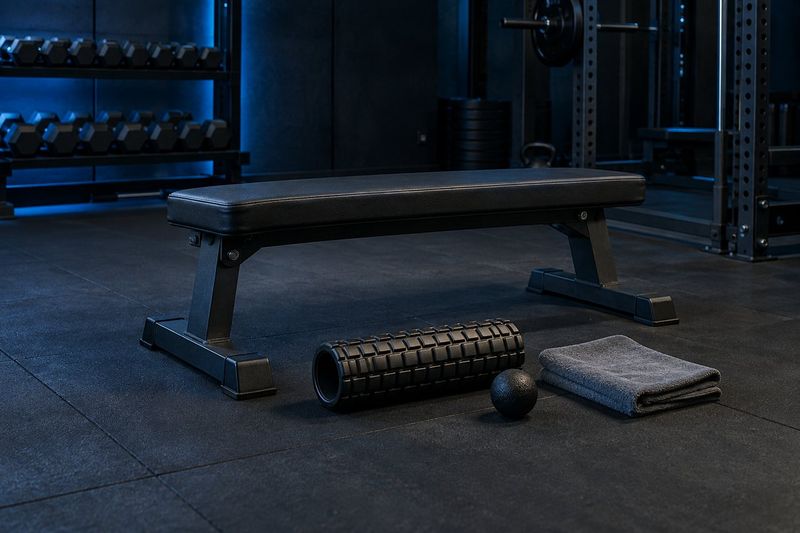
Muscle pain a day or two after unaccustomed exercise is delayed onset muscle soreness, commonly called DOMS. It goes away on its own and isn't a reliable sign of a good workout: muscles grow without it. You can train, either lighter or by working other muscles. Soreness is best reduced by massage and light movement; stretching barely helps. Sharp pain during a movement, severe swelling, or dark urine is a reason to see a doctor.
Why muscles get sore on the second day
Delayed onset muscle soreness appears 24–72 hours after unaccustomed, prolonged, or intense exercise. According to Hall's biomechanics textbook, it may be accompanied by microtears in muscle tissue and shows up as pain, stiffness, and limited movement.
Muscles get sore like this most often after work in which they lengthen, when you lower a weight or walk downhill, and after new exercises. The 2003 review by Cheung and colleagues states that these movements damage muscle more often and more severely than others. Soreness is most common at the start of a season and when you first encounter a type of exercise.
It is also more noticeable after exercises in which the muscle works in a stretched position. In the 2001 experiment by Nosaka and Sakamoto, soreness and strength loss were greater when the elbow flexors, the muscles that bend the arm at the elbow, were loaded in a lengthened position.
Is it good or bad?
Neither: soreness doesn't show whether your muscles got a stimulus to grow. In 2016, Damas and colleagues followed 10 young men for 10 weeks. Muscle damage was greatest after the first workout, decreased by week three, and was minimal by week ten. Muscle growth was linked to muscle protein synthesis, the building of new protein in muscle, only at weeks three and ten, once the damage had subsided.
Muscles can also get sore after ordinary stretching, which doesn't replace strength work. In the 2017 experiment by Muanjai and colleagues, 22 women did eight 30-second sets of stretching. The next day their muscles were slightly more sore, although no signs of damage were found in the blood.
If soreness after the same exercises has faded over time, your workout hasn't become any worse. The muscle adapts to the load and is damaged less the next time; this is called the repeated bout effect (review by Hyldahl and colleagues, 2017).
Can you train if your muscles are sore?
Yes. In 2006, Chen and colleagues had 51 athletes do a heavy workout for the elbow flexors and repeated it three days later, with the same weight or 10–20% lighter. The repeat workout didn't increase damage or slow recovery compared with those who rested.
It still makes sense to reduce the load. According to the Cheung review, when a muscle is sore, its strength and the range of motion in the joint decrease, and your usual technique changes. That's why the authors advise training lighter and shorter for 1–2 days after a hard workout or working other muscles; movement itself reduces soreness, though only for a while.
How to spread the load across the week is covered in the article How Many Times a Week to Train for Muscle Growth.
What reduces soreness and what doesn't
The table mentions meta-analyses, papers that combine the results of several studies.
| Remedy | What studies show |
|---|---|
| Massage | The strongest effect: meta-analysis by Dupuy and colleagues, 2018, 99 studies |
| Light movement | Reduces soreness (Dupuy); the effect is temporary (Cheung) |
| Compression garments (which squeeze the muscles), cold and contrast water (alternating warm and cold) | Reduce soreness (Dupuy) |
| Foam roller (a roller for self-massage) | Slightly reduces soreness after exercise: meta-analysis by Wiewelhove and colleagues, 2019, 21 studies |
| Stretching | Barely helps: review by Herbert and colleagues, 2011, 12 studies |
In the Herbert review, stretching after exercise reduced soreness the next day by an average of 1 point on a 100-point scale. In the largest study, with 2,377 participants, stretching before and after exercise reduced soreness over a week by 4 points out of 100, and the authors concluded that the effect is too small for a person to notice.
There's a caveat with cold water. In the 2024 meta-analysis by Piñero and colleagues (8 studies), a cold bath right after strength training, according to the available data, blunted muscle growth. The authors themselves ask readers to treat this conclusion with caution because of the quality of the studies. If your goal is muscle growth, it's better not to use cold after strength training. Painkillers and pain-relief ointments are worth discussing with a doctor: I don't prescribe medication.
How to make it hurt less
Introduce new loads gradually. Cheung and colleagues advise adding unaccustomed exercises and lengthening work over one to two weeks, and I also set aside the first two weeks of a new program for getting used to the load.
When it's not DOMS
DOMS is soreness spread throughout the muscle that appears 24–72 hours after exercise and gradually subsides. You need to see a doctor in two other cases.
The first is an injury: sharp pain at the moment of a movement, joint pain, bruising or swelling, loss of strength. Hall's textbook describes the signs of a muscle strain, ranging from a feeling of tightness to a rupture in which the muscle stops working, with bleeding into the tissue and swelling.
The second is rhabdomyolysis, a breakdown of muscle tissue that is dangerous for the kidneys. The 2017 review by Rawson and colleagues describes cases in which severe muscle pain and dark urine appeared 2–4 days after unaccustomed heavy exercise. In especially susceptible people, marked swelling and sudden weakness appeared. With these signs, you see a doctor the same day.
How I view soreness after a workout
To me, soreness after a workout is a side effect. The main stimulus for growth is mechanical tension: the muscle has to produce a lot of force under load. I judge a workout by the results over several weeks.
In my experience, a foam roller only reduces soreness. Use minimal pressure, 30–60 seconds, on the muscle only. My main recovery tool is a gradually increasing load.
What to do if your muscles are sore: step by step
- Make sure it's DOMS: the soreness is diffuse, appeared 24–72 hours after exercise, and isn't linked to a sudden movement.
- Keep moving: walking and a light warm-up reduce soreness.
- Make your next workout lighter and shorter, or work other muscles.
- If you want to reduce the soreness, get a massage or use a foam roller.
- Don't count on stretching, and don't take a cold bath after strength training if your goal is muscle growth.
- Introduce new exercises gradually, over one to two weeks.
- If you have sharp pain, swelling, sudden weakness, or dark urine, see a doctor the same day.
If you need a plan for your goal and your circumstances, there's the personalized program.
Sources
- Hall SJ. Basic Biomechanics. 9th edition. McGraw Hill, 2022. Chapter 6, the biomechanics of skeletal muscle and muscle injuries.
- Cheung K et al. Delayed onset muscle soreness: treatment strategies and performance factors. Sports Med, 2003. Article
- Nosaka K et al. Effect of elbow joint angle on the magnitude of muscle damage to the elbow flexors. Med Sci Sports Exerc, 2001. Article
- Damas F et al. Resistance training-induced changes in integrated myofibrillar protein synthesis are related to hypertrophy only after attenuation of muscle damage. J Physiol, 2016. Article · Full text
- Muanjai P et al. The acute benefits and risks of passive stretching to the point of pain. Eur J Appl Physiol, 2017. Article
- Hyldahl RD et al. Mechanisms and mediators of the skeletal muscle repeated bout effect. Exerc Sport Sci Rev, 2017. Article
- Chen TC et al. Responses of elbow flexors to two strenuous eccentric exercise bouts separated by three days. J Strength Cond Res, 2006. Article
- Dupuy O et al. An evidence-based approach for choosing post-exercise recovery techniques to reduce markers of muscle damage, soreness, fatigue, and inflammation: a systematic review with meta-analysis. Front Physiol, 2018. Article · Full text
- Wiewelhove T et al. A meta-analysis of the effects of foam rolling on performance and recovery. Front Physiol, 2019. Article · Full text
- Herbert RD et al. Stretching to prevent or reduce muscle soreness after exercise. Cochrane Database Syst Rev, 2011. Article
- Piñero A et al. Throwing cold water on muscle growth: a systematic review with meta-analysis of the effects of postexercise cold water immersion on resistance training-induced hypertrophy. Eur J Sport Sci, 2024. Article · Full text
- Rawson ES et al. Perspectives on exertional rhabdomyolysis. Sports Med, 2017. Article · Full text




