
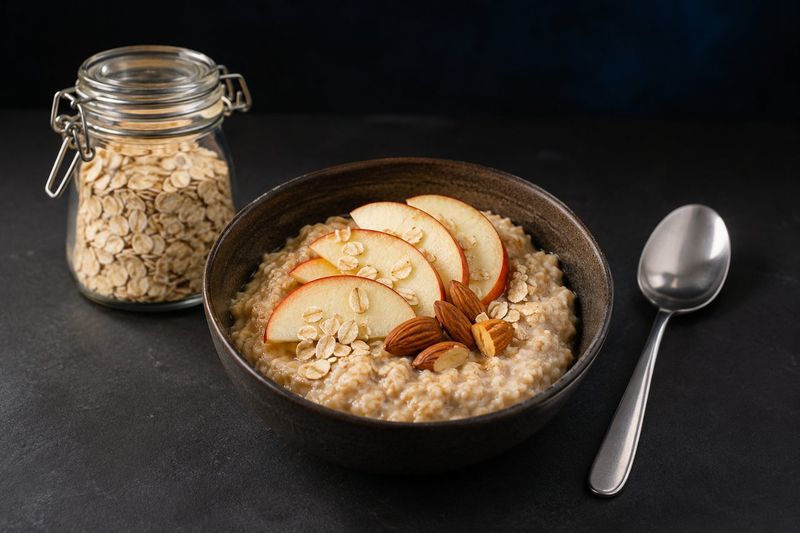
You can eat oatmeal while losing weight. Weight goes down when you're in a calorie deficit for the day, so there's no need to ban any one kind of porridge. Oatmeal on its own barely lowers weight: in meta-analyses, the difference is less than a kilogram, or there is none. On the other hand, in short studies it was more filling than ready-to-eat breakfast cereal. 60 g of dry oats comes to about 219 kcal.
I'm Demid Lobanov, a fitness coach. In the recipe database for the meal plans I put together, oatmeal is part of 20 dishes out of 260: 14 breakfasts and 6 snacks. Below are the numbers, the research, and example dishes.
How many calories are in oatmeal?
The food database for my meal plans uses "Hercules" rolled oats from the table of the Federal Research Center of Nutrition and Biotechnology. Calories are calculated including fiber. The Center's own table lists 352 kcal because fiber isn't counted there.
| Nutrient | Per 100 g dry oats | 60 g serving |
|---|---|---|
| Energy | 364 kcal | 219 kcal |
| Protein | 12.3 g | 7.4 g |
| Fat | 6.2 g | 3.7 g |
| Carbs | 61.8 g | 37.1 g |
| Fiber | 6.0 g | 3.6 g |
In my recipes, a serving of oats ranges from 20 to 90 g, most often 60 g.
How to weigh oatmeal
Weigh the dry oats: it's easier that way. According to the USDA, which gives its own values for oats, 100 g of dry oats has 379 kcal, and 100 g of oatmeal cooked in water has 71 kcal. That means the cooked oatmeal weighs roughly 5 times as much as the dry oats.
If you log cooked oatmeal as dry oats, your food diary will show roughly 5 times more calories than you actually ate. More in the article How to Weigh Food.
Oatmeal with water or with milk
In oatmeal made with water, all the calories come from the oats. Milk adds calories and protein:
| Serving | Calories | Protein |
|---|---|---|
| 60 g oats with water | 219 kcal | 7.4 g |
| 60 g oats with 200 g of 2.5% milk | 325 kcal | 13.2 g |
Milk doesn't get in the way of weight loss if the oatmeal fits into your daily calories. It also adds protein, which oatmeal itself is low in. What matters is your calories for the day.
What is the glycemic index of oatmeal?
The glycemic index (GI) shows how much a food raises blood sugar compared with glucose. In the 2008 international tables by Atkinson and colleagues, porridge made from rolled oats has a GI of 55, which is low. Instant oatmeal has a GI of 79, which is high.
A GI of 55 or less counts as low, and 70 or more as high. GI varies between different oats and cooking methods, and the authors of the tables note this specifically for oatmeal.
But GI shouldn't be looked at separately from calories and composition, and the authors of the tables advise the same. Details in the article Fast Carbs.
Does oatmeal help you lose weight?
Hardly at all. The 2022 meta-analysis by Llanaj and colleagues included 74 randomized trials with 4,937 participants, mostly people with high cholesterol and obesity. In randomized trials, participants are randomly assigned to groups.
The meta-analysis included 59 studies, but weight was compared in only 5 of them: 250 people, with a median duration of 4 weeks. With oats, weight went down by 0.94 kg more, and waist circumference by 1.06 cm more (3 studies).
Where oats were compared with other foods (7 studies, 739 people), there was no difference in weight. 81% of all the studies had concerns about risk of bias.
The 2026 meta-analysis by Zheng and colleagues included 49 studies and 3,854 people with overweight and obesity. Cereal beta-glucan, a soluble fiber found in oats, lowered cholesterol but had no effect on weight. For BMI, or body mass index, the data are conflicting.
In the 2019 meta-analysis by Rahmani and colleagues (20 studies), beta-glucan lowered weight by 0.77 kg but had no effect on waist circumference or on calories eaten.
Studies of ordinary eating in a calorie deficit give the same answer. In the 2010 study by Maki and colleagues, 144 people with excess weight ate with a deficit of about 500 kcal a day.
One group ate two servings of whole-grain oat cereal a day, the other ate low-fiber foods with the same calories. The groups lost the same amount of weight: 2.2 and 1.7 kg, and the difference was not significant. Waist circumference went down more in the oat group: 3.3 vs. 1.9 cm.
In the 2010 study by Beck and colleagues, 66 women with overweight ate in a calorie deficit for 3 months. One group got 5–6 g of oat beta-glucan extract a day added to their diet, another got 8–9 g, and a third ate the same foods without the supplement. All the groups lost weight, and the supplement didn't improve the result.
Bottom line: oatmeal has no special effect on weight. The difference averages less than a kilogram and was found mainly in people with metabolic disorders. What makes you lose weight is a calorie deficit.
How filling is oatmeal?
Here the data are more convincing, but these are short experiments with a single breakfast:
- in the 2013 study by Rebello and colleagues, 48 people ate either oatmeal or ready-to-eat breakfast cereal with the same calories for breakfast, 363 kcal each including milk. After oatmeal, fullness was higher and hunger was lower for 4 hours;
- in the 2016 study by Rebello and colleagues, 48 people compared instant oatmeal with an oat-based ready-to-eat cereal with the same calories. After oatmeal, they ate 85 kcal less at lunch 4 hours later;
- in the 2015 study by Geliebter and colleagues, 36 people had oatmeal, corn flakes with the same calories, or water for breakfast. After oatmeal, lunch 3 hours later was the smallest, especially in people with overweight.
It doesn't always work this way. In the 2020 study by Wolever and colleagues, 28 people ate as much at lunch after a breakfast with oat beta-glucan as after a breakfast without it.
The 2026 systematic review by Machalias and colleagues included 48 short studies. Cereal fiber increased fullness, and rye and oat fiber had a more noticeable effect than wheat and barley fiber. But the effect on how much people ate afterward was limited.
These results can't be carried over directly to weight change over several months: see the section above. Feeling full helps you stick to a deficit, but it doesn't replace it.
Oatmeal and cholesterol
The 2014 meta-analysis by Whitehead and colleagues pooled 28 randomized trials. Taking 3 g or more of oat beta-glucan a day lowered LDL, the "bad" cholesterol, by 0.25 mmol/L, and total cholesterol by 0.30 mmol/L.
HDL, the "good" cholesterol, and triglycerides didn't change. Triglycerides are one of the types of fat in the blood. The search for this meta-analysis also included internal reports from the company CreaNutrition AG.
If you have high cholesterol, diabetes, or another condition where a doctor prescribes your diet, your meal plan is put together with that doctor. I don't make diagnoses or prescribe therapeutic diets.
How much oatmeal can you eat, and when?
There's no strict limit: the guide is your calories for the day. Oatmeal is low in protein, so it usually doesn't become the base of a meal. In my recipes, it's paired with cottage cheese, yogurt, or milk.
You can eat oatmeal in the morning or in the evening as long as it fits into your daily calories, although eating late increased hunger in studies. More in the article Is It OK to Eat at Night?
Examples of oatmeal dishes from my meal plans
| Dish | Ingredients | Calories | Protein |
|---|---|---|---|
| Oatmeal with milk, banana, and nuts | oats 60 g, milk 200 g, banana 100 g, walnuts 15 g | 522 kcal | 16.6 g |
| Oatmeal with water, apple, and almonds | oats 60 g, apple 120 g, almonds 15 g, cottage cheese 120 g | 517 kcal | 31.3 g |
| Overnight oats in a jar | oats 50 g, Greek yogurt 150 g, blueberries 60 g, honey 10 g | 360 kcal | 21.5 g |
These aren't ready-made servings for everyone: the serving size is matched to your daily target. Nuts, honey, and fruit add calories, so count them separately.
How to eat oatmeal and lose weight: step by step
- Calculate your calorie target: see the article How Many Calories You Need per Day.
- Weigh dry oats instead of cooked oatmeal.
- Choose water or milk and count the calories in your serving.
- Add protein: cottage cheese, yogurt, or milk.
- Count nuts, honey, and fruit in your daily calories.
I also talk about nutrition and training on my YouTube channel @lobanov_fitness.
Sources
- Federal Research Center of Nutrition and Biotechnology (Russia). Chemical composition of foods used in the Russian Federation. "Hercules" rolled oats (in Russian).
- U.S. Department of Agriculture. FoodData Central. Cereals, oats, regular and quick, not fortified, dry (FDC 173904).
- Atkinson FS et al. International tables of glycemic index and glycemic load values: 2008. Diabetes Care, 2008. Article · Full text
- Llanaj E et al. Effect of oat supplementation interventions on cardiovascular disease risk markers: a systematic review and meta-analysis of randomized controlled trials. Eur J Nutr, 2022. Article · Full text
- Zheng R et al. Cereal beta-glucan and cardiovascular disease risk reduction in overweight and obese populations: a systematic review and meta-analysis of lipid, blood pressure, and anthropometric parameters. Food Funct, 2026. Article
- Beck EJ et al. Oat beta-glucan supplementation does not enhance the effectiveness of an energy-restricted diet in overweight women. Br J Nutr, 2010. Article
- Rahmani J et al. Effects of cereal beta-glucan consumption on body weight, body mass index, waist circumference and total energy intake: A meta-analysis of randomized controlled trials. Complement Ther Med, 2019. Article
- Maki KC et al. Whole-grain ready-to-eat oat cereal, as part of a dietary program for weight loss, reduces low-density lipoprotein cholesterol in adults with overweight and obesity more than a dietary program including low-fiber control foods. J Am Diet Assoc, 2010. Article
- Rebello CJ et al. Acute effect of oatmeal on subjective measures of appetite and satiety compared to a ready-to-eat breakfast cereal: a randomized crossover trial. J Am Coll Nutr, 2013. Article
- Rebello CJ et al. Instant Oatmeal Increases Satiety and Reduces Energy Intake Compared to a Ready-to-Eat Oat-Based Breakfast Cereal: A Randomized Crossover Trial. J Am Coll Nutr, 2016. Article · Full text
- Geliebter A et al. Effects of oatmeal and corn flakes cereal breakfasts on satiety, gastric emptying, glucose, and appetite-related hormones. Ann Nutr Metab, 2015. Article
- Wolever TMS et al. Increasing oat β-glucan viscosity in a breakfast meal slows gastric emptying and reduces glycemic and insulinemic responses but has no effect on appetite, food intake, or plasma ghrelin and PYY responses in healthy humans: a randomized, placebo-controlled, crossover trial. Am J Clin Nutr, 2020. Article
- Machalias A et al. Cereal Fibers and Satiety: A Systematic Review. Nutr Rev, 2026. Article · Full text
- Whitehead A et al. Cholesterol-lowering effects of oat β-glucan: a meta-analysis of randomized controlled trials. Am J Clin Nutr, 2014. Article · Full text




