
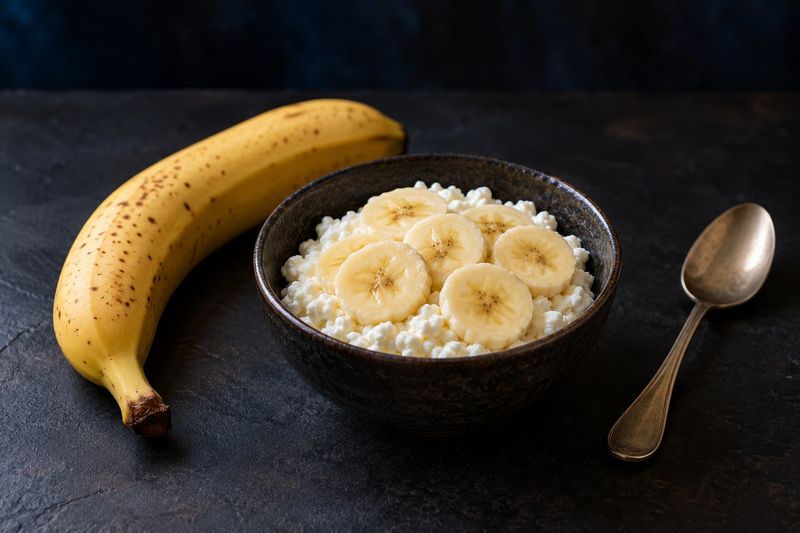
You can eat bananas while losing weight: weight goes down with a daily calorie deficit, and there's no need to ban any single fruit. 100 g of banana flesh has about 93 kcal and 20 g of carbs. I haven't found direct studies on whether whole bananas reduce weight. Whole fruit in general either doesn't affect weight or slightly limits weight gain. A banana simply counts toward your daily calories.
I'm Demid Lobanov, a fitness coach. In the meal plans I put together, bananas appear in 20 of 260 recipes, for breakfast and snacks. Below are the numbers, research findings, and sample portions.
How many calories are in a banana
Here are the values in the food database for my meal plans. The data come from USDA FoodData Central for raw bananas. Carbs are listed without fiber, and calories are calculated from these values. USDA lists 89 kcal and 22.8 g of carbs including fiber.
| Nutrient | Per 100 g of flesh |
|---|---|
| Energy | 93 kcal |
| Protein | 1.1 g |
| Fat | 0.3 g |
| Carbs | 20.2 g |
| Fiber | 2.6 g |
The peel is about 36% of the weight. A 150 g banana with the peel gives roughly 96 g of flesh and 89 kcal. It's easier to weigh the flesh. For how to work out the weight of foods, read the article How to weigh food.
Bananas are low in protein, so a banana won't become the base of a meal. In half of my banana recipes, it's paired with cottage cheese or yogurt.
What is the glycemic index of a banana?
The glycemic index (GI) shows how much a food raises blood sugar compared with glucose. In the 2008 international tables by Atkinson and colleagues, the GI of a banana is 51. This is an average across several studies. A GI like this is considered low: low is 55 or less.
But GI shouldn't be looked at apart from calorie content and composition, which is what the authors of the tables themselves advise. More details in the article Fast carbs.
Do bananas help you lose weight?
I haven't found direct studies on whether whole bananas reduce weight. There are data on fruit in general. The 2017 systematic review by Hebden and colleagues examined 11 randomized trials and 6 cohorts. In randomized trials, participants are randomly assigned to groups, while a cohort is a group of people followed over a long period.
Whole fruit reduced the risk of long-term weight gain in middle-aged people. Experiments suggest the reason is fewer calories per day. Fruit juice, on the other hand, was associated with weight gain in long-term data.
A 2015 study by Bertoia and colleagues followed 133,468 people from three US cohorts for up to 24 years. Each additional daily serving of fruit was associated with less weight gain: −0.53 pounds (about −0.24 kg) over 4 years. For berries, the association was stronger at −1.11 pounds, and for apples and pears, −1.24 pounds. The abstract doesn't give a separate result for bananas. This is an association; it doesn't prove cause.
The 2020 meta-analysis by Arnotti and colleagues pooled the results of 16 studies involving 3,719 people with excess weight. Programs with higher fruit and vegetable intake produced −2.81 kg on average. This refers to the programs as a whole, not to any single fruit.
But when people were simply advised to eat more fruits and vegetables, weight didn't change. The 2014 meta-analysis by Kaiser and colleagues (7 randomized trials) found no effect. In the 2023 network meta-analysis by Jayedi and colleagues (152 studies, 9,669 people), individual foods and food groups either didn't reduce weight or reduced it only slightly. Certainty in these data is low.
In Guyenet's 2019 review, whole fresh fruit over 3–24 weeks helped maintain weight or reduce it slightly. So here's how I see it: a banana helps with weight loss only if it replaces higher-calorie food rather than being added on top of it.
There are few studies on bananas themselves, and weight isn't their main outcome. In a 2011 study by Mitsou and colleagues, 34 healthy women with a body mass index of 24–30 were randomly divided into three groups. For two months, twice a day before meals, one group ate a banana, another drank a banana-flavored beverage, and the third drank water. The researchers studied gut bacteria: bananas were well tolerated, and at some measurement points there was less bloating than with water.
In a 2014 pilot study by Cressey and colleagues, 30 people with high cholesterol and 15 with type 2 diabetes ate 250 or 500 g of banana for breakfast for 12 weeks. In people with high cholesterol, fasting glucose dropped slightly. The abstract reports this for the first 4 weeks. In people with diabetes, changes in glucose and lipids were not significant.
The abstract doesn't describe a comparison group and says nothing about weight, so I don't draw any conclusions about weight loss.
Separately, there are studies on green banana biomass. In a 2019 study by Costa and colleagues, 113 people with prediabetes and diabetes received dietary advice for 24 weeks. Some got 40 g of this biomass, while others went without it. Weight decreased in the biomass group; no weight loss is reported for the other group. The abstract doesn't compare the two groups on weight.
This is resistant starch from unripe fruit, so I don't apply this result to ripe bananas.
Can you eat bananas at night?
Yes, if the banana fits into your daily calories. Weight depends on daily calories, although late eating increased hunger in studies. More details in the article Can you eat at night. I haven't found specific studies on bananas before bed and weight.
How many bananas can you eat?
There's no strict limit; your calories and the rest of your diet are the guide. Two bananas with 100 g of flesh each come to about 186 kcal. If you're short on protein, replace part of the snack with cottage cheese or yogurt. In my recipes, a banana portion is most often 100–120 g.
If you have diabetes or another condition where a doctor prescribes your diet, work out the amount of fruit together with them. I don't make diagnoses or prescribe therapeutic diets.
How to fit a banana into your diet: examples
In the recipe database for my meal plans, bananas most often go into breakfast and snacks:
| Dish | Ingredients | Calories | Protein |
|---|---|---|---|
| Banana with peanut butter | 120 g banana, 20 g peanut butter | 238 kcal | 5.8 g |
| Yogurt with banana and sesame seeds | 150 g Greek yogurt, 100 g banana, 10 g sesame seeds | 261 kcal | 17.7 g |
| Cottage cheese with banana and peanut butter | 180 g cottage cheese, 100 g banana, 15 g peanut butter | 405 kcal | 35 g |
These aren't ready-made portions for everyone: the size is adjusted to your daily target. Cottage cheese and eggs are covered in detail in the articles Cottage cheese and weight loss and Eggs and weight loss.
How to eat bananas and lose weight: step by step
- Calculate your calorie target: see the article How many calories you need per day.
- If you like bananas, include one in breakfast or a snack.
- Weigh the flesh, at least at first.
- Pair the banana with a protein food: cottage cheese or yogurt.
- If your weight isn't changing, check your overall calorie deficit.
I also talk about nutrition and training on my YouTube channel @lobanov_fitness.
Sources
- U.S. Department of Agriculture. FoodData Central. Bananas, raw (FDC 173944).
- Atkinson FS et al. International tables of glycemic index and glycemic load values: 2008. Diabetes Care, 2008. Article · Full text
- Hebden L et al. Fruit consumption and adiposity status in adults: A systematic review of current evidence. Crit Rev Food Sci Nutr, 2017. Article
- Bertoia ML et al. Changes in Intake of Fruits and Vegetables and Weight Change in United States Men and Women Followed for Up to 24 Years: Analysis from Three Prospective Cohort Studies. PLoS Med, 2015. Article · Full text
- Arnotti K et al. Fruit and Vegetable Consumption in Overweight or Obese Individuals: A Meta-Analysis. West J Nurs Res, 2020. Article
- Kaiser KA et al. Increased fruit and vegetable intake has no discernible effect on weight loss: a systematic review and meta-analysis. Am J Clin Nutr, 2014. Article · Full text
- Jayedi A et al. Comparative effectiveness of single foods and food groups on body weight: a systematic review and network meta-analysis of 152 randomized controlled trials. Eur J Nutr, 2023. Article
- Guyenet SJ. Impact of Whole, Fresh Fruit Consumption on Energy Intake and Adiposity: A Systematic Review. Front Nutr, 2019. Article · Full text
- Mitsou EK et al. Effect of banana consumption on faecal microbiota: a randomised, controlled trial. Anaerobe, 2011. Article
- Cressey R et al. Daily consumption of banana marginally improves blood glucose and lipid profile in hypercholesterolemic subjects and increases serum adiponectin in type 2 diabetic patients. Indian J Exp Biol, 2014. PubMed
- Costa ES et al. Beneficial effects of green banana biomass consumption in patients with pre-diabetes and type 2 diabetes: a randomised controlled trial. Br J Nutr, 2019. Article




