
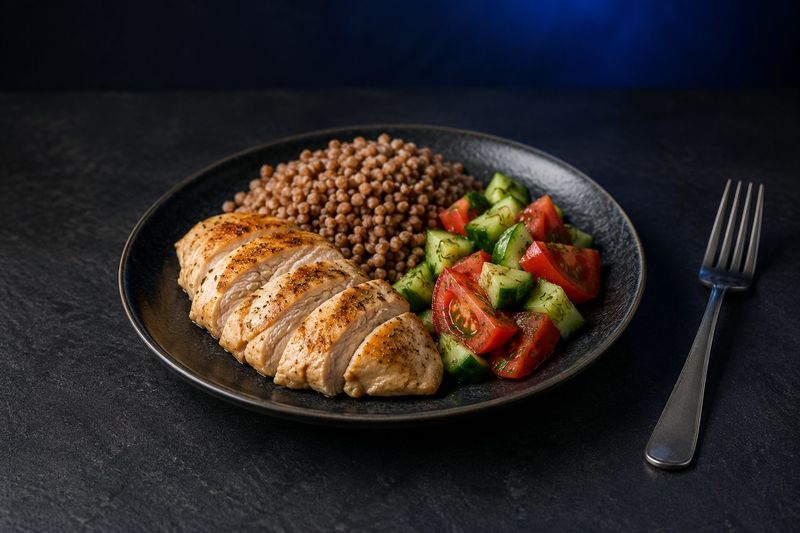
You can eat chicken while losing weight: weight goes down with a daily calorie deficit, and chicken is a convenient source of protein. It has no special effect on weight. In the two randomized trials I found, chicken produced the same result as lean beef. Skinless breast and thigh are nearly equal in calories: 113 and 116 kcal per 100 g of raw meat.
I'm Demid Lobanov, a fitness coach. In the dish database for the meal plans I create, chicken appears in 42 of 260 dishes, mostly lunches and dinners. Below are data on chicken cuts, research results, and sample dishes.
How many calories and how much protein are in chicken
These are the values in the food database for my meal plans. The data come from USDA FoodData Central for raw meat, with calories calculated from protein and fat. Chicken has almost no carbs.
| Cut, raw | Calories | Protein | Fat |
|---|---|---|---|
| Skinless breast | 113 kcal | 22.5 g | 2.6 g |
| Skinless thigh | 116 kcal | 19.7 g | 4.1 g |
| Skinless drumstick | 111 kcal | 19.4 g | 3.7 g |
| Ground chicken | 143 kcal | 17.4 g | 8.1 g |
| Liver | 114 kcal | 16.9 g | 4.8 g |
| Turkey breast, for comparison | 109 kcal | 23.7 g | 1.5 g |
USDA lists 120 kcal for breast: it calculates calories using different conversion factors.
Breast or thigh: which to choose for weight loss
Without the skin, breast and thigh are nearly the same in calories: 113 and 116 kcal per 100 g. Breast has more protein (22.5 g vs. 19.7 g) and less fat (2.6 g vs. 4.1 g). If you need to get more protein in, breast is the easier choice. If you like thigh better, you can eat it too: the calories are almost the same.
The difference comes from the skin. According to USDA, in a boneless thigh, skin and separable fat make up about a quarter of the weight. In a drumstick, a third of the weight is bone and cartilage, and another 9% is skin and fat. That's why my food database lists thigh and drumstick without skin.
Does chicken help you lose weight?
There are few direct studies on how chicken affects weight. A 2023 review by Connolly and colleagues brings together the small number of randomized studies. In them, lean chicken as the main protein source either helped reduce weight or had no effect on it.
In a 2003 study by Melanson and colleagues, 61 women with excess weight ate 500 kcal below their needs for 12 weeks and did walking workouts. Their average BMI, or body mass index, was 32.
It was a randomized trial: the participants were randomly assigned to groups. The main protein source for one group was lean beef, and for the other, chicken. Weight dropped by 5.6 and 6.0 kg, and the difference between the groups was not significant. Both groups saw decreases in body fat percentage, total cholesterol, and LDL, the "bad" cholesterol.
In a 2007 study by Mahon and colleagues, 54 postmenopausal women ate about 1,100 kcal per day for 9 weeks. The main protein source for one group was beef, and for another, chicken. A third group got more carbs and fat instead of meat.
The difference in weight loss between chicken and beef was not significant: 7.9 and 6.6 kg. Fat and cholesterol went down in all groups on the deficit, with no difference between them. The chicken group lost more than the carb group, which lost 5.6 kg. In the meat groups, protein provided 25% of calories; in the carb group, 17%.
A 2025 umbrella review by Kristoffersen and colleagues, which is a review of existing meta-analyses, found no meta-analyses on white meat and excess weight. Higher red meat intake was linked to a higher risk of excess weight, but the authors had the least data on red meat. These are observational data: they show an association but don't prove a cause.
The benefit of chicken for weight loss lies in its protein. A 2012 meta-analysis by Wycherley and colleagues pooled 24 randomized trials with 1,063 participants that lasted 12 weeks on average. With equal calories and equal fat, a high-protein diet produced on average 0.79 kg more weight loss and 0.87 kg more fat loss. Loss of fat-free mass (body weight without fat) was 0.43 kg smaller.
Bottom line: when you're losing weight, chicken is useful as a source of protein in a calorie deficit. On its own, it doesn't reduce weight.
How much chicken you can eat
There's no fixed amount: the guide is your daily calories and the protein you need. 150 g of raw breast provides about 33.8 g of protein. In my recipes, a portion of raw breast ranges from 60 to 180 g, most often 140–180 g.
To find out how much protein you need, read the article How much protein you need per day. With kidney disease, diabetes, or another condition in which your diet is prescribed by a doctor, protein intake is set together with your doctor. I don't make diagnoses or prescribe therapeutic diets.
How to weigh chicken
It's easier to weigh meat raw: the weight of cooked meat depends on how it's cooked. According to USDA tables, baked breast weighs 72% of its raw weight, and boiled breast 77%. 150 g of baked breast comes from about 208 g of raw.
If you log cooked chicken as raw, your food diary will show fewer calories than you actually ate. More in the article How to weigh your food.
How to cook chicken for weight loss
During cooking, meat loses water and some fat, so the weight of a piece drops more than its calories do. Oil adds the most calories: 10 g of oil is 90 kcal, and it's counted separately.
In the dish "Chicken breast with buckwheat and vegetable salad" from my database, 10 g of oil accounts for 90 of the 562 kcal. So it's better to measure oil with a spoon or weigh it. When people estimate by eye, they usually underestimate how much they ate; the research on this is covered in the article How to weigh your food.
Examples of chicken dishes from my meal plans
| Dish | Ingredients, raw weight | Calories | Protein |
|---|---|---|---|
| Chicken breast with buckwheat and vegetable salad | breast 180 g, buckwheat 70 g, cucumber 100 g, tomato 100 g, oil 10 g | 562 kcal | 50.9 g |
| Chicken breast with vegetable salad | breast 180 g, cucumber 120 g, tomato 120 g, lettuce 60 g, oil 10 g | 347 kcal | 43.1 g |
| Chicken salad with avocado | breast 150 g, avocado 80 g, lettuce 80 g, tomato 100 g, oil 8 g | 403 kcal | 37.2 g |
These aren't ready-made portions for everyone: the size is adjusted to your daily target. You can eat chicken in the evening too, as long as it fits your daily calories. More in the article Can you eat before bed.
How to eat chicken and lose weight: step by step
- Calculate your calorie target; see the article How many calories you need per day.
- Choose a skinless cut you like: breast, thigh, or drumstick.
- Weigh the meat raw, at least at first.
- Cook with measured oil and log it separately.
- Add vegetables and a side dish to the chicken, keeping your daily calories in mind.
I also talk about nutrition and training on my YouTube channel @lobanov_fitness.
Sources
- U.S. Department of Agriculture. FoodData Central. Chicken, broiler or fryers, breast, skinless, boneless, meat only, raw (FDC 171077).
- U.S. Department of Agriculture. FoodData Central. Chicken, broilers or fryers, dark meat, thigh, meat only, raw (FDC 173627).
- Showell BA et al. USDA Table of Cooking Yields for Meat and Poultry. U.S. Department of Agriculture, 2012. Table
- Melanson K et al. Weight loss and total lipid profile changes in overweight women consuming beef or chicken as the primary protein source. Nutrition, 2003. Article
- Mahon AK et al. Protein intake during energy restriction: effects on body composition and markers of metabolic and cardiovascular health in postmenopausal women. J Am Coll Nutr, 2007. Article · Full text
- Connolly G et al. Poultry Consumption and Human Cardiometabolic Health-Related Outcomes: A Narrative Review. Nutrients, 2023. Article · Full text
- Kristoffersen E et al. Umbrella Review of Systematic Reviews and Meta-Analyses on the Consumption of Different Food Groups and the Risk of Overweight and Obesity. Nutrients, 2025. Article · Full text
- Wycherley TP et al. Effects of energy-restricted high-protein, low-fat compared with standard-protein, low-fat diets: a meta-analysis of randomized controlled trials. Am J Clin Nutr, 2012. Article




