
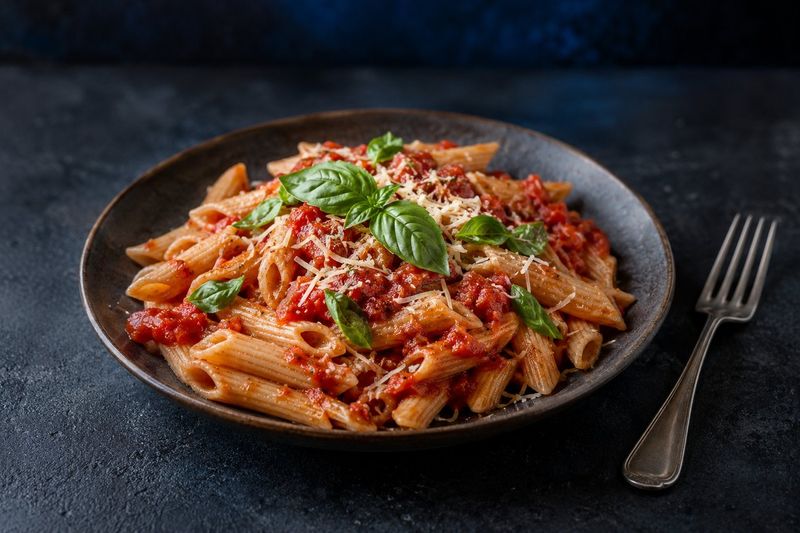
You can eat pasta while losing weight: weight goes down because of a calorie deficit, and you don't need to give up individual foods for that. In one study, people with obesity spent six months losing weight on a diet that included pasta either 5 or more times a week or no more than 3 times. Weight dropped in both groups with no significant difference. What matters is counting pasta in your daily calories and weighing it dry: 100 g of dry pasta is about 345 kcal.
I'm Demid Lobanov, a fitness coach. In the meal plans I create, pasta, like bread, isn't on a list of banned foods: everything is allowed within your calories. Below is what research shows, how to count pasta, and where extra calories hide on your plate.
Can you eat pasta while losing weight?
Yes. A calorie deficit is when you get less energy from food than you spend. It comes from the total calories in your diet, so pasta within your target doesn't get in the way of weight loss. With diabetes or a therapeutic diet, the amount of carbs, including pasta, is set together with your doctor. In my approach, the amount of carbs is calculated from the calories left after protein and fat, and I don't ban any types of carbs.
In my experience, food bans come with rebounds and slip-ups, and clients fall off their meal plans more often because of monotony than because of calories. Pasta helps make a meal plan more varied while you stay in a deficit.
What research shows about pasta and weight
There are few direct studies, and most of them are linked to pasta manufacturers. So below you'll find both the numbers and who paid for the research.
In a 2020 study by Rosi and colleagues, 49 people with obesity spent 6 months losing weight on a reduced-calorie Mediterranean diet. One group ate pasta 5 or more times a week, the other no more than 3 times. Weight dropped by 10% and 7%, the difference between the groups was not significant, and the result held a year later. The groups were formed based on habitual pasta intake, without random allocation.
In a 2018 meta-analysis by Chiavaroli and colleagues (32 comparisons, 2,448 participants), low-glycemic-index diets that included pasta reduced weight by 0.63 kg more than high-glycemic-index diets. The glycemic index shows how much a food raises blood sugar compared with pure glucose. The authors found no studies that tested pasta alone. The studies typically lasted about 12 weeks. The work was funded by a Canadian government research foundation, but some of the authors had received grants and fees from many food companies, including the pasta maker Barilla.
| Study | What was compared | Result | Who funded it |
|---|---|---|---|
| Rosi 2020, 49 people, 6 months | a lot or a little pasta on a reduced-calorie diet | both groups lost weight, difference not significant | not stated in the abstract or the article metadata |
| Chiavaroli 2018, 32 comparisons | low-glycemic-index diets that included pasta vs. high-glycemic-index diets | weight 0.63 kg lower | a government foundation; some authors had Barilla grants |
| Pounis 2016, 23,366 people | people who eat more pasta (an observation, not an experiment) | lower body mass index, but the association depends on how it's calculated | Barilla funded part of the study |
The observational study by Pounis and colleagues in 2016 covered 14,402 and 8,964 residents of Italy in two samples. The association depended on how it was calculated. When adjusted for dietary calories, pasta lovers had a lower body mass index only among women in one sample; when adjusted for body weight, in all groups. Observations like these don't prove cause and effect. A 2023 review by Sanders and colleagues concluded that pasta as part of a healthy diet doesn't lead to weight gain. It was paid for by the U.S. National Pasta Association, which also commented on the review's design and saw the data before publication.
The conclusion is cautious: research doesn't show that pasta gets in the way of weight loss, but it doesn't prove any special benefit for weight loss either. Calories decide.
How many calories are in dry and cooked pasta
In the food database for my meal plans, pasta has 345 kcal per 100 g of dry weight, 11 g of protein, and 3.7 g of fiber. These are data from the Federal Research Center of Nutrition and Biotechnology (Russia). When cooked, pasta absorbs water and gets about 2.2–2.35 times heavier. So 100 g of cooked pasta has about 147–157 kcal, versus 345 kcal for dry pasta.
That's why my meal plans list all grains and pasta by dry weight. How much water pasta absorbs depends on cooking time and the amount of water, but the original dry weight doesn't change. If you weigh cooked pasta but count it using the calories for dry pasta, the error will be more than twofold. More on weighing in the article How to weigh your food.
Which pasta to choose for weight loss
Their calories are almost the same. According to the U.S. Department of Agriculture (USDA) food database, recalculated with the same formula used in my meal plans' database, 100 g of dry regular pasta has 358 kcal and whole-wheat pasta has 357. In USDA's own numbers the difference is about 5%: 371 and 352 kcal. Whole-wheat pasta has almost three times as much fiber, 9.2 g vs. 3.2 g. Check the calories of a specific package on the label: they vary slightly between brands.
Whole-wheat pasta may be more filling, but in research people didn't eat less because of it. In a 2016 study by Cioffi and colleagues, 16 people with overweight or obesity felt fuller and less hungry after a lunch of whole-wheat pasta. Yet at their next meal they ate as much as after regular pasta. Choose the pasta you like and will eat regularly.
Glycemic index, al dente, and chilled pasta
Pasta usually has a low glycemic index, 55 or below. That's how it's rated in the 2021 international tables by Atkinson and colleagues. Bread, rice, and breakfast cereals appear there with high, medium, and low indexes alike.
The advice to cook pasta al dente for lower blood sugar has weak support. In a 1990 study by Bornet and colleagues, 12 healthy people ate pasta cooked for 11, 16.5, and 22 minutes. There was no difference in blood sugar or insulin. With chilled pasta, the effect is small. In a 2019 study by Hodges and colleagues in 45 young people, average blood sugar over the two hours after eating chilled and reheated pasta was about 4% lower than after freshly cooked pasta. Cold pasta that wasn't reheated didn't differ from freshly cooked pasta in average blood sugar. These studies measured blood sugar and didn't look at weight. So cook pasta the way you like it best.
Pasta in the evening and for dinner
You can eat pasta for dinner while losing weight: in my approach, what matters is your calories for the whole day. In my meal plans I more often put carbs at lunch, but that's only a preference, with no ban on carbs in the evening. What's known about eating in the evening is covered in the article Can you eat before bed.
Where extra calories hide on your plate
Most often, the extra calories come from what goes on the pasta: oil, cheese, creamy sauces. In my meal plans, oil and sauces are listed on separate lines because they count toward the dish's calories. The rule is simple: if a food goes in your mouth, it goes into the count.
An example from the dish database for my meal plans: chicken breast with pasta and cheese.
| Food | Weight, g | Kcal |
|---|---|---|
| Pasta, dry weight | 150 | 518 |
| Chicken breast and tomato | 140 and 100 | 177 |
| Semi-hard cheese | 30 | 104 |
| Sunflower oil | 10 | 90 |
| Total | 889 |
Here the oil and cheese add 194 kcal, more than a fifth of the dish. This is a base portion: in a meal plan, it's adjusted to a specific person's target by scaling all the ingredients down or up.
Common mistakes
| Mistake | What happens | How to fix it |
|---|---|---|
| Counting cooked pasta using the calories for dry pasta | calories are overestimated more than twofold, and the person undereats or quits tracking | weigh pasta dry |
| Not counting oil, cheese, and sauce | a fifth of the calories or more quietly gets added to the portion | weigh everything you put on your plate |
| Assuming durum wheat pasta doesn't need to be counted | the portion grows and the deficit disappears | count any pasta using the calories on the label |
| Giving up pasta completely | the meal plan becomes monotonous, and the risk of falling off it goes up | keep pasta within your daily calories |
How to fit pasta into a weight-loss meal plan: step by step
- Calculate your daily calorie target; how to do it is covered in the article How many calories you need per day.
- Leave room in your target for carbs and count pasta as part of them; more in the article How many carbs you need per day.
- Weigh pasta dry and count it using the calories on the label.
- Weigh oil, cheese, and sauce separately.
- Choose pasta by taste: regular and whole-wheat barely differ in calories.
- If your weight stalls, check your tracking first; see the article Weight not going down.
I post exercise breakdowns on my YouTube channel @lobanov_fitness.
Sources
- Rosi A et al. Body weight of individuals with obesity decreases after a 6-month high pasta or low pasta Mediterranean diet weight-loss intervention. Nutr Metab Cardiovasc Dis, 2020. Article
- Chiavaroli L et al. Effect of pasta in the context of low-glycaemic index dietary patterns on body weight and markers of adiposity: a systematic review and meta-analysis of randomised controlled trials in adults. BMJ Open, 2018. Article · Full text
- Pounis G et al. Association of pasta consumption with body mass index and waist-to-hip ratio: results from Moli-sani and INHES studies. Nutr Diabetes, 2016. Article · Full text
- Sanders LM et al. Impact of Pasta Intake on Body Weight and Body Composition: A Technical Review. Nutrients, 2023. Article · Full text
- Federal Research Center of Nutrition and Biotechnology (Russia). Chemical composition of foods used in the Russian Federation. Pasta made from premium-grade flour (in Russian).
- USDA FoodData Central, SR Legacy: Pasta, dry, enriched (FDC 169736); Pasta, whole-wheat, dry (FDC 169738). Database
- Cioffi I et al. Effects on satiation, satiety and food intake of wholegrain and refined grain pasta. Appetite, 2016. Article
- Atkinson FS et al. International tables of glycemic index and glycemic load values 2021: a systematic review. Am J Clin Nutr, 2021. Article
- Bornet FR et al. Pasta cooking time: influence on starch digestion and plasma glucose and insulin responses in healthy subjects. Am J Clin Nutr, 1990. Article
- Hodges C et al. Method of Food Preparation Influences Blood Glucose Response to a High-Carbohydrate Meal: A Randomised Cross-over Trial. Foods, 2019. Article · Full text




