
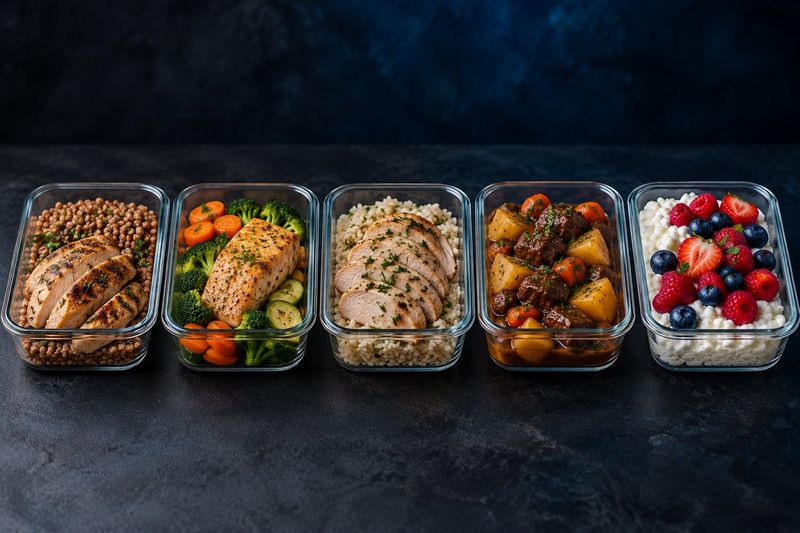
Below is a sample weekly weight loss menu for a 30-year-old woman who is 165 cm tall and weighs 65 kg, with a 20% deficit: the meal plan has fewer calories than her body burns. Per day, that's about 1,500 kcal, 112–118 g of protein, 59–64 g of fat, and 27 g of fiber on average. Fiber here means dietary fiber.
I'm Demid Lobanov, a fitness coach. This menu was put together by a program from a dish database, using the same algorithm I use to build 28-day meal plans for clients. The menu is the first week of a meal plan for a fictional client with the parameters from the article How Many Calories Do You Need a Day.
The calories for each day differ from the target by no more than 2.4%. Portion weights aren't listed here: they are calculated for a specific person's target. At a different body weight or activity level, the portions of the same dishes would be different. How to calculate portions for yourself is explained below.
Who this menu is for and how many calories it has
The target was calculated like this. Basal metabolic rate, the energy the body uses to run itself at rest, is 1,370 kcal for this woman. With light activity (a factor of 1.375), her energy expenditure is 1,884 kcal per day. Calories with a 20% deficit come to 1,507 kcal, which is above her basal metabolic rate.
Protein is 117 g, or 1.8 g per kg of body weight; fat is 65 g, or 1.0 g per kg; carbs make up the remaining calories: (1,507 − 117 × 4 − 65 × 9) ÷ 4 ≈ 114 g. On average over the week, the menu provides 1,519 kcal, 114 g of protein, 62 g of fat, 113 g of carbs, and 27 g of fiber.
The menu passes the same checks as my clients' meal plans. These are my algorithm's tolerances:
| Check | Tolerance | In this menu |
|---|---|---|
| daily calories | ±3% of target | +0.3% to +2.4% |
| daily protein | no lower than target minus 5 g (112 g) | 112.1 to 118.2 g |
| daily fat | no lower than target minus 10% (58.5 g) and at least 45 g | 58.6 to 63.6 g |
| weekly calories | ±1.5% | +0.8% |
| weekly fat | ±10% of target | −4.8% |
| weekly fiber | an average of at least 25 g, the World Health Organization (WHO) guideline | 27 g |
The 1.0 g of fat per kg threshold applies to the target. On any single day, fat can be up to 10% below target, and the weekly average can differ from the target by no more than 10%.
The high protein is deliberate: in a calorie deficit, protein helps preserve muscle. A meta-analysis combines the results of several studies into a single estimate. The 2012 meta-analysis by Wycherley and colleagues included 24 studies. On a high-protein diet, weight dropped by 0.79 kg more and fat mass by 0.87 kg more, while the loss of lean mass (body mass without fat) was 0.43 kg smaller.
How the menu is built: cook less often without eating the same thing
Breakfast and lunch repeat for two days in a row, and the chicken with buckwheat on days 3–4 is cooked for both days at once. The snack on days 1–4 also repeats for two days, while dinner is new every day. Clients fall off their plans more often because of monotony and the way the plan is set up than because of the calories themselves, so there are exactly as many repeats as needed to spend less time at the stove.
It's convenient to shop at different intervals: perishables for the week, and grains, oil, nuts, and sauces for several weeks at once.
There are no strict bans: the menu includes rye crispbreads, potatoes, a banana, dried apricots, and peanut butter, all within the calorie budget. In three studies by Westenhoefer and colleagues from 1999, rigid control of eating was associated with overeating and a higher body mass index, a measure of weight relative to height. With flexible control, the likelihood of losing weight over the one-year program was higher; these are observations, and the study included no experiment.
7-day menu
Calories, protein, fat, carbs, and fiber are listed for each day. Carbs are listed without fiber, and calories are calculated as follows: protein and carbs at 4 kcal per gram, fat at 9, fiber at 2. My algorithm calculates the target without fiber, so the calories from protein, fat, and carbs in the menu are slightly below target: on average, fiber provides about 55 kcal a day. A sample one-day menu with portions in grams for this target is in the article A 1,500-Calorie Menu for One Day.
Tofu is soybean curd, hummus is a chickpea paste, a bowl is a dish served in a deep bowl, and an oat pancake is a pancake made from rolled oats and eggs.
Day 1: 1,514 kcal, protein 115 g, fat 62 g, carbs 107 g, fiber 32 g
- Breakfast: Greek yogurt with berries and seeds.
- Lunch: salad with beans, corn, and egg.
- Snack: cottage cheese with cucumber and dill.
- Dinner: tofu with broccoli, rice, and teriyaki sauce.
Day 2: 1,513 kcal, protein 113 g, fat 64 g, carbs 104 g, fiber 37 g
- Breakfast: Greek yogurt with berries and seeds.
- Lunch: salad with beans, corn, and egg.
- Snack: cottage cheese with cucumber and dill.
- Dinner: bowl with chickpeas, egg, and hummus.
Day 3: 1,512 kcal, protein 113 g, fat 62 g, carbs 113 g, fiber 22 g
- Breakfast: oatmeal cooked in water with apple and almonds.
- Lunch: chicken breast with buckwheat and a vegetable salad, cooked for 2 days at once.
- Snack: boiled eggs with cucumber, also for 2 days.
- Dinner: herring with crispbreads and vegetables.
Day 4: 1,515 kcal, protein 112 g, fat 60 g, carbs 117 g, fiber 27 g
- Breakfast: oatmeal cooked in water with apple and almonds.
- Lunch: chicken breast with buckwheat and a vegetable salad, cooked on day 3.
- Snack: boiled eggs with cucumber, cooked on day 3.
- Dinner: bean salad with egg and herbs.
Day 5: 1,543 kcal, protein 113 g, fat 63 g, carbs 118 g, fiber 26 g
- Breakfast: oat pancake with cheese and tomato.
- Lunch: tuna with crispbreads, beans, and cucumber.
- Snack: cottage cheese with dried apricots.
- Dinner: baked Adyghe cheese with lentils and zucchini.
Day 6: 1,521 kcal, protein 112 g, fat 59 g, carbs 124 g, fiber 25 g
- Breakfast: oat pancake with cheese and tomato.
- Lunch: tuna with crispbreads, beans, and cucumber.
- Snack: tuna with crispbreads and tomato.
- Dinner: herring with boiled potatoes and onion.
Day 7: 1,518 kcal, protein 118 g, fat 63 g, carbs 110 g, fiber 21 g
- Breakfast: cottage cheese with banana and peanut butter.
- Lunch: soba (buckwheat noodles) with tofu and vegetables.
- Snack: crab sticks with cucumber.
- Dinner: cottage cheese with berries and flaxseeds.
How to calculate portions for your own target
- Calculate your target using the article How Many Calories Do You Need a Day.
- Split it across your meals. A guideline for four meals: breakfast 25% of the day's calories, lunch 35%, snack 10%, dinner 30%.
- Enter the dish into a calorie-tracking app and adjust the portion weight: keep the day's protein close to target, and make up the rest of the calories with the side dish and oil.
- Fat target: no lower than 1.0 g per kg, and for a woman at least 45 g. Calories: no lower than basal metabolic rate.
A detailed step-by-step process with an example is in the article Weight Loss Meal Plan.
How to swap a dish you don't like
Compare the replacement with the portion of the dish for that day. Acceptable difference: calories ±5%, but no more than 40 kcal; protein and fat ±5 g; carbs ±10 g. Breakfast is swapped only for breakfast, lunch only for lunch.
If your doctor has limited your salt intake, replace the herring on days 3 and 6 with another dinner of the same calories. If you don't eat fish, dairy, or meat, it's better to build the menu from scratch: swapping one dish won't solve it.
What it takes for the menu to work
- Weigh food raw and log everything you eat, including oil and sauces. How to weigh it is covered in How to Weigh Your Food. In studies, participants underreported calories on average with every recording method, even in food diaries with weighed food. This was shown by a 2021 meta-analysis by McKenzie and colleagues.
- Weigh yourself every morning and calculate your average weight for each week.
- After 14 days, compare the average weights of two consecutive weeks. The expected loss is estimated with the rule “1 kg of fat is about 7,700 kcal”: daily deficit × 7 ÷ 7,700. For this target, (1,884 − 1,507) × 7 ÷ 7,700 ≈ 0.34 kg per week.
- If your weight dropped by less than half the expected amount (here, less than 0.17 kg) and you stuck to the plan, cut 5–10 g of fat from the target. Don't take the fat target below 1.0 g per kg and 45 g for a woman. If it's already at that limit, as in this menu, cut about 90 kcal from carbs.
- If you had your period during the second week and your weight barely changed, don't change the target and keep watching your weight for another week: water retention before your period hides the loss.
- If your period is delayed while you're in a calorie deficit, raise your calories and see a gynecologist.
When this menu isn't right for you
This is an example for a healthy woman with the parameters from the article. With diabetes, kidney or liver disease, pregnancy and breastfeeding, stomach and bowel diseases, an eating disorder, or food allergies, a meal plan is built together with a doctor.
A man, or a woman with a different weight and activity level, needs their own target; how to calculate it is described above.
I post exercise breakdowns on my YouTube channel @lobanov_fitness.
Sources
- Wycherley TP et al. Effects of energy-restricted high-protein, low-fat compared with standard-protein, low-fat diets: a meta-analysis of randomized controlled trials. Am J Clin Nutr, 2012. Article
- Westenhoefer J et al. Validation of the flexible and rigid control dimensions of dietary restraint. Int J Eat Disord, 1999. Article
- World Health Organization. Carbohydrate intake for adults and children: WHO guideline, 2023. WHO guideline · WHO news release
- McKenzie BL et al. Investigating sex differences in the accuracy of dietary assessment methods to measure energy intake in adults: a systematic review and meta-analysis. Am J Clin Nutr, 2021. Article · Full text