
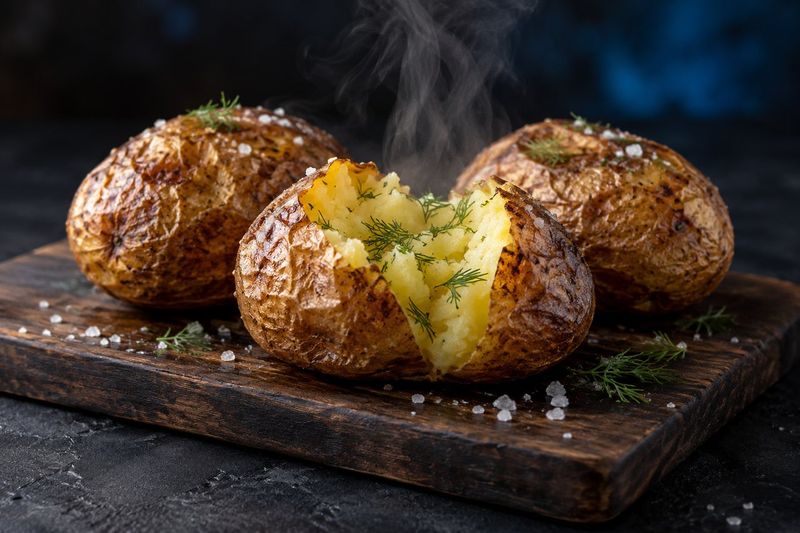
Yes, you can eat potatoes while losing weight. You lose weight when you take in fewer calories from food than you burn, and potatoes don't get in the way of that. In Randolph's 2014 study, people lost weight while eating potatoes 5–7 times a week, and the potatoes did not lead to weight gain. Boiled potatoes are one of the most filling foods per calorie (Holt 1995). What matters is how they're cooked: French fries have about 3.6 times as many calories as boiled potatoes.
I'm Demid Lobanov, a fitness coach. In the meal plans I create, potatoes, like bread and pasta, have no place on a list of banned foods: everything is allowed within your calorie budget. In the dish database for my meal plans, potatoes appear in 20 of 260 recipes. Below: what the research shows, how many calories potatoes have, and where extra calories quietly come from.
How many calories are in potatoes
In the food database for my meal plans, raw potatoes have 74.7 kcal per 100 g, 2 g of protein, and 2.1 g of fiber. The composition comes from the American USDA database and is recalculated using my database's formula. The calories in a cooked dish depend on how much water is lost during cooking and on add-ins, such as butter and milk.
| Potatoes, 100 g | Calories, kcal |
|---|---|
| Boiled (with or without skin) | 86–87 |
| Mashed with whole milk and butter | 113 |
| French fries | 312 |
| Potato chips | 532 |
The figures come from the USDA, the American food composition database. French fries have about 3.6 times the calories of boiled potatoes, and chips about 6 times.
Do potatoes get in the way of weight loss? What the research says
In studies, potatoes in the diet did not hinder weight loss. In a 2014 study by Randolph and colleagues, 90 people with excess weight ate potatoes 5–7 times a week for 12 weeks. Two groups were told to cut their intake by 500 kcal a day, and the third had no recommendations. There was no difference in weight loss between the groups; everyone lost a little. The authors attribute the weight loss to reduced calorie intake and write that potatoes did not lead to weight gain.
In a 2022 study by Rebello and colleagues, 36 people with insulin resistance ate meals prepared by the researchers for 8 weeks. On a diet with few calories per gram and plenty of potatoes, weight dropped by 5.6%; on the same kind of diet with legumes, by 4.1%. The difference was not statistically significant, and the authors consider the diets equivalent.
Observations of large groups of people don't show a convincing link between potatoes and obesity. The 2016 systematic review by Borch and colleagues included only observational studies. They show no convincing link between potatoes and obesity, but French fries were associated with obesity in all three studies that looked at them separately. According to a 2025 meta-analysis of observational studies by Su and colleagues, total potato intake is not associated with blood pressure, diabetes, or heart disease. When potatoes are split by cooking method, fried potatoes are associated with diabetes risk, with a 16% higher risk. The association for non-fried potatoes is weaker, with a 5% higher risk. These are observational data: they show an association, not a cause.
| Study | What was studied | What was found |
|---|---|---|
| Randolph 2014 | 90 people, potatoes 5–7 times a week, 12 weeks | all groups lost weight; potatoes did not add weight |
| Rebello 2022 | 36 people, a potato-based diet, 8 weeks | weight −5.6%, −4.1% on the legume diet; difference not significant |
| Borch 2016 | review of observational studies | no convincing link with obesity; French fries are linked to obesity |
| Su 2025 | meta-analysis of observational studies | total intake not associated with blood pressure, diabetes, or heart disease; fried and, more weakly, non-fried potatoes associated with diabetes risk |
Potatoes and satiety
In a 1995 study by Holt and colleagues, 38 foods were served in 240 kcal portions, and each food was tested by 11–13 people. Boiled potatoes came out as the most filling: 323% relative to white bread and seven times higher than croissants. In a 2013 study by Geliebter and colleagues, 12 people of normal weight had less desire to eat after potato meals than after pasta. Yet their hunger and fullness ratings on the scales did not differ. At the next meal, people ate the same amount.
In these studies, satiety was rated by the participants themselves over a couple of hours after eating. The takeaway for weight loss is simple: boiled potatoes give you a lot of volume for few calories. In Holt's study, satiety was higher the heavier the portion and the more water it contained.
Boiled, baked, or fried potatoes
Cooking doesn't make calories disappear; it's water that's lost. According to the reference values in my meal-plan database, vegetables lose about a quarter of their weight when baked and about 30% when fried. That's why 100 g of cooked potatoes has more calories than 100 g of raw. The oil absorbed during frying stays in the dish entirely. So in my meal plans, potatoes are counted by raw weight, and the oil as a separate line. Potatoes boiled in their skins are counted the same way as regular boiled potatoes.
More often, the extra calories come from what's added to the potatoes. An example from the dish database for my meal plans: chicken patties with mashed potatoes. 250 g of potatoes is 187 kcal; 60 g of milk and 10 g of butter add another 107 kcal. The mash contains 294 kcal, and more than a third of that comes from the add-ins. The rule in my meal plans: if it goes in your mouth, it goes in the count.
Glycemic index of potatoes and chilled potatoes
The glycemic index shows how much a food raises blood sugar compared with glucose. According to the 2021 tables by Atkinson and colleagues, most potato varieties have a high glycemic index, although varieties with a low one have also been found.
Baked and chilled potatoes raised blood sugar slightly less than boiled ones. In a 2019 study by Patterson and colleagues, 30 women with elevated fasting blood sugar and insulin ate either boiled or baked-and-chilled potatoes. After the chilled potatoes, blood sugar at 15 and 30 minutes was 4.8% and 9.2% lower, and insulin was lower too. The total rise in blood sugar over the whole measurement period and satiety did not differ. The study was funded by the Alliance for Potato Research and Education.
For weight loss, the glycemic index matters less than calories. In Geliebter's study, it predicted neither satiety nor how much people ate afterward. In Randolph's study, participants found it hard to stick to a low- or high-glycemic-index diet, and the authors attribute the weight loss to calories. More in the article Fast Carbs.
Potatoes for dinner
You can eat potatoes for dinner: for weight loss, what matters is your calorie intake for the whole day. More in the article Can You Eat at Night?.
Potatoes, buckwheat, or pasta
In calories per cooked weight, potatoes and buckwheat are close, while pasta has almost twice as many. Per 100 g according to USDA: boiled potatoes 87 kcal, cooked buckwheat 92, cooked pasta 158. Choose your side dish by taste and count it within your calorie target. Sweet potatoes are also close to regular potatoes in calories: in the food database, they have 81.7 kcal per 100 g raw versus 74.7 for potatoes, and 3 g of fiber versus 2.1. More about pasta in the article Pasta for Weight Loss.
Common mistakes with potatoes when losing weight
| Mistake | What happens | How to fix it |
|---|---|---|
| Counting French fries or fried potatoes as boiled | fries have 3.6 times the calories; fried potatoes carry the calories of all the oil they absorbed | count fries at their own calorie value; for fried potatoes, log the oil as a separate line |
| Not counting the butter and milk in mashed potatoes | more than a third of the mash's calories go missing | log everything you add to potatoes as a separate line |
| Weighing baked potatoes and counting them as raw | an error of a quarter or more | weigh them raw or convert |
| Banning potatoes completely | in my practice, bans can lead to rebounds and lapses | keep potatoes in your diet within your calories |
How to eat potatoes and lose weight: step by step
- Work out your calorie target using the article How Many Calories You Need per Day.
- Make room for carbs using the article How Many Carbs You Need per Day.
- Weigh potatoes raw; more in the article How to Weigh Food.
- Log butter, milk, and cheese separately.
- Choose boiled or baked potatoes more often; have fries and chips less often and within your calories.
- If your weight stalls, check your counting first: see the article Weight Loss Plateau.
If you have diabetes or are on a therapeutic diet, the amount of carbs, including potatoes, is set together with your doctor.
If you need meals built around your calorie target and your tastes, there's the meal plan.
I post exercise breakdowns on my YouTube channel @lobanov_fitness.
Sources
- Randolph JM et al. Potatoes, glycemic index, and weight loss in free-living individuals: practical implications. J Am Coll Nutr, 2014. Article
- Rebello CJ et al. Low-Energy Dense Potato- and Bean-Based Diets Reduce Body Weight and Insulin Resistance: A Randomized, Feeding, Equivalence Trial. J Med Food, 2022. Article · Full text
- Borch D et al. Potatoes and risk of obesity, type 2 diabetes, and cardiovascular disease in apparently healthy adults: a systematic review of clinical intervention and observational studies. Am J Clin Nutr, 2016. Article
- Su Y et al. Potato Intake and the Risk of Overweight/Obesity, Hypertension, Diabetes, and Cardiovascular Disease: A Systematic Review and Meta-analysis of Observational Studies. Nutr Rev, 2025. Article
- Holt SH et al. A satiety index of common foods. Eur J Clin Nutr, 1995. PubMed
- Geliebter A et al. Satiety following intake of potatoes and other carbohydrate test meals. Ann Nutr Metab, 2013. Article
- Atkinson FS et al. International tables of glycemic index and glycemic load values 2021: a systematic review. Am J Clin Nutr, 2021. Article
- Patterson MA et al. Chilled Potatoes Decrease Postprandial Glucose, Insulin, and Glucose-dependent Insulinotropic Peptide Compared to Boiled Potatoes in Females with Elevated Fasting Glucose and Insulin. Nutrients, 2019. Article · Full text
- U.S. Department of Agriculture. FoodData Central, SR Legacy. Website