
The leg muscles are the quads on the front of the thigh, the hamstrings on the back of the thigh, the adductors on the inner thigh, and the calves. For the glutes, see the article How to Build Your Glutes. Squats grow the quads and adductors, but the hamstrings need leg curls, that is, bending the knee: in studies, the hamstrings didn't grow from squats. Calves grow better from standing calf raises, with straight knees. The guideline is 10–20 working sets per muscle group per week.
I'm Demid Lobanov, a fitness coach. In my exercise library, the main hamstring exercise is the seated leg curl, not the lying leg curl: when you're seated, the hip is flexed, and the muscles work in a more stretched position. Below is what grows each leg muscle and how to put it all together into a workout.
What muscles make up the legs
Anatomy and muscle functions are based on Hall's biomechanics textbook; the exercises are based on research and my exercise library, covered below:
| Muscles | Location | What they do | What grows them |
|---|---|---|---|
| Quads: the three vastus muscles and the rectus femoris | front of the thigh | extend the knee; the rectus femoris also flexes the hip, bringing the thigh toward the torso | squats, leg press, leg extensions |
| Hamstrings: biceps femoris, semitendinosus, semimembranosus | back of the thigh | flex the knee; all except the short head of the biceps femoris also extend the hip, moving the thigh backward | leg curls, hip extension exercises |
| Adductors: adductor magnus, longus, brevis, and gracilis | inner thigh | adduct the hip, moving the thigh toward the midline of the body | deep squats, machine hip adduction |
| Calves: gastrocnemius and soleus | back of the lower leg | raise the heel; the gastrocnemius also flexes the knee | standing and seated calf raises |
Why squats alone aren't enough
Squats don't grow every leg muscle. In a 2019 study by Kubo and colleagues, 17 men did full or partial squats twice a week for 10 weeks. Quad volume increased by 4.9% and 4.6%, adductor volume by 6.2% and 2.7%, while the rectus femoris and hamstrings didn't change in either group.
In a 2023 study by Plotkin and colleagues, squats and hip thrusts, a barbell glute bridge with the shoulder blades resting on a bench, grew the gluteus maximus equally over 9 weeks. The quads and adductors grew more from squats, while the hamstrings didn't grow in either group.
That's why squats or leg presses are paired with hamstring exercises, plus leg extensions for the rectus femoris.
How to build the front of your thighs
The foundation is the squat; in my exercise library, the leg press is the quad option without axial loading on the spine. In Kubo's study, the quads grew equally from full and partial squats, while the adductors and glutes grew more from full squats. For more on depth, see the articles Full or Partial Range of Motion and Can Your Knees Go Past Your Toes in a Squat?
The rectus femoris grows more from leg extensions when the backrest is reclined than in the usual seated position. In a 2025 study by Larsen and colleagues, 22 untrained men trained for 10 weeks, extending one leg with the hip flexed at 40° and the other at 90°, as in the usual seated position. The rectus femoris grew more at 40°, while the vastus lateralis grew equally.
In a 2022 study by Pedrosa and colleagues, untrained women did leg extensions through different ranges of motion; there were 45 participants in total, including a control group. Working only in the initial part of the movement, from 100° to 65° of knee flexion, where the quads are stretched, produced greater growth in some regions of the muscle than the full range of motion or the final part of the movement.
How to build your hamstrings
With seated leg curls. In a 2021 study by Maeo and colleagues, 20 untrained people trained for 12 weeks, curling one leg seated, with the hip flexed at about 90°, and the other lying down. The hamstrings as a whole grew by 14% from seated curls and by 9% from lying curls. The difference came from the heads that cross two joints; the short head of the biceps femoris grew equally. What matters is the hip flexion angle and the machine's design, not the word "seated" itself: in this study, the hip was flexed about 90° in the seated position and about 30° in the lying position.
In a 2024 study by Maeo and colleagues, young men spent 12 weeks doing either seated machine leg curls, with the backrest tilted so the hip was more flexed and with an emphasis on lowering the weight, or Nordic curls: lowering the torso forward from a kneeling position with the feet anchored. Each group had 14 people, and another 14 served as controls. The hamstrings grew by 18% and 11%.
The second exercise is a hip extension movement. In a 2017 study by Bourne and colleagues, a hip extension exercise done for 10 weeks increased the volume of the long head of the biceps femoris more than Nordic curls did. A similar movement in my exercise library is the narrow-stance 45-degree hip extension (hyperextension): lowering and raising the torso with the legs anchored. On a horizontal back extension bench, it's hardest at the top; on an angled bench, in the middle of the lift; and in the most stretched position, the load is lower. That's why it complements the Romanian deadlift, bending forward with a weight while pushing the hips back, which loads the muscle in a stretched position.
How to build your inner thighs
The adductors grow from deep squats: in Kubo's study, by 6.2% from full squats versus 2.7% from partial squats. My exercise library includes wide-stance squats and the seated hip adduction machine for them; on the machine, the load falls on the stretched and middle positions of the muscles. This exercise won't help remove fat from the inner thigh, because fat doesn't come off locally. More on that in the article How to Lose Belly Fat.
How to build your calves
With standing calf raises, knees straight. In a 2023 study by Kinoshita and colleagues, 14 untrained people trained for 12 weeks, one leg standing and the other seated, with the knee bent at 90°. The gastrocnemius grew by 9.2–12.4% from standing raises, while seated raises produced no statistically significant growth: 0.6–1.7%. In other words, in the second case the data didn't allow growth to be reliably distinguished from random fluctuation. The soleus grew by 2.1% and 2.9%, and the difference between legs was not significant. The authors note that the lower-leg muscles are harder to grow with training than other muscles.
The bottom of the movement matters. In a 2023 study by Kassiano and colleagues, 42 young women did calf raises on a leg press machine for 8 weeks. When they worked only in the bottom part, where the gastrocnemius is stretched, the medial, or inner, head of the gastrocnemius grew by 15.2%; with the full range of motion, by 6.7%; and in the top part, by 3.4%.
How to build your legs at home
At home, you train your quads with squats and lunges, making them progressively harder. According to a 2021 meta-analysis by Lopez and colleagues, muscles grow from light weights too, if sets are taken to failure. Details are in the article Working Out at Home.
For the hamstrings at home, Nordic curls work well: in Maeo 2024, they produced 11% growth in 12 weeks. For the calves, do standing calf raises on a step, lowering your heels below the step.
How many sets to do for legs
The guideline is the same as for other muscles: 10–20 working sets per week for each group, and 10–12 when you're starting out, split across 2 workouts. Quads, hamstrings, and calves are counted separately. A set of squats counts toward the quads but not the hamstrings: in studies, the hamstrings didn't grow from squats. Details are in the article How Many Sets per Week.
Most sets are 6–12 reps with 1–3 reps in reserve before failure. Failure is the point at which you can no longer complete another rep with proper form.
How I choose leg exercises
Leg exercises from my exercise library:
| Exercise | Muscle | Where it's hardest | Why it's in the program |
|---|---|---|---|
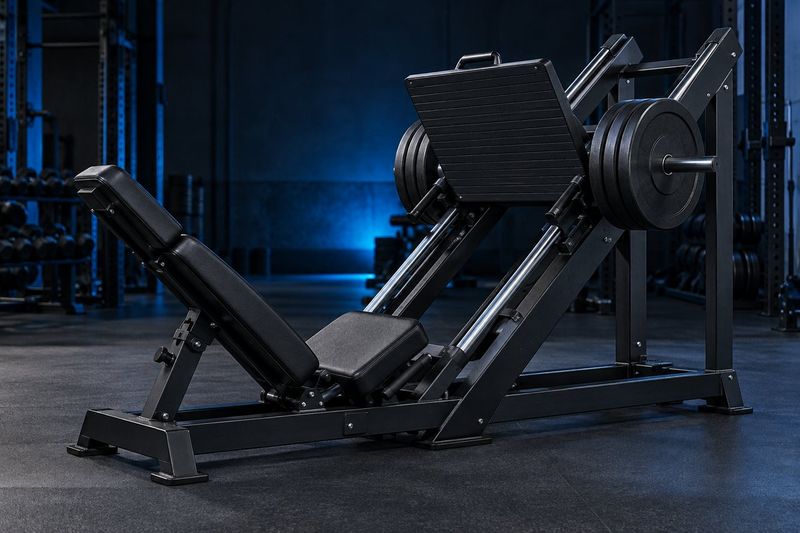
| Horizontal leg press, feet wide, at mid-height on the platform | quads, adductor magnus | at the bottom, in the stretched position | quads without axial loading on the spine |
| Walking lunges | quads | at the bottom of the step | single-leg work evens out differences between sides |
| Seated machine leg extension | quads; rectus femoris with the backrest reclined | at the end of the extension, in the shortened position | targeted quad loading, complements squats or the leg press |
| Seated machine leg curl | hamstrings | depends on the machine | the muscles are stretched throughout the range of motion |
| Narrow-stance 45-degree hip extension | hamstrings | on a horizontal bench, at the top; on an angled bench, in the middle of the lift | complements the Romanian deadlift |
| Seated hip adduction machine | adductors, mainly the adductor magnus | the load is even | adductors in the stretched position |
I combine exercises with different resistance profiles: for example, the leg press, which is hardest at the bottom, and the leg extension, which is hardest at the end of the movement.
How to build your legs: step by step
- Quads: squats or leg presses plus leg extensions, preferably with the backrest reclined.
- Hamstrings: seated leg curls plus Romanian deadlifts or 45-degree hip extensions.
- Adductors: deep squats, wide-stance squats, or the hip adduction machine.
- Calves: standing calf raises, with straight knees and a stretch at the bottom.
- When starting out: 10–12 working sets per week for each group, 2 workouts.
- Add weight when, for several workouts in a row, you can complete the target number of reps within your range in all working sets with proper form.
- After a month, assess your progress in weights and reps.
If you have knee pain or have had an injury or surgery, choose exercises and squat depth together with your doctor.
If you need a plan for your goal and your gym, there's the personalized program.
I post exercise breakdowns on my YouTube channel @lobanov_fitness.
For technique on key lower-body lifts, see Sumo Deadlift, Leg Extension Machine, and How to Build Glutes. You can review your lifting video and volume distribution in a training audit.
Sources
- Hall SJ. Basic Biomechanics. 9th edition. McGraw Hill, 2022. Chapter 8: the lower extremity.
- Kubo K et al. Effects of squat training with different depths on lower limb muscle volumes. Eur J Appl Physiol, 2019. Article
- Plotkin DL et al. Hip thrust and back squat training elicit similar gluteus muscle hypertrophy and transfer similarly to the deadlift. Front Physiol, 2023. Article · Full text
- Larsen S et al. The effects of hip flexion angle on quadriceps femoris muscle hypertrophy in the leg extension exercise. J Sports Sci, 2025. Article
- Pedrosa GF et al. Partial range of motion training elicits favorable improvements in muscular adaptations when carried out at long muscle lengths. Eur J Sport Sci, 2022. Article
- Maeo S et al. Greater Hamstrings Muscle Hypertrophy but Similar Damage Protection after Training at Long versus Short Muscle Lengths. Med Sci Sports Exerc, 2021. Article · Full text
- Maeo S et al. Hamstrings Hypertrophy Is Specific to the Training Exercise: Nordic Hamstring versus Lengthened State Eccentric Training. Med Sci Sports Exerc, 2024. Article · Full text
- Bourne MN et al. Impact of the Nordic hamstring and hip extension exercises on hamstring architecture and morphology: implications for injury prevention. Br J Sports Med, 2017. Article
- Kinoshita M et al. Triceps surae muscle hypertrophy is greater after standing versus seated calf-raise training. Front Physiol, 2023. Article · Full text
- Kassiano W et al. Greater Gastrocnemius Muscle Hypertrophy After Partial Range of Motion Training Performed at Long Muscle Lengths. J Strength Cond Res, 2023. Article
- Lopez P et al. Resistance Training Load Effects on Muscle Hypertrophy and Strength Gain: Systematic Review and Network Meta-analysis. Med Sci Sports Exerc, 2021. Article · Full text




