
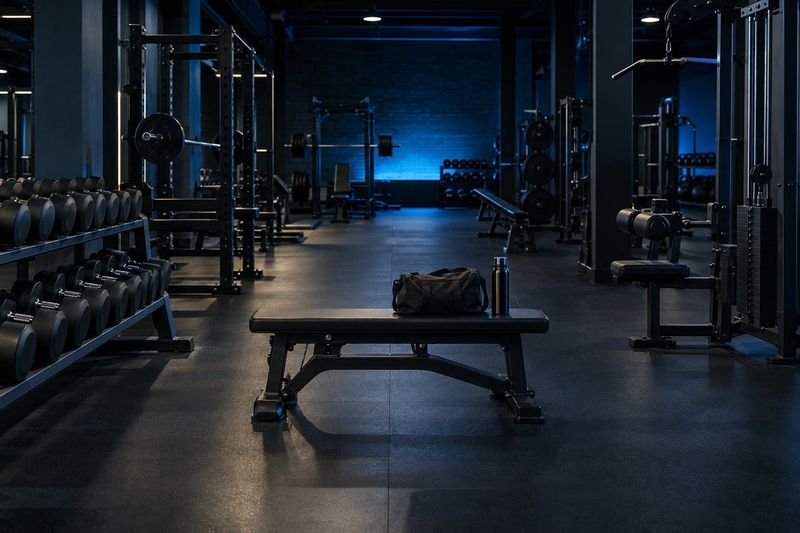
Gym workouts for women follow the same rules as for men: strength exercises for all the major muscle groups 2–3 times a week. To start, do 10–12 working sets per muscle group per week and add weight gradually. A working set is a set of reps taken close to failure, the point where you can no longer do the next rep with proper technique. As a percentage of their starting size, women's muscles grow just as men's do. For weight loss you need a calorie deficit: you get less energy from food than you burn.
I'm Demid Lobanov, a fitness coach. When I build a program for a client, I start with her priority muscle groups. For Kristina, for example, we designed a program around her proportions, with an emphasis on glutes and back. Below: how women's training differs from men's, five myths that make women afraid of the gym, and a sample 3-day program.
How women's training differs from men's
In terms of the rules, it doesn't. A 2025 meta-analysis by Refalo and colleagues pooled the results of 29 studies in which men and women aged 18–45 followed the same program. Relative muscle growth, as a percentage of starting size, was the same. In absolute terms, men gained slightly more, mostly in the upper-body muscles.
In a 2020 meta-analysis by Roberts and colleagues, muscle growth also didn't differ between men and women (10 studies). In percentage terms, upper-body strength increased even more in women (17 studies), and leg strength increased equally.
What differs is the goals: which muscles a person wants to develop first.
Myth 1. "Strength training will make me bulky"
Muscle grows slowly: you can't get bulky from a single workout, and noticeable size takes years to build. In percentage terms, women's muscles grow just as men's do, but women's starting muscle size is smaller on average, so their absolute gain is smaller.
Kristina came to me after losing weight on her own: she weighed 46 kg, had no strength, no shape, and was afraid of gaining weight again. We raised her calories and built a program with an emphasis on glutes and back, and we reviewed her technique on video. Her weight went up to 55 kg, all through muscle: her glutes and shoulders got bigger, and her working weights went up.
Myth 2. "You can build your glutes with resistance bands"
For a beginner, a band works as long as the exercise still feels hard with it. But once you have even a little training experience, its resistance is no longer enough, and it's hard to increase the load with a band. To grow, you need a weight you can increase gradually.
In a 2019 meta-analysis by Lopes and colleagues (8 studies), strength increased equally with band training and with machine or dumbbell training; muscle growth wasn't compared directly. According to a 2021 meta-analysis by Lopez and colleagues, muscles grow even with light weights if you take your sets to failure. So a band works as long as you can still take a set to failure with it.
Myth 3. "I won't lose weight without cardio"
Weight loss comes from a calorie deficit. Cardio, such as running or cycling, helps you burn more calories, but nutrition plays the decisive role. Exercise alone, without dieting, reduces weight in people with excess weight by an average of 1.5–3.5 kg, according to a 2021 overview of reviews by Bellicha and colleagues.
A comparison of cardio and strength training is in the article Cardio or Strength Training for Weight Loss.
Myth 4. "Hip adduction gets rid of inner thigh fat"
Fat isn't lost locally: no matter how much you work one area, fat won't come off it any faster. Your whole body slims down when you're in a calorie deficit. In a 2021 meta-analysis by Ramirez-Campillo and colleagues (13 studies, 1,158 participants), training one arm or leg didn't reduce fat on it any more than on the other, untrained one.
In my exercise library, the machine hip adduction, or adductor machine, is classified as an exercise for the adductors, primarily the adductor magnus. Treating it as a "women's exercise for the inner thigh" is a typical mistake. More on spot reduction, including small studies with the opposite result, in the article How to Lose Belly Fat.
Myth 5. "You need to train your glutes every day"
The number of training days isn't what matters most. What matters is how the load is spread across the week: when to train hard and when to let your muscles rest. That way they have time to recover and grow.
According to a 2019 meta-analysis by Schoenfeld and colleagues (25 studies), when volume (the number of working sets) is equal, training frequency has no significant effect on muscle growth. Meta-regressions by Pelland and colleagues in 2026, an analysis of relationships between variables using data from several studies, showed that muscle growth increases with weekly volume, while the effect of frequency on growth may be negligible.
How many times a week should women train?
| Decision | Guideline for a healthy beginner | Details |
|---|---|---|
| Workouts per week | 2–3, each muscle at least 2 times | How Many Times a Week to Train |
| Working sets per muscle | 10–12 per week to start, then up to 20 | How Many Sets per Week |
| Reps | 6–12 in most sets | How Many Reps to Do |
| Proximity to failure | 1–3 reps in reserve, reps you could still do | Training to Failure |
| Rest between sets | longer than a minute | How Long to Rest Between Sets |
A 3-day gym program for women
Three full-body workouts, for example on Monday, Wednesday, and Friday. The priority in this example is the glutes. The exercises come from my exercise library, which I use to build programs for clients. This is an example for a healthy beginner; a program for a specific person is chosen based on their goal, equipment, and limitations.
Workout 1
| Exercise | Sets × reps |
|---|---|
| Horizontal leg press, feet high and narrow | 4 × 8–12 |
| Wide-grip lat pulldown | 4 × 8–12 |
| 45° incline dumbbell bench press | 3 × 8–12 |
| Seated leg curl | 4 × 10–15 |
| Dumbbell lateral raises | 2 × 10–15 |
Workout 2
| Exercise | Sets × reps |
|---|---|
| Barbell Romanian deadlift | 4 × 8–12 |
| Chest-supported cable row | 3 × 8–12 |
| Seated lever chest press | 4 × 8–12 |
| Seated leg extension | 4 × 10–15 |
| Seated machine overhead press | 3 × 8–12 |
| Crunches | 2 × 10–15 |
Workout 3
| Exercise | Sets × reps |
|---|---|
| Machine glute bridge | 4 × 8–12 |
| Seated leg extension | 4 × 10–15 |
| Wide-grip lat pulldown | 3 × 8–12 |
| Cable chest press | 3 × 8–12 |
| Seated leg curl | 4 × 10–15 |
| Dumbbell lateral raises | 2 × 10–15 |
In this example, the glutes get 12 working sets per week. The quads, the muscles on the front of the thigh, get 10, as do the hamstrings, back, and chest. Each of these groups is trained 3 times a week.
In a multi-joint exercise, movement happens at several joints. For a muscle that assists the main one, a set of such an exercise counts as half a set. Here, this applies to the Romanian deadlift for the hamstrings and to the leg press with a high, narrow foot placement for the quads. In my exercise library, this leg press variation is classified as a glute exercise.
The glutes are the priority here, so every workout starts with a glute exercise: the leg press, the Romanian deadlift, the glute bridge.
The delts, your shoulder muscles, get 7 direct sets, where they take most of the load, and they also work during presses. If your shoulders are a priority, give them more sets.
Before each workout, do a warm-up.
How to start and add weight
The first 2 weeks are for getting used to the load: learn the technique and practice estimating how many reps you have in reserve. How to put together a program on your own is covered in the article Gym Workout Program.
Add weight when, for several workouts in a row, you manage to do the target number of reps within the set range in all your working sets with proper technique.
Training during your period and pregnancy
You can train during your period, adjusting the load to how you feel; you don't have to build your program around the phases of your cycle. Details in the article Can You Work Out During Your Period?
During pregnancy, your program should be agreed on with your doctor.
Nutrition: losing weight or building muscle
To lose weight, you need a calorie deficit. More in the article How Many Calories You Need per Day.
To build muscle, you need enough protein; the guideline is at least 1.6 g per kilogram of body weight per day. More in the article How Much Protein You Need per Day. For Kristina to build muscle, we raised her calories.
When to expect results
In studies, muscle growth is measured after several weeks of training. In a 2023 study by Plotkin and colleagues, where most participants were women, the gluteus maximus grew over 9 weeks of training twice a week. It grew with both the hip thrust, raising the hips with the upper back supported on a bench, and squats.
Assess your progress in working weights and reps once a month.
Gym workouts for women: step by step
- Choose 2–3 days a week to train.
- Identify your priority muscle groups and start your workouts with them.
- To start, do 10–12 working sets per week for each major muscle group.
- In most sets, do 6–12 reps with 1–3 reps in reserve; spend the first 2 weeks learning technique.
- Add weight when you hit the target number of reps in all your working sets for several workouts in a row.
- To lose weight, create a calorie deficit; to build muscle, eat enough protein.
- Once a month, assess your progress in working weights and reps.
I post exercise breakdowns on my YouTube channel @lobanov_fitness.
Sources
- Refalo MC et al. Sex differences in absolute and relative changes in muscle size following resistance training in healthy adults: a systematic review with Bayesian meta-analysis. PeerJ, 2025. Article · Full text
- Roberts BM et al. Sex Differences in Resistance Training: A Systematic Review and Meta-Analysis. J Strength Cond Res, 2020. Article
- Lopes JSS et al. Effects of training with elastic resistance versus conventional resistance on muscular strength: A systematic review and meta-analysis. SAGE Open Med, 2019. Article · Full text
- Lopez P et al. Resistance Training Load Effects on Muscle Hypertrophy and Strength Gain: Systematic Review and Network Meta-analysis. Med Sci Sports Exerc, 2021. Article · Full text
- Bellicha A et al. Effect of exercise training on weight loss, body composition changes, and weight maintenance in adults with overweight or obesity: An overview of 12 systematic reviews and 149 studies. Obes Rev, 2021. Article · Full text
- Ramirez-Campillo R et al. A proposed model to test the hypothesis of exercise-induced localized fat reduction (spot reduction), including a systematic review with meta-analysis. Hum Mov., 2021. Article
- Schoenfeld BJ et al. How many times per week should a muscle be trained to maximize muscle hypertrophy? A systematic review and meta-analysis of studies examining the effects of resistance training frequency. J Sports Sci, 2019. Article
- Pelland JC et al. The Resistance Training Dose Response: Meta-Regressions Exploring the Effects of Weekly Volume and Frequency on Muscle Hypertrophy and Strength Gains. Sports Med, 2026. Article
- Plotkin DL et al. Hip thrust and back squat training elicit similar gluteus muscle hypertrophy and transfer similarly to the deadlift. Front Physiol, 2023. Article · Full text