
BCAAs are three essential branched-chain amino acids: leucine, isoleucine, and valine. If you already meet your daily protein target through whole food or protein powder, a separate tub of BCAAs will not accelerate muscle growth or burn fat. Against placebo, BCAAs have shown moderate reductions in muscle soreness, yet when daily protein intake is adequate, their impact on preserving muscle performance becomes negligible.
I am Demid Lobanov, a fitness coach and strength-training educator. Among all sports supplements, BCAAs are often a beginner's very first purchase—recommended to "sip during workouts so muscle doesn't break down." Below, I break down where that reputation came from, what clinical trials actually show, and where your budget is better spent.
What BCAAs are and why they are marketed so heavily
Of the twenty amino acids used to build body proteins, nine are essential—the body cannot synthesize them and must get them from food. BCAAs include only three of those nine: leucine, isoleucine, and valine.
Special interest in BCAAs grew out of leucine, which acts as an intracellular trigger for muscle protein synthesis. A narrative review without statistical pooling (Plotkin et al., 2021) notes that early enthusiasm came from extrapolating mechanistic data on BCAAs and leucine to real-world training. The authors stress that practical benefits must be judged against accumulated acute and long-term human studies.
The core biochemical bottleneck was laid out by Wolfe (2017). To synthesize new muscle protein, a cell needs all nine essential amino acids. If you take BCAAs alone without other protein, the only source of the missing six essential amino acids is the breakdown of your own muscle proteins.
In two human studies analyzed by Wolfe, intravenous infusion of BCAAs alone lowered both muscle protein breakdown and synthesis, leaving net balance catabolic—breakdown still exceeded synthesis. The author's conclusion was direct: the claim that dietary BCAAs alone produce an anabolic response in humans is scientifically unwarranted.
Do BCAAs accelerate muscle growth and strength?
Supporters often point to short-term muscle biopsy studies (taking a small tissue sample). In a crossover trial of 10 resistance-trained young men (Jackman et al., 2017), taking 5.6 g of BCAAs immediately after lifting increased myofibrillar protein synthesis (the contractile proteins of muscle) by 22% over 4 hours compared with placebo (0.110 vs. 0.090%/h; p = 0.012). Intracellular mTORC1 signaling also rose (S6K1Thr389 p = 0.017; PRAS40 p = 0.037).
Later, the same group tested 5.6 g of BCAAs plus 30.6 g of carbohydrates against 34.7 g of carbohydrates alone in 10 trained men (Jackman et al., 2023). Myofibrillar protein synthesis over 4 hours was roughly 15% higher (0.128 vs. 0.115%/h; p = 0.039; d = 0.63).
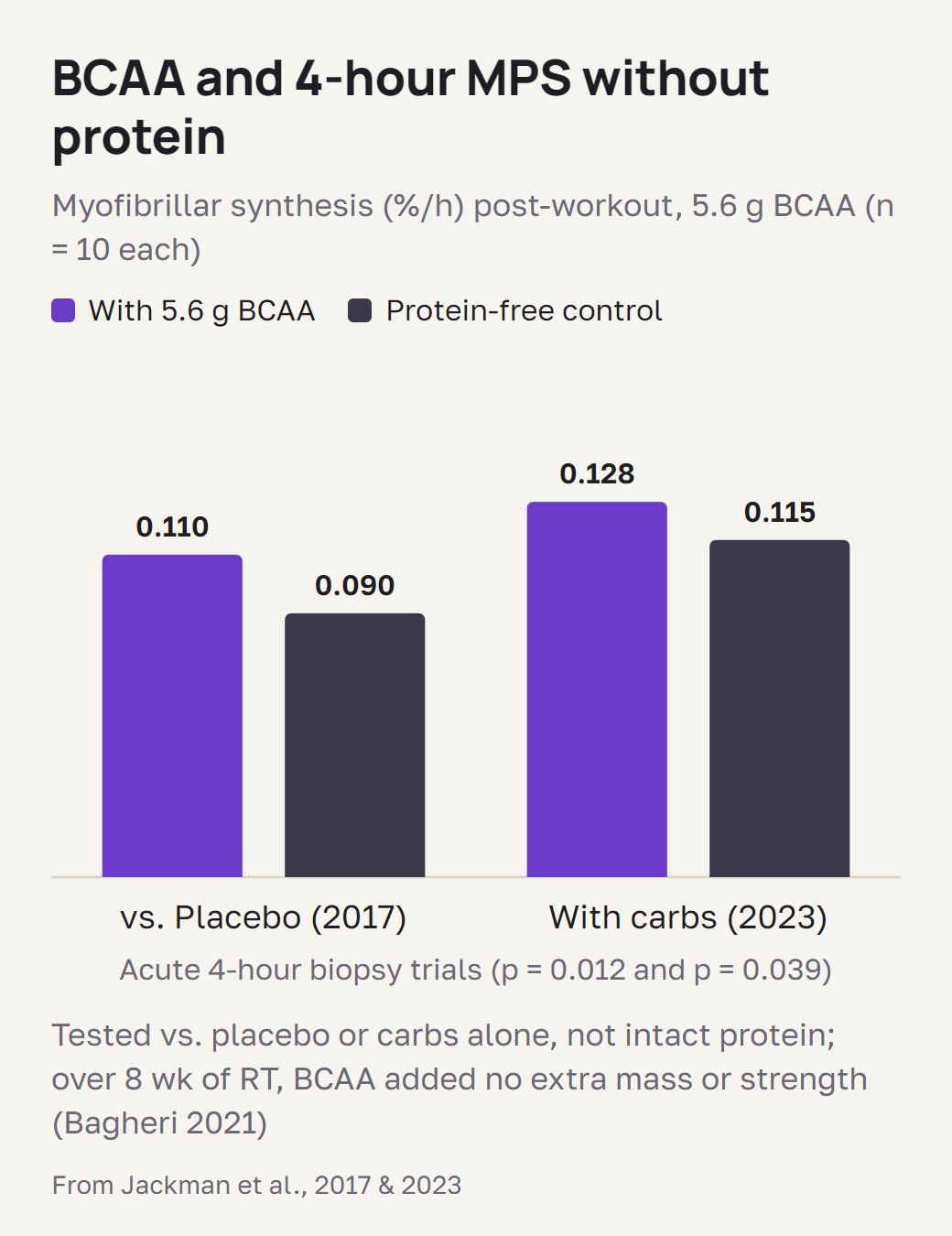
Two key caveats apply to those numbers. First, both studies compared BCAAs with placebo or pure carbohydrate, with no complete-protein control group. Second, a brief four-hour bump in protein synthesis does not guarantee greater muscle growth across months of training.
In an 8-week randomized trial of 30 postmenopausal women (Bagheri et al., 2021; three groups of 10), researchers compared resistance training 3 times per week with 9 g/day of BCAAs, resistance training with placebo, and a non-exercising control. Both training groups significantly increased muscle mass and strength (p < 0.05), with no difference whatsoever between BCAAs and placebo after eight weeks.
The International Society of Sports Nutrition (ISSN) position stand on essential amino acids (Ferrando et al., 2023) sets the record straight: full stimulation of muscle protein synthesis and turnover requires all essential amino acids (EAAs), while non-essential amino acids are not needed. At rest, stimulation starts at 1.5–3.0 g of EAAs and appears to plateau around 15–18 g, with free-form EAAs stimulating synthesis more strongly than an equal amount of intact protein.
Do BCAAs help with muscle soreness and recovery?
Among practical outcomes beyond short-term 4-hour protein-synthesis readings, the only notable benefit of BCAAs over placebo in research involves subjective delayed-onset muscle soreness after heavy exercise—a mechanism covered in Sore Muscles After a Workout.
In a meta-analysis of 8 randomized trials with 37 effect sizes across 61 participants (Fedewa et al., 2019), post-exercise BCAA intake significantly lowered delayed muscle soreness compared with placebo (ES = 0.7286; 95% CI 0.5017–0.9555; p < 0.001).
A meta-analysis of 9 randomized trials in trained men (Khemtong et al., 2021) painted a more modest picture. BCAAs reduced blood creatine kinase during the first 48 hours and eased soreness only within the first 24 hours (<24 h), with no effect on lactate dehydrogenase (LDH) at any time point (creatine kinase and LDH are enzymes used to gauge muscle damage). A systematic review of 19 studies (Arroyo-Cerezo et al., 2021) noted that protocols showing recovery effects typically used 2–10 g/day of BCAAs in a 2:1:1 ratio, often starting 3 days before exercise as well as before and after workouts.
A decisive diet-controlled caveat comes from a randomized trial in 20 resistance-trained men (VanDusseldorp et al., 2018). After heavy eccentric loading—where the muscle lengthens under weight—participants taking BCAAs reported less soreness at 48 and 72 hours (p < 0.01) and lower creatine kinase at 48 hours (p = 0.02). However, there was no overall statistically significant group-by-time interaction, and jump performance still dropped similarly. The authors concluded directly: when someone already consumes roughly 1.2 g of protein per kg of body weight daily, any benefit of BCAAs for preserving performance is likely negligible.
BCAAs, EAAs, or protein: what works best for muscle and fat loss
The ISSN position stand on protein (Jäger et al., 2017) sets practical targets for active people: 1.4–2.0 g of complete protein per kg of body weight per day for building and maintaining muscle, and 2.3–3.1 g/kg/day for trained individuals in a calorie deficit. Each 20–40 g (or 0.25 g/kg) serving every 3–4 hours should aim to supply 700–3,000 mg of leucine alongside a balanced spectrum of all essential amino acids.
A meta-analysis of 49 randomized trials with 1,863 adults training for at least 6 weeks (Morton et al., 2018) confirmed the value of protein supplementation. It increased strength gains (+2.49 kg in one-rep max, 1RM) and fat-free mass (+0.30 kg), and in meta-regression (analyzing how study characteristics relate to outcomes) the effect was larger in resistance-trained lifters (+0.75 kg; p = 0.03). Above a total intake of roughly 1.6 g/kg/day (point estimate 1.62 g/kg; the threshold is approximate—95% CI 1.03–2.20, breakpoint model non-significant at p = 0.079), further protein did not accelerate fat-free mass gains. For calculating daily intake, see How Much Protein Do You Need Per Day, and for choosing a powder, see How to Take Protein Powder.
| Food or supplement | Essential amino acid profile | Muscle-growth effect with adequate daily protein | When it makes practical sense |
|---|---|---|---|
| Whole protein foods (meat, fish, eggs, cottage cheese) | All 9 EAAs, including BCAAs | Foundation for building and keeping muscle | Daily cornerstone of every diet |
| Whey or other complete protein powder | All 9 EAAs, including BCAAs | Helps hit daily targets (Morton 2018); extra above target adds no boost | When whole food falls short of your daily protein goal |
| Complete EAA supplement | All 9 EAAs in free form | Supplies all 9 EAAs and stimulates muscle protein synthesis (ISSN 2023); helpful in low-protein states and aging | Strict calorie deficits, poor appetite, or older adults when specifically needed |
| BCAAs | Only 3 of 9 (leucine, isoleucine, valine) | Does not accelerate muscle growth (Wolfe 2017, Bagheri 2021) | Narrow high-frequency competition schedules or flavored water (counting calories), without growth expectations |
On fat loss specifically: BCAAs do not burn fat, and the calories from amino acids still count toward your daily energy balance. Fat loss is driven by a calorie deficit, while muscle retention during dieting depends on adequate total protein and consistent strength training. The 2023 ISSN stand does note that EAA needs rise during calorie deficits. Meeting them is far smarter with whole protein foods, complete protein powder, or—in select cases—a full EAA blend rather than three isolated amino acids.
How to handle supplements in practice: step by step
- Track your actual protein for 3–5 days. Compare your average with the 1.4–2.0 g/kg/day benchmark (higher for trained lifters in a calorie deficit).
- Close any gap with food or protein powder. If you are 25–30 g short, one scoop of whey or plant protein delivers all three BCAAs plus the other six essential amino acids, which is more practical than standalone BCAAs for closing a protein gap.
- Do not expect BCAAs to prevent muscle breakdown. A 60–90 minute workout does not dissolve your muscles when daily protein and calories fit your goal.
- Spend your budget on proven basics. Among supplements with the strongest evidence for strength training, complete protein (when short on intake) and creatine sit much higher—see How to Take Creatine.
- Respect medical precautions. If you have kidney or liver disease, amino acid metabolism disorders, are pregnant, or are considering supplements for a minor, consult a physician first.
If hitting your protein goal without extra calories or unnecessary supplement tubs feels difficult, a tailored menu around your tastes and routine can be built in a monthly meal plan, while training and nutrition can be aligned together in online coaching.
I also publish short breakdowns of supplements and training nutrition on my YouTube channel @lobanov_fitness.
Sources
- Wolfe RR. Branched-chain amino acids and muscle protein synthesis in humans: myth or reality? J Int Soc Sports Nutr, 2017. Article · Full text
- Plotkin DL et al. Isolated Leucine and Branched-Chain Amino Acid Supplementation for Enhancing Muscular Strength and Hypertrophy: A Narrative Review. Int J Sport Nutr Exerc Metab, 2021. Article
- Ferrando AA et al. International Society of Sports Nutrition Position Stand: Effects of essential amino acid supplementation on exercise and performance. J Int Soc Sports Nutr, 2023. Article · Full text
- Jäger R et al. International Society of Sports Nutrition Position Stand: protein and exercise. J Int Soc Sports Nutr, 2017. Article · Full text
- Jackman SR et al. Branched-Chain Amino Acid Ingestion Stimulates Muscle Myofibrillar Protein Synthesis following Resistance Exercise in Humans. Front Physiol, 2017. Article · Full text
- Jackman SR et al. Co-Ingestion of Branched-Chain Amino Acids and Carbohydrate Stimulates Myofibrillar Protein Synthesis Following Resistance Exercise in Trained Young Men. Int J Sport Nutr Exerc Metab, 2023. Article
- Bagheri R et al. Effects of branched-chain amino acid supplementation and resistance training in postmenopausal women. Exp Gerontol, 2021. Article
- Morton RW et al. A systematic review, meta-analysis and meta-regression of the effect of protein supplementation on resistance training-induced gains in muscle mass and strength in healthy adults. Br J Sports Med, 2018. Article · Full text
- Fedewa MV et al. Effect of branched-Chain Amino Acid Supplementation on Muscle Soreness following Exercise: A Meta-Analysis. Int J Vitam Nutr Res, 2019. Article
- Khemtong C et al. Does Branched-Chain Amino Acids (BCAAs) Supplementation Attenuate Muscle Damage Markers and Soreness after Resistance Exercise in Trained Males? A Meta-Analysis of Randomized Controlled Trials. Nutrients, 2021. Article · Full text
- Arroyo-Cerezo A et al. Intake of branched chain amino acids favors post-exercise muscle recovery and may improve muscle function: optimal dosage regimens and consumption conditions. J Sports Med Phys Fitness, 2021. Article
- VanDusseldorp TA et al. Effect of Branched-Chain Amino Acid Supplementation on Recovery Following Acute Eccentric Exercise. Nutrients, 2018. Article · Full text




