
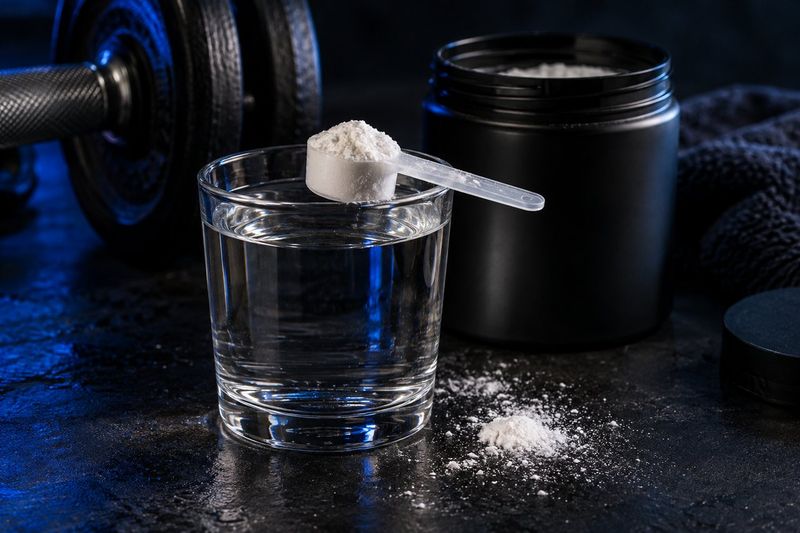
Creatine is taken at 3–5 g every day, including days without training, at any time that suits you. Loading (taking a higher dose in the first days) at 20 g a day is not required. With loading, your muscles become saturated with creatine in about a week; at 3 g a day, in about four weeks, and the end result is the same. The dose is the same for women. The best-studied form of creatine is creatine monohydrate, and it works together with strength training.
What creatine does
Taking creatine increases its stores in your muscles and helps you perform high-intensity work, including strength sets. In its 2017 position stand, the International Society of Sports Nutrition (ISSN) calls creatine monohydrate the most effective supplement available for improving performance under heavy loads and for gaining lean mass, that is, body mass without fat.
The gain is small, though. In the 2024 meta-analysis by Desai et al., a statistical pooling of results from 12 studies in adults up to age 50, creatine combined with strength training produced 1.14 kg more lean mass and 0.73 kg less fat than training alone. Part of that lean mass is water.
When muscle was measured directly, with magnetic resonance imaging (MRI), computed tomography (CT), or ultrasound, the increase in muscle thickness in the 2023 meta-analysis by Burke et al. (10 studies) was 0.10–0.16 cm. The authors described the effect as small.
The picture is similar for strength. In the 2025 meta-analysis by Kazeminasab et al. (69 studies, 1,937 people), creatine plus training added 1.43 kg to the bench press and 5.64 kg to the squat compared with a placebo, a supplement with no active ingredient. It had no noticeable effect on grip strength or the leg press.
How much creatine to take per day
The usual dose is 3–5 g a day; the 2021 review by Antonio et al. also gives a calculation based on body weight: 0.1 g per kg. At a body weight of 70 kg, that's 3–5 g, or about 7 g if you go by body mass. The ISSN notes that larger athletes may need 5–10 g a day to maintain their stores.
You need to take creatine every day. In the 1996 study by Hultman et al. (31 men), without supplementation, muscle creatine stores returned to baseline within 30 days.
Do you need a loading phase?
Loading means 20 g a day, split into four 5 g doses, for 5–7 days, then 3–5 g a day. Without loading, you take 3–5 g from day one. Hultman et al. compared both approaches: 20 g a day for 6 days increased muscle creatine stores by about 20%, and 3 g a day produced the same increase over 28 days.
| With loading | Without loading | |
|---|---|---|
| Dose | 20 g a day for 5–7 days, then 3–5 g | 3–5 g a day |
| Muscles saturated | in about a week | in 3–4 weeks |
| Who it's for | you need results faster, for example before a competition | everyone else |
The conclusion of the review by Antonio et al.: loading isn't necessary, and 3–5 g a day increases creatine stores, muscle mass, and performance.
When to take it: before or after a workout?
Timing doesn't matter much. In the 2021 review by Ribeiro et al., some studies showed a slightly greater effect when creatine was taken after training, but the authors write that because of the limitations of these studies, no firm conclusion can be drawn. What matters more is not skipping days: muscle creatine stores are maintained by taking it daily.
Before or after meals, and what to take it with
You can take creatine with food or on its own, dissolved in water or any other drink. According to the ISSN, when creatine is taken with carbs, or with carbs and protein, muscles take up more of it, but this may not affect results.
In the Desai meta-analysis, a sugary drink taken with creatine didn't add to muscle gain. There's no need to deliberately wash creatine down with juice or a mass gainer, a mix of carbs and protein.
Creatine for women
For women, the dose is the same: 3–5 g a day. According to the 2021 review by Smith-Ryan et al., women's own creatine stores are 70–80% lower than men's. Before menopause (the end of menstruation), creatine helps build strength and performance. After menopause, the benefit for muscle shows up at high doses (0.3 g per kg a day), and the benefit for bone shows up in combination with strength training.
There are fewer studies in women. In the Kazeminasab meta-analysis, the strength gains in the squat and leg press were statistically significant in men, but in women they were not for a number of measures: the difference in women couldn't be reliably distinguished from chance. The authors call for more studies that include women.
In women, water retention may not show up on the scale. In 2023, Moore et al. had 30 women do a loading phase of 5 g four times a day for 5 days. Their body weight changed the same way as in those taking a placebo, even though body water increased during the second half of the menstrual cycle.
Does creatine cause water retention?
In the first days, yes, especially with loading. According to the ISSN, loading retains about 0.5–1 L of water, and body weight goes up by roughly the same amount; no other consistent side effects have been described in studies.
The review by Antonio et al. adds that the water goes mainly inside the cells, and in studies lasting several weeks, total body water relative to muscle didn't change.
Creatine doesn't make you gain fat: according to the same review, randomized studies lasting from one week to two years didn't confirm it. In these studies, participants are assigned to groups at random.
Does creatine harm your kidneys?
In healthy people, no. In the 2025 meta-analysis by Naeini et al. (21 studies in the review, 12 in the meta-analysis), creatine slightly raised blood creatinine, a marker used to assess kidney function. But the rate at which the kidneys filter blood didn't change. The authors attribute the rise in creatinine to the metabolism of creatine itself, and the ISSN considers up to 30 g a day for 5 years safe in healthy people.
Before a blood test for creatinine, tell your doctor that you take creatine; otherwise the result may be mistaken for a sign of kidney disease. If you have kidney disease, take creatine only after talking to your doctor.
Does creatine cause hair loss?
The fear comes from a single study. In 2009, van der Merwe et al. gave 20 rugby players a loading phase of 25 g a day for a week, followed by 5 g a day for two weeks. Levels of dihydrotestosterone, a hormone linked to balding, rose by 56%, and two weeks later they were still 40% above baseline. Hair wasn't studied.
In 2025, Lak et al. studied hair directly: 45 trained men (38 completed the study) took 5 g of creatine a day or a placebo for 12 weeks. There was no difference in dihydrotestosterone levels, its ratio to testosterone, or hair density and thickness.
Creatine is not an anabolic steroid, a synthetic analog of testosterone. Chemically, it's a completely different substance.
Which creatine to choose
Creatine monohydrate is the most studied and most effective form (ISSN). According to the review by Antonio et al., other forms don't work any better. Capsules are the same creatine in a shell: count your dose in grams from the label.
How I recommend taking creatine
I recommend only a few supplements, and creatine is one of them: the evidence for its benefits is among the most convincing. My recommendation: 3–5 g of monohydrate a day without loading, and the same for women. Water retention is possible in the first days, but in studies lasting several weeks, water didn't increase relative to muscle. In a 2025 study, dihydrotestosterone, its ratio to testosterone, and hair density and thickness didn't differ between creatine and placebo.
How to take creatine: step by step
- Buy creatine monohydrate, as a powder or capsules.
- Take 3–5 g every day, including days without training.
- Pick a time that's convenient for you; you can take it with food.
- If you need results faster, do a loading phase: 20 g a day, split into four 5 g doses, for 5–7 days, then 3–5 g.
- In the first days, your weight may go up because of water.
- Before a blood test for creatinine, let your doctor know you take creatine.
This advice is for healthy adults. With kidney disease, diabetes, pregnancy, or breastfeeding, take creatine only after talking to your doctor.
If you need meals built around your calorie target and your tastes, there's the meal plan.
Sources
- Kreider RB et al. International Society of Sports Nutrition position stand: safety and efficacy of creatine supplementation in exercise, sport, and medicine. J Int Soc Sports Nutr, 2017. Article · Full text
- Antonio J et al. Common questions and misconceptions about creatine supplementation: what does the scientific evidence really show? J Int Soc Sports Nutr, 2021. Article · Full text
- Hultman E et al. Muscle creatine loading in men. J Appl Physiol, 1996. Article
- Desai I et al. The effect of creatine supplementation on resistance training-based changes to body composition: a systematic review and meta-analysis. J Strength Cond Res, 2024. Article
- Burke R et al. The effects of creatine supplementation combined with resistance training on regional measures of muscle hypertrophy: a systematic review with meta-analysis. Nutrients, 2023. Article · Full text
- Kazeminasab F et al. The effects of creatine supplementation on upper- and lower-body strength and power: a systematic review and meta-analysis. Nutrients, 2025. Article · Full text
- Ribeiro F et al. Timing of creatine supplementation around exercise: a real concern? Nutrients, 2021. Article · Full text
- Smith-Ryan AE et al. Creatine supplementation in women's health: a lifespan perspective. Nutrients, 2021. Article · Full text
- Moore SR et al. A randomized controlled trial of changes in fluid distribution across menstrual phases with creatine supplementation. Nutrients, 2023. Article · Full text
- Naeini EK et al. Effect of creatine supplementation on kidney function: a systematic review and meta-analysis. BMC Nephrol, 2025. Article · Full text
- van der Merwe J et al. Three weeks of creatine monohydrate supplementation affects dihydrotestosterone to testosterone ratio in college-aged rugby players. Clin J Sport Med, 2009. Article
- Lak M et al. Does creatine cause hair loss? A 12-week randomized controlled trial. J Int Soc Sports Nutr, 2025. Article · Full text