
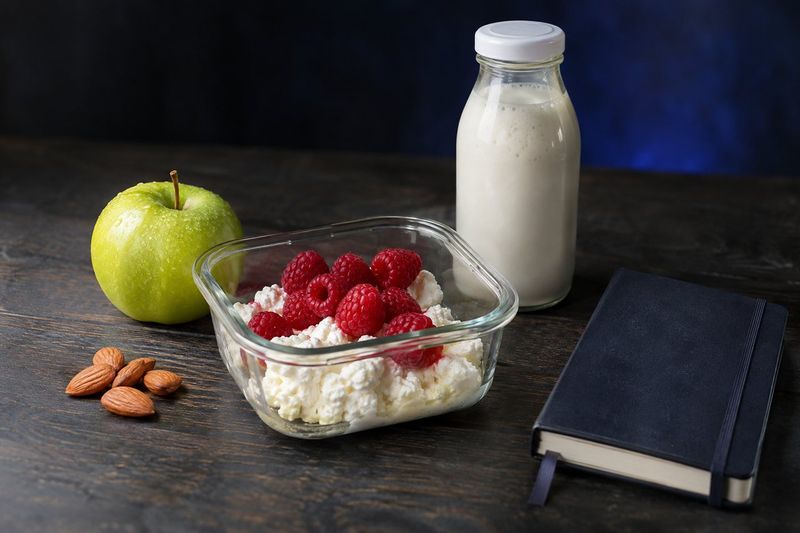
You can snack while losing weight, but you don't have to. Eating more often doesn't speed up weight loss by itself: what matters is your total calories for the day. A snack is useful if it makes it easier for you not to overeat at lunch and dinner. In my meal plans, a snack is about 10% of the day's calories; at 1,500 kcal, that's about 150 kcal. Your best choice is a snack with protein.
I'm Demid Lobanov, a fitness coach. The recipe database I use to build meal plans for clients has 52 snacks, and 49 of them are easy to take with you. Examples from it are in the table below.
Do you need a snack when losing weight
Not necessarily. In a 2020 network meta-analysis, Schwingshackl and colleagues compared the results of 22 randomized trials involving 647 people. These trials looked at different numbers of meals at the same calorie intake.
With two meals a day, weight went down slightly more than with three or six: by 1.02 kg and 1.29 kg. Confidence in this estimate is moderate. Calorie intake didn't depend on the number of meals. The authors themselves write that there's little reliable evidence that eating less often is beneficial.
The International Society of Sports Nutrition (ISSN) takes the same view in its 2026 position stand on diets for weight loss. The number of meals per day doesn't play a decisive role and can be tailored to the person.
The takeaway is simple: frequent snacking doesn't speed up weight loss, and eating less often doesn't give much of an advantage either. Choose the number of meals based on your schedule and your hunger.
Does a snack help you eat less
It can, but its calories aren't always offset by smaller portions over the rest of the day. A 2013 randomized trial by Douglas and colleagues included 15 healthy women who weren't dieting. In the afternoon, they ate a 160 kcal yogurt with varying amounts of protein or had no snack at all.
With the snack, they were less hungry and asked for dinner later: 178 minutes after the yogurt with 24 g of protein, versus 124 minutes with no snack. The yogurt with 24 g of protein kept them full longer than the yogurt with 5 g. After the snack, they ate less at dinner, but that didn't fully offset the yogurt's 160 kcal.
Almonds tell a different story. In a 2015 study by Hull and colleagues, 32 normal-weight women who weren't trying to lose weight ate 28 or 42 g of almonds (173 and 259 kcal) between breakfast and lunch. They ate less at lunch and dinner, and their total calories for that day came out the same as without the snack.
But that was a single day in the lab. In real life, it all depends on how much less you eat at lunch and dinner.
That's why a snack always counts toward your daily calories. If you don't eat less at lunch and dinner after a snack, it simply adds calories.
How many calories a snack should have
In my meal plans with four meals a day, the snack is about 10% of the day's calories: breakfast is 25%, lunch 35%, and dinner 30%. If two snacks or a more filling snack works better for you, the calorie split is adjusted. The calories are taken from other meals, not added on top.
| Daily calorie target | Snack, about 10% |
|---|---|
| 1,300 kcal | 130 kcal |
| 1,500 kcal | 150 kcal |
| 1,800 kcal | 180 kcal |
| 2,000 kcal | 200 kcal |
Snack portions in my database start at 111 kcal, and half of them contain up to 260 kcal. In a meal plan, the portion is adjusted to your target, so the grams depend on your calorie intake. To learn how to calculate your target, read How Many Calories Do You Need per Day.
Which snack to choose for weight loss
An easy formula is protein plus fruit, a vegetable, or crispbread. Protein helps keep hunger away longer. In a 2020 meta-analysis by Kohanmoo and colleagues, which covered 49 publications on single meals, protein reduced hunger compared with food of the same calorie content.
In the long-term studies from the same meta-analysis, there was no longer any difference in appetite. Protein in a snack helps for the next few hours.
The amount of protein matters. In the Douglas study, yogurt with 24 g of protein kept people full longer than yogurt with 5 g. In a 2013 study by Ortinau and colleagues involving 32 women, yogurt with 14 g of protein didn't change fullness compared with 5 g.
Of the 52 snacks in my database, 33 have at least 10 g of protein, and 13 have at least 20 g. These include cottage cheese, tuna, and Greek yogurt.
| Snack base | Examples | What to keep in mind |
|---|---|---|
| Cottage cheese, yogurt, kefir | cottage cheese with berries, Greek yogurt, kefir with strawberries | choose unsweetened yogurt; if it has sugar, count that in your calories |
| Eggs, fish, seafood | boiled eggs with cucumber, tuna with crispbread, crab sticks | weigh crispbread and butter in grams |
| Fruits and vegetables | apple, pear, carrot, cucumber | add protein or nuts; if you have diabetes, decide on the amount of fruit with your doctor |
| Nuts and nut butter | almonds, walnuts, peanut butter | 20 g of nuts is about 115–140 kcal, so always weigh them |
For more on nuts, see the article Nuts for Weight Loss; for yogurt, see Yogurt for Weight Loss.
Snack examples for weight loss
Below are snacks from my database. Calories, protein, fat, and carbs are given per serving of each dish as listed in the database.
| Snack | Kcal | Protein, g | Fat, g | Carbs, g |
|---|---|---|---|---|
| Crab sticks with cucumber | 111 | 8.3 | 0.6 | 17.6 |
| Boiled eggs with cucumber | 156 | 13.3 | 9.6 | 3.8 |
| Kefir with strawberries | 158 | 8.0 | 6.5 | 15.7 |
| Cottage cheese with cucumber and dill | 200 | 26.4 | 7.7 | 6.0 |
| Tuna with crispbread and tomato | 203 | 22.5 | 1.6 | 21.9 |
| Apple with almonds | 215 | 4.8 | 10.3 | 22.3 |
| Cottage cheese with raspberries | 218 | 26.5 | 8.1 | 7.3 |
| Greek yogurt with honey and walnuts | 246 | 17.2 | 12.6 | 15.1 |
In my meal plans, the same snack can repeat several days in a row. Clients usually don't mind having the same snacks.
Snacks at work: what to bring and what to buy
For work, choose snacks that don't need reheating: fruit with a portion of nuts, or tuna with crispbread. Bring cottage cheese, yogurt, and boiled eggs if you can keep them cold, in a fridge at work or in a cooler bag. At the store, kefir, unsweetened yogurt, cottage cheese, fruit, and crispbread are easy to pick up.
Count store-bought bars and snacks labeled “healthy” by their label: their calories count just like any other food's.
Snacking in the evening and before bed
You can have a snack in the evening if it fits into your daily calories. A protein option is the easier choice: cottage cheese, kefir, or yogurt.
In a 2018 study by Leyh and colleagues, 10 physically active, lean women ate cottage cheese with 30 g of protein before bed. Their energy expenditure and appetite the next morning didn't change.
In a 2014 study by Kinsey and colleagues of 44 overweight women who didn't exercise, a nighttime snack, either protein or carbs, led to greater fullness the next morning, but fasting insulin was higher too.
There are no long-term studies, so count an evening snack within your daily calories, not on top of them. More in the article Is It OK to Eat Before Bed.
Common snacking mistakes
| Mistake | What's wrong |
|---|---|
| Snacking “to boost your metabolism” | eating more often doesn't speed up weight loss |
| Not counting the snack in your daily calories | snack calories aren't always offset by a smaller lunch and dinner |
| Nuts and dried fruit by the handful | they're calorie-dense: 20 g of nuts is about 115–140 kcal |
| A snack with almost no protein | after yogurt with 24 g of protein, fullness was better than after yogurt with 5 g |
| “Healthy” bars without reading the label | their calories count just like any other food's |
Snacking for weight loss: step by step
- Decide whether you need a snack: if you don't overeat at lunch and dinner without one, you can skip it.
- Set aside about 10% of your daily target for the snack (at 1,500 kcal, that's about 150 kcal), or take the calories from other meals.
- Build your snack from protein plus fruit, a vegetable, or crispbread.
- Weigh nuts, nut butter, and dried fruit.
- For work, bring fruit with nuts or tuna with crispbread; bring cottage cheese, yogurt, and eggs if you have a fridge or a cooler bag.
- After two weeks, compare your average weight for the week with your average for the previous week. If your weight isn't going down, reduce your portions of calorie-dense foods.
I post nutrition and training breakdowns on my YouTube channel @lobanov_fitness.
Sources
- Schwingshackl L et al. Impact of Meal Frequency on Anthropometric Outcomes: A Systematic Review and Network Meta-Analysis of Randomized Controlled Trials. Adv Nutr, 2020. Article · Full text
- Douglas SM et al. Low, moderate, or high protein yogurt snacks on appetite control and subsequent eating in healthy women. Appetite, 2013. Article
- Hull S et al. A mid-morning snack of almonds generates satiety and appropriate adjustment of subsequent food intake in healthy women. Eur J Nutr, 2015. Article · Full text
- Kohanmoo A et al. Effect of short- and long-term protein consumption on appetite and appetite-regulating gastrointestinal hormones, a systematic review and meta-analysis of randomized controlled trials. Physiol Behav, 2020. Article
- Leyh SM et al. Pre-sleep protein in casein supplement or whole-food form has no impact on resting energy expenditure or hunger in women. Br J Nutr, 2018. Article
- Ortinau LC et al. The effects of increased dietary protein yogurt snack in the afternoon on appetite control and eating initiation in healthy women. Nutr J, 2013. Article · Full text
- Kinsey AW et al. Influence of night-time protein and carbohydrate intake on appetite and cardiometabolic risk in sedentary overweight and obese women. Br J Nutr, 2014. Article
- Aragon AA et al. International Society of Sports Nutrition position stand: diets for body weight reduction. J Int Soc Sports Nutr, 2026. Article · Full text