

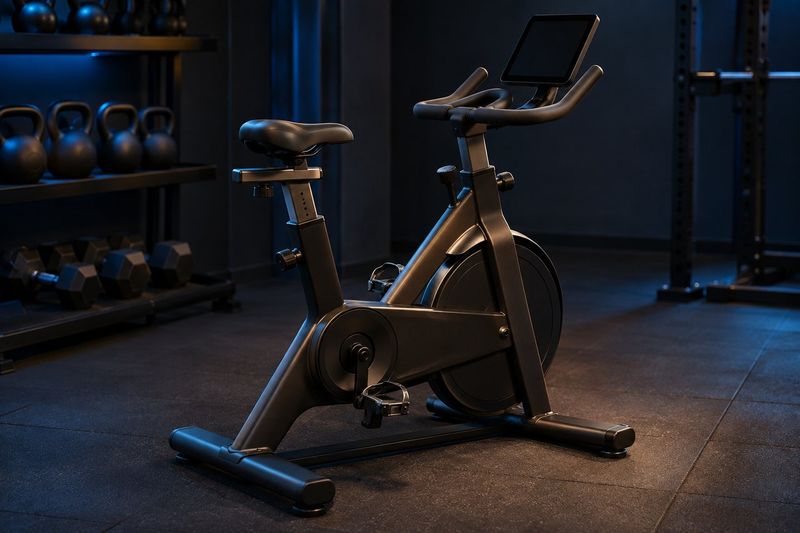
The stationary bike is one of the safest, most approachable cardio tools for weight loss—especially with excess body weight or sensitive knees. It boosts daily energy expenditure and aerobic fitness with virtually zero impact stress.
Still, cycling alone without nutrition changes yields modest scale shifts, and console calorie readouts are often inflated. Below we cover 2017–2024 evidence, machine comparisons, saddle setup, and a practical weekly plan.
Does a stationary bike help you lose weight? Research findings
Fat loss is governed by a sustained calorie deficit with adequate protein to preserve lean mass (ISSN Position Stand; Aragon et al., 2017). Cycling supports that deficit and improves cardiometabolic health:
- Indoor cycling review. Across 13 studies totaling 372 participants (306 women; Chavarrias et al., 2019), indoor cycling improved VO2max, blood pressure, lipids, and body composition; authors specifically recommended pairing cycling with diet for weight loss while noting scarce RCTs.
- Weekly cardio dose. A dose-response meta-analysis of 116 RCTs in 6,880 overweight/obese adults (Jayedi et al., 2024; ≥8 weeks) found each 30 min/week of aerobic exercise reduced weight by −0.52 kg, waist by −0.56 cm, body fat by −0.37%, and visceral fat by −1.60 cm², with clinically meaningful shifts starting at ≥150 min/week of moderate-to-vigorous work up to 300 min/week.
- Exercise alone vs. diet. An overview of 12 systematic reviews (149 studies; Bellicha et al., 2021) reported −1.5 to −3.5 kg weight loss and −1.3 to −2.6 kg fat loss from exercise alone, no difference between steady cardio and HIIT at matched expenditure, and +0.8 kg lean-mass preservation from lifting. In 11 trials of adults with overweight and type 2 diabetes (Memelink et al., 2023) including cycle ergometers, adding exercise to a hypocaloric diet did not significantly add weight loss (−0.77 kg; 95% CI −2.03 to 0.50), though VO2max improved in 2 studies.
Actual calories burned depend heavily on body mass and pedaling power—the 2024 Adult Compendium of Physical Activities (Herrmann et al., 2024; 1,114 activities) documents wide MET ranges from easy spinning to hard intervals. Track two-week weight trends rather than trusting handlebar calorie counters.
Stationary bike vs. treadmill and rowing machine
In shorter trials without diet control, seated cycling sometimes burns less than weight-bearing or full-body machines. In 13 trials averaging ~10 weeks (Wewege et al., 2017), HIIT saved ~40% time and running produced large fat-mass reductions (SMD = −0.82 and −0.85), whereas cycling alone did not reduce fat mass. In a 3×20 s REHIT crossover of 14 adults (Clausen et al., 2024), cycling spent 82.1 kcal vs. 95.0 kcal on the rowing machine (p < 0.001) with higher lactate (11.1 vs. 7.0 mmol/L), but slightly higher post-exercise EPOC (6.69 vs. 5.52 L; p = 0.009).
| Machine | Joint impact | Calorie burn at matched RPE | Best suited for |
|---|---|---|---|
| Upright stationary bike | Minimal | Moderate (mostly lower body) | Excess weight, sensitive knees, home use |
| Recumbent stationary bike | Minimal, low back supported | Moderate | Lower-back fatigue or discomfort |
| Treadmill (run / incline walk) | High running, low walking | Higher (weight-bearing) | Healthy joints or steady incline walking |
| Rowing machine | Minimal | High (legs + upper back) | Lifters who learn clean stroke mechanics |
Knee health and evidence-based saddle height
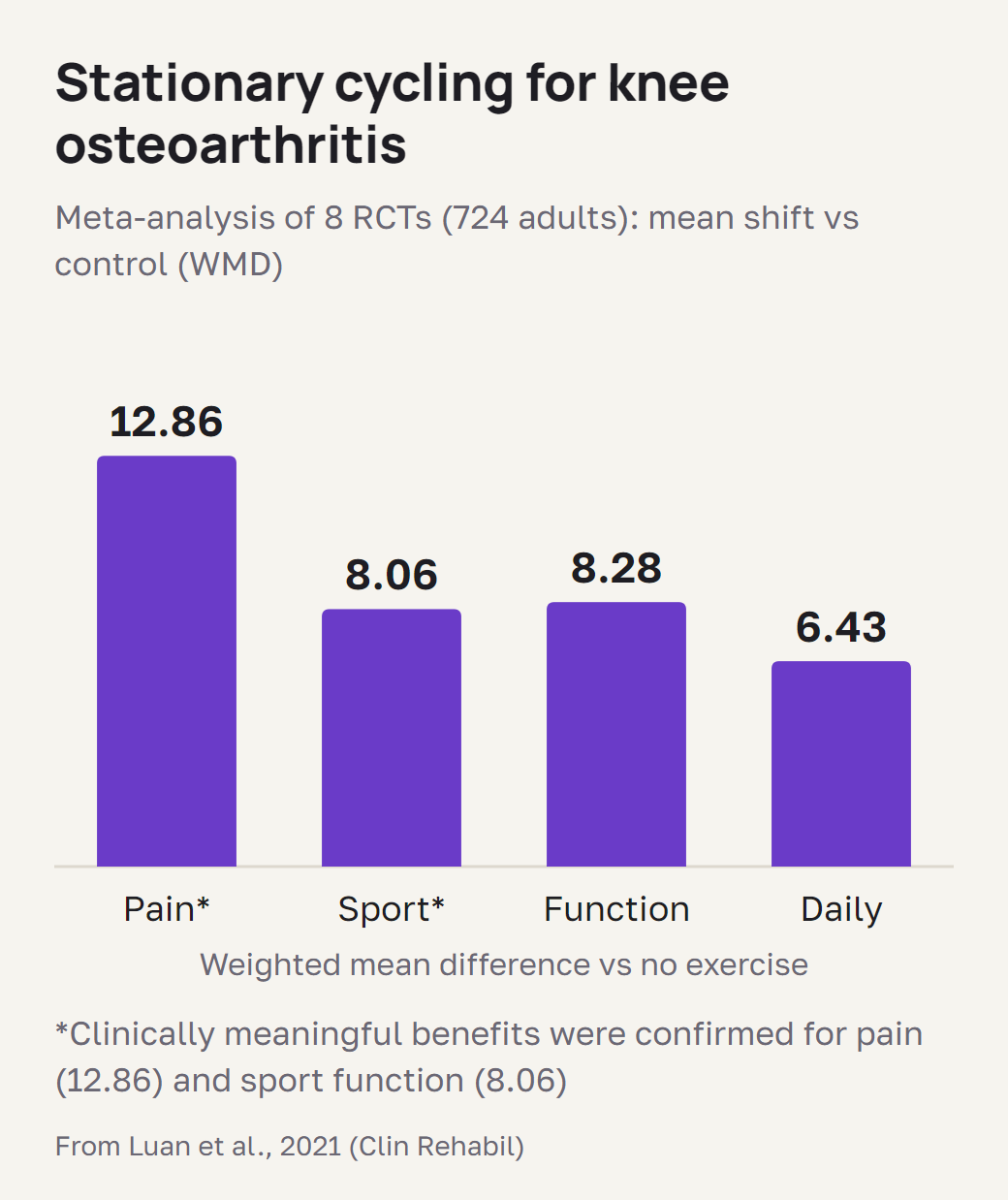
Smooth, impact-free pedaling is the bike's biggest strength. In a meta-analysis of 11 RCTs (8 pooled, 724 participants with knee osteoarthritis; Luan et al., 2021), stationary cycling significantly reduced pain (WMD = 12.86; 95% CI 6.90–18.81) and improved sport function (WMD = 8.06; 95% CI 0.92–15.20), whereas stiffness (11.47), general function (8.28), daily living (6.43), and quality of life (0.99) stayed below clinical significance thresholds.
Proper saddle height keeps knees happy. A systematic review of 41 studies (Bini et al., 2022) found strong support for dynamic knee-angle setup—and reassuring moderate evidence that deviations under 4% of leg length barely alter joint loads or oxygen cost.
Four setup checkpoints:
- Saddle height. Keep a slight soft knee bend at the bottom of the pedal stroke. Full lockout with rocking hips means the saddle is too high; deep knee compression at the front means too low.
- Foot placement. Push through the ball of the foot rather than the arch or heel.
- Cadence and resistance. Spin smoothly at ~70–90 RPM; grinding heavy resistance at 40–50 RPM spikes patellofemoral stress.
- Neutral spine. Set handlebar height so shoulders stay relaxed without rounding the low back; choose a recumbent bike if your back tires.
Fitting cycling into a fat-loss week
I am Demid Lobanov, a fitness coach and training methodologist. In online coaching and custom nutrition plans, cycling layers neatly onto two pillars:
- Set a moderate calorie deficit. Estimate daily targets with our calorie and macro calculator and do not eat back display calories.
- Keep 2–3 strength sessions per week. Lifting preserves lean tissue during fat loss (Bellicha, 2021; see cardio vs. strength for fat loss).
- Start with 2–3 rides of 20–30 minutes. Hold a conversational pace and gradually build total moderate cardio and walking toward 120–150 min/week.
- Skip daily HIIT. One short interval session per week is plenty if you enjoy faster efforts; steady riding recovers better alongside leg lifting.
I also share weight-loss and joint-friendly training guides on YouTube at @lobanov_fitness.
When to see a doctor first
Get medical clearance before starting regular cycling if you have:
- acute knee pain, swelling, or joint locking;
- low-back pain radiating into a leg;
- chest pain, dizziness, or unusual shortness of breath on mild effort;
- resting BP ≥160/100 mm Hg, uncontrolled hypertension ≥140/90 mm Hg, or diagnosed heart disease.
Frequently asked questions
Will a stationary bike make my thighs bulky?
No. In practice, moderate cycling in a calorie deficit does not cause bulky thighs; resistance training plays the primary role in preserving or modestly increasing fat-free mass during weight loss (Bellicha, 2021).
How many minutes a day should I ride to lose weight?
Per Jayedi 2024, aim for ≥150 minutes of moderate aerobic activity weekly (e.g., 3–4 rides of 35–40 minutes or cycling plus daily walks) alongside a calorie deficit.
Fasted vs. fed cycling: which burns more fat?
At matched daily calories, fat loss is equivalent whether you ride fasted or after a light meal—pick whichever feels better.
Before or after lifting?
Use 5–7 minutes of easy spinning to warm up before weights; place full 25–40 minute cardio sessions after lifting or on separate days.
Sources
- Chavarrias M et al. Health Benefits of Indoor Cycling: A Systematic Review. Medicina (Kaunas), 2019. Article · Full text
- Jayedi A et al. Aerobic Exercise and Weight Loss in Adults: A Systematic Review and Dose-Response Meta-Analysis. JAMA Netw Open, 2024. Article · Full text
- Bellicha A et al. Effect of exercise training on weight loss, body composition changes, and weight maintenance in adults with overweight or obesity: An overview of 12 systematic reviews and 149 studies. Obes Rev, 2021. Article · Full text
- Memelink RG et al. Additional effects of exercise to hypocaloric diet on body weight, body composition, glycaemic control and cardio-respiratory fitness in adults with overweight or obesity and type 2 diabetes: A systematic review and meta-analysis. Diabet Med, 2023. Article
- Wewege M et al. The effects of high-intensity interval training vs. moderate-intensity continuous training on body composition in overweight and obese adults: a systematic review and meta-analysis. Obes Rev, 2017. Article
- Clausen RD et al. Excess post-exercise oxygen consumption after reduced exertion high-intensity interval training on the cycle ergometer and rowing ergometer. Eur J Appl Physiol, 2024. Article
- Luan L et al. Stationary cycling exercise for knee osteoarthritis: A systematic review and meta-analysis. Clin Rehabil, 2021. Article
- Bini R et al. Methods to determine saddle height in cycling and implications of changes in saddle height in performance and injury risk: A systematic review. J Sports Sci, 2022. Article
- Herrmann SD et al. 2024 Adult Compendium of Physical Activities: A third update of the energy costs of human activities. J Sport Health Sci, 2024. Article · Full text
- Aragon AA et al. International society of sports nutrition position stand: diets and body composition. J Int Soc Sports Nutr, 2017. Article · Full text