Dumbbell squats are a versatile, accessible lower-body staple for home and gym training. They work the quadriceps, gluteus maximus, and hip adductors, and depending on how you hold the weights, they can noticeably reduce lower-back strain.
Two caveats are worth knowing upfront: squats barely grow the hamstrings, and grip strength eventually limits how heavy you can load bilateral dumbbell squats. Below we review lower-limb biomechanics, 2018–2026 research, and four practical variations.
Muscles worked and why squat depth matters
Squatting coordinates the hip, knee, and ankle joints (Hall, 2022, Ch. 8; Straub et al., 2024). The quadriceps drive knee extension, while the gluteus maximus and adductor magnus drive hip extension.
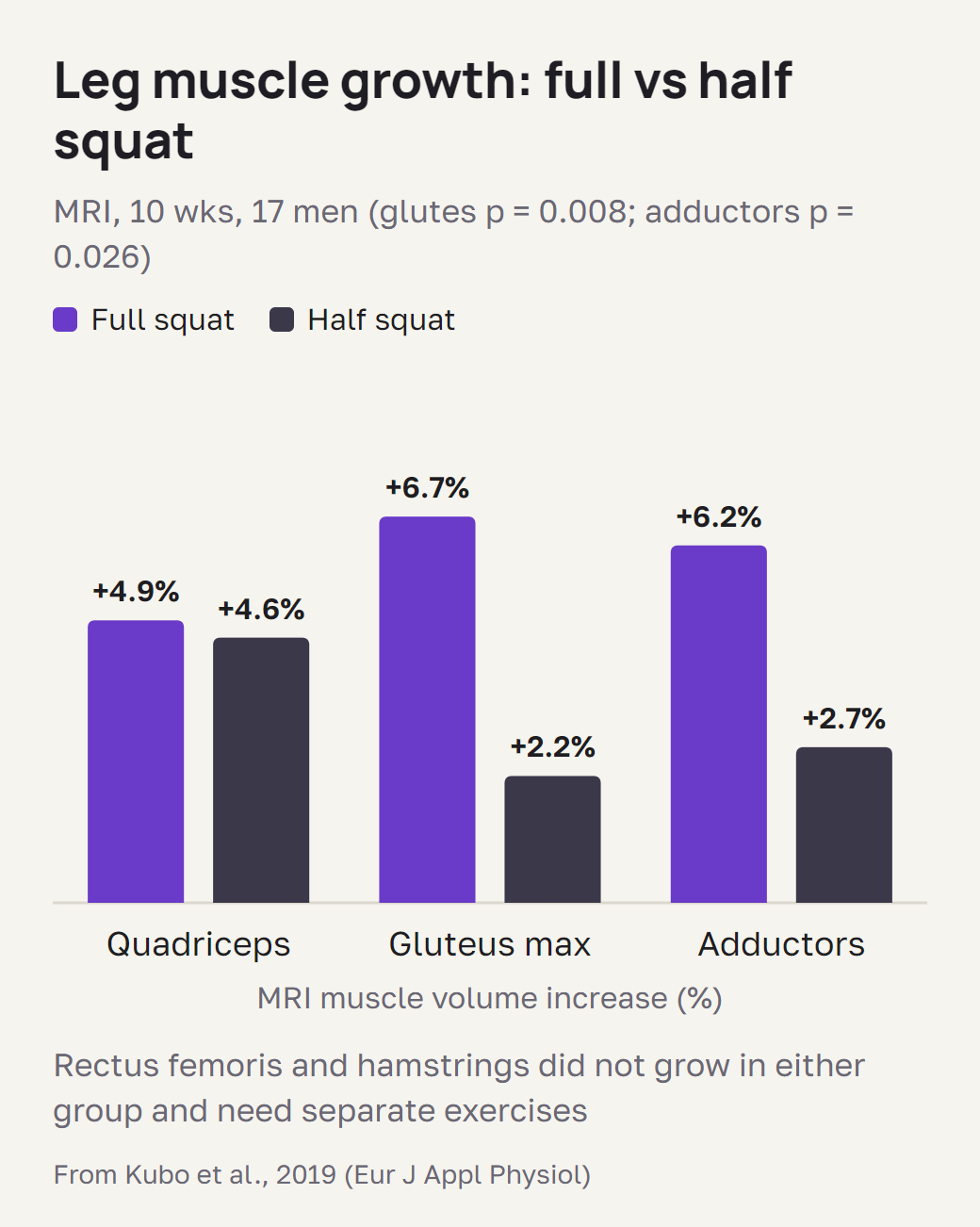
Depth dramatically alters hypertrophy. In a 10-week MRI study of 17 men squatting twice weekly (Kubo et al., 2019), full squats were compared with half squats:
- Quadriceps (vasti). Knee extensor volume grew similarly in both groups: +4.9% in full squats (p < 0.001) vs. +4.6% in half squats (p = 0.003).
- Glutes and adductors. Full squats produced 2–3× greater growth: gluteus maximus +6.7% vs. +2.2% (p = 0.008) and adductors +6.2% vs. +2.7% (p = 0.026).
- Hamstrings and rectus femoris. Neither changed in volume in either group—balanced lower-body programs pair squats with Romanian deadlifts or machine leg curls.
How dumbbell placement and stance shift mechanics
A 2026 systematic review of 24 studies (Alqahtani et al., 2026; very low GRADE certainty, largely acute lab trials in healthy men) shows how load position and stance modify joint demands.
Holding weight in front of the chest (goblet or front squat) shifts the center of mass forward, letting you stay more upright with comparable muscle activity (and lower knee compression in one study). In acute barbell EMG tests of 10 competitive bodybuilders at 80% 1RM (Coratella et al., 2021), front squats raised gluteus maximus, gluteus medius, and iliocostalis activity during descent vs. all other variants and rectus femoris on ascent vs. full back squats (p < 0.05), while wide sumo stances increased vastus lateralis and adductor longus on ascent (p < 0.05). In 13 trained women at 75% 1RM (Korak et al., 2018), front squat gluteus maximus EMG exceeded deadlifts (94% vs. 72%; p ≤ 0.05).
Kinematics between front and back squats showed no average velocity differences across 30–100% 1RM in 24 lifters (Kasovic et al., 2019). And in the 5-study hypertrophy subgroup of a 13-study meta-analysis (Haugen et al., 2023), free weights and machines produced similar muscle growth (SMD = −0.055; p = 0.751), though the authors urge caution given the small subset.
Four practical dumbbell squat variations
| Variation | Dumbbell position | Main advantage | Limitation |
|---|---|---|---|
| Goblet squat | One dumbbell vertical at chest | Upright torso and easy depth learning | Arms and upper back tire before legs on heavy loads |
| Suitcase (side) squat | Two dumbbells at sides | Low center of mass, low spinal load | Limited by grip strength and dumbbell clearance |
| Elevated sumo squat | One heavy dumbbell between legs on risers | Deep ROM with strong adductor focus and deep glute stretch | Requires sturdy elevated platforms |
| Bulgarian split squat | Two dumbbells at sides, rear foot elevated | Doubles load per leg and recruits hip stabilizers | Higher balance demand |
Step-by-step dumbbell squat technique
I am Demid Lobanov, a fitness coach and training methodologist. During a training process audit, beginners learn clean squat mechanics fastest with goblet squats because the front weight acts as a counterbalance.
- Foot stance. Set feet slightly wider than shoulder-width with toes turned out naturally (~15–30°). Keep heels, big-toe bases, and outer edges rooted to the floor.
- Load and brace. Hold a goblet dumbbell snugly against your chest, elbows down. Inhale, brace the core, and keep the chest tall.
- Controlled descent. Sit hips back and bend knees together over 2–3 seconds, tracking knees over the second and third toes without caving inward.
- Depth and knees. Squat to parallel or slightly below while keeping a neutral lower back without pronounced butt wink. Moderate forward knee travel past the toes with heels flat is safe for healthy knees.
- Drive up. Push smoothly through the full foot and stand tall on the exhale without overextending the lower back at lockout.
Common mistakes and progressing at home
- Knees caving inward. Usually caused by excess load or poor foot control—lighten up and track knees cleanly over toes.
- Heels lifting off the floor. Often reflects limited ankle dorsiflexion; place thin 1–2 cm plates under heels or wear slightly heeled shoes while improving ankle mobility.
- Lower-back rounding at the bottom. Trim depth slightly or switch to goblet squats.
- Outgrowing light dumbbells. Once you hit 15–20 clean bilateral reps, move to Bulgarian split squats or add a 2-second bottom pause—unilateral squats boost hip stabilizer demand at lower maximal force (Alqahtani, 2026).
In a custom training program, I use 3–4 sets of 8–15 reps at 1–3 RIR twice weekly paired with a hip-hinge lift. Gym lifters can combine them with barbell back squats; home plans are detailed in home workouts, and technique videos are on YouTube at @lobanov_fitness.
When to stop and consult a physician
Pause weighted squats and see a doctor if you experience:
- sharp or worsening pain inside the knee, groin, or lower back (see training with knee pain);
- locking, buckling, or joint instability;
- post-workout joint swelling;
- recent ligament injury or knee, hip, or spine surgery.
Frequently asked questions
Can dumbbell squats at home build glutes?
Yes—with sufficient depth (parallel or below, Kubo 2019) and progressive overload. Once bilateral squats get light, shift into Bulgarian split squats (and use elevated sumo squats for adductors).
Can knees travel past toes during squats?
With healthy knees and flat heels, moderate forward knee travel is normal biomechanics—especially with longer femurs. Forcing vertical shins simply shifts excess torque into the lower back.
What dumbbell weight should beginners start with?
Pick a weight where the final 2–3 reps of a 10–12 rep set feel genuinely challenging with crisp form. Once you hit 15 clean reps across all sets, increase load gradually.
Dumbbell squats vs. barbell squats: which is better?
Dumbbells are simpler, gentler on the back, and ideal at home; barbells make long-term heavy loading easier in the gym.
Sources
- Hall SJ. Basic Biomechanics, 9th ed. McGraw Hill, 2022. Chapter 8 – The Biomechanics of the Human Lower Extremity.
- Kubo K et al. Effects of squat training with different depths on lower limb muscle volumes. Eur J Appl Physiol, 2019. Article
- Alqahtani BS et al. Effects of Squat Exercise Variations on Lower Limb Biomechanics and Functional Outcomes: Implications for Physiotherapy and Rehabilitation: A Systematic Review. Healthcare (Basel), 2026. Article · Full text
- Straub RK et al. A Biomechanical Review of the Squat Exercise: Implications for Clinical Practice. Int J Sports Phys Ther, 2024. Article · Full text
- Coratella G et al. The Activation of Gluteal, Thigh, and Lower Back Muscles in Different Squat Variations Performed by Competitive Bodybuilders: Implications for Resistance Training. Int J Environ Res Public Health, 2021. Article · Full text
- Korak JA et al. Muscle Activation Patterns of Lower-Body Musculature Among 3 Traditional Lower-Body Exercises in Trained Women. J Strength Cond Res, 2018. Article
- Kasovic J et al. Kinematic Differences Between the Front and Back Squat and Conventional and Sumo Deadlift. J Strength Cond Res, 2019. Article
- Haugen ME et al. Effect of free-weight vs. machine-based strength training on maximal strength, hypertrophy and jump performance - a systematic review and meta-analysis. BMC Sports Sci Med Rehabil, 2023. Article · Full text