
Running helps lower body weight and fat mass, yet on its own without dietary control it produces modest changes: in major reviews, exercise alone removes roughly 1.5–3.5 kg on average. Clinically meaningful drops in waist circumference and body fat begin around 150 minutes of weekly aerobic training, while the best body-composition results come from combining a calorie deficit, strength training, and a gradual running ramp-up.
I am Demid Lobanov, a fitness coach and strength-training educator. Every season I see the same pattern: someone decides to lose weight fast, jumps straight into 5 km runs every other day without preparation, develops knee or shin pain within three weeks, and sees the scale barely budge. Below, I break down what research shows about running for fat loss, why calories do not add up linearly, and how to start without getting hurt.
How much weight and fat running actually removes
Both major reviews below evaluate structured aerobic training as a whole, including running. A dose-response meta-analysis pooled 116 randomized trials covering 6,880 adults with overweight or obesity lasting at least 8 weeks (Jayedi et al., 2024). Every additional 30 minutes of weekly aerobic exercise reduced body weight by 0.52 kg (109 trials, moderate GRADE certainty), waist circumference by 0.56 cm (62 trials, high certainty), and body fat percentage by 0.37% (65 trials, moderate certainty).
Both abdominal fat depots shrank as well: visceral fat area dropped by 1.60 cm² (26 trials, high certainty) and subcutaneous fat area by 1.37 cm² (27 trials, moderate certainty). Reductions continued linearly up to 300 minutes per week, while clinically important reductions in waist size and body fat required at least 150 minutes per week at moderate or vigorous intensity.
An earlier overview of 12 systematic reviews and 149 studies in adults with overweight and obesity (Bellicha et al., 2021) reported a similar range. Exercise alone reduced weight by 1.5–3.5 kg and fat mass by 1.3–2.6 kg, while trimming visceral fat (SMD −0.33 to −0.56). Without changing your food intake, expecting running alone to produce major weight loss is unrealistic.
Why a run burns fewer net calories than expected
In practice, running burns roughly 500 kcal per hour (versus about 200 kcal for easy walking), yet those numbers rarely translate one-to-one on the scale. The main reason is energy compensation: when you add running, the body trims energy expenditure across other physiological processes.
An analysis of daily and basal energy expenditure in 1,754 adults (Careau et al., 2021) found that people compensate on average for 28% of activity expenditure through lower basal expenditure. Roughly 72% of exercise calories carry through to net daily burn, and the degree of compensation varies noticeably with body composition.
A 2026 quantitative synthesis of experimental and population data (Pontzer & Trexler, 2026) notes that the constrained total energy expenditure model remains actively debated, yet human trials point in one consistent direction. In aerobic exercise interventions, total daily energy expenditure rose by only about 30% of what a simple additive model predicts. Compensation appeared weaker with resistance training and stronger when aerobic cardio was paired with calorie restriction.
The International Society of Sports Nutrition (ISSN) position stand on diets and body composition (Aragon et al., 2017) summarizes the core principle: lasting fat loss is driven by adherence to a calorie deficit with adequate protein to preserve lean mass. Within that framework, running adds extra energy expenditure and is associated in observational cohorts with lower cardiovascular mortality risk. For estimating your daily target, see How Many Calories Do You Need Per Day.
Steady jogging, intervals, or pairing running with strength training
A frequent question is whether you need high-intensity intervals or if steady easy running works just as well. A meta-analysis of 13 trials in adults aged 18–45 with overweight or obesity (Wewege et al., 2017; averaging 10 weeks, 3 sessions per week) compared both styles. High-intensity interval training (HIIT) and moderate-intensity continuous training (MICT) produced similar drops in body fat and waist size, though intervals required roughly 40% less time. Notably, running showed large fat-mass reductions in both formats (SMD −0.82 and −0.85), whereas cycling showed no significant fat-mass drop in those short protocols. Bellicha et al. (2021) likewise found no difference between continuous cardio and intervals when energy expenditure was matched.
For body composition, however, running alone is not enough. In a systematic review of 36 randomized trials with 1,564 metabolically healthy adults (Lafontant et al., 2025; 31 trials meta-analyzed), in programs lasting at least 10 weeks aerobic training alone dropped more weight (−1.82 kg; p < 0.001) and fat (−1.06 kg; p = 0.01) than lifting alone, but preserved less fat-free mass (−0.88 kg; p = 0.04). Concurrent cardio plus lifting removed more fat than lifting alone (−1.09 kg; p = 0.009), while shorter protocols (<10 weeks) and matched workloads showed no differences across modes (p > 0.05).
An even broader meta-analysis of 114 randomized trials in 4,184 people with overweight or obesity (Lopez et al., 2022) highlights the winning combination. Compared with no intervention, resistance training plus calorie restriction achieved the largest drop in body fat percentage (−3.8%) and fat mass (−5.3 kg) while preserving lean mass (p = 0.550–0.727). By contrast, combined resistance and aerobic training without calorie restriction yielded −2.3% and −1.4 kg of fat loss. For balancing both modalities, see Cardio or Strength Training for Weight Loss and Cardio After Strength Training.
| Weight-loss approach | Fat loss | Muscle retention | Main early risk |
|---|---|---|---|
| Running alone without diet control | Modest (~1.3–2.6 kg fat in exercise reviews) | Worse than with lifting | Energy compensation and elevated beginner running-injury risk |
| Running + calorie deficit | Solid, depending on deficit and volume | Part of weight lost may come from lean mass | Stronger energy compensation when pairing aerobic cardio with calorie restriction |
| Calorie deficit + strength training + moderate running or walking | Sustainable via deficit and extra burn (in Lopez 2022, lifting plus calorie restriction achieved the largest fat drop) | Better fat-free mass retention | Requires careful leg-recovery scheduling |
Does running ruin knees, and why do beginners get injured?
The myth that "running destroys your knees" confuses two distinct things: chronic joint osteoarthritis and running injuries caused by doing too much too soon.
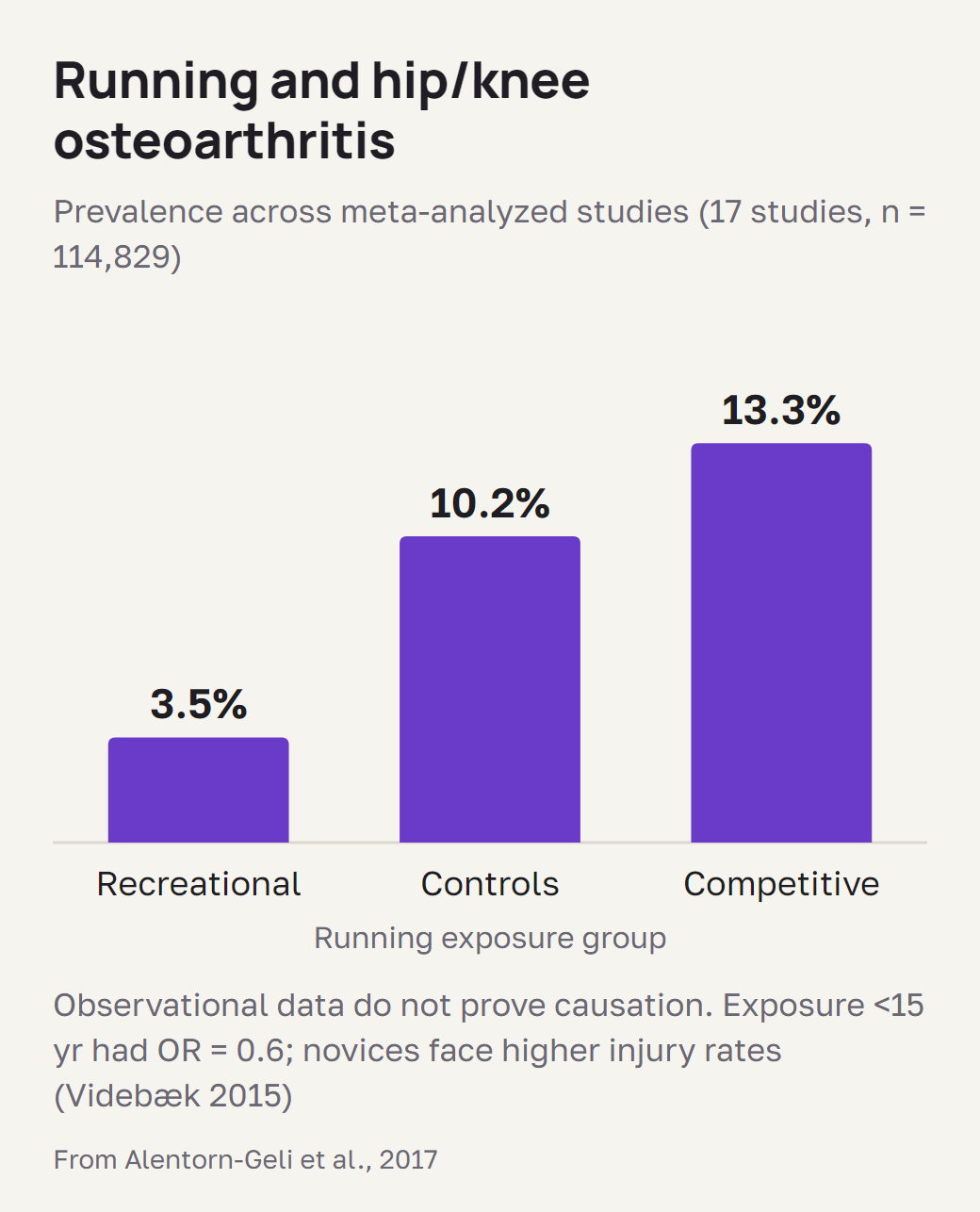
On osteoarthritis, a major systematic review of 25 studies covering 125,810 people (Alentorn-Geli et al., 2017; 17 studies and 114,829 people meta-analyzed) produced a result that surprises many. Prevalence of hip and knee osteoarthritis was 3.5% in recreational runners versus 10.2% in sedentary non-running controls and 13.3% in competitive or elite runners. Odds relative to controls were higher in competitive runners than in recreational runners (OR = 1.34 vs. OR = 0.86; difference p < 0.001), and running exposure under 15 years was associated with lower odds of osteoarthritis versus controls (OR = 0.6; 95% CI 0.49–0.73). Because these data are observational, they do not prove causation and cannot rule out prior injuries or self-selection where people with painful joints stop running.
Overuse injury risk in beginners, by contrast, is genuinely elevated. A meta-analysis of 13 prospective cohorts and trials (Videbæk et al., 2015) found 17.8 running-related injuries per 1,000 hours in novice runners (95% CI 16.7–19.1) versus 7.7 (95% CI 6.9–8.7) in recreational runners—more than double. In Jayedi et al. (2024), aerobic exercise also added roughly 2 mild-to-moderate adverse events per 100 participants, mostly musculoskeletal (low GRADE certainty).
An umbrella review of 13 systematic reviews (Correia et al., 2024) confirms that running injuries are multifactorial—tied to training load, health history, lifestyle, morphology, and biomechanics—though the underlying reviews were rated low or critically low quality. Over the long haul, moderate running is linked to substantial health benefits. An observational meta-analysis of 14 studies from 6 cohorts covering 232,149 participants (Pedisic et al., 2020) linked running to a 27% lower risk of all-cause mortality (HR = 0.73), 30% lower cardiovascular mortality (HR = 0.70), and 23% lower cancer mortality (HR = 0.77), with associations seen even at once-weekly running regardless of strict pace or volume thresholds.
How to start running for weight loss without injuries: step by step
- Assess your starting point honestly. If you carry substantial excess weight, have knee or ankle pain, joint conditions, heart or vascular disease, or high blood pressure, consult a doctor first and begin with slow incline treadmill walking or cycling, where joint impact is lower.
- Set up nutrition before ramping mileage. Build a moderate calorie deficit with adequate protein so running supports your plan rather than trying to outrun overeating.
- Start with walk-jog intervals. For the first 3–4 weeks, train 2–3 times weekly for 20–30 minutes at a conversational pace (such as 2 minutes of walking and 1–2 minutes of easy jogging), gradually increasing the running share.
- Add 2–3 strength sessions per week. Resistance training helps preserve muscle in a calorie deficit and strengthens lower-body muscles and tendons.
- Never push volume and speed at the same time. First build comfortable steady aerobic volume up toward 150 minutes per week (counting brisk walking too), and add faster intervals only once your body handles easy volume smoothly.
- Track progress every two weeks. Compare weekly average scale weight, waist circumference, and morning knee or shin feel; if joint or shin pain builds, pause running and switch back to walking.
If you want a practical fat-loss eating plan without rigid bans, I build custom monthly meal plans, and to integrate strength training, cardio, and recovery around your weight and schedule, I work with clients through online coaching.
I also publish practical fat-loss and training breakdowns on my YouTube channel @lobanov_fitness.
Sources
- Jayedi A et al. Aerobic Exercise and Weight Loss in Adults: A Systematic Review and Dose-Response Meta-Analysis. JAMA Netw Open, 2024. Article · Full text
- Bellicha A et al. Effect of exercise training on weight loss, body composition changes, and weight maintenance in adults with overweight or obesity: An overview of 12 systematic reviews and 149 studies. Obes Rev, 2021. Article · Full text
- Careau V et al. Energy compensation and adiposity in humans. Curr Biol, 2021. Article · Full text
- Pontzer H, Trexler ET. The evidence for constrained total energy expenditure in humans and other animals. Curr Biol, 2026. Article
- Wewege M et al. The effects of high-intensity interval training vs. moderate-intensity continuous training on body composition in overweight and obese adults: a systematic review and meta-analysis. Obes Rev, 2017. Article
- Lopez P et al. Resistance training effectiveness on body composition and body weight outcomes in individuals with overweight and obesity across the lifespan: A systematic review and meta-analysis. Obes Rev, 2022. Article · Full text
- Lafontant K et al. Comparison of concurrent, resistance, or aerobic training on body fat loss: a systematic review and meta-analysis. J Int Soc Sports Nutr, 2025. Article · Full text
- Videbæk S et al. Incidence of Running-Related Injuries Per 1000 h of running in Different Types of Runners: A Systematic Review and Meta-Analysis. Sports Med, 2015. Article · Full text
- Correia CK et al. Risk factors for running-related injuries: An umbrella systematic review. J Sport Health Sci, 2024. Article · Full text
- Alentorn-Geli E et al. The Association of Recreational and Competitive Running With Hip and Knee Osteoarthritis: A Systematic Review and Meta-analysis. J Orthop Sports Phys Ther, 2017. Article
- Pedisic Z et al. Is running associated with a lower risk of all-cause, cardiovascular and cancer mortality, and is the more the better? A systematic review and meta-analysis. Br J Sports Med, 2020. Article
- Aragon AA et al. International society of sports nutrition position stand: diets and body composition. J Int Soc Sports Nutr, 2017. Article · Full text




