


A workout log is a simple record of your exercises, loads, reps, and effort (reps in reserve) in every working set. It turns gym visits from guesswork into a measurable system where progress across weeks and months is unmistakable.
Overloaded templates and scattered notes make regular tracking and finding past numbers inconvenient. Below we review clinical evidence for tracking, the five essential fields, and the most practical log format.
Why keep a workout log: what 2022–2026 trials show
Tracking drives results through four concrete mechanisms:
- Systematic overload instead of spinning your wheels. In an 8-week RCT of 55 untrained women (110 arms; Kassiano et al., 2026; 3 × 8–12 elbow extensions, 3 days/week), increasing weight upon hitting 12 reps grew summed triceps thickness by +22.9% (+0.79 cm) vs. +11.6% (+0.41 cm) with fixed load and reps and +1.8% in controls (p < 0.001). Without a log, staying stuck at comfortable weights is effortless.
- Individualized weekly volume from your own history. In an 8-week within-subject RCT of 16 trained lifters (Scarpelli et al., 2022), prescribing +20% above each lifter's prior logged volume outperformed a fixed 22-set standard for vastus lateralis CSA (+1.08 cm²; p = 0.042; ES = 0.75) and responder rate (p = 0.0035).
- Adherence and feedback. In a 10-week RCT of 112 trained adults (79 completers; Gavanda et al., 2025), minimum training adherence reached 88.2% in-person (note: in-person group was younger, p = 0.026), 81.2% in a digital log app with delayed video technique feedback, and only 52.2% with self-guided PDFs. Supervised lifting also improved adherence, squat 1RM, and hypertrophy in an 8-week RCT of 36 lifters (Coleman et al., 2023), while self-monitoring was the most frequent behavior technique (25/29 weight-loss app RCTs; Li et al., 2025).
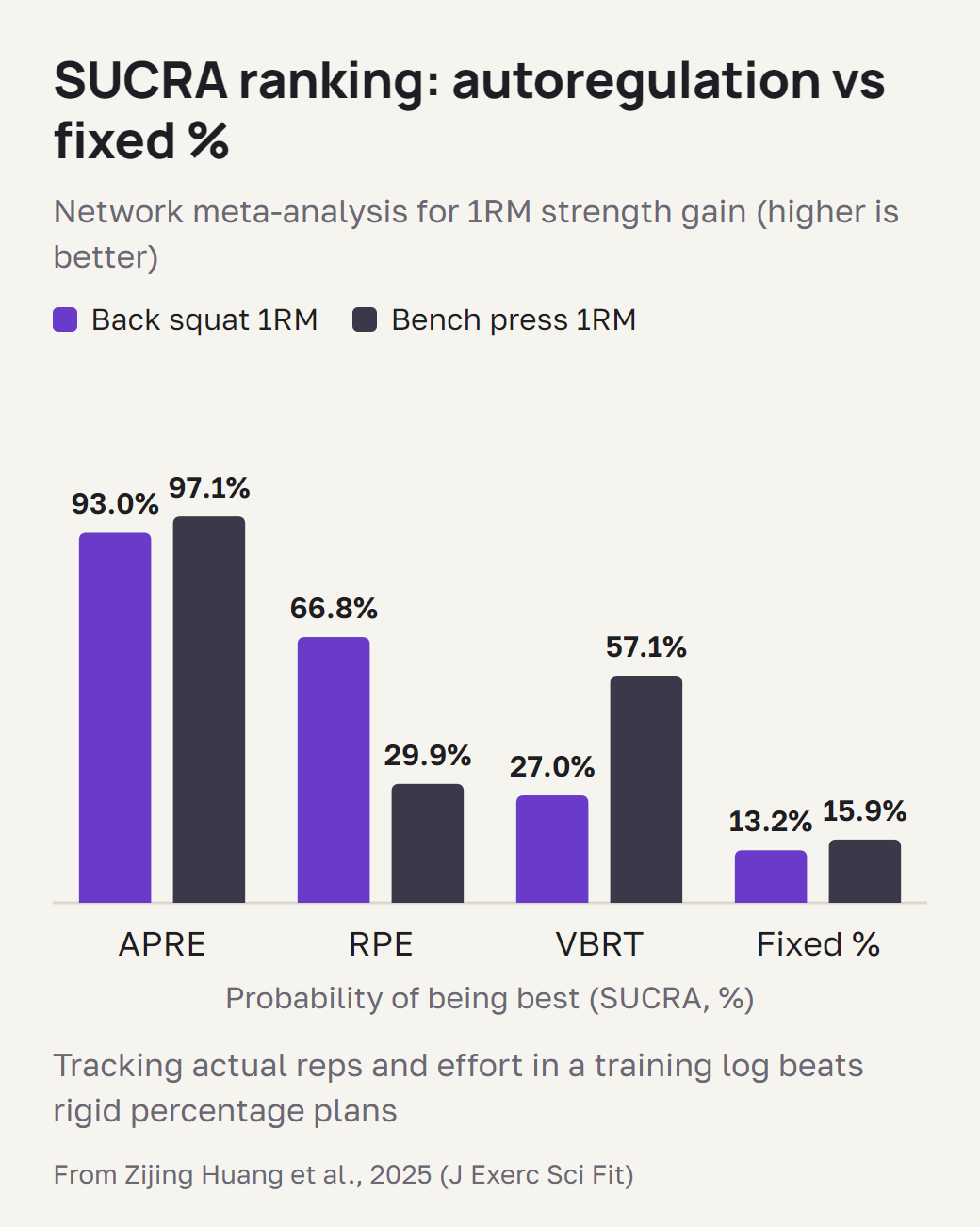
- Smarter autoregulation. In a network meta-analysis (Zijing Huang et al., 2025), autoregulated protocols (APRE, RPE, VBRT) outranked fixed percentages (PBRT) on SUCRA for squat 1RM (APRE 93.0% vs. PBRT 13.2%, though direct moderate/large squat differences were absent) and bench press 1RM (APRE 97.1% vs. PBRT 15.9%; PBRT vs. APRE SMD = −0.83). In 15 studies (Hickmott et al., 2022), direct 1RM gains were similar (MD = 2.07 kg; p = 0.09), whereas volume control mattered: ≤25% velocity loss favored strength (p = 0.02), while >25% favored hypertrophy compared with ≤25% and ≤20% thresholds (p = 0.03; vs. 20–25% was non-significant, p = 0.28).
What to record: five essential fields
A solid log takes 15–20 seconds between sets. To drive progressive overload, track five fields:
- Date and exercise. Keep core "anchor" lifts stable for 6–12 weeks so numbers stay comparable.
- Working weight. Record barbell/dumbbell load or machine pin, plus grip or bench angle.
- Completed reps per working set. Skip detailed warm-ups; log working sets cleanly (e.g., "60 kg: 10, 10, 9").
- Reps in reserve (RIR 0–4). If 60 × 10 was 1 RIR last week and 3 RIR today, you got stronger and are ready to progress.
- Short note (3–5 words). Only actionable context: poor sleep, shoulder twinge, machine swap, or video check.
Skip resting pulse, 1–10 mood scores, and daily tape measurements inside a gym log—they turn tracking into a chore.
Notebook, spreadsheet, or web app?
A 2026 review of 6 popular free clinician-directed exercise prescription apps (Wu et al., 2026) found that all 6 handled basic FITT structure yet none included explicit FITT-VP progression logic or adverse-event tracking, and only 2 had scientific evaluation. Choose a tool that stays fast and out of the way.
| Log format | Main advantage | Limitation | Best suited for |
|---|---|---|---|
| Paper notebook | Zero distractions, no battery needed | Slow to check 2-month history or sum volume | Solo lifters who prefer pen and paper |
| Spreadsheet | Great charts and weekly set counts | Tiny cells are clunky one-handed in the gym | Analytics fans logging after workouts |
| Phone notes | Instant start | Turns into messy wall of text within a month | First 2–3 weeks only |
| Browser web app with inline history | Last session's loads right in the set row, one-hand entry, video uploads | Needs internet to open session | Coached clients and practicing trainers |
How we track training in practice
I am Demid Lobanov, a fitness coach and training methodologist. In every custom training program, clients log weights and RIR on anchor lifts. When progress feels stalled after 4–6 weeks, the log immediately shows whether load never actually progressed or fatigue accumulated (see training plateaus).
That exact workflow shaped our web app for fitness coaches and clients: it opens via a direct browser link with no app-store download, supports one-hand entry, displays previous loads inline, and keeps technique videos alongside numbers (see choosing a fitness coaching app).
I also share training-process and technique breakdowns on YouTube at @lobanov_fitness.
Four logging mistakes that stall results
- Logging from memory at home. Rep counts and RIR blur by evening; enter numbers during rest periods.
- Counting load increases with broken form. Half-repping 75 kg after full-depth 70 kg is not progress.
- Swapping exercises every week. Without anchors, you cannot evaluate trends or plan a deload week.
- Ignoring repeat pain notes. Seeing "right shoulder aches on press" three sessions in a row signals a technique adjustment or doctor visit, not pushing through.
Frequently asked questions
Should beginners keep a workout log?
Yes—it is most valuable early on to build steady progression habits (Kassiano, 2026). Logging 4–6 main exercises per session is plenty.
What should I log for bodyweight home workouts?
Track variation, clean reps, RIR, and tempo or pauses (e.g., "push-ups, 3 s down: 12, 11, 10, RIR 1") so you know when to advance leverage or add weight.
Do I need to calculate total tonnage (kg × reps)?
For most lifters, no. Counting hard weekly sets per muscle group and tracking load/rep growth on anchor lifts with consistent form is far more actionable.
How does a log tell me it is time for a deload?
If performance drops across 2–3 anchor lifts for two consecutive sessions despite normal sleep and nutrition, take one week of reduced volume to recover.
Sources
- Kassiano W et al. Progressive Overload Affects the Magnitude of Muscle Hypertrophy. Med Sci Sports Exerc, 2026. Article
- Scarpelli MC et al. Muscle Hypertrophy Response Is Affected by Previous Resistance Training Volume in Trained Individuals. J Strength Cond Res, 2022. Article
- Gavanda S et al. Optimizing Resistance Training Outcomes: Comparing In-Person Supervision, Online Coaching, and Self-Guided Approaches: A Randomized Controlled Trial. J Strength Cond Res, 2025. Article · Full text
- Hickmott LM et al. The Effect of Load and Volume Autoregulation on Muscular Strength and Hypertrophy: A Systematic Review and Meta-Analysis. Sports Med Open, 2022. Article · Full text
- Zijing Huang et al. Autoregulated resistance training for maximal strength enhancement: A systematic review and network meta-analysis. J Exerc Sci Fit, 2025. Article · Full text
- Wu CH et al. Clinical Usability of Exercise Prescription Apps for Professional Use: Systematic Review and Multidimensional Evaluation. JMIR Mhealth Uhealth, 2026. Article · Full text
- Li S et al. Behavior Change Resources Used in Mobile App-Based Interventions Addressing Weight, Behavioral, and Metabolic Outcomes in Adults With Overweight and Obesity: Systematic Review and Meta-Analysis of Randomized Controlled Trials. JMIR Mhealth Uhealth, 2025. Article · Full text
- Coleman M et al. Supervision during resistance training positively influences muscular adaptations in resistance-trained individuals. J Sports Sci, 2023. Article