
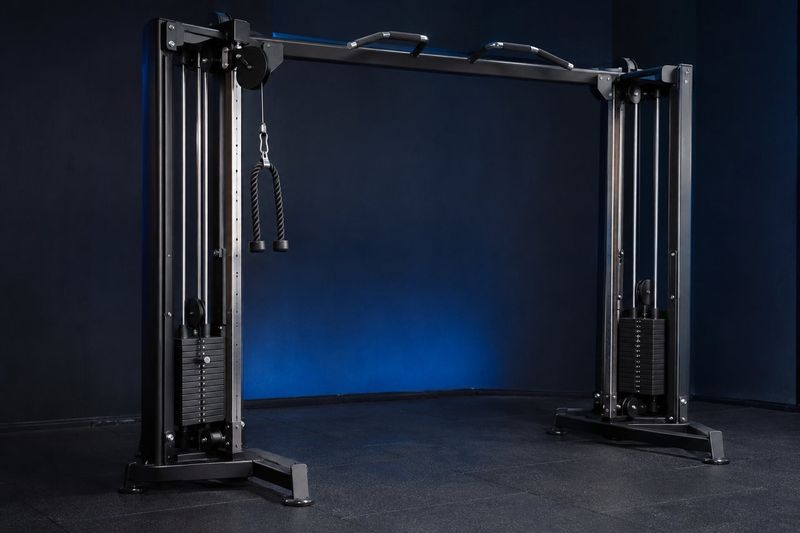
The face pull is an exercise for the rear delts and the muscles that pull the shoulder blades together. You pull a rope from a high pulley toward your face, keeping your elbows at shoulder height. At the end, your hands move apart and your upper arm rotates outward. The movement is hardest at the end, so the weight is kept light. I haven't found any studies on muscle growth from this exercise.
I'm Demid Lobanov, a fitness coach. In my exercise library, the rope face pull on a high cable is rated as an intermediate exercise. It's also called the cable face pull.
Muscles worked in the face pull
The main muscle is the posterior head of the deltoid, or rear delt. According to Hall's biomechanics textbook (Chapter 7), it performs horizontal abduction of the shoulder together with the middle delt, infraspinatus, and teres minor. It also helps rotate the shoulder outward. The other muscles work as described in my exercise library:
- Middle trapezius and rhomboids—by my library's estimate, half of the work; this is an estimate, nothing was measured. The rope pulls the shoulder blades forward, and these muscles draw them back toward the spine. Their load increases toward the end of the movement.
- Infraspinatus and teres minor rotate the shoulder outward as the ends of the rope separate. Over the last part of the range, they essentially drive the movement.
- Lower trapezius, with a high pulley, keeps the shoulder blade from riding up toward the ear and helps rotate it upward.
- Teres major and lats assist. Their share grows if your elbows drop below shoulder level: the movement then turns into a regular horizontal row.
- Biceps and brachialis keep the elbow bent.
- Core muscles keep you from leaning back.
How to do a rope face pull: step by step
- Set the pulley above shoulder height and attach the rope.
- Grab the ends of the rope. Your arms are extended forward and up, and your shoulder blades are allowed to drift forward.
- Pull the rope toward your face. Lead with your elbows: they stay at shoulder height.
- At the end, pull your hands out and back—the ends of the rope separate. Your hands end up beside your face, your elbows at or slightly above shoulder height, and your shoulder blades squeezed together.
- Return smoothly to the start, letting your shoulder blades move forward.
If you don't let your shoulder blades move forward at the start, the movement begins with the rear delt already shortened. You lose some of the range this way, but less than if you cut the range short at the end: the load at the start is the lowest anyway. Don't take your arms past the line of your shoulders: beyond that point, it's the shoulder blade that continues the movement.
Where the face pull is hardest
It's hardest at the end: hands at your face, shoulder blades squeezed together, rear delt fully shortened. At the start, the cable runs almost along your outstretched arm, and the load is small. Toward the end, your hand moves to the side and back while the pulley stays in front of you and above, so the load increases.
This is a calculation based on the mechanics in my library; nothing was measured. Two conclusions follow from it:
- The weight is deliberately kept light. Failure—the point where you can't do another rep—comes right where the load peaks. That's why technique breaks down precisely at the end.
- This isn't an exercise for the rear delt in the stretched position. The muscle passes through the stretched position, but the load there is small. As long as your arm points at the pulley at the start, the peak will be at the end at any pulley height.
Pulley height: the key setting
| Pulley | Where the load shifts |
|---|---|
| Higher | more lower trapezius and the muscles that rotate the shoulder outward; the rear delt sits closer to the joint axis, and its leverage is worse |
| Lower | closer to a regular horizontal row, more lats |
My database doesn't put a number on the pulley height at which the rear delt stops working at full capacity. The second setting is where your hands are at the end of the movement. If they separate to the sides of your face and your elbows stay at shoulder height, the rear delt is working. If your hands come to your chest and your elbows drop, the lats and biceps are working.
Why do face pulls when there are other exercises?
According to my database, the face pull is a corrective exercise for programs with pressing and a shoulder warm-up before presses. In the programs I've written, it has come up once. The exercise teaches you to hold your shoulder blades together and your shoulder in external rotation under load—exactly where the load is highest. This is my database's methodology, not a research finding.
There's no direct data on muscle growth. There is indirect data:
- In a 2025 study by Zhu et al. of 10 healthy men, rear delt force was calculated using a computer model of the body. In the standing face pull, it was 58.2 N; in bent-over dumbbell reverse flyes, 58.6 N; the difference was not significant. In the bent-over dumbbell row, it was 47.9 N, lower than both. This is a model calculation, not a measurement and not growth.
- In a 2004 study by Reinold et al. of 10 healthy people, rear delt activity was measured with electrodes inserted into the muscle during 7 shoulder external rotation exercises. It was highest—88% of maximum—lying face down with the arm raised out to the side slightly above shoulder level (100°) and the shoulder fully rotated outward. This is a different exercise, but it combines the same movements as the end of the face pull.
Presses barely load the rear head. In a 2020 study by Campos et al. of 13 resistance-trained men, the rear delt worked at 3.5% of maximum in the bench press, 11.4% in the overhead press, and 24% in lateral raises. That's activity, not growth. That's why, according to my database, the rear head lags behind more often than the others, and the face pull loads it together with the shoulder blade muscles.
What to pair with the face pull
Other variations from my library load the rear delt in the stretched position:
| Exercise | Rear delt length range |
|---|---|
| Face pull | short, peak at the end |
| Single-arm reverse pec deck fly | long: the arm crosses the midline |
| Single-arm cable rear delt fly across the body | long: the cable is perpendicular to the arm at the start |
| Bent-over dumbbell reverse fly | short and medium |
That the stretched range is better for growth is not proven. For more, see the articles Reverse Pec Deck Fly and How to Build Your Shoulders.
Common face pull mistakes
- Pulling to your chest with bent arms—your elbows drop below shoulder level, and the lats and biceps work instead of the rear delt.
- Leaning back—you finish the rep with your body weight.
- Shrugging your shoulders toward your ears—the upper traps take over the movement.
All three mistakes show up at the end of the movement, where the load is highest. If you see them, the weight is too heavy.
Face pulls with shoulder, neck, or lower back pain
- Acute lower back pain—don't do horizontal rows during this period.
- An impingement flare-up, when it hurts to raise your arm above shoulder height: lower the pulley to shoulder level and keep the movement below shoulder level. In impingement, the shoulder tendons get compressed under a bony projection of the shoulder blade, the acromion.
- Cervical radiculopathy already diagnosed by a doctor, outside a flare-up: make sure your neck doesn't jut forward after the rope. If you get new numbness or shooting pain down your arm, stop training and see a doctor.
The shoulder and neck modifications are temporary, and you scale the load within them. With acute lower back pain, you skip the exercise entirely. Keep in mind: by cutting off the end of the movement, you remove its most heavily loaded part. The load drops more than the change in range would suggest. With your elbows below shoulder level, the movement turns into a horizontal row: the upper back and lats work more, the rear delt less.
Pain without an established cause, or pain that is severe or getting worse, is a reason to see a doctor first. Pain at rest or at night, numbness, shooting pain, and weakness in the arm are reasons to stop training and see a doctor.
How many sets and reps to do
My database's guidelines for the delts: 10–20 reps per set, 1–3 reps in reserve, twice a week. Sets per week: 10–20, with each head getting its own volume. Rows where the rear delt only assists count as half a set for it. If your rear delts lag behind, put an exercise for them at the start of your workout.
For more, see the articles How to Build Your Shoulders and How Many Sets per Week.
How to add face pulls to your workout: step by step
- Check your shoulder, neck, and lower back. With acute lower back pain, skip the exercise. Pain without an established cause: see a doctor first. Pain at rest or at night, numbness, or weakness in the arm: stop training and see a doctor.
- Set the pulley above shoulder height, or at shoulder height during an impingement flare-up. Use a light weight.
- Do face pulls as light sets before presses or before your working sets for the rear delts. If your rear delts lag behind, do them at the start of the workout.
- Watch for three signs: elbows at shoulder height, torso not leaning back, shoulders not creeping up toward your ears.
- Add an exercise for the rear delt in the stretched position: a single-arm reverse pec deck fly or a cable rear delt fly across the body.
If you need a plan for your goal and your gym, there's the personalized program.
I post exercise breakdowns on my YouTube channel @lobanov_fitness.
Sources
- Hall SJ. Basic Biomechanics. 9th edition. McGraw Hill, 2022. Chapter 7: upper extremity.
- Zhu Q et al. Biomechanical evaluation of posterior deltoid exercises and kinematic trajectory modeling. Acta Bioeng Biomech, 2025. Article
- Campos YAC et al. Different Shoulder Exercises Affect the Activation of Deltoid Portions in Resistance-Trained Individuals. J Hum Kinet, 2020. Article · Full text
- Reinold MM et al. Electromyographic analysis of the rotator cuff and deltoid musculature during common shoulder external rotation exercises. J Orthop Sports Phys Ther, 2004. Article