
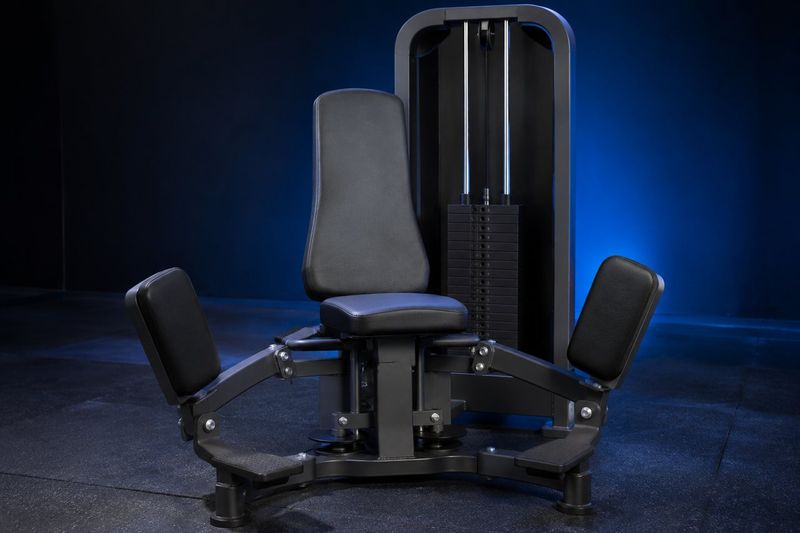
Hip adduction on the machine, or seated hip adduction, loads the hip adductor muscles. The main one is the adductor magnus, and given its structure, it is primarily a hip extensor. The muscles are stretched the most at the start of the exercise, when your legs are spread apart. This exercise doesn't remove fat from your inner thighs: fat can't be lost from one spot.
I'm Demid Lobanov, a fitness coach. In the programs I've written, hip adduction has appeared 4 times. It's suitable for beginners, and it has one setting that changes the working length of the muscles.
Which muscles work in hip adduction
According to Hall's biomechanics textbook (Chapter 8), the hip is adducted by the adductor longus, adductor brevis, and adductor magnus, as well as the gracilis. In the muscle table, Hall adds the pectineus. In my exercise library, the roles are divided like this:
- adductor magnus is the largest muscle in the group and produces most of the force;
- adductor longus lies near the surface, and it's the one you feel the most;
- adductor brevis lies deeper than the longus;
- gracilis crosses both the hip and the knee joint. If your knee is bent in the machine, its contribution drops;
- obturator externus and quadratus femoris are listed in my exercise library as minor helpers; in Hall, they are external rotators of the hip.
The abdominal muscles and the iliopsoas hold the pelvis so it doesn't tuck under. The gluteus medius, gluteus minimus, and the upper part of the gluteus maximus control the spreading of your legs as you return to the start.
The adductor magnus is more than the "inner thigh"
Hip adduction is often thought of as a women's exercise for the inner thigh. In my exercise library, this is recorded as a methodological mistake.
In a 2025 study, Takahashi et al. reconstructed the fiber paths of the adductor magnus from MRI in 15 young people. More than 80% of its volume belongs to parts whose moment arm for hip extension is longer than for adduction. The moment arm is the distance from the joint to the line along which the muscle pulls. The estimated torque in extension turned out to be more than twice as high as in adduction.
So the adductor magnus is first and foremost a hip extensor, and it makes sense to load it on its own. The seated position wasn't studied in this work. From here on, I rely on the mechanics from my exercise library.
When you're seated, the posterior fibers of the adductor magnus are stretched more than when you're standing: the hip is flexed to about 80–90°. That's why, seated, the adductors work at a longer length than in standing hip adduction on a cable machine.
Does hip adduction remove inner thigh fat?
No. Fat doesn't come off the area you train. The 2021 review by Ramirez-Campillo et al. pooled 13 studies with 1,158 participants in which one arm or leg was trained and the other wasn't. Of 37 comparisons, 17 favored the trained limb and 20 favored the untrained one. The overall effect was about zero.
Fat is lost through a calorie deficit. More on this in the article How to Lose Weight.
How to set up the machine
| Setting | What it changes |
|---|---|
| Starting leg spread | the only setting that changes the working length of the muscles. Usually 40–45°; the limit is the lever's range of travel and the stretch in your groin |
| Backrest angle | the closer the hip angle is to a right angle, the longer the adductor magnus |
| Knee position | a bent knee reduces the contribution of the gracilis |
Choose the starting spread based on how your groin feels: the stretch should be tolerable. This is an analysis of the mechanics of a typical machine; a specific machine may give a different angle and a different range of travel.
With the hip flexed to 90°, adduction strength in the lowering phase is lower than at 0° and 45°, while adductor longus activity stays the same. Marušič et al. showed this in 2025 in 16 people using a dynamometer.
So if your working weight is lower when seated, the reason may be your hip position rather than a technique error. For building strength, the authors recommend flexing the hip less. In my exercise library, the seated position is chosen for the sake of muscle length.
How to do hip adduction: step by step
- Set the starting spread so that the stretch in your groin is tolerable.
- Sit down and press your pelvis and back against the backrest. The pads press on your thighs closer to the knees.
- Bring your thighs together until they touch. The machine won't let you go any further: your other leg and the seat are in the way.
- Smoothly spread your legs back to the starting position, without letting them drop.
- Keep your pelvis pressed in the whole time, and don't slide down the backrest.
Where hip adduction is hardest
A typical machine has no pronounced load peak: the pads press on the thigh close to the knee, and the resistance barely changes. The hardest part feels like the first third of the movement from the spread position, where the muscles are at their longest and already fully loaded. This is an estimate based on how a typical machine is built; there's no measurement.
The exercise loads the muscles more in the stretched position: at the start, your legs are spread as wide as possible, the adductors are fully stretched, and the resistance is already at its maximum. At the end, when your thighs are together, the load on the shortened muscles is light. This is one of the few ways to load the adductors in a stretched position.
What the research says
I haven't found studies on adductor growth from training on this particular machine. There is data on other exercises and on muscle activity:
- squat: in the 2019 study by Kubo et al., the adductors of 17 men grew by 6.2% over 10 weeks with deep squats and by 2.7% with shallow squats. In the 2023 study by Plotkin et al., in 34 untrained people over 9 weeks, the adductors grew more from squats than from the barbell hip thrust;
- machine and band: in the 2013 study by Brandt et al., in 16 untrained women, adductor activity was the same on the machine and with an elastic band. Perceived exertion on the Borg scale, an effort scale from 0 to 10, was linked to muscle activity;
- leg press: in the 2026 study by Kinoshita et al., in 17 untrained people over 12 weeks, the adductor magnus grew by 6.2% from the leg press and didn't grow from machine leg extensions;
- groin in soccer players: the 2019 study by Harøy et al. involved 35 teams and 652 soccer players. They did a single exercise, the Copenhagen adduction. On average, in a given week of the season, 13.5% of players had groin complaints versus 21.3% in the control group, a 41% lower risk. This is a different exercise, and it was done by male soccer players. Nothing like this has been tested for the machine.
In my methodology, hip adduction is used to load the adductors when a program is built around a narrow stance and they're underloaded. Another use is the late stage of returning after a groin injury, with precise dosing of the range of motion.
Common hip adduction mistakes
- Cutting the starting spread to lift more weight. The exercise loses exactly the part it's done for.
- Tucking the pelvis and sliding down the backrest. The hip angle changes, and with it the length of the adductor magnus.
- Letting your legs drop open on the way back. This is the most common cause of discomfort in the groin.
Hip adduction and hip abduction machines
People often search for them together, but they're different exercises. Adduction loads the adductors; abduction loads the upper part of the gluteus maximus and the gluteus medius. For abduction, see the article Hip Abduction Machine.
Hip adduction with groin pain
- Fresh adductor injury or groin strain: the exercise isn't done.
- After your doctor clears you, progress from partial to full range of motion as tolerated. The guideline: pain no higher than 5 out of 10, no worse after training, and back to its previous level by the next day.
- Groin pain of unclear origin: don't do the exercise; see a doctor first. Groin pain has many causes that have nothing to do with muscles.
- Pain along the sciatic nerve, a large nerve on the back of the thigh, is triggered by hip flexion itself. Hip adduction has nothing to do with it. The flexion angle is adjusted by tilting the backrest, and diagnosis and load are discussed with a doctor.
Pain at rest or at night, or numbness, is a reason to stop training and see a doctor.
How many sets to do
I haven't found separate data on the number of sets for hip adduction. Count your adductor sets using the article How Many Sets per Week. Keep in mind that squats also load the adductors. For more on planning your leg training, see the article How to Build Your Legs.
How to add hip adduction to your workout: step by step
- Check your groin: with a fresh injury or pain of unclear origin, see a doctor first.
- Set the starting spread according to how well you tolerate the stretch, and set the backrest angle.
- Place the exercise after your main leg exercises.
- Return to the spread position smoothly, without letting your legs drop.
- Don't cut the starting spread to lift more weight.
If you need a plan for your goal and your gym, there's the personalized program.
I post exercise breakdowns on my YouTube channel @lobanov_fitness.
Sources
- Hall SJ. Basic Biomechanics. 9th edition. McGraw Hill, 2022. Chapter 8: lower extremity.
- Takahashi K et al. Redefining muscular action: human «adductor» magnus is designed to act primarily for hip «extension» rather than adduction in living young individuals. Journal of Applied Physiology, 2025. Article
- Ramirez-Campillo R et al. A proposed model to test the hypothesis of exercise-induced localized fat reduction (spot reduction), including a systematic review with meta-analysis. Hum Mov., 2021. Article
- Kubo K et al. Effects of squat training with different depths on lower limb muscle volumes. Eur J Appl Physiol, 2019. Article
- Plotkin DL et al. Hip thrust and back squat training elicit similar gluteus muscle hypertrophy and transfer similarly to the deadlift. Front Physiol, 2023. Article · Full text
- Kinoshita M et al. Hypertrophic Effects of Single- versus Multi-Joint Exercise: A Direct Comparison between Knee Extension and Leg Press. Med Sci Sports Exerc, 2026. Article · Full text
- Marušič J et al. Joint torque and electromyographic activity during eccentric exercise for hip adductors at different hip flexion angles. PLoS One, 2025. Article · Full text
- Brandt M et al. Perceived loading and muscle activity during hip strengthening exercises: comparison of elastic resistance and machine exercises. Int J Sports Phys Ther, 2013. Full text
- Harøy J et al. The Adductor Strengthening Programme prevents groin problems among male football players: a cluster-randomised controlled trial. Br J Sports Med, 2019. Article