A dumbbell hammer curl is a curl in which your palms face each other the whole time. Three muscles flex the elbow: the biceps, the brachialis, and the brachioradialis. From a mechanical standpoint, a neutral grip suits the brachioradialis best. Measurements of muscle activity don't confirm this, and I found no studies on muscle growth with different grips. So hammer curls complement regular curls but can't replace them.
I'm Demid Lobanov, a fitness coach. In my exercise library, hammer curls appear in a seated dumbbell version, which is suitable for beginners. The same exercise is also called the hammer curl or the neutral-grip curl.
Which muscles work in hammer curls
According to Hall's biomechanics textbook (chapter 7), three muscles flex the elbow:
- the brachialis is the strongest elbow flexor. It attaches to the ulna and works the same way in any forearm position;
- the biceps brachii, or simply the biceps, is stronger when the palm faces up and weaker when the palm faces down;
- the brachioradialis is most effective in the neutral position, midway between the two.
In hammer curls, the brachioradialis and brachialis take a larger share of the work than in palms-up curls. But in overall contribution, the brachioradialis falls behind the biceps and brachialis, and the biceps remains one of the two main flexors.
The other muscles hold the position, as described in my exercise library:
- the pronators are the muscles that turn the palm down. When the biceps contracts, it pulls the palm up, and the pronators hold the neutral grip;
- the front delt keeps the elbow at your side;
- the finger flexors and wrist extensors hold the dumbbell;
- the back and core muscles keep the torso steady. They work less seated than standing.
How hammer curls differ from regular curls
The difference is the forearm position. According to the textbook, with the palm up (supination) the biceps is stronger, and with a neutral grip the brachioradialis is. Forearm position doesn't affect the brachialis. Direct measurements don't confirm this model.
Muscle activity is recorded with sensors on the skin; this method is called electromyography. In a 2023 study by Coratella and colleagues, 10 competitive bodybuilders did standing cable curls. They used a straight bar with palms up and with palms down, and a rope with a neutral grip.
On the way up, the biceps was 12% more active with a palms-up grip than with a neutral grip. The brachioradialis was also more active with palms up, by 6%. The front delt worked 9% more with the neutral grip. On the way down, the biceps and brachioradialis showed no difference between grips.
Other studies:
- Caufriez and colleagues, 2018: 15 men flexed the elbow with maximal effort on a dynamometer in three forearm positions. All three flexors were active in every position, and the brachioradialis was slightly stronger with the palm up;
- Kleiber and colleagues, 2015: 16 people. Brachioradialis activity differed only with a palms-down grip; there was no difference between a neutral grip and palm up. The biceps showed no difference in any position;
- Boland and colleagues, 2008: found no difference in brachioradialis activity among the three forearm positions;
- Croskery and colleagues, 2026: 15 people, four types of curls. Biceps activity was lowest in hammer curls.
None of these studies showed that the brachioradialis works hardest specifically with a neutral grip. That model is based on the mechanics in the textbook. Besides, activity measured by sensors doesn't predict muscle growth: it only shows which muscles switch on.
Do hammer curls grow the brachialis and brachioradialis
I found no studies in scientific journals that compared muscle growth with a hammer grip and a palms-up grip. There are data on the growth of individual flexors in other curls.
The brachialis grows noticeably. In the 1995 study by O'Hagan and colleagues, after 20 weeks of curls its cross-sectional area increased by 53% in women and by 31% in men, while the area of the biceps increased by 13% and 7%. There were only 12 participants.
In the 2026 study by Kobayashi and colleagues, 21 untrained people trained one arm with incline curls and the other with preacher curls for 12 weeks. The biceps grew more from incline curls: 22.1% vs. 18.9%.
The brachialis and brachioradialis grew more from preacher curls: 21.1% vs. 17.1% and 17.6% vs. 13.5%. All the flexors combined grew with no significant difference: 17.6% and 19.2%. The authors themselves rate the difference as small or moderate.
The takeaway: different curls grow individual muscles slightly differently, but total flexor growth in this study didn't differ. Hammer curls let you add load to the elbow flexors with a different grip. They don't replace palms-up curls.
How to do dumbbell hammer curls: step by step
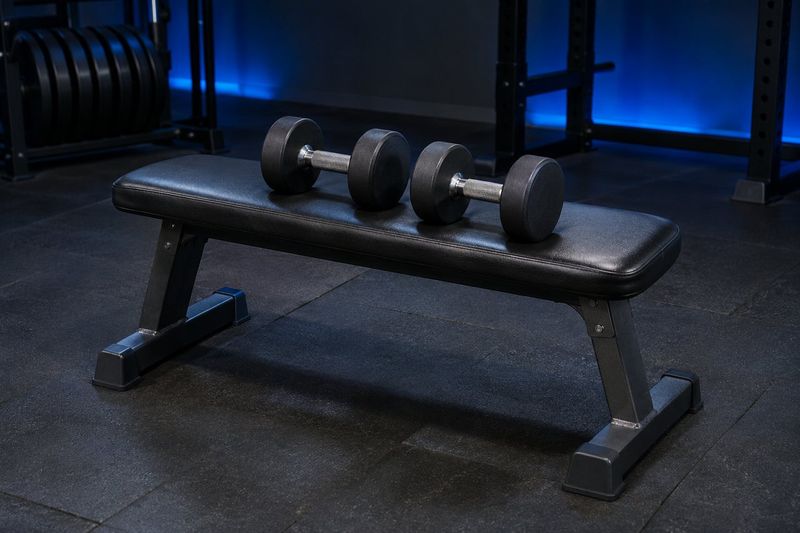
- Sit on a bench with your torso upright. Keep your upper arm vertical, alongside your torso.
- Hold the dumbbells with a neutral grip, palms facing each other.
- Bend your elbows without swinging your torso. The elbow stays at your side and doesn't move forward.
- Lift to 130–140° of elbow flexion, with the dumbbells at your shoulders. Your palm faces inward the whole way; don't rotate it up.
- Lower the dumbbells smoothly until your elbows are fully straight.
If you bring the elbow forward at the top, the shoulder starts to flex and the load comes off the elbow.
Seated or standing
Seated, it's easier to keep the upper arm vertical and to avoid swinging your torso or moving the elbow forward. That's why my library features the seated version of hammer curls. Standing, the back and core muscles work more.
If the back of the bench is reclined, the upper arm ends up behind the torso. This stretches the biceps more, and the exercise becomes closer to incline curls.
Where hammer curls are hardest
The hardest point is around 90° at the elbow, when the forearm is horizontal. This is where the moment arm is greatest: the distance from the elbow to the line along which the weight of the dumbbell acts.
At 30° of flexion, the load is half of the maximum, and at the top, at 130–140°, it's about two-thirds. The load would disappear completely only if the forearm became vertical, and with the elbow at your side, that doesn't happen.
The forearm becomes vertical if you move the elbow forward, and then the work shifts to the shoulder.
This is a mechanical calculation; there's no measurement. It points to the main limitation of hammer curls: the bottom part of the movement, where the flexors are stretched, is barely loaded.
Incline curls, with the upper arm drawn back, load the biceps in its stretched position. More on this in How to build your biceps.
Common hammer curl mistakes
- The elbow moves forward at the top of the lift: the work shifts to the shoulder.
- Swinging the torso: the torso does part of the lift.
- The palm turns up during the movement: that's already a regular curl.
- Uncontrolled lowering: the dumbbells are dropped instead of lowered smoothly.
Hammer curls with elbow pain
A neutral grip is sometimes more comfortable. In my library, hammer curls are also suitable for people who find palms-up curls uncomfortable because of how their wrist or elbow feels.
During a flare-up of already diagnosed lateral epicondylitis (pain on the outside of the elbow), a neutral grip mechanically puts less load on the wrist extensors than a palms-down grip. But the weight is reduced for that period.
With already diagnosed tendinopathy of the biceps tendon at the elbow, the weight and range of motion are chosen based on tolerance. These are restrictions for the flare-up period; the diagnosis itself doesn't rule the exercise out.
Pain with no established cause, or pain that's severe or getting worse, is a reason to see a doctor first. Pain at rest or at night, numbness and weakness in the arm are a reason to stop training and see a doctor.
How many sets and reps to do
Hammer curls are counted together with your other curls. The guideline for experienced lifters is 10–20 working sets per muscle per week, taking recovery into account.
Pulling exercises load the biceps as a secondary muscle and count as half a set for it. The number of reps can be anything, as long as your sets end close to failure, the point where you can't do another rep with good form.
More on this in How to build your biceps and How many sets per week.
How to add hammer curls to your workout: step by step
- Check your elbow: during a pain flare-up, reduce the weight; with pain of no established cause, see a doctor first.
- Do hammer curls after your main curls, or replace some of those sets with them.
- Do them seated: upper arm at your side, no swinging, palms facing each other.
- Count the sets together with your other curls.
- Add an exercise where the biceps works in a stretched position: incline curls.
If you need a plan for your goal and your gym, there's the personalized program.
I post exercise breakdowns on my YouTube channel @lobanov_fitness.
Sources
- Hall SJ. Basic Biomechanics. 9th edition. McGraw Hill, 2022. Chapter 7: upper extremity.
- Coratella G et al. Biceps Brachii and Brachioradialis Excitation in Biceps Curl Exercise: Different Handgrips, Different Synergy. Sports (Basel), 2023. Article · Full text
- Caufriez B et al. The Role of the Muscle Brachioradialis in Elbow Flexion: An Electromyographic Study. J Hand Surg Asian Pac Vol, 2018. Article
- O'Hagan FT et al. Response to resistance training in young women and men. Int J Sports Med, 1995. Article
- Kleiber T et al. Muscular coordination of biceps brachii and brachioradialis in elbow flexion with respect to hand position. Front Physiol, 2015. Article · Full text
- Boland MR et al. The function of brachioradialis. J Hand Surg Am, 2008. Article
- Croskery M et al. Inter-day ranking of biceps brachii sEMG amplitude during four arm curl exercises. J Electromyogr Kinesiol, 2026. Article
- Kobayashi Y et al. Exercise-specific preferential hypertrophy of individual elbow flexor muscles after incline versus preacher dumbbell curl training. J Sports Sci, 2026. Article