
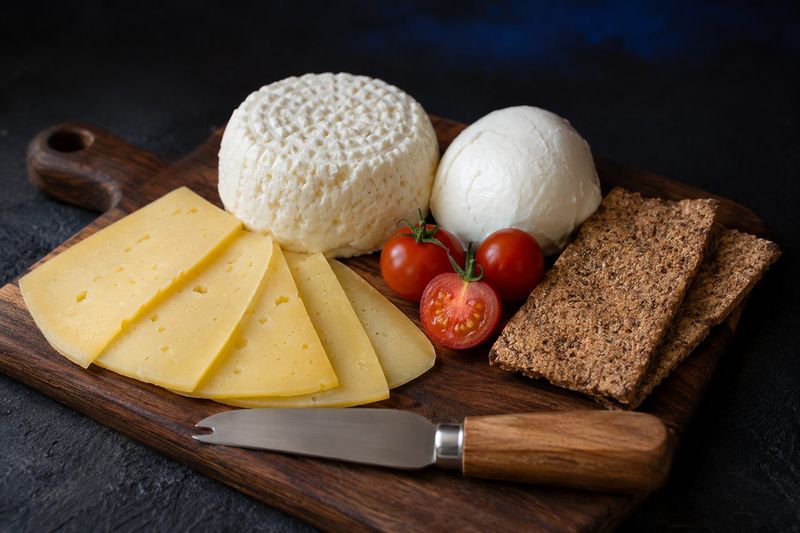
You can eat cheese while losing weight: weight goes down when you're in a calorie deficit over the day, and cheese is a calorie-dense food. Semi-hard cheese has about 350 kcal per 100 g, and a 30 g piece has 104 kcal. In large observational studies, cheese is either not linked to weight at all or linked to a very small gain. Cheese has no special effect that helps you lose weight.
I'm Demid Lobanov, a fitness coach. In the recipe database for the meal plans I create, cheese appears in 46 of 260 dishes. Below: the calories in different cheeses, research findings, and sample dishes.
How many calories and how much protein are in cheese
Here are the values per 100 g from the food database for my meal plans. For semi-hard cheese, these are values within the GOST range; for Adyghe cheese, a typical label; for the rest, USDA FoodData Central data.
| Cheese, 100 g | Calories | Protein | Fat |
|---|---|---|---|
| Semi-hard: Russian, Gouda, Dutch | 348 kcal | 24 g | 28 g |
| Firm mozzarella | 297 kcal | 22.2 g | 22.1 g |
| Feta or brynza | 266 kcal | 14.2 g | 21.5 g |
| Adyghe | 260 kcal | 19 g | 19.8 g |
| Cream cheese | 356 kcal | 6.2 g | 34.4 g |
| Cottage cheese 5%, for comparison | 121 kcal | 17 g | 5 g |
The "45%" or "50%" on the package is the share of fat in the cheese's dry matter. To see how much fat is in 100 g, check the "fat" line on the label.
What research shows about cheese and weight
I found almost no studies in which people lost weight specifically with cheese versus without it. There are large observational studies, studies that added cheese to the diet, and studies on dairy products in general.
Observational studies:
- Harvard cohorts, USA, about 120,000 people. In a 2016 meta-analysis by Schwingshackl and colleagues based on these data, each additional daily serving of cheese was associated with a gain of about 11 g of weight per year, and a serving of yogurt with a loss of 41 g. Smith and colleagues analyzed the same cohorts differently in 2015: regular cheese was associated with weight gain, and low-fat cheese with a relative weight loss. The association depended on carbohydrates. When people ate more cheese while the glycemic load of their diet—the overall effect of carbohydrates on blood sugar—went down, their weight went down. When it went up along with cheese, their weight went up;
- Framingham, USA: 3,440 people followed from 1991 to 2008. No link was found between cheese and changes in weight or waist size (Wang and colleagues, 2014);
- France: 2,267 people over 6 years. No link was found between cheese and weight change (Vergnaud and colleagues, 2008);
- Rouhani and colleagues, 2026: 28 observational studies, mostly cross-sectional. People who ate more dairy, including full-fat dairy, were less likely to have abdominal obesity, meaning belly fat. The abstract gives no separate figure for cheese.
Observational studies show an association but don't prove cause. The takeaway: cheese by itself neither puts weight on nor takes it off; calories are what decide.
There are studies in which people were given 50–120 g of cheese a day for 6–12 weeks in place of part of their usual food: Raziani and colleagues, 2016; Nilsen and colleagues, 2015; Feeney and colleagues, 2018. Waist circumference and other measures didn't differ from those in groups that ate little cheese or got the same calories or the same fat from other foods.
Randomized trials of dairy products in general:
- Chen and colleagues, 2012: 29 trials, 2,101 people. Dairy products reduced weight in short trials or under calorie restriction. Without restriction and in long trials, it was the opposite: they slightly increased weight. On average across all 29, there was no difference;
- Stonehouse and colleagues, 2016: 27 trials, adults aged 18–50 with excess weight in a calorie deficit, almost all of them women. With dairy, weight dropped by 1.16 kg more and fat by 1.49 kg more. In trials with strength training, there was no difference;
- Bendtsen and colleagues, 2018: 80 people with excess weight ate 500 kcal below their needs for 24 weeks, with either a high or a low amount of dairy. Weight dropped by 6.6 and 7.9 kg, with no significant difference between the groups.
On satiety:
- Hansson and colleagues, 2020: 47 adults ate the same amount of fat in butter, cheese, whipped cream, or sour cream. After cheese, appetite was lower than after whipped cream, but not lower than after sour cream. There was no difference between the foods in hunger or fullness;
- Hansen and colleagues, 2018: 39 people ate 80 g of cheese with different compositions for breakfast. After the higher-protein, lower-fat cheese, they ate fewer calories over the day than after the full-fat one, and didn't make up for it later;
- Dougkas and colleagues, 2012: 40 men with excess weight. After a cheese snack, they ate 9% less at lunch than after water, but with the snack itself included, their total calories were no lower;
- Vela-Vásquez and colleagues, 2026: a pilot study in which 19 people ate in a calorie deficit for four weeks and, three times a week, had 80 g of goat cheese for breakfast, with either 23% or 17% fat. Satiety didn't differ, and weight went down equally in both groups, thanks to the deficit.
Which cheese to choose for weight loss
If cheese is a protein source for you, choose based on calories per gram of protein. According to the database for my meal plans, to get 20 g of protein you need:
- cottage cheese 5%: about 120 g and 140 kcal;
- semi-hard cheese: about 85 g and 290 kcal;
- mozzarella: about 90 g and 270 kcal;
- Adyghe cheese: about 105 g and 275 kcal;
- feta: about 140 g and 375 kcal;
- cream cheese: more than 300 g and about 1,150 kcal.
This is my calculation based on the table above. Cheese provides protein, but the same amount of protein costs roughly twice as many calories as it does with cottage cheese. If you want cheese for flavor, pick the one you like and count the grams.
Cream cheese for weight loss
Cream cheese is mostly fat. The food database for my meal plans uses American cream cheese from USDA: 356 kcal, 34.4 g of fat, and only 6.2 g of protein per 100 g. Russian cream cheeses can be lower in fat, so check the fat content on the label.
My recipes use 25–40 g of cream cheese per dish: on crispbread or in a sandwich with salmon. It's there for flavor: it has little protein.
How much cheese you can eat while losing weight
There's no set amount of cheese: eat as much as fits into your calories for the day. My recipes use 15–45 g of semi-hard cheese per dish. For Adyghe cheese it's 30–150 g: when it replaces meat, the portion is bigger.
It's easy to eat more cheese than you think. A 30 g piece is 104 kcal, while 100 g is already 348 kcal. Weigh your cheese, at least at first. More on this in the article How to Weigh Your Food.
You can eat cheese in the evening too: calories are counted over the whole day. More on this in the article Is It OK to Eat Before Bed.
Sample cheese dishes from my meal plans
| Dish | Ingredients, raw weight | Calories | Protein |
|---|---|---|---|
| Omelet with cheese and spinach | eggs 150 g, semi-hard cheese 30 g, spinach 60 g, oil 5 g | 373 kcal | 27.8 g |
| Adyghe cheese and tomato sandwich | rye bread 50 g, Adyghe cheese 50 g, tomato 80 g | 249 kcal | 13.5 g |
| Grapes with cheese | grapes 150 g, semi-hard cheese 40 g | 252 kcal | 10.7 g |
| Baked Adyghe cheese with vegetables | Adyghe cheese 150 g, tomato 150 g, bell pepper 100 g, oil 10 g | 535 kcal | 30.9 g |
If you have kidney disease or another condition for which your doctor has restricted your diet, discuss how much cheese to eat with them.
How to eat cheese and lose weight: step by step
- Calculate your daily calorie target: see the article How Many Calories You Need per Day.
- Decide why you want cheese: for protein, Adyghe, mozzarella, or semi-hard cheese is better; for flavor, any kind works.
- Check the label for the amount of fat per 100 g.
- Weigh your portion and log it.
- Eat cheese in place of other food.
- After two weeks, compare your average weight for the week with the previous week's. If it isn't going down, cut back on portions of calorie-dense food, including cheese.
I also talk about nutrition and training on my YouTube channel @lobanov_fitness.
Sources
- GOST 32260-2013. Semi-hard cheeses. Technical specifications (in Russian).
- GOST 33480-2015. Adyghe cheese. Technical specifications (in Russian).
- U.S. Department of Agriculture. FoodData Central. Cheese, mozzarella, whole milk (FDC 170845); Cheese, feta (FDC 173420); Cheese, cream (FDC 173418).
- Schwingshackl L et al. Consumption of Dairy Products in Relation to Changes in Anthropometric Variables in Adult Populations: A Systematic Review and Meta-Analysis of Cohort Studies. PLoS One, 2016. Article · Full text
- Smith JD et al. Changes in intake of protein foods, carbohydrate amount and quality, and long-term weight change: results from 3 prospective cohorts. Am J Clin Nutr, 2015. Article · Full text
- Rouhani P et al. Consumption of Dairy Products and Abdominal Obesity in Adults: A Systematic Review and Dose-Response Meta-Analysis of Epidemiologic Studies With GRADE Assessment. Nutr Rev, 2026. Article
- Chen M et al. Effects of dairy intake on body weight and fat: a meta-analysis of randomized controlled trials. Am J Clin Nutr, 2012. Article · Full text
- Stonehouse W et al. Dairy Intake Enhances Body Weight and Composition Changes during Energy Restriction in 18-50-Year-Old Adults-A Meta-Analysis of Randomized Controlled Trials. Nutrients, 2016. Article · Full text
- Bendtsen LQ et al. High intake of dairy during energy restriction does not affect energy balance or the intestinal microflora compared with low dairy intake in overweight individuals in a randomized controlled trial. Appl Physiol Nutr Metab, 2018. Article
- Hansson P et al. Dairy products influence gut hormone secretion and appetite differently: A randomized controlled crossover trial. J Dairy Sci, 2020. Article
- Vela-Vásquez DA et al. Commercial Goat Cheeses Show No Differences in Postprandial Satiety During Caloric Restriction: A Randomized Controlled Pilot Trial. Nutrients, 2026. Article · Full text
- Wang H et al. Longitudinal association between dairy consumption and changes of body weight and waist circumference: the Framingham Heart Study. Int J Obes (Lond), 2014. Article · Full text
- Vergnaud AC et al. Dairy consumption and 6-y changes in body weight and waist circumference in middle-aged French adults. Am J Clin Nutr, 2008. Article
- Raziani F et al. High intake of regular-fat cheese compared with reduced-fat cheese does not affect LDL cholesterol or risk markers of the metabolic syndrome: a randomized controlled trial. Am J Clin Nutr, 2016. Article
- Nilsen R et al. Effect of a high intake of cheese on cholesterol and metabolic syndrome: results of a randomized trial. Food Nutr Res, 2015. Article · Full text
- Feeney EL et al. Dairy matrix effects: response to consumption of dairy fat differs when eaten within the cheese matrix-a randomized controlled trial. Am J Clin Nutr, 2018. Article
- Hansen TT et al. Macronutrient manipulations of cheese resulted in lower energy content without compromising its satiating capacity. J Nutr Sci, 2018. Article · Full text
- Dougkas A et al. Differential effects of dairy snacks on appetite, but not overall energy intake. Br J Nutr, 2012. Article




