
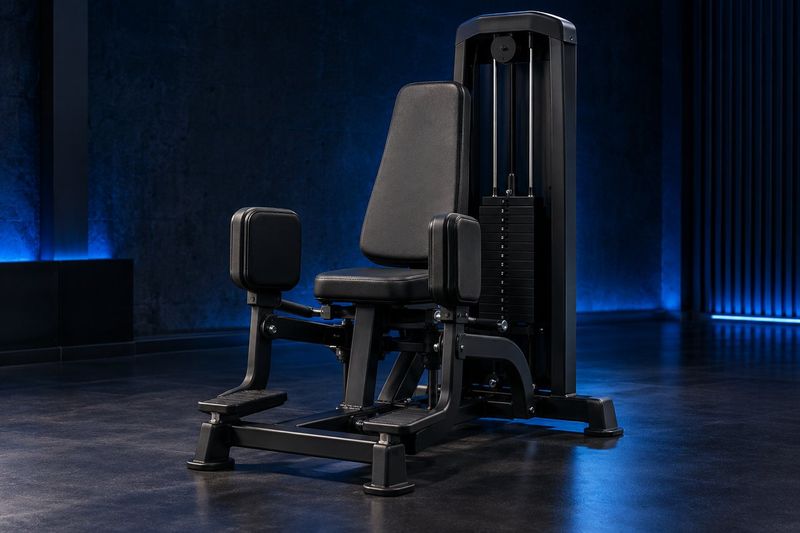
Machine hip abduction, also called seated hip abduction, is an exercise in which you push your knees apart against the resistance of the pads. The work is done by the upper fibers of the gluteus maximus and by the gluteus medius. They are assisted by the gluteus minimus and the tensor fasciae latae.
Torso lean changes how the load is shared: when you lean forward, the upper gluteus maximus works more; when you sit upright, the gluteus medius does. This is an accessory exercise. The main glute work comes from other movements.
I'm Demid Lobanov, a fitness coach. In the programs I've written, machine hip abduction with a forward lean and without one each appear 3 times. Below I'll go over what the research shows and how to do the exercise.
Which muscles work during machine hip abduction
According to my exercise library, the main work is done by the upper fibers of the gluteus maximus. At about 90° of hip flexion, the direction of their fibers matches the direction of resistance. This conclusion is based on fiber direction and muscle size. A direct measurement of growth is below.
The lower part of the gluteus maximus doesn't contribute. The other muscles share the work like this:
- gluteus medius: its posterior segment abducts and extends the hip, and the middle segment joins in only when you sit upright. In the seated position, the anterior segment is at a disadvantage and barely contributes;
- gluteus minimus helps abduct the hip and holds the femoral head in the joint; its contribution is small;
- tensor fasciae latae also abducts the hip. Its share is higher with an upright backrest;
- piriformis, gemelli, and obturator internus take part in the movement when you're seated, but they are small in volume.
According to Hall's biomechanics textbook (Chapter 8), the main muscle that abducts the hip is the gluteus medius. The gluteus minimus assists it.
Does hip abduction grow your glutes?
Yes, and this was measured directly, but with a cable rather than a machine. In a 2026 study by Attarieh and colleagues, 17 young people trained for 10 weeks, twice a week. They did about 10 sets per week per leg of 8–12 reps with a weight that allowed no more reps.
One leg did cable hip extension, the other did cable hip abduction. Muscle size was measured with MRI.
| Measure | Hip abduction | Hip extension |
|---|---|---|
| Gluteus maximus overall | +5% | +9% |
| Its upper, middle, and lower parts | +10%, +4%, +1% | +5%, +8%, +14% |
| Gluteus medius and minimus combined | +4% | +2% |
The authors consider the 2% gain in the gluteus medius and minimus from hip extension not significant. I draw two conclusions from this.
Abduction grows the gluteus maximus less than cable hip extension does, so there's no reason to use it in place of hip extension. I extend this conclusion to hip thrusts and deadlifts based on the similarity of the movement: they weren't studied here.
At the same time, abduction specifically loads the upper part of the muscle and produces a small gain in the gluteus medius and minimus. The authors call this the first direct indication that exercise selection can change how different parts of the glutes grow. So far, this is the only study.
The main glute exercises are covered in How to Build Your Glutes and Glute Bridge.
Leaning forward or sitting upright
Torso lean is the main way to adjust the load in this exercise, and it works in both directions. There is no universally correct seat position. The choice depends on your goal:
| Sitting upright | Leaning forward | |
|---|---|---|
| Which muscles get more load | the upper gluteus maximus and the gluteus medius equally | the upper gluteus maximus |
| Gluteus medius | more | posterior segment only, smaller share |
| Tensor fasciae latae | higher | lower |
| Range of motion | 35–40° | 40–50° |
| When to choose it | your goal is the gluteus medius, or deep hip flexion is contraindicated for you | your goal is the upper gluteus maximus |
These are the mechanics from my exercise library. The range of motion in it is an estimate; there's no measurement on this machine.
A direct measurement of muscle activity comes from a 2026 study by de Farias and colleagues. In it, 12 people with recreational training experience did machine abduction at 45°, 90°, and 135° of hip flexion, using 60% of their maximum for 6 reps.
Hip flexion of 135° corresponds to a strong forward lean of the torso. The abstract doesn't say exactly how the angle was set.
Tensor fasciae latae activity was lower at 135° than at 45° and 90°. Peak gluteus medius activity didn't differ between the angles. Its average activity at 135° was lower than at 45°.
At 135°, the ratio of gluteus medius to tensor fasciae latae activity went up, but that came from a drop in tensor fasciae latae activity. This doesn't contradict my table: leaning reduces the work of the tensor fasciae latae and doesn't increase the work of the gluteus medius.
The study didn't show that the gluteus medius works noticeably more when you sit upright than when you lean: no difference between 90° and 135° was reported for it. Growth wasn't assessed here.
How to do machine hip abduction: step by step
- Sit so that your pelvis rests on the seat. The pads should be on the outside of your thighs and brought together to roughly the width of your pelvis.
- Choose your position: press your back against the backrest, or lean forward from the hips while keeping your lower back flat.
- Push your knees apart by moving your thighs out to the sides. Don't lift or rotate your pelvis.
- Go to the end of the machine's range of motion without rotating your pelvis.
- Bring your legs together slowly and don't let the pads drop: the return is part of the rep too.
Where the exercise is hardest
There's no pronounced peak here: the pads press on the far part of the thigh, the moment arm changes little, and with a round pulley the load stays close to constant.
It gets hard at the end of the range of motion, but not because the load increases. The reason is that a shortened muscle produces less force. With a different machine cam, one that changes the load through the movement, the picture would change.
The muscles work at medium and short lengths. There is no stretched position: the machine won't let you bring your thigh past the midline, and the movement starts from neutral. With a forward lean, the gluteus maximus works at a longer length than when you sit upright.
That's why the exercise is valued for precise targeting and low overall fatigue. Don't expect it to work the muscles in a stretch.
Common mistakes
The main mistake is changing your position mid-set without noticing. If you chose to sit upright and then start leaning forward, the target of the load changes.
The reverse happens too: when you lean, your torso often straightens toward the end of the set, and the load shifts toward the gluteus medius. Other mistakes:
- leaning by rounding your lower back instead of moving at the hips;
- lifting your pelvis off the seat and spreading your knees by rotating your pelvis;
- letting the weight drop on the way back. A slow return is what sets the quality of the rep.
Hip abduction and pain
Pain is a reason to drop the exercise. I don't consider the theory that abductions are dangerous because of the piriformis and the sciatic nerve to be such a reason. For most people, these exercises are not dangerous.
When it's worth changing the variation or seeing a doctor:
- a sciatic nerve problem. Deep hip flexion stretches the nerve (Robinson and colleagues, 2019) and can worsen symptoms in people with nerve problems. In that case, the upright variation is better than leaning forward. Discuss your diagnosis and training load with your doctor;
- pain along the outer thigh with a known diagnosis, during a flare-up. Limit the end of the range of motion. Without a diagnosis, see a doctor first;
- pain with no established cause, severe or worsening: see a doctor first.
Will hip abduction remove fat from your thighs?
No. The idea that fat comes off where a muscle is working is called spot reduction.
In a 2021 meta-analysis by Ramirez-Campillo and colleagues (13 studies in which one arm or leg was trained), fat near the working muscle decreased just as it did on the other side of the body. More on this in How to Lose Belly Fat. The amount of fat is changed by a calorie deficit.
How many sets to do and where to put it
In my programs, hip abduction goes at the end of the workout as an accessory exercise. The only direct guideline for growth is the Attarieh protocol: 2 workouts per week, about 10 sets per week per leg, 8–12 reps each with a weight that allows no more reps.
This is a single study, and it didn't use a machine, so treat it as a rough guide.
The hip adduction machine is a different exercise: it loads the adductors. This article doesn't cover it.
How to add hip abduction to your workout: step by step
- Define your goal: for the upper gluteus maximus, lean forward; for the gluteus medius, sit upright.
- Do your main glute exercises first and put hip abduction at the end of the workout.
- Do sets of 8–12 reps. Use a weight that lets your pelvis stay on the seat and your position stay the same.
- Return the pads slowly.
- If you get pain with no established cause, severe or worsening, see a doctor first. With a known diagnosis, choose the variation and range of motion as described in the section on pain.
If you need a plan for your goal and your gym, there's the personalized program.
I post exercise breakdowns on my YouTube channel @lobanov_fitness.
Sources
- Hall SJ. Basic Biomechanics. 9th edition. McGraw Hill, 2022. Chapter 8: the lower extremity.
- Attarieh P et al. Regional Hypertrophy of the Gluteal Muscles Is Task-Specific: Differential Responses to 10 Weeks of Hip Extension Versus Hip Abduction Training. J Strength Cond Res, 2026. Article
- de Farias AM et al. Higher hip flexion decreases tensor fascia latae activation and increases GMed: TFL ratio during seated abduction machine. Sci Rep, 2026. Article
- Robinson LR et al. How Much Sciatic Nerve Does Hip Flexion Require? Can J Neurol Sci, 2019. Article
- Ramirez-Campillo R et al. A proposed model to test the hypothesis of exercise-induced localized fat reduction (spot reduction), including a systematic review with meta-analysis. Hum Mov, 2021 (journal issue: 2022). Article