
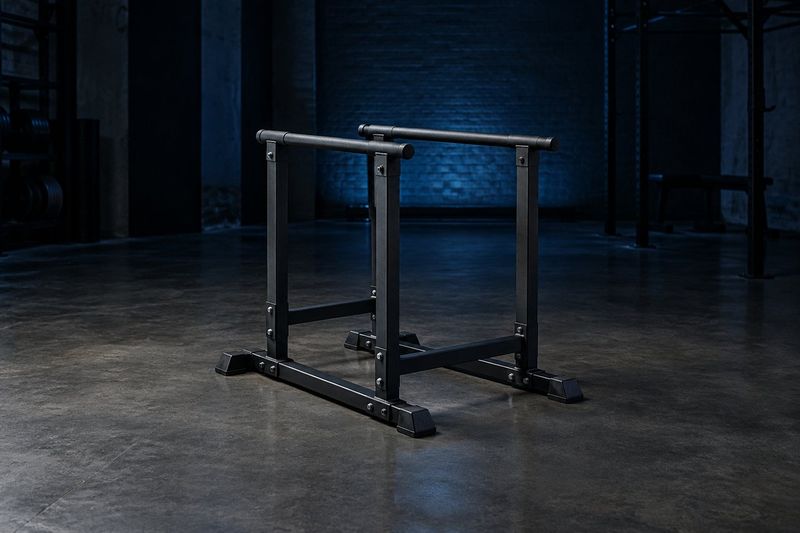
Dips are an exercise in which you start supported on straight arms and lower and raise your body between two bars. The working muscles are the triceps, the lower part of the pectoralis major, and the front delt, the front part of the shoulder muscle. Torso lean distributes the load among them: leaning forward puts more on the chest, staying upright puts more on the triceps. Go down until your upper arm (the part of the arm from the shoulder joint to the elbow) is parallel to the floor. To start, an assisted dip machine works well; a band is for specific purposes.
I'm Demid Lobanov, a fitness coach. My exercise library includes two assisted dip variations, on an assisted dip machine and with a resistance band, because not everyone can do dips with their own bodyweight. Below you'll find the technique, research findings, and the path to bodyweight dips.
Which muscles work in dips
Three muscles do the main work. Here is how my exercise library describes them:
- the triceps extends the arm at the elbow. You can't push up without it, which makes it indispensable;
- the pectoralis major, its lower fibers, lower and adduct the upper arm and, together with the triceps, raise the body. They are stretched at the bottom, and that's also where the load is greatest;
- the front delt helps lift the upper arm from a position behind the body.
A 2022 study by McKenzie and colleagues included 15 healthy men who regularly do dips. They performed one set to failure, meaning until they couldn't complete another rep: 25 reps on average. Muscle activity was measured with sensors on the skin.
By the end of the set, electrical activity had increased in the pectoralis major, the triceps, and three stabilizer muscles, which help hold the body and joints in the right position. Range of motion decreased slightly, but the maximum joint angles did not change.
The authors consider the exercise effective for loading the chest and triceps. According to their data, technique in experienced trainees doesn't change sharply over one set to failure. They advise against extending this conclusion to beginners. Muscle growth was not assessed in the study.
Torso lean: chest or triceps
Lean is the main way to shift the load. Here are the mechanics from my exercise library:
| Torso | What gets more load | What happens at the shoulder |
|---|---|---|
| Leaning forward | chest and front delt | the shoulders move in front of the hands; part of the depth comes from the lean itself |
| Upright | triceps | the shoulders stay over the hands, the elbow travels back, the shoulder extends further |
I haven't found direct measurements of dips at different lean angles. In the McKenzie studies, the electrode was placed only on the clavicular part of the pectoral muscle, so they can't be used to compare activity in different regions of the chest during dips. The emphasis on the lower chest is an inference from the direction of the load.
How deep to go
Go down until your humerus is roughly parallel to the floor. That's where the load is greatest. Below that it no longer increases; the shoulder just gets closer to its extension limit.
In the two McKenzie studies, participants chose their own depth and used, on average, 76–88% of their maximum shoulder extension. In other words, they went down close to their limit.
At the top, your arms are straight and the external load is close to zero. So most of the work happens in the bottom half of the movement.
How to do dips: step by step
- Get into a support position on straight arms and draw your shoulders down, away from your ears.
- Decide what you're targeting: for the chest, lean your torso forward; for the triceps, keep it upright.
- Lower yourself slowly until your upper arm is parallel to the floor.
- Don't let your shoulders rise toward your ears at the bottom.
- Push back up to straight arms without jerking.
How to learn to do dips
Start with assistance and gradually reduce it. In another study by McKenzie and colleagues from the same year, three exercises were compared in 13 experienced men: bench dips, bar dips, and ring dips.
In bench dips, you stand with your back to a bench, hands behind you on its edge and feet on the floor. Bar dips are considered the next step after this exercise. Peak triceps activity in them is indeed higher: 1.04 mV versus 0.83 mV.
But the authors warn that bodyweight bar dips can overload the shoulder in people who are inexperienced, weak, or injured. They don't recommend bench dips for regular training or rehabilitation. In bench dips, participants went past their maximum shoulder extension, to 101%.
The authors suggest three easier variations. For complete beginners: dips on low bars with your feet on the floor. At every stage: a counterweight machine. For more experienced trainees: a resistance band, since the loop moves and you have to hold your torso steady yourself.
| Variation | How it helps | What matters |
|---|---|---|
| Assisted dip machine | the counterweight in a weight-stack machine subtracts a constant amount of weight, and the shape of the load stays the same | reduce the counterweight; don't push off the platform with your knees |
| Resistance band | helps more the deeper you go and, by my calculation, shifts the peak to the middle of the movement | control the descent; the band shouldn't "launch" you out of the bottom |
I consider the assisted dip machine the main option. I use a band as a gentler entry point for a sensitive shoulder, because it helps most at the bottom. You can also use it to get a few more reps after failure. If you can't do push-ups yet, start with the article How to learn to do push-ups.
There's also indirect evidence. In a 2023 survey by Bernstorff and colleagues, 1,387 gym-goers in Germany reported which exercises they associated with pain.
Bodyweight dips made the top four of these exercises: 136 of the 392 people who do them reported pain. On the machine, it was 36 of 386. This was a survey with no physical examination; it doesn't establish the cause of the pain.
Common mistakes in dips
The main mistake: your shoulders creep up toward your ears at the bottom, and depth comes at the expense of the front structures of the shoulder. Other mistakes:
- going deeper than your shoulder extension allows: the upper arm is noticeably below parallel;
- pushing off the platform with your knees on the assisted dip machine: the load quietly shifts away from your arms;
- the torso drifts upright without you noticing, and the exercise turns into a triceps exercise;
- "launching" out of the bottom on a band without controlling the descent.
When to be careful
In my library, restrictions depend on the stage; there's no permanent ban:
- anterior shoulder instability or a past dislocation: limit your depth, since at the bottom the shoulder is close to its extension limit;
- acute shoulder pain when raising the arm, if a diagnosis has already been made: go only as deep as is pain-free;
- a recent tear of or surgery on the pectoralis major: only after medical clearance;
- hypermobility, meaning excessive joint mobility, calls for caution at the end of the range of motion;
- pain with no established cause, severe or worsening pain: see a doctor first.
Pain at rest or at night, numbness, shooting pains, or weakness in the arm are reasons to stop training and see a doctor.
Pectoralis major tears during dips have been reported, but rarely. A 1998 paper by Carek and colleagues describes a case during weighted dips. The authors note that such injuries are infrequently reported with this exercise.
The McKenzie measurements were taken with bodyweight, for four reps, on V-shaped bars where the hands are closer together. The authors warn that added weight, fatigue, or a wide grip could noticeably increase the risk of a pec injury.
So it's better to avoid a wide grip. Add weight only after your technique is solid, and move without jerking at the bottom.
In the fatigue study, four participants failed their last rep. In two of them, the shoulder went past their maximum extension on that rep. The authors recommend a spotter and lower bars if you take a set to failure.
How many sets to do
I haven't found studies specifically on sets, reps, and frequency for dips. Count your sets toward your total weekly volume for chest and triceps, as described in the article How many sets per week. For a muscle that only assists, a set counts as half. When bodyweight sets become easy, add weight gradually.
How to add dips to your workout: step by step
- Check the conditions. Pain with no established cause, severe or worsening pain: see a doctor first.
- Choose a variation: assisted dip machine, band, or bodyweight.
- Choose your goal: lean forward for chest or stay upright for triceps.
- Go down until your upper arm is parallel to the floor; don't let your shoulders rise toward your ears.
- Reduce the assistance as sets become easy.
If you need a plan for your goal and your gym, there's the personalized program.
I post exercise breakdowns on my YouTube channel @lobanov_fitness.
For related pressing lifts and arm volume, see Barbell Bench Press and How to Build Arms. If dips bother your shoulders or progress has stalled, you can check your technique in a training audit.
Sources
- McKenzie A et al. Bench, Bar, and Ring Dips: Do Kinematics and Muscle Activity Differ? Int J Environ Res Public Health, 2022. Article · Full text
- McKenzie A et al. Fatigue Increases Muscle Activations but Does Not Change Maximal Joint Angles during the Bar Dip. Int J Environ Res Public Health, 2022. Article · Full text
- Carek PJ et al. Rupture of pectoralis major during parallel bar dips: case report and review. Med Sci Sports Exerc, 1998. Article
- Bernstorff MA et al. Popular Gym Fitness Sport: An Analysis of 1387 Recreational Athletes Regarding Prone to Pain Exercises and the Corresponding Localisations. Sports (Basel), 2023. Article · Full text