

Someone can count calories and show up to the gym, yet still see slow progress or struggle with relentless evening hunger. Sleep is often the last variable people inspect. Controlled clinical trials, however, show that short sleep both pushes calorie intake up and worsens the ratio of fat to fat-free mass lost during a deficit.
I am Demid Lobanov, a fitness coach and strength-training educator. When working on fat loss, I always review sleep alongside food intake—both in nutrition coaching and in online coaching. Below is what human trials actually prove about sleep and weight loss.
Short sleep quietly adds calories without "breaking metabolism"
A common claim says sleeping less slows your metabolic rate. Intervention studies show a different mechanism. In a systematic review and meta-analysis of partial sleep deprivation (Al Khatib et al., 2017; 17 studies, n = 496; 11 studies meta-analyzed, n = 172), sleeping less produced no statistically significant change in resting metabolic rate or total daily energy expenditure. Instead, daily energy intake rose by an average of 385 kcal per day (95% CI 252 to 517; p < 0.00001), driven by higher fat intake and a lower share of protein with no change in carbohydrates.
Over time, a recurring surplus shows up in population risk. In a meta-analysis of observational studies (Bacaro et al., 2020), short sleep duration (12 studies, 154,936 adults) was significantly associated with higher risk of future obesity (OR 1.412; 95% CI 1.177–1.694). Long sleep (8 studies, 152,192 adults) showed no such association (OR 0.995; 95% CI 0.889–1.114), though heterogeneity across studies was high.
Researchers also tested the reverse in real life. In a short-term randomized clinical trial (Tasali et al., 2022), 80 adults aged 21–40 with a BMI of 25.0–29.9 and habitual sleep under 6.5 hours received either individualized sleep hygiene counseling aiming for an 8.5-hour bedtime window or continued habitual sleep. No diet or exercise was prescribed, and energy balance was tracked objectively with doubly labeled water and DXA scans. Participants extended sleep by roughly 1.2 hours per night and spontaneously reduced intake by 270 kcal per day compared with controls (95% CI −393 to −147; p < 0.001). Total energy expenditure did not change, resulting in weight loss versus controls, and longer sleep correlated inversely with calorie intake (r = −0.41; p < 0.001).
Why short sleep shifts a calorie deficit toward fat-free mass loss
Even if you stick strictly to a planned calorie deficit without overeating, short sleep degrades the quality of weight lost. In a classic randomized crossover clinic trial (Nedeltcheva et al., 2010), 10 overweight adults completed two 14-day moderate calorie-restriction phases—once with 8.5 hours of sleep opportunity and once with 5.5 hours.
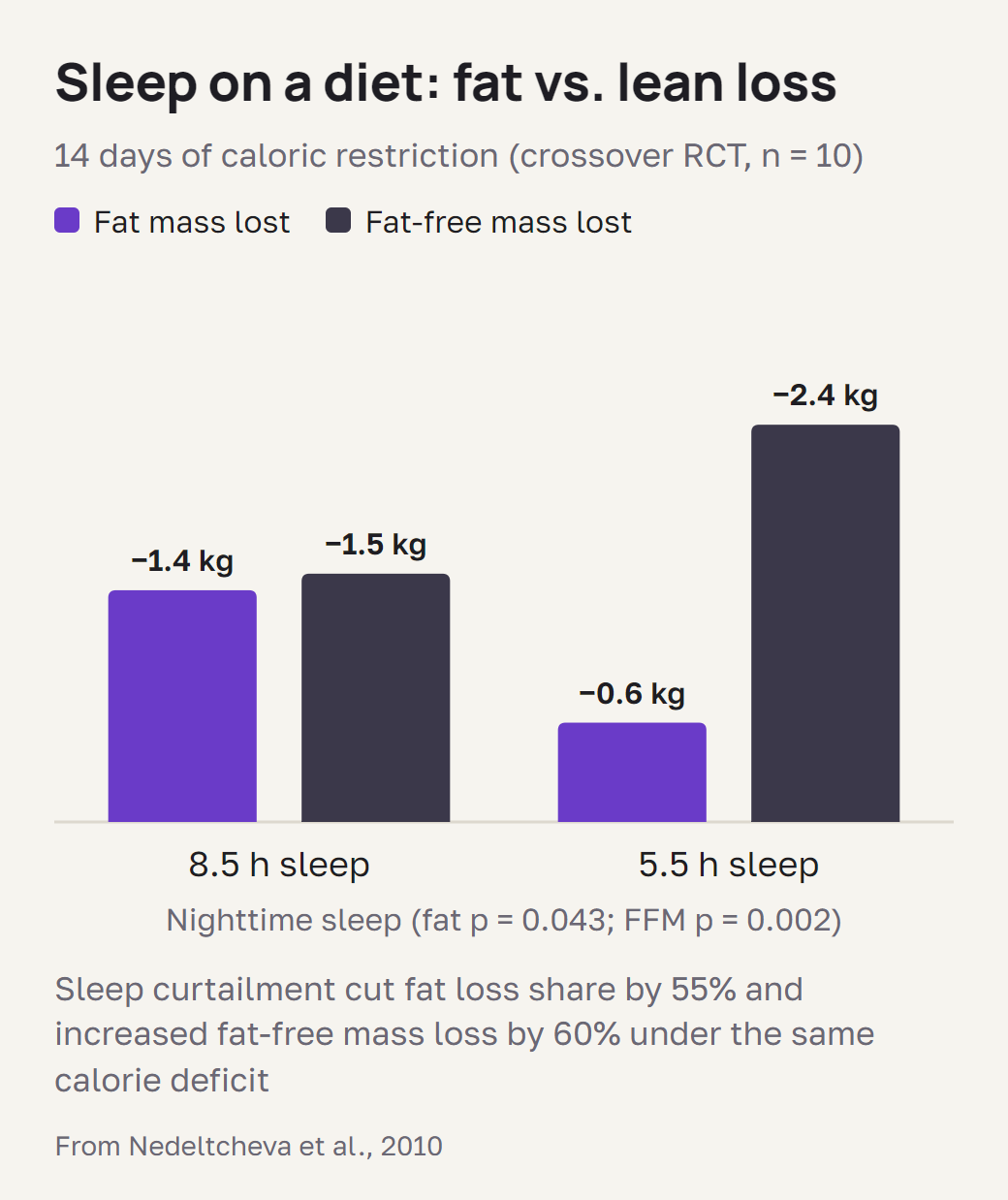
Based on Nedeltcheva et al. 2010 (10 participants, 14 days of calorie restriction): with a 5.5-hour sleep window, the proportion of weight lost as fat dropped by 55% while fat-free mass loss rose by 60%.
With 8.5 hours in bed, participants lost 1.4 kg of fat and 1.5 kg of fat-free mass. With 5.5 hours, total scale loss was nearly identical, yet the composition flipped: the proportion of weight lost as fat fell by 55% (0.6 kg vs. 1.4 kg; p = 0.043), while fat-free mass loss increased by 60% (2.4 kg vs. 1.5 kg; p = 0.002). Two caveats matter: the sample was small, the duration was two weeks, and fat-free mass includes water and glycogen alongside muscle. Even so, the shift in muscle protein turnover shows up at the cellular level as well.
In a crossover study of 13 healthy young adults (Lamon et al., 2021), a single night of total sleep deprivation reduced postprandial muscle protein synthesis by 18% (from 0.072 to 0.059 %/h; p = 0.040), raised plasma cortisol by 21% (p = 0.030), and lowered testosterone by 24% (p = 0.029), while protein degradation markers remained unchanged. Although one all-nighter is an extreme model, it shows how sleep loss blunts protein synthesis and promotes a catabolic environment.
Does catching up on sleep over the weekend fix weeknight restriction?
Many people sleep 6 hours on weekdays and try to repay the debt on Saturday and Sunday. An 8-week randomized trial tested this exact pattern (Wang et al., 2018) in 36 adults with overweight or obesity following a diet set at 95% of measured resting metabolic rate. The sleep-restriction group cut sleep by an average of 57 minutes on five nights per week and slept ad libitum on two free nights (+59 minutes), netting a weekly deficit of about 169 minutes.
In this modest sample (15 vs. 21 participants), absolute losses in body weight, fat mass, and lean mass did not differ statistically between groups. However, the proportion of total weight lost as fat was significantly higher in the normal-sleep group (p = 0.016). Fasting leptin dropped only in the sleep-restricted group (p = 0.029), while resting respiratory quotient decreased—indicating greater fat oxidation—only in well-rested participants (p = 0.033). Weekend catch-up sleep did not fully reverse five restricted nights.
Hunger hormones and reduced strength-training quality
Why do pastries and sweet coffee feel so tempting after a short night? In an early crossover trial of 12 young men restricted for two days (Spiegel et al., 2004), leptin fell 18% (p = 0.04), ghrelin rose 28% (p < 0.04), subjective hunger rose 24%, and appetite for calorie-dense high-carbohydrate foods climbed 33–45%. A larger meta-analysis of 21 studies covering 2,250 participants (Lin et al., 2020) refined the picture: elevated ghrelin with short sleep holds consistently (SMD 0.14; p = 0.01), whereas leptin responses vary by study design and even increased in some acute deprivation protocols. In practice, heightened hunger and cravings for calorie-dense food drive much of the overeating—see Diet Slip-Ups and Sugar Cravings for related strategies.
Workouts suffer too. A systematic review of 17 studies of moderate-to-weak quality (Knowles et al., 2018) found that a single sleepless night rarely slashes strength, whereas consecutive nights of restricted sleep can reduce force output in compound multi-joint lifts (without clear drops in single-joint exercises) unless motivation is offset with caffeine or group training. In practice, dropping working loads makes it harder to maintain a strong muscle-retention stimulus during a deficit.

How much sleep to target and what to do on a busy schedule
The practical target for most dieting adults is 7–9 hours of actual sleep (around 7.5–9 hours in bed) with a consistent wake time varying by no more than an hour between weekdays and weekends.
The International Society of Sports Nutrition (ISSN) position stand on diets and body composition (Aragon et al., 2017) underscores that fat loss is driven by a sustained calorie deficit, while a moderate rate of weight loss and higher protein intake help preserve lean mass. Improving sleep works best in small steps, reviewing actual sleep hours, evening hunger, and average scale weight after two weeks:
| Step | Concrete action | Why it helps |
|---|---|---|
| 1. Shift by 30–45 minutes | Move bedtime 30–45 minutes earlier for two weeks | Gradual extension raises sleep duration (in Tasali 2022, +1.2 hours cut intake by 270 kcal/day) |
| 2. Caffeine cutoff | Finish coffee or strong tea 8–10 hours before bed | Helps avoid lighter, more fragmented sleep |
| 3. Dim lights and park screens | Lower room lighting and put the phone away 45–60 minutes before bed | Makes winding down easier without endless scrolling |
| 4. Protect muscle in busy weeks | Keep protein near 1.8–2 g/kg and maintain 2–3 strength sessions weekly | Practical anchor to preserve training stimulus in a deficit |
| 5. Skip aggressive deficits under 6 hours | Use a gentle 10–15% calorie cut rather than a steep 30% cut | Steep deficits on poor sleep raise slip-up risk and reduce diet adherence |
When fatigue coincides with a weight-loss plateau, adding an hour of sleep and stabilizing your routine is often smarter than cutting another 200 kcal immediately. If you experience persistent snoring, breathing pauses during sleep, or chronic insomnia, consult a sleep physician—sleep hygiene alone does not treat clinical sleep disorders.
If you want an eating plan tailored to your real work hours and sleep schedule without rigid bans, I build custom plans in nutrition coaching and integrate training and recovery in online coaching.
I also publish practical nutrition, recovery, and training breakdowns on my YouTube channel @lobanov_fitness.
Sources
- Nedeltcheva AV et al. Insufficient sleep undermines dietary efforts to reduce adiposity. Ann Intern Med, 2010. Article · Full text
- Tasali E et al. Effect of Sleep Extension on Objectively Assessed Energy Intake Among Adults With Overweight in Real-life Settings: A Randomized Clinical Trial. JAMA Intern Med, 2022. Article · Full text
- Wang X et al. Influence of sleep restriction on weight loss outcomes associated with caloric restriction. Sleep, 2018. Article · Full text
- Al Khatib HK et al. The effects of partial sleep deprivation on energy balance: a systematic review and meta-analysis. Eur J Clin Nutr, 2017. Article · PubMed
- Lamon S et al. The effect of acute sleep deprivation on skeletal muscle protein synthesis and the hormonal environment. Physiol Rep, 2021. Article · Full text
- Lin J et al. Associations of short sleep duration with appetite-regulating hormones and adipokines: A systematic review and meta-analysis. Obes Rev, 2020. Article · PubMed
- Bacaro V et al. Sleep duration and obesity in adulthood: An updated systematic review and meta-analysis. Obes Res Clin Pract, 2020. Article · PubMed
- Knowles OE et al. Inadequate sleep and muscle strength: Implications for resistance training. J Sci Med Sport, 2018. Article · PubMed
- Spiegel K et al. Brief communication: Sleep curtailment in healthy young men is associated with decreased leptin levels, elevated ghrelin levels, and increased hunger and appetite. Ann Intern Med, 2004. Article · PubMed
- Aragon AA et al. International society of sports nutrition position stand: diets and body composition. J Int Soc Sports Nutr, 2017. Article · Full text