
After 40, strength training helps maintain muscle mass and strength and reduce pain in osteoarthritis, while in postmenopausal women programs combining resistance and impact loads support bone density; the muscular and strength response to training remains high. Daily energy expenditure adjusted for fat-free mass stays stable until age 60; in my practice, a smooth start is built on 2–3 regular sessions per week, a gradual ramp-up in load, and sufficient protein.
I am Demid Lobanov, a fitness coach and training methodology specialist with over six years of experience (over 300 clients) and more than four years teaching strength practice at PRO-FG school (170+ graduates). Below, I review recent meta-analyses on training between ages 40 and 55 and show how to start safely at the gym or at home. If you are over 50–60 and your main focus is fall prevention and osteoporosis, pair this with Strength Training After 50.
What changes after 40: muscle and the metabolism myth
The popular claim that metabolism drops sharply on its own after 40 did not hold up under direct measurement. In a landmark study by Pontzer et al. (2021) in Science, total daily energy expenditure was measured using doubly labeled water in people aged 8 days to 95 years. Adjusted for fat-free mass, expenditure stayed stable from age 20 to 60 (including pregnancy) and began declining only after 60.
Expenditure stability in that study was calculated after adjusting for fat-free mass: losing muscle and moving less in daily life still lowers total energy burn. According to a review by Wilkinson et al. (2018), age-related muscle loss begins quietly in middle age—at roughly 1% per year—and in severe cases can reach around 50% by the eighth or ninth decade. Alongside this, anabolic resistance develops: muscles respond with weaker protein synthesis to the same meal, and as Aragon et al. (2023) note, sedentarism and obesity can exacerbate this blunting.
Women after 40: pre- and postmenopause, strength, and bone
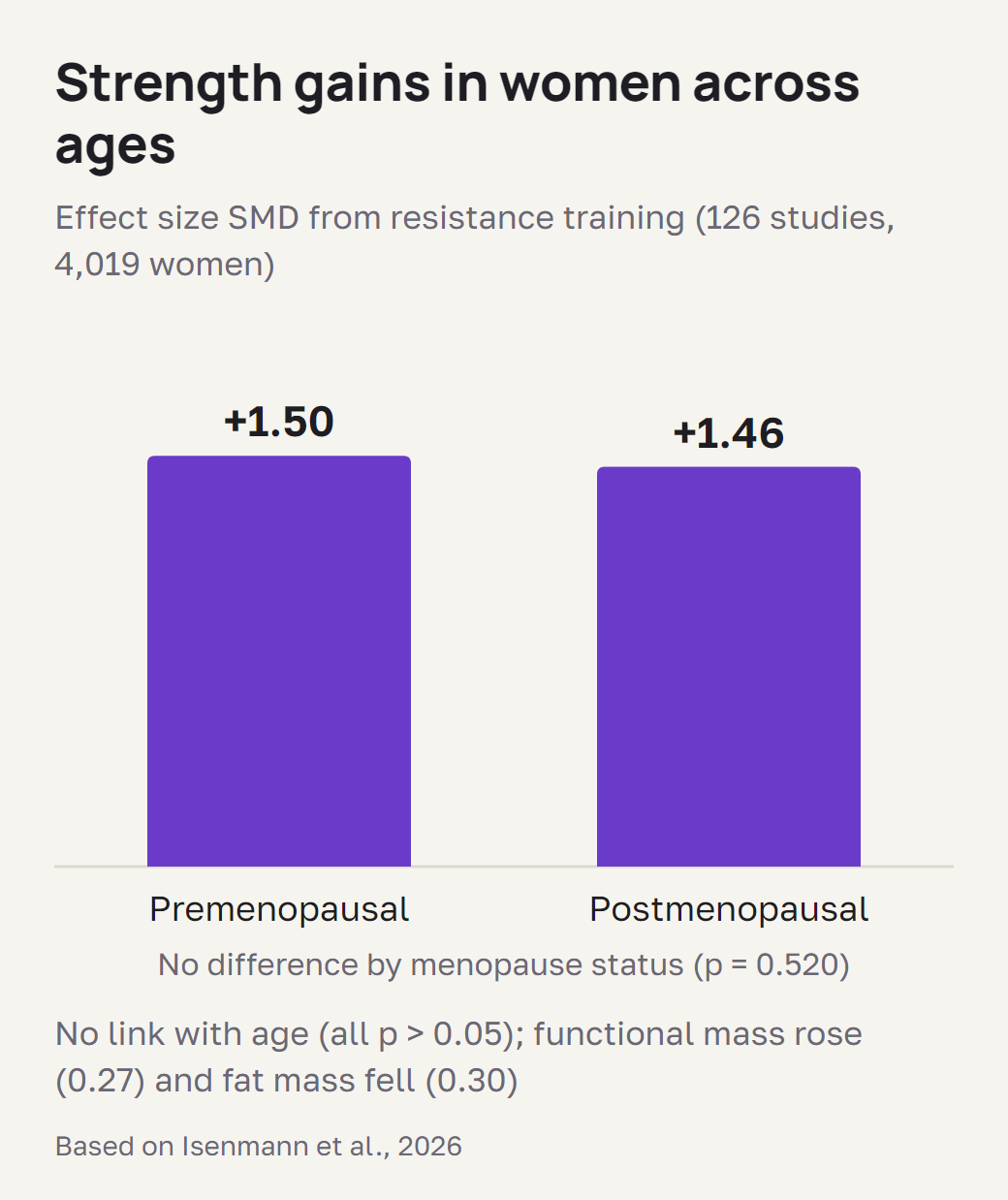
Fears that resistance training stops working during hormonal transition are contradicted by large-scale data. In a meta-analysis by Isenmann et al. (2026; 126 studies, 4,019 women, 66.2% postmenopausal, mean age 50.9 years), resistance training produced nearly identical strength gains in premenopausal women (standardized mean difference 1.50; interval 1.28–1.73) and postmenopausal women (1.46; interval 1.26–1.67; p = 0.520). In both groups, functional mass increased (0.27) and fat mass fell (0.30), with no association between outcomes and age (all p > 0.05).
For bone mineral density, results depend on life stage and training modality. In a meta-analysis of 8 randomized trials by Jones et al. (2026; 379 women: 267 postmenopausal and 112 premenopausal), pooled analysis of high-intensity, impact, and strength training showed a small significant gain in bone density at the femoral neck (effect 0.47; p = 0.014) and lumbar spine (0.36; p = 0.012) in postmenopausal women. No significant gain was found in premenopausal women, though only two trials studied them. In a meta-analysis of 6 trials by Souza et al. (2020; men and women aged 45+), high and low loads overall produced similar effects on femoral neck (p = 0.63) and lumbar spine (p = 0.12) bone density. However, at the femoral neck in participants with normal baseline bone density (p = 0.04) and over cycles up to 6 months (p = 0.03), high loads produced a significant gain (+0.01 g/cm²).
Men after 40: strength training and testosterone
Fitness marketing often promises that barbell squats will sharply raise resting testosterone. Scientific reviews paint a far more modest and mixed picture.
In a meta-analysis of 22 studies in men aged 60+ (Hayes et al., 2018), resistance training itself did not change resting basal testosterone (effect −0.003; p = 0.986). Small increases appeared with endurance (0.398; p = 0.010) and interval training (0.283; p = 0.028), though the review also included 13 uncontrolled trials. Meanwhile, a systematic review of 33 studies across exercise modalities in men and women over 40 (14 resistance, 10 interval, and 9 endurance; Zouhal et al., 2022) reported another pattern. The authors noted rises in resting testosterone, insulin-like growth factor IGF-1, growth hormone, DHEA, and the transport protein SHBG (effect sizes 0.19 to 3.37). No consensus was reached for cortisol or insulin.
The practical takeaway for men 40+ is simple: lifting builds muscle and strength through direct mechanical tension without relying on a promised hormonal surge. Diagnosing and treating low testosterone always stays with a physician.
Joints and tendons: why loading strengthens them
A common fear after 40 is that "tendons can no longer keep up with muscles, and weights wear down joints." Recent meta-analyses show that tendons adapt to regular resistance loading while osteoarthritis joint pain decreases.
- Tendons. In a meta-analysis of 61 studies (763 participants, mostly Achilles and patellar tendons), Lazarczuk et al. (2022) showed that mechanical loading moderately increases tendon stiffness (effect 0.74) and strongly increases elastic modulus (0.82). Strength training drove the largest modulus gain (0.90), and higher-strain protocols outperformed low-strain ones for stiffness (1.04; p = 0.007). A multilevel meta-analysis of 57 reports from 50 cohorts (Pang et al., 2026) found within-group increases across 37 cohorts averaging 16.12% for strength and 24.06% for tendon stiffness, while restricting the analysis to controlled trials attenuated the contrast to non-significance.
- Joints with osteoarthritis. In a dose-response meta-analysis of 28 randomized trials (2,164 participants, Liu et al., 2025), resistance training significantly reduced pain in knee and hip osteoarthritis (effect −0.57; interval −0.65 to −0.49). The relationship was U-shaped with an optimum around 680 MET·min per week, and pain relief lasted up to 6 months post-intervention. Both very low and overly high doses helped less; benefits were more pronounced in women and smaller in older patients.
Volume, combining with cardio, and breaks after 40
After 40, you do not need to train six days a week or chase maximum volume in month one. Volume should match your goal and recovery.
| Goal | Research and practice guideline | Basis |
|---|---|---|
| Baseline health | Strength training for major muscle groups ≥2 days/week plus 150–300 min moderate or 75–150 min vigorous cardio | WHO Guidelines, 2020 |
| Smooth start at 40–55 | 2–3 full-body sessions, 2–3 working sets per exercise with 2–3 reps in reserve during the first 2 adaptation weeks | Demid Lobanov's practice and Marques, 2023 |
| Muscle and strength growth | From 10 working sets per muscle group per week; for maximal strength – loads ≥80% 1RM through full range of motion ≥2 times/week | ACSM Position Stand (Currier, 2026) |
In a meta-analysis of 15 studies in adults aged 57.9–70.1 (430 participants, 93% women; Marques et al., 2023), multiple sets per exercise gave a small advantage over single sets for leg strength (effect 0.29; +1.91 kg) and muscle quality (0.40). No differences appeared for upper-body strength, muscle size, or functional tests. In my practice, a smooth start after 40 also begins with moderate starting volume and gradual set additions. How to schedule sessions without overload is covered in Full Body vs. Split, and load-progression rules in Progressive Overload.
Cardio does not interfere with lifting. In a meta-analysis of 49 studies (2,587 participants, mean age 55–88; Khalafi et al., 2022), combining resistance and aerobic training did not impair lower-body (p = 0.48) or upper-body (p = 0.38) strength gains versus resistance training alone, while clearly boosting VO2max endurance (effect 0.77; p = 0.005).
Consistency also pays off. A meta-analysis of 15 studies in middle-aged and older adults (383 participants; Yang et al., 2022) showed how much cycle length matters. When people trained for 24 weeks or longer, leg strength gains held after a long break even if they had trained at moderate or light intensity before pausing (effect 1.16; p = 0.004). After shorter cycles (under 24 weeks), only high-intensity training maintained strength, and only when the break did not exceed the training block itself.
Protein and nutrition after 40
Because of age-related blunting in the amino acid response, getting enough protein noticeably affects results. In a meta-analysis of 74 randomized trials in healthy adults (Nunes et al., 2022), added protein alongside resistance training produced small gains in lean mass (effect 0.22 across 62 studies) and leg strength (0.40 across 19 studies at ≥1.6 g/kg per day). For adults under 65, the statistically significant threshold was from 1.6 g of protein per kilogram of body weight per day, and for adults 65+ it was 1.2–1.59 g/kg per day. Practical daily food portions are broken down in How Much Protein Per Day.
When to see a doctor first and how to start step by step
The American College of Sports Medicine preparticipation consensus (ACSM; Riebe et al., 2015) recommends evaluating three factors before starting: current activity level, signs, symptoms, or diagnoses of cardiovascular, metabolic, or renal disease, and planned exercise intensity.
Being over 40 or having zero training experience is not a contraindication on its own. In my practice, you should see an in-person doctor before starting if you have any of these signs:
- diagnosed cardiovascular disease or chest pain;
- resting blood pressure of 160/100 or higher, or 140/90 and above with known uncontrolled hypertension;
- pain at rest or at night, or acute undiagnosed pain;
- numbness, shooting pain, or weakness in an arm or leg;
- fainting episodes in the past year, a recent injury, or incomplete post-surgical rehabilitation.
If you are over 45 and unaccustomed to heavy loading, do not start with near-maximal weights. With chronic pain that has a medical diagnosis and is outside an acute flare, load is scaled to tolerance. Discomfort should not worsen by the next day.
A published case from my practice illustrates this: a 54-year-old male client arrived with knee and back pain and could not perform even a bodyweight squat. Gradual selection of accessible range of motion and load alongside weight loss and increased daily activity helped him drop 6 kg, noticeably straighten his posture, walk long distances without shortness of breath, and start going on active travel tours. This is an individual case, with no guarantee of the same result. If you want regular form reviews and ongoing adjustments based on how you feel, that format is available in online training coaching. I share technique breakdowns on my YouTube channel @lobanov_fitness.
A step-by-step start at 40+ looks like this:
- Review the warning signs above. If any red flag applies, see a doctor first.
- Start with 2–3 full-body workouts per week. Include foundational lifts for legs, glutes, back, chest, and shoulders with a rest day between sessions.
- Plan 2 weeks of adaptation. Do 2–3 working sets leaving 2–3 reps in reserve and never skip warm-up sets before working weights (see Warm-Up Before a Workout).
- Progress load gradually. Increase weight in small steps (up to 2.5 kg) only after completing your target rep range across two consecutive workouts with clean form.
- Add daily movement and from 1.6 g of protein per kg of body weight. Walking and aerobic sessions complement lifting and build endurance.
If you want a ready-made plan for your gym or home accounting for age and joint limitations, it can be built as a custom workout program.
Sources
- Pontzer H et al. Daily energy expenditure through the human life course. Science, 2021. Article · Full text
- Wilkinson DJ et al. The age-related loss of skeletal muscle mass and function: Measurement and physiology of muscle fibre atrophy and muscle fibre loss in humans. Ageing Res Rev, 2018. Article · Full text
- Aragon AA et al. Age-related muscle anabolic resistance: inevitable or preventable? Nutr Rev, 2023. Article
- Isenmann E et al. It's never too late: The impact of resistance training on strength and body composition in females across the lifespan - A systematic review and meta-analysis. J Sci Med Sport, 2026. Article
- Jones E et al. A systematic review and meta-analysis of the effects of high-intensity, impact, and strength training on bone mineral density in premenopausal and postmenopausal women. Menopause, 2026. Article
- Souza D et al. High and low-load resistance training produce similar effects on bone mineral density of middle-aged and older people: A systematic review with meta-analysis of randomized clinical trials. Exp Gerontol, 2020. Article
- Hayes LD et al. Short-Term Exercise Training Inconsistently Influences Basal Testosterone in Older Men: A Systematic Review and Meta-Analysis. Front Physiol, 2018. Article · Full text
- Zouhal H et al. Effects of Exercise Training on Anabolic and Catabolic Hormones with Advanced Age: A Systematic Review. Sports Med, 2022. Article · Full text
- Lazarczuk SL et al. Mechanical, Material and Morphological Adaptations of Healthy Lower Limb Tendons to Mechanical Loading: A Systematic Review and Meta-Analysis. Sports Med, 2022. Article · Full text
- Pang K et al. Do Strength and Tendon Stiffness Adapt in Parallel? A Systematic Review and Multilevel Meta-Analysis of Chronic Mechanical Loading in Healthy Humans. J Funct Morphol Kinesiol, 2026. Article · Full text
- Liu W et al. Optimizing resistance training for pain management in knee and hip osteoarthritis: a pairwise and dose-response meta-analysis. Front Public Health, 2025. Article · Full text
- Marques DL et al. Manipulating the Resistance Training Volume in Middle-Aged and Older Adults: A Systematic Review with Meta-Analysis of the Effects on Muscle Strength and Size, Muscle Quality, and Functional Capacity. Sports Med, 2023. Article
- Currier BS et al. American College of Sports Medicine Position Stand. Resistance Training Prescription for Muscle Function, Hypertrophy, and Physical Performance in Healthy Adults: An Overview of Reviews. Med Sci Sports Exerc, 2026. Article · Full text
- Khalafi M et al. Impact of concurrent training versus aerobic or resistance training on cardiorespiratory fitness and muscular strength in middle-aged to older adults: A systematic review and meta-analysis. Physiol Behav, 2022. Article
- Bull FC et al. World Health Organization 2020 guidelines on physical activity and sedentary behaviour. Br J Sports Med, 2020. Article · Full text
- Yang Y et al. Training Session and Detraining Duration Affect Lower Limb Muscle Strength Maintenance in Middle-Aged and Older Adults: A Systematic Review and Meta-Analysis. J Aging Phys Act, 2022. Article
- Nunes EA et al. Systematic review and meta-analysis of protein intake to support muscle mass and function in healthy adults. J Cachexia Sarcopenia Muscle, 2022. Article · Full text
- Riebe D et al. Updating ACSM's Recommendations for Exercise Preparticipation Health Screening. Med Sci Sports Exerc, 2015. Article